August 20, 2025 2:03 pm

by David Swindle

French President Emmanuel Macron speaks during a press conference in Paris, France, June 12, 2024. Photo: REUTERS/Stephane Mahe

French President Emmanuel Macron has rejected Israeli Prime Minister Benjamin Netanyahu’s argument connecting a rise in hate against France’s Jewish community with the recent decision by Paris to recognize a Palestinian state.

“The analysis that France’s decision to recognize the state of Palestine in September explains the rise in antisemitic violence in France is erroneous, abject, and will not go unanswered,” Macron’s office said in a statement on Tuesday, insisting that “the current period calls for seriousness and responsibility, not generalization and manipulation.”

The French leader’s office added that “violence against the Jewish community is unacceptable” and called for all local and regional governments in the country to “take the strongest possible action against the perpetrators of antisemitic acts.”

Netanyahu on Sunday sent a letter to Macron in which he wrote that “your call for a Palestinian state pours fuel on this antisemitic fire.” He warned that “it is not diplomacy, it is appeasement. It rewards Hamas terror, hardens Hamas’s refusal to free the hostages, emboldens those who menace French Jews, and encourages the Jew-hatred now stalking your streets.”

The letter came a few weeks after Macron in late July announced that France will recognize a Palestinian state and issue a formal statement at the United Nations General Assembly in September as part of its “commitment to a just and lasting peace in the Middle East.”

Canada, the United Kingdom, and Australia all announced their own plans to recognize a Palestinian state in the following days.

The Palestinian terrorist group Hamas has celebrated the Western countries for their decisions. Senior Hamas official Ghazi Hamad, for example, praised the plans to recognize a Palestinian state as “the fruits of Oct. 7,” citing the Hamas-led massacre across southern Israel on Oct. 7, 2023, as the reason for increasing Western support.

“As [US President Donald] Trump has shown, antisemitism can and must be confronted. The president is protecting the civil rights of American Jews, enforcing the law, protecting public order and prosecuting antisemitic crimes,” Netanyahu wrote in his letter. “He has deported Hamas sympathizers and revoked the visas of foreign students who incite violence against Jews.”

France has seen an alarming rise in antisemitic incidents and anti-Israel sentiment since the Hamas-led Oct. 7 invasion of the Jewish state, amid the ensuing war in Gaza.

The total number of antisemitic outrages in 2024 — 1,570 — was a slight dip from 2023’s record total of 1,676, but it marked a striking increase from the 436 antisemitic acts recorded in 2022, according to a report by the Representative Council of Jewish Institutions of France (CRIF), the main representative body of French Jews.

“Antisemitism is a cancer,” Netanyahu warned Macron in his letter. “It spreads when leaders stay silent. It retreats when leaders act. I call upon you to replace weakness with action, appeasement with resolve, and to do so by a clear date: the Jewish New Year, Sept. 23, 2025. History will not forgive hesitation. It will honor action.”

Benjamin Haddad, who serves as France’s Minister Delegate for European Affairs, said in response to Netanyahu that “France has no lessons to learn in the fight against antisemitism.”

Last week, vandals targeted a tree planted to memorialize Ilan Halimi, a Jew who was kidnapped and tortured to death in France in 2006.

“Cutting down the tree honoring Ilan Halimi is an attempt to kill him a second time. It will not succeed: the Nation will not forget this child of France who died because he was Jewish,” Macron posted Friday on X. “All means are being deployed to punish this act of hatred. In the face of antisemitism: the Republic, always uncompromising.”

On Aug. 7, employees of Israeli airline El Al discovered red paint splashed all over the doors of their Paris office and graffiti of such slogans as “Palestine will live, Palestine will win,” “To hell with Zionism,” and “Genocidal airline El Al.”

This prompted the airline to pull all its staff from the country and issue a statement saying, “El Al takes the incident very seriously and is actively cooperating with the authorities, adhering to the guidance of officials in both France and Israel. The airline proudly displays the Israeli flag on its planes and strongly condemns all forms of violence, particularly antisemitism.”

On March 13, the Institute for the Study of Global Antisemitism and Policy released an analysis of hate against Jews in France by historian Marc Knobel, an associate researcher at the Jonathas Institute in Brussels and author of Cyberhate: Propaganda and Antisemitism on the Internet. He found a link between conflict in the Middle East and antisemitism in France.

“A recurring correlation emerges between peaks in antisemitic acts in France and periods of tension in the Middle East, particularly visible in the years 2000, 2002, 2004, 2009, 2012, 2014, 2019, 2023, and 2024,” Knobel wrote. “What stands out in 2025 is the prevalence of antisemitism linked to the conflict between Israel and Hamas.”

Knobel urged that “it is essential that politicians are aware of the impact of their words on the Israeli-Palestinian conflict; irresponsible and violent speeches by the radical left can exacerbate tensions and fuel antisemitism in our country.”


Members of the Iranian Basij paramilitary force march as a domestically built missile is displayed during a parade in Tehran, Iran, Friday, January 10, 2025. (AP/Vahid Salemi)

Members of the Iranian Basij paramilitary force march as a domestically built missile is displayed during a parade in Tehran, Iran, Friday, January 10, 2025. (AP/Vahid Salemi)

Iran says it is prepared for any new Israeli attack, announcing it has developed missiles with greater capabilities than those used during their recent 12-day war.

“The missiles used in the 12-day war were manufactured… a few years ago,” Defense Minister Aziz Nassirzadeh says, quoted by the official IRNA news agency.

“Today, we have manufactured and possess missiles with far greater capabilities than previous missiles, and if the Zionist enemy embarks on the adventure again, we will undoubtedly use them,” he says without elaborating on the new capabilities.

Israel said its sweeping assault on Iran’s top military leaders, nuclear scientists, uranium enrichment sites, and ballistic missile program was necessary to prevent the Islamic Republic from realizing its avowed plan to destroy the Jewish state.

Iran retaliated to Israel’s strikes by launching over 500 ballistic missiles and around 1,100 drones at Israel.

The attacks killed 31 people and wounded over 3,000 in Israel, according to health officials and hospitals.

In all, there were 36 missile impacts and one drone strike in populated areas, causing damage to 2,305 homes in 240 buildings, along with two universities and a hospital, and leaving over 13,000 Israelis displaced.


Reserve troops will get at least 2 weeks’ notice before reporting for duty, with some sent to replace standing army elsewhere; Katz meets top defense officials to approve IDF’s plans

IDF troops operate in the Gaza Strip, in an image published on August 18, 2025. (Israel Defense Forces)

IDF troops operate in the Gaza Strip, in an image published on August 18, 2025. (Israel Defense Forces)

Some 60,000 Israeli reservists were set to receive call-up orders that the military will issue starting Wednesday for an offensive against Hamas in Gaza City, after Defense Minister Israel Katz approved the army’s plans, according to the Israel Defense Forces and security officials.

The orders were not immediate, but rather were slated to take place in several waves. The majority — around 40,000-50,000 — would be ordered to show up for duty on September 2. Another wave would take place in November-December, and a third wave in February-March 2026, the IDF said.

The number of reservists being called up is in addition to tens of thousands of reservists who are currently serving in the reserves.

The IDF said it was also extending reserve duty for many reservists who were currently on duty by 30-40 days. This would bring the total number of reservists at a given time during the offensive to around 130,000.

The reservists included three brigades and several more battalions, and many combat support soldiers, including in intelligence and logistics.

Not all of the reservists are expected to participate in the operation to capture Gaza City, as some will instead be replacing standing army troops on other fronts.

In all, five IDF divisions, made up of tens of thousands of troops, were set to participate in the military’s planned offensive against Hamas in Gaza City, according to the army.

The forces included 12 brigade-level teams, each of which has infantry, armored, artillery, and combat engineering forces, along with combat support. In addition, the Gaza Division’s northern and southern brigades — normally tasked with the border — are set to participate in the offensive, bringing the total number of brigades to 14.

The reserve call-up orders were sent out after Katz met Tuesday with IDF Chief of Staff Lt. Gen. Eyal Zamir, other senior officers, and Shin Bet representatives to approve the military’s plans for the capture of Gaza City, his office said.

R-L: Defense Minister Israel Katz meets with IDF Chief of Staff Lt. Gen. Eyal Zamir, Deputy Chief of Staff Maj. Gen. Tamir Yadai, Operations Directorate chief Maj. Gen. Itzik Cohen, and Intelligence Directorate chief Maj. Gen. Shlomi Binder, in Katz’s office in Tel Aviv, August 19, 2025. (Ariel Hermoni/Defense Ministry)

The Gaza City takeover offensive — which Katz approved — was dubbed “Gideon’s Chariots B,” following a previous operation of the same name, which saw the IDF take over 75% of the Strip’s territory in an attempt to pressure Hamas into a hostage deal.

A security source said Katz praised the IDF’s plan and preparations during the meeting, which came after the government instructed the military to capture Gaza City.

The military said the preparation phases for the offensive have already begun, with an ongoing offensive on the outskirts of Gaza City. The Nahal Infantry Brigade and 7th Armored Brigade have been operating in the Zeitoun neighborhood, and the Givati Infantry Brigade began a new offensive in the Kafr Jabalia area, north of the city.

In addition, the IDF said efforts to set up humanitarian infrastructure in the Strip’s south for the estimated one million Palestinian civilians who are set to be displaced from Gaza City have started, including allowing tents and shelter equipment into the Strip in recent days.

Katz, during the meeting, approved “humanitarian preparations” for the offensive, his office said.

The military said more aid distribution sites and at least two more field hospitals are set to be established. The European Hospital in Khan Younis, which was closed after the IDF raided a Hamas tunnel running underneath it, was also slated to resume operations.

Troops from the IDF Golani Brigade guard the entrance to a tunnel underneath the European Hospital in Khan Younis, June 8, 2025. (AP Photo/Ohad Zwigenberg)

“As part of the preparations to move the population from Gaza City to the southern Gaza Strip, talks have begun with international organizations to recruit them to establish additional field hospitals in the south, and there is a positive response to this,” a security official said Wednesday.

The official said “there are also plans to expand the existing medical infrastructure in the south in cooperation with the organizations, and in addition, options are being examined to open access routes to additional medical facilities.”

“The UN and the organizations have begun formulating a plan to restart the European Hospital as an additional medical response,” the official added.

The IDF’s offensive in Gaza City is set to be carried out in several stages, beginning with an evacuation warning for the civilians in the area. Israeli officials have previously said that Palestinians will have until October 7, 2025, to evacuate Gaza City, which coincides with the second anniversary of Hamas’s attack on Israel.

The IDF will then encircle Gaza City before pushing in deeper into the city, including reaching areas that were previously not completely cleared of Hamas infrastructure, military officials said.

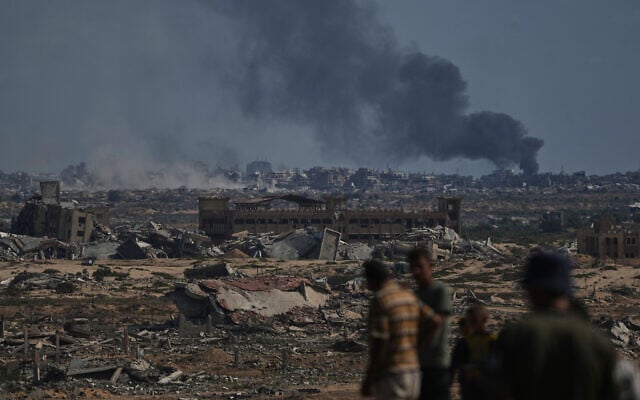
Palestinians walk past the destroyed Abu Khudra mosque in Gaza City on August 18, 2025. (Omar AL-QATTAA / AFP)

The meeting and the presentation of the army’s plans to Katz came despite Hamas saying Monday that it had agreed to a truce proposal. Should a hostage-ceasefire deal be reached, the plans to capture Gaza City are likely to be called off.

The plans, approved by Katz Tuesday night, were set to be presented to Prime Minister Benjamin Netanyahu on Thursday.

Terror groups in the Gaza Strip are holding 50 hostages, including 49 of the 251 abducted by Hamas-led terrorists on October 7, 2023. They include the bodies of at least 28 confirmed dead by the IDF. Twenty are believed to be alive and there are grave concerns for the well-being of two others, Israeli officials have said. Hamas is also holding the body of an IDF soldier killed in Gaza in 2014.

Times of Israel staff contributed to this report.