The British public-service broadcaster cited the official saying that the plan “serves Israel’s interests” and “ignores those of the Palestinian people.”

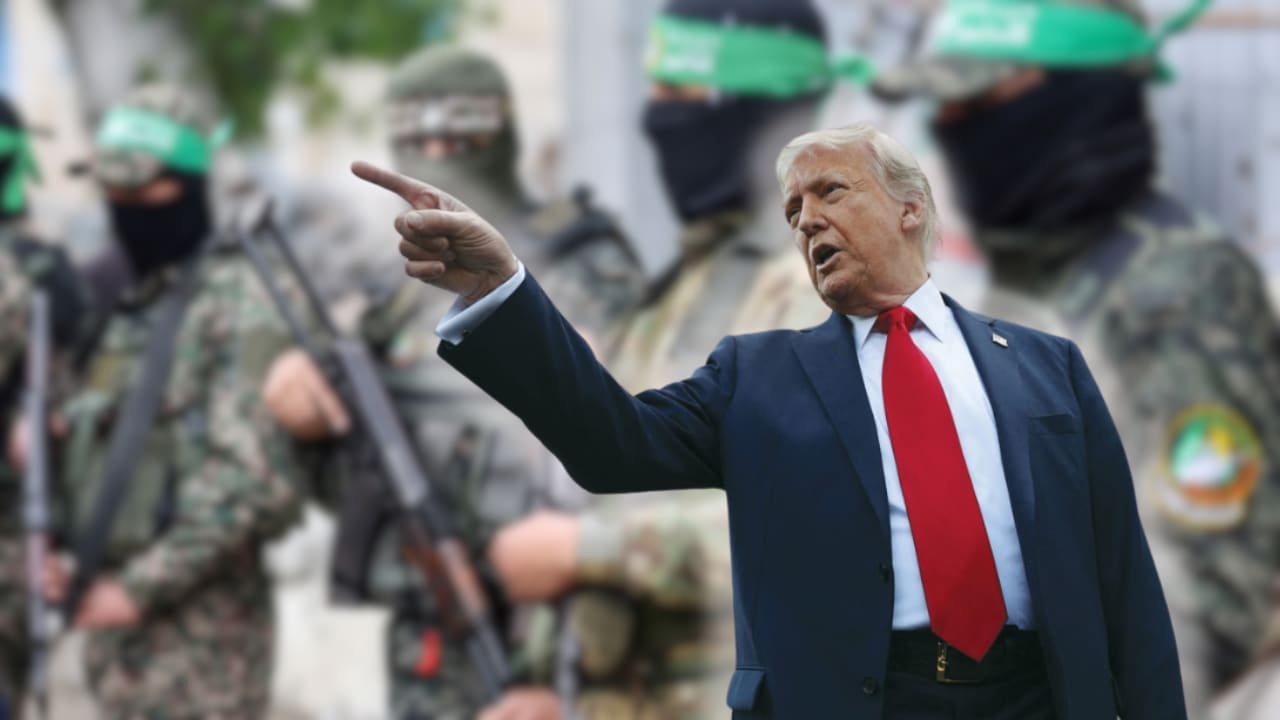
US PRESIDENT Donald Trump over a background of Hamas members.
(photo credit: KEVIN LAMARQUE/REUTERS, Ramadan Abed/Reuters)
Hamas will likely reject US President Donald Trump’s 20-point peace plan that would end the war in Gaza and see the release of the remaining 48 hostages, a senior official of the terrorist organization told the BBC on Wednesday.

The British public-service broadcaster cited the official saying that the plan “serves Israel’s interests” and “ignores those of the Palestinian people.”

The official added that Hamas also refuses to disarm and surrender its weapons. It also rejects any presence of an “International Stabilization Force” in the Gaza Strip, both of which are conditions in Trump’s plan, the BBC noted.

The terrorist organization had not given an official response to the proposal, but was reviewing it “responsibly,” the CBS report stated. The BBC report noted that a Palestinian official had said that it is being examined by Hamas leadership both inside and outside of Gaza.

Hamas members stand at the funeral of Marwan Issa, a senior Hamas deputy military commander who was killed in an Israeli airstrike during the conflict between Israel and Hamas, in the central Gaza Strip, February 7, 2025. (credit: Ramadan Abed/Reuters)

Another condition that Hamas reportedly rejects is releasing the remaining hostages at once, which the BBC describes as them letting go of their only “bargaining chip.”

This comes after Palestinian Islamic Jihad spokesman Mohammed al-Haj Musa told Ultra Palestine on Tuesday evening that Hamas was set to meet with other Palestinian groups to discuss their response to the plan.

The proposal “does not pertain to Hamas alone, but rather to the entire Palestinian people,” Musa told the Palestinian outlet. “Therefore, all factions are required to participate in formulating a unified national response to it.”

The PIJ spokesperson added that the Palestinian Authority was in a politically precarious position, and called on it to engage with the Palestinian groups on the proposal, discussing it point by point, to come up with a unified response.

Qatar, Egypt, Turkey urge Hamas to accept Trump’s 20-point plan

Separately, Qatar, Turkey, and Egypt have urged the Hamas terrorist organization to accept the peace plan, Axios reported on Wednesday, citing two sources with knowledge of the talks.

Officials from each of those countries have met with Hamas leaders for talks since Tuesday, the report added.

Qatari Prime Minister Mohammed bin Abdulrahman al-Thani also reportedly told Hamas leaders that “this was the best deal he was able to get for them and it won’t get much better.”

On the Israeli side, Prime Minister Benjamin Netanyahu previously agreed to the plan on Monday, following a meeting between the two leaders at the White House.

Israel has full US backing to finish Hamas if terror group rejects deal

“Israel would have my full backing to finish the job of destroying the threat of Hamas,” Trump said at a press conference after the meeting. “But I hope we’re going to have a deal for peace. If Hamas rejects the deal, which is always possible — they’re the only ones left. Everyone else has accepted it. But I have a feeling that we’re going to have a positive answer. But if not, as you know, Bibi, you’d have our full backing to do what you would have to do.”

Trump added that the US would be involved in Israel’s security after the ceasefire agreement.

In addition to Hamas, many anti-Israel and Western activists have also rejected Trump’s plan, claiming that the proposal to end the war is an emblem of surrender, colonialism, and ethnic cleansing.

Corinne Baum, James Genn, and Michael Starr contributed to this report.


Reshuffling conflict after increasingly rough diplomatic stretch for Israel, US president harnesses broad support for plan to free hostages, disarm Hamas, and transform Middle East

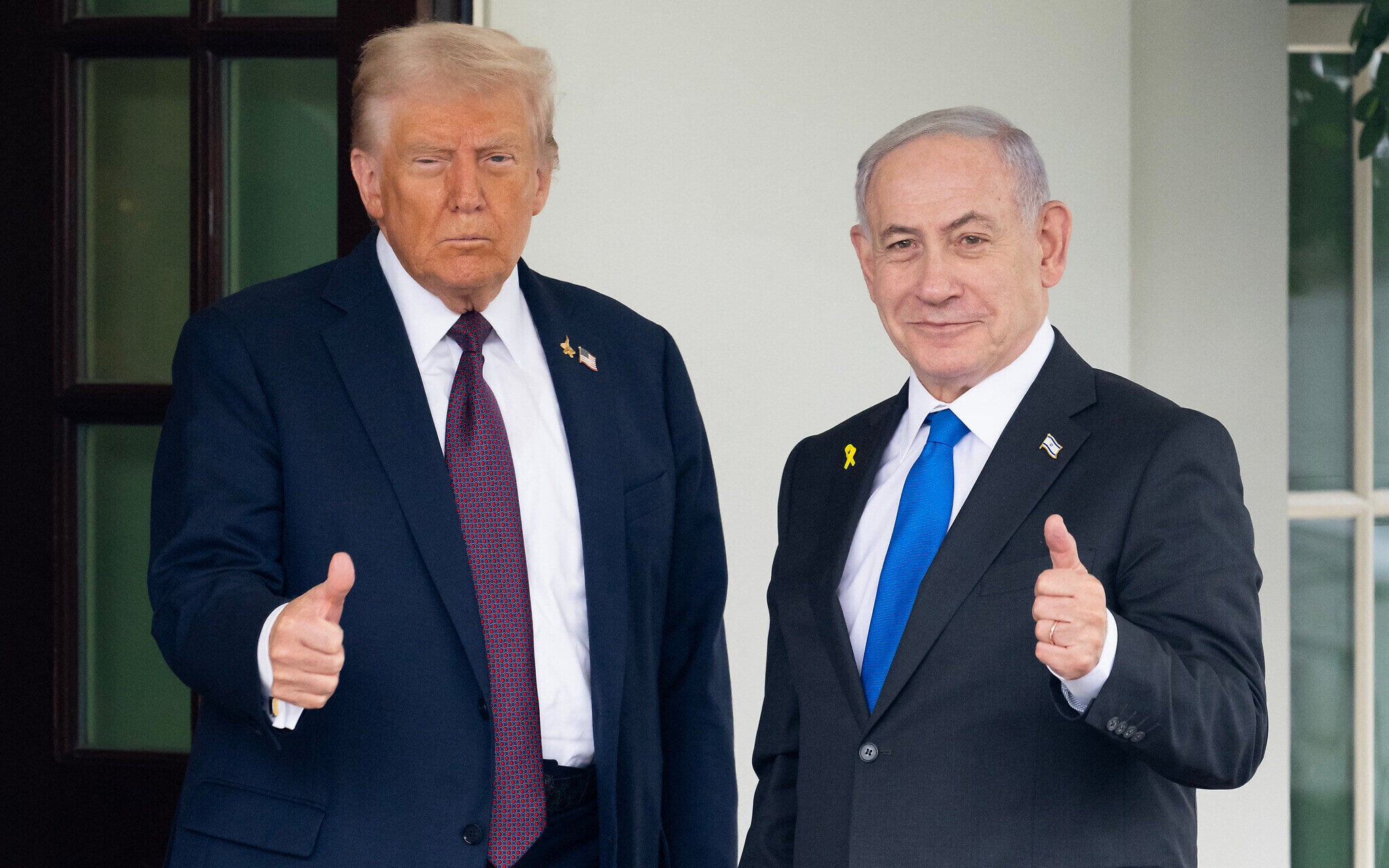
US President Donald Trump (L) greets Prime Minister Benjamin Netanyahu as he arrives at the West Wing of the White House in Washington, DC, on September 29, 2025. (SAUL LOEB / AFP)

WASHINGTON — The world suddenly looks very different than it did for Israel — and for Hamas — only a week ago.

An anti-Israel campaign had been gaining momentum for months. Photographs of emaciated babies, many with serious pre-existing health conditions, were spread by leading media outlets to promote the idea that there was mass starvation in the Gaza Strip. Citing the images, leaders of leading Western countries usually close to Israel hopped on the French train speeding toward recognition of a Palestinian state.

Meanwhile, Israel’s botched strike on Hamas leaders in Doha earlier this month united Muslim countries in a rhetorical offensive against Israel.

The wave crested last week at the United Nations General Assembly, as leaders announced that they recognized a state of Palestine and continued to excoriate Israel for allegedly blocking aid into Gaza.

In Gaza, IDF troops were moving steadily into Gaza City, but there were no indications the military pressure was pushing Hamas into an imminent hostage release.

And annexation of parts of the West Bank was shaping up to be a source of tension between US President Donald Trump and Prime Minister Benjamin Netanyahu, as well as a serious threat to Netanyahu’s own coalition.
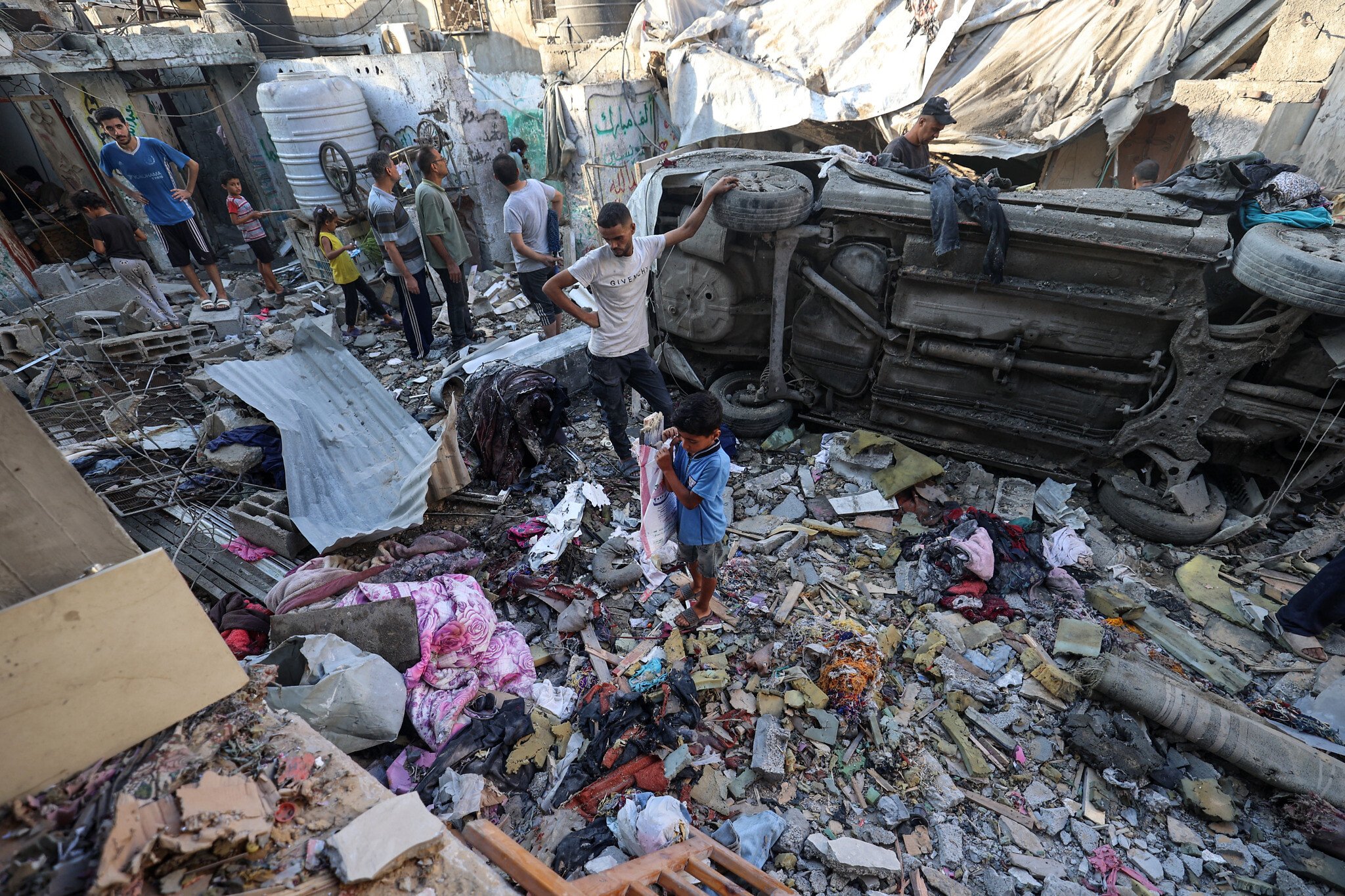
Palestinians check the damage outside a house hit by an Israeli strike in the Nuseirat camp in the central Gaza Strip on September 27, 2025. (Photo by Eyad BABA / AFP)

After Monday’s White House statement by Trump following his meeting with Netanyahu, those issues may have begun their fade into history.

Peak Trump

It’s easy to let Trump’s style get in the way of recognizing the scale of his diplomatic achievements on Monday.

The US president was certainly at peak Trumpiness during his address, especially as he got deeper into the speech. Speaking about the world leaders he had been consulting with about his Gaza plan, he said for some reason, “They tend to be mostly men, however, I will say that.” He repeatedly blasted Joe Biden, and decided to start changing the way he pronounces the Abraham Accords to approximate the Hebrew pronunciation of the patriarch, more or less.
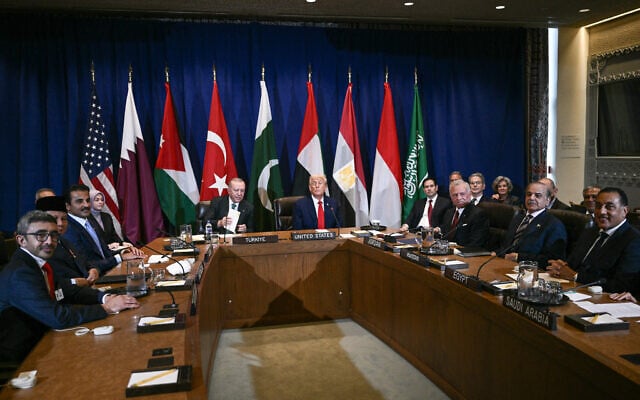
Seated at main table, L/R, UAE Foreign Minister Sheikh Abdullah bin Zayed Al Nahyan, Indonesia’s President Prabowo Subianto, Qatar’s Emir Sheikh Tamim bin Hamad al-Thani, Turkey’s President Recep Tayyip Erdogan, US President Donald Trump, Jordan’s King Abdullah II, Pakistan’s Prime Minister Shehbaz Sharif, and Egypt’s Prime Minister Mostafa Madbouly attend a multilateral meeting to discuss the situation in Gaza, on the sidelines of the United Nations General Assembly in New York City on September 23, 2025. (Photo by Brendan SMIALOWSKI / AFP)

Beyond the laughter- or cringe-inducing elements of the speech, what Trump did through his brand of personal diplomacy is striking. Israel’s right-wing prime minister appeared to sign up for the same Gaza proposal that Hamas defender and Israel-basher Recep Tayyip Erdogan of Turkey endorsed, alongside a number of leading Arab and Muslim countries.

What’s more, only three weeks after Israel fired ballistic missiles into Qatar in a failed attempt to eliminate Hamas’s leadership there, Trump had the Qatari prime minister accepting Netanyahu’s apology and agreeing to set up a trilateral framework to discuss disagreements.

Path to victory

The most significant aspect of the Trump-Netanyahu meeting is the US president’s proposal itself.

If implemented, it would represent Israel’s most direct path to victory in Gaza. All the hostages would be released at the outset of the deal, Hamas would slowly be disarmed, and a range of regional partners would back a new, non-Hamas and possibly non-Palestinian Authority ruler in the Strip.

Troops from the Givati Brigade operate in Gaza City in this photo released on September 29, 2025 (Israel Defense Forces)

From there, Trump intends to use the momentum to transform the Middle East, and rapidly expand the circle of countries that recognize Israel.

But those are exactly the reasons for Hamas to try to prevent Trump’s vision from ever taking effect. The Hamas-Israel war has always been a zero sum game, and a victory for one means a defeat for the other.

Given the relatively unified front backing the Trump proposal, and the assurances that Israel has Trump’s “full backing to finish the job of destroying the threat of Hamas” if the terror group rejects it, Hamas is unlikely to outright reject the framework.

The weekly rally at Hostage Square in Tel Aviv, in support for the release of the Israeli hostages from Hamas captivity in Gaza, , on September 27, 2025. (Avshalom Sassoni/FLASH90 )

What it is more likely to do is offer clarifications, to play for time, and if that fails, to do whatever it needs in order to maintain some weapons and a coherent structure so it can begin reasserting itself when the dynamics change at some point in the future.

Though he doesn’t want to answer questions about any of it, Netanyahu appears to have accepted that he has no better path than the one Trump is offering.

It has the potential to bring back all the hostages, meet Israel’s war aims, and get normalization with more countries back on track, all ahead of an extremely precarious election in the next year.

National Security Minister Itamar Ben Gvir, center, and Finance Minister Bezalel Smotrich at a ‘Victory Conference’ at the International Convention Center in Jerusalem on January 28, 2024. (Chaim Goldberg/Flash90)

It will of course create problems for Netanyahu among his political allies on his right. They won’t get to resettle Gaza, move Palestinians out, or annex the West Bank. That could complicate his political future.

At the same time, none of those priorities were at any point the stated aims of the war in Gaza.

Freeing the hostages and removing Hamas were, and peace deals with more Muslim countries has always been an Israeli goal.

One would hope would that those aims win out over short-term political calculations.

For now, at least, they seem to be.


“Iran took a heavy blow from the IDF,” the official added. “It knows very well the scope of the damage it suffered. It understands the meaning of the damage and Israel’s capabilities.”

 An illustrative image of the silhouettes of Iranian Supreme Leader Ali Khamenei and Israeli Prime Minister Benjamin Netanyahu set to a backdrop of their respective countries' flags.
An illustrative image of the silhouettes of Iranian Supreme Leader Ali Khamenei and Israeli Prime Minister Benjamin Netanyahu set to a backdrop of their respective countries’ flags.
(photo credit: SHUTTERSTOCK)
Israel is preparing for several scenarios, including the possibility of another strike against Iran, a senior IDF official told Maariv on Monday.

Regarding the Gaza front, the official said the IDF is doing everything to secure the best possible conditions for a ceasefire and a hostage deal. “We are monitoring what is happening across the Middle East and in Iran and are preparing for a variety of scenarios and options; one of them is that we may need to act again against Iran.”

“Iran took a heavy blow from the IDF,” the official added. “It knows very well the scope of the damage it suffered. It understands the meaning of the damage and Israel’s capabilities.”

“We are busy and acting to protect Israel’s security on multiple fronts.”

Israeli Air Force fighter jets seen ahead of Operation Rising Lion in Iran, June 13, 2025 (credit: IDF SPOKESPERSON'S UNIT)
Israeli Air Force fighter jets seen ahead of Operation Rising Lion in Iran, June 13, 2025 (credit: IDF SPOKESPERSON’S UNIT)

Renewed Iranian threats against Israel

Earlier on state television, former Islamic Revolutionary Guard Corps (IRGC) commander Mohsen Rezaei issued a string of threats against Israel and the United States.

Rezaei warned that Iran would enter a war with the United States if Israel carried out another attack against it, and said Tehran would not accept negotiations with Western countries that would give Israel time to prepare or strengthen its position.

Rezaei struck a darker tone in his remarks, saying that “if the war lasts two months, today there would be nothing left of Israel.”

“The Israelis want to try their military luck against Iran again. If that happens, we will use all our forces, we will change our red lines, and things will happen that are not right for me to say now,” Razei added.