Trump’s Gaza Peace plan: No role for Hamas, no timeline for IDF exit

CNN report sheds more light on Trump’s 21-point Gaza peace plan, says it calls for hostage release in 48 hours for phased IDF pullout.

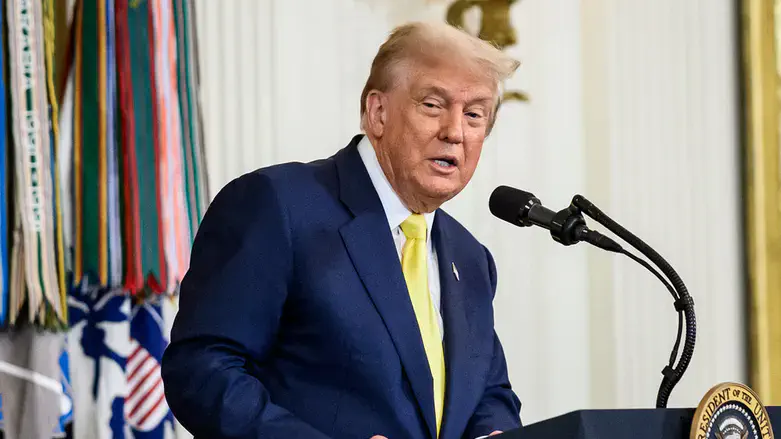
Donald Trump

Donald TrumpWhite House, Joyce N. Boghosian

CNN report on Friday provided more details about the Trump administration’s 21-point proposal aimed at ending the war in Gaza, which has been circulated in recent days.

According to the report, the plan calls for the release of all hostages within 48 hours of agreement in exchange for a phased withdrawal of Israeli forces.

The plan, shared with Arab leaders earlier this week, has not yet been formally presented to Hamas and may still undergo revisions. It is expected to be relayed via Qatari intermediaries to the remaining Hamas negotiators in Doha, the report said.

President Donald Trump expressed optimism about the plan’s prospects, stating Thursday that the sides are “very close” to a deal.

On Wednesday, US envoy Steve Witkoff said he was confident a breakthrough would be reached in the coming days, though he declined to share further details.

Arab leaders have responded positively to the proposal, though they acknowledge it is not without flaws. “They want to see an end to the conflict as quickly as possible,” a source familiar with the discussions said.

– No timeline for the withdrawal of Israeli troops from Gaza.

– A clause stating Israel will not attack Qatar again.

– A prohibition on forced displacement from Gaza.

– A stipulation that Hamas will have no future role in governing Gaza.

– A two-tier interim governance structure: an international body and a Palestinian committee.

– No timeline for transferring leadership to the Palestinian Authority.

– A UN role in humanitarian aid, with no mention of the Gaza Humanitarian Foundation.

– Recognition of Palestinian aspirations for statehood, without US endorsement of a Palestinian state.

(Israel National News’ North American desk is keeping you updated until the start of Shabbat in New York. The time posted automatically on all Israel National News articles, however, is Israeli time.)


He will also meet with US President Donald Trump on Monday and will return to Israel on Tuesday morning.

Prime Minister Benjamin Netanyahu and his wife Sara at Ben-Gurion Airport, September 25, 2025.
(photo credit: Avi Ohayon/GPO)
Prime Minister Benjamin Netanyahu called the recognition by some world leaders of a Palestinian state a “disgraceful capitulation,” ahead of his flight to New York City on Wednesday night.

Netanyahu is traveling in order to address the United Nations General Assembly on Friday.

“The disgraceful capitulation of some leaders to Palestinian terror will not bind Israel in any way,” Netanyahu stated. “A Palestinian state will not be established.”

“I will tell our truth – citizens of Israel, the truth of IDF soldier, of our state. I will condemn those leaders who, instead of condemning the murderers, rapists, and burners of our children, want to give them a state in the heart of Israel. This will not happen,” he added.

Netanyahu also confirmed that he will meet with US President Donald Trump in Washington during this visit, noting that he will discuss “the great opportunities our victories have brought, and out need to complete the war objectives,” of returning all the hostages, defeating Hamas, and to “expand the circle of peace that has occurred for us in the wake of our historic victory” in the Israel-Iran War, and “the other victories that we have achieved.”

Prime Minister Benjamin Netanyahu and his wife Sara at Ben-Gurion Airport, September 25, 2025. (credit: Avi Ohayon/GPO)

Netanyahu’s meeting with Trump is expected to take place on Monday before the prime minister returns to Israel on Tuesday morning. 

Ahead of his departure, protesters gathered at Ben-Gurion Airport on Wednesday evening, where they reportedly expressed opposition to the appointment of David Zini as head of the Shin Bet, opposed the continuation of the war in Gaza, and protested for the return of the hostages.

Protesters were also seen on Wednesday night calling for a deal to end the war and bring the hostages home at Tel Aviv’s Begin Gate.

Discourse over Israeli-Palestinian conflict at UNGA

The UN General Assembly has been the scene of a lot of talk about a two-state solution. Several Western countries have used their platform there to announce their recognition of a Palestinian state.

During his speech at the UNGA, President Trump said at the plenum that “instead of giving in to Hamas’ ransom demands, we should be united with those who want real peace and get the hostages back.”

The president added that “we can’t get one or two; we need everyone, dead or alive.”

Also at the UNGA, Italian Prime Minister Giorgia Meloni said that Italy could recognize a Palestinian state only on condition that all Israeli hostages are released and Hamas is excluded from any government role.

Indonesian President Prabowo Subianto said that he was prepared to send 20,000 soldiers to Gaza as a peacekeeping force on Tuesday during his address at the UN General Assembly, and claimed Indonesia would recognize Israel the same day that the Jewish state recognizes a Palestinian state.

Reuters contributed to this report.


Documentary screened as Iran’s president meets with world leaders at UN; it allegedly includes personal details of 189 Israeli nuclear scientists and specialists, photos of Dimona

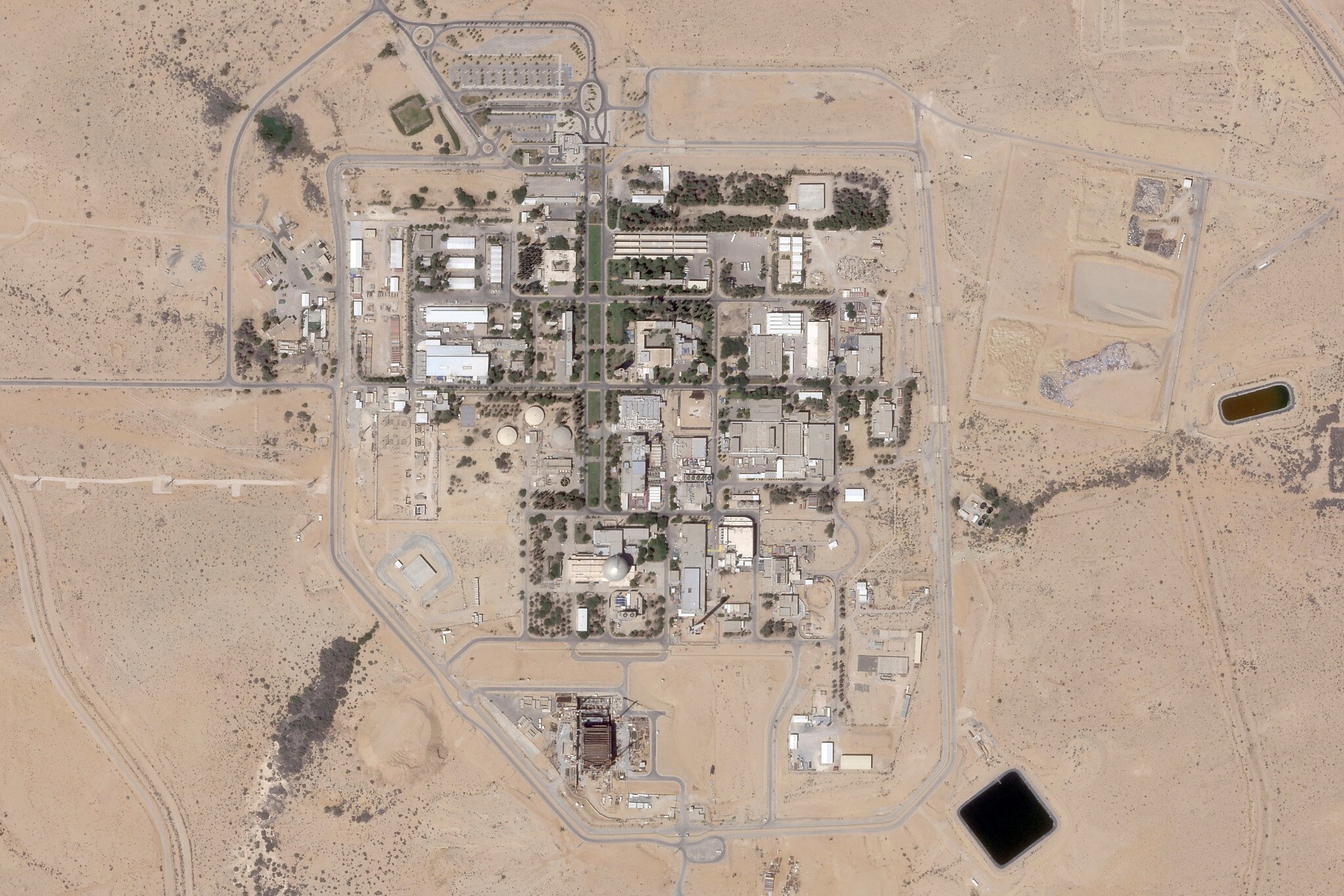
Satellite photo provided by Planet Labs PBC shows the Shimon Peres Negev Nuclear Research Center near the city of Dimona, Israel, July 5, 2025. (Planet Labs PBC via AP)

Satellite photo provided by Planet Labs PBC shows the Shimon Peres Negev Nuclear Research Center near the city of Dimona, Israel, July 5, 2025. (Planet Labs PBC via AP)

Iranian state television broadcast images of documents and footage on Wednesday that it said relate to Israel’s alleged nuclear activities.

The documentary showed copies of passports said to identify more than 100 Israeli scientists, along with information on the location of military sites. It also aired footage said to have been filmed inside the Dimona reactor in southern Israel.

According to foreign reports, Israel is believed to be the only nuclear-armed state in the Middle East, with its main nuclear facility suspected to be at Dimona. Israel has never confirmed or denied having nuclear weapons.

The Iranian documentary comes three months after an air war between Israel and Iran that began when the Israel Defense Forces conducted a sweeping assault on Iran’s top military leaders, nuclear scientists, uranium enrichment sites and ballistic missile program. Jerusalem said the attack was necessary to prevent the Islamic Republic from realizing its avowed plan to destroy the Jewish state, and that Tehran had been taking concrete steps toward assembling an atomic bomb.

In the documentary, Intelligence Minister Esmail Khatib claimed that in June, Iran obtained information that it used to hit sensitive sites inside Israel during the war. Before the war, Iranian officials had contended that they acquired thousands of classified Israeli documents, including details on nuclear and military sites.

Israel has conducted intelligence operations inside Iran, and has previously uncovered troves of material about Tehran’s nuclear program.
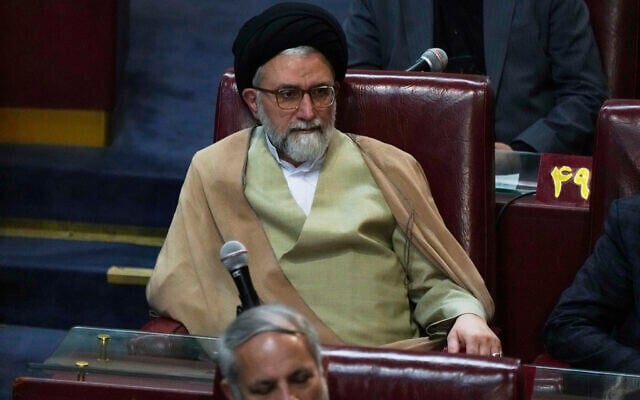
Iranian Intelligence Minister Esmail Khatib attends the inauguration ceremony of the 6th term of the Assembly of Experts in Tehran, Iran, May 21, 2024. (AP Photo/Vahid Salemi)

Iran has long tried to recruit a domestic network of spies inside Israel, and Khatib boasted in the program about Israeli sources who funneled a “huge volume of documents” to Tehran, Israel’s Kan public broadcaster reported. The spies, he reportedly said, were motivated by financial gain and animosity toward Prime Minister Benjamin Netanyahu.

Kan reported that the documentary included purported footage from Dimona, as well as personal information about 189 Israeli nuclear scientists and specialists.

The documentary also included photos of UN International Atomic Energy Agency chief Rafael Grossi that were described as personal, with one showing him kissing a person in a Minnie Mouse costume. Iran claimed the photos had been obtained by Israel, accusing it of spying on Grossi. The IAEA monitors the use of nuclear facilities worldwide, including in Iran.

The documentary comes as tensions continue to simmer over Iran’s nuclear program.

Speaking on Wednesday at the United Nations General Assembly, Iranian President Masoud Pezeshkian condemned Israel’s June attack on its nuclear facilities, which the United States joined at the end of the war. And he reiterated Iran’s longtime denial of a nuclear weapons program.

“I hereby declare once more before this assembly that Iran has never sought and will never seek to build a nuclear bomb,” he said.
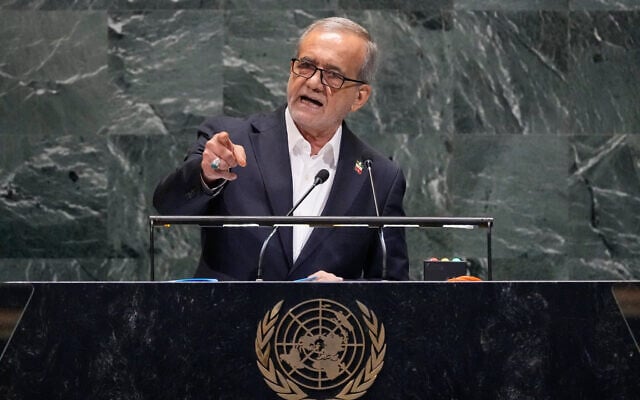
Iran President Masoud Pezeshkian addresses the 80th session of the United Nations General Assembly, in New York City, September 24, 2025. (AP Photo/Richard Drew)

Iran has consistently denied trying to obtain a bomb. However, it has been enriching uranium to levels that have no peaceful application, obstructed international inspectors from checking its nuclear facilities, and expanded its ballistic missile capabilities, all while regularly threatening to flatten Israeli cities.

Iran retaliated to Israel’s strikes by launching over 500 ballistic missiles and around 1,100 drones at Israel. The attacks killed 31 people and wounded over 3,000 in Israel, almost all of them civilians, according to health officials and hospitals.

Since then, Iran’s political leadership has openly targeted the IAEA and its director, accusing them of partial complicity. Tehran slammed the agency for failing to condemn the strikes on its nuclear facilities, and has restricted the agency’s access to its nuclear sites.

In addition, France, Britain and Germany triggered a mechanism for the UN Security Council to reimpose sweeping sanctions at the end of Saturday on Iran, which they say has not cooperated in talks over its nuclear program.
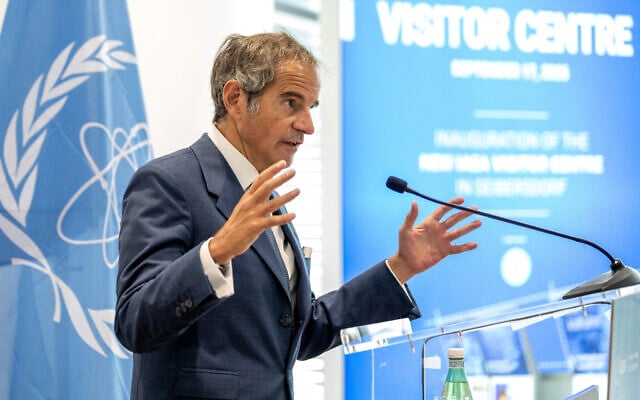
Rafael Grossi, Director General of the International Atomic Energy Agency, speaks outside Vienna, Austria, on September 17, 2025. (Joe Klamar / AFP)

On Wednesday, French President Emmanuel Macron and US envoy Steve Witkoff said that Iran still had a last chance to avoid the sanctions if it addresses their concerns.

Macron met Pezeshkian on the sidelines of the UN General Assembly and urged him to allow full access to UN nuclear inspectors, immediately resume nuclear negotiations and offer transparency on highly enriched uranium whose whereabouts have been the subject of speculation.

“An agreement remains possible. Only a few hours are left. It’s up to Iran to respond to the legitimate conditions we have raised,” Macron wrote on X after meeting Pezeshkian.

Witkoff, US President Donald Trump’s envoy who had been negotiating with Iran until Israel attacked, said without further elaboration that he was still in touch with Iran.

Witkoff said that Iran was in a “tough position” ahead of the return of the so-called snapback sanctions.

“I think that we have no desire to hurt them. We have a desire, however, to either realize a permanent solution and negotiate around snapbacks,” Witkoff told the Concordia summit on the sidelines of the General Assembly.