Iranian supreme leader says Jewish state must be ‘uprooted,’ US driven from the region; Iranian president says nuclear talks to continue despite American threats

A handout picture provided by the Iranian Supreme Leader Ayatollah Ali Khamenei's office shows him addressing teachers and education officials from across the country in Tehran on May 17, 2025.  (Photo by KHAMENEI.IR / AFP)

A handout picture provided by the Iranian Supreme Leader Ayatollah Ali Khamenei’s office shows him addressing teachers and education officials from across the country in Tehran on May 17, 2025. (Photo by KHAMENEI.IR / AFP)

TEHRAN, Iran — Iran’s Supreme Leader Ayatollah Ali Khamenei on Saturday said US President Donald Trump was lying about his intentions for the region, and once again called Israel a “cancerous tumor” that must be uprooted.

In his first reaction to Trump’s regional visit, Khamenei said Trump wasn’t truthful when he made claims about creating peace through power and said the Americans must be ousted from the region.

“Trump said that he wanted to use power for peace, he lied. He and the US administration used power for the massacre in Gaza, for waging wars in any place they could,” Khamenei said Saturday during a meeting with teachers broadcast on state television.

The US has provided Israel with 10-ton bombs to “drop on Gaza children, hospitals, houses of people in Lebanon and anywhere else when they can,” Khamenei claimed.

Khamenei, who has the final say on all Iranian state matters, reiterated his traditional stance, calling for the destruction of the Jewish state.

Beyond repeatedly calling for Israel’s destruction, Iran has pumped billions of dollars into funding proxy terror groups like Hezbollah, Hamas and Yemen’s Houthis that threaten and attack Israel.

A woman walks past a billboard bearing portraits of slain Iranian, Hezbollah and Hamas leaders in Tehran’s Enghelab square on May 11, 2025. (Photo by ATTA KENARE / AFP)

The remarks from the Iranian supreme leader come a day after Trump concluded a high-profile Gulf tour aimed at strengthening alliances and securing multi-trillion-dollar investments.

On his tour, Trump condemned Iran’s leadership for its role in the region and threatened to cut Iran’s oil exports to zero.

“Iran’s leaders have focused on stealing their people’s wealth to fund terror and bloodshed abroad,” Trump told a Saudi investment forum on Tuesday.

Without referring to specific comments, Khamenei said some of Trump’s remarks are a “source of shame” and “not even worth responding to.”

“The level of those comments is so low that they are a source of shame for the speaker himself and a cause for embarrassment for the American people.”

“Surely this model has failed. With the efforts of the regional nations, the US should leave the region, and it will leave,” Khamenei said.

US President Donald Trump and Saudi Crown Prince Mohammed bin Salman shake hands after exchanging documents during a signing ceremony at the Royal Palace in Riyadh, Saudi Arabia, May 13, 2025. (AP Photo/Alex Brandon)

Iran has long considered the US military presence in the region as a threat on its doorstep, especially after Trump pulled the US out of a 2015 nuclear deal with Iran in 2018 and reimposed crippling sanctions.

“The president of America proposed a model to these Arab countries, a model which, according to his own words, implies that without the United States, these countries would not be able to last for even 10 days.

“Even now, through their dealings, their behavior, and their proposals, the Americans continue to promote and impose this very same model, a model designed to make these countries dependent, so they cannot exist without US support,” Khamenei said.

“This model is undoubtedly a failed one.”

Nuclear talks to go ahead

Despite Khamenei’s rhetoric, Iran’s president said his country will continue talks with the US over its rapidly advancing nuclear program but will not give up its rights because of US threats.

“We are negotiating, and we will negotiate, we are not after war but we do not fear any threat,” President Masoud Pezeshkian said during a speech to navy officials broadcast by state television Saturday.

“It is not like that they think if they threaten us , we will give up our human right and definite right,” Pezeshkian said. “We will not withdraw, we will not easily loose honorable military, scientific, nuclear in all fields.”

The negotiations have reached the “expert” level, meaning the sides are trying to reach an agreement on the details of a possible deal. But a major sticking point remains Iran’s enrichment of uranium, which Tehran insists it must be allowed to do and the Trump administration increasingly insists the Islamic Republic must give up.

Iranian President Masoud Pezeshkian, center, reviews the army’s hardware as he is accompanied by armed forces commanders during the army parade commemorating National Army Day in front of the shrine of the late revolutionary founder Ayatollah Khomeini, just outside Tehran, Iran, on April 18, 2025. (AP Photo/Vahid Salemi)

Trump has repeatedly threatened to unleash airstrikes targeting Iran’s program if a deal isn’t reached. Iranian officials increasingly warn they could pursue a nuclear weapon with their stockpile of uranium enriched to near weapons-grade levels.

On Friday, Trump said Iran received a proposal during the talks, though he did not elaborate.

During his trip to the region this week, Trump at nearly every event insisted Iran would not be allowed to obtain the bomb.

The US and other Western countries have long accused Iran of pursuing nuclear weapons — a claim Tehran denies, insisting that its atomic program is solely for civilian purposes. But Iran, which openly seeks Israel’s destruction, has ramped up its enrichment of uranium to 60 percent purity, just below weapons-grade, and for which has no peaceful application, and has obstructed international inspectors from checking its nuclear facilities.

Mohammad Eslami, the head of Iran’s atomic organization, asserted the peaceful nature of the program, saying it is under “continuous” monitoring by the UN nuclear watchdog, state TV reported Saturday.

“No country is monitored by the agency like us,” Eslami said, adding that the agency inspected the country’s nuclear facilities more than 450 times in 2024. “Something about 25% of all the agency inspections” in the year.

Israel views Iran — which repeatedly calls for its destruction — as an existential threat and has vowed to prevent Tehran from acquiring nuclear weapons.


Military estimates it will take a month for Iran-backed terror group to repair Hodeidah and Salif ports following airstrikes; 15 jets dropped 35 bombs

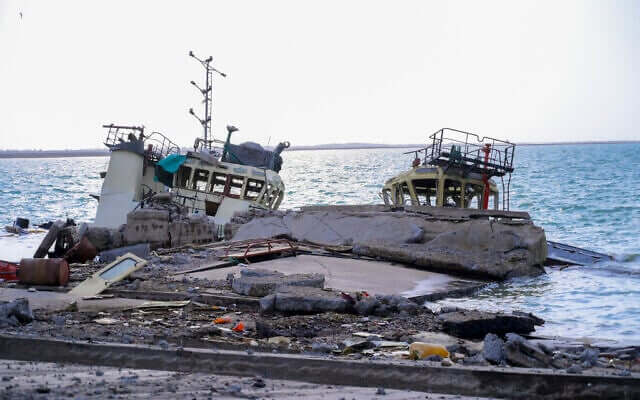
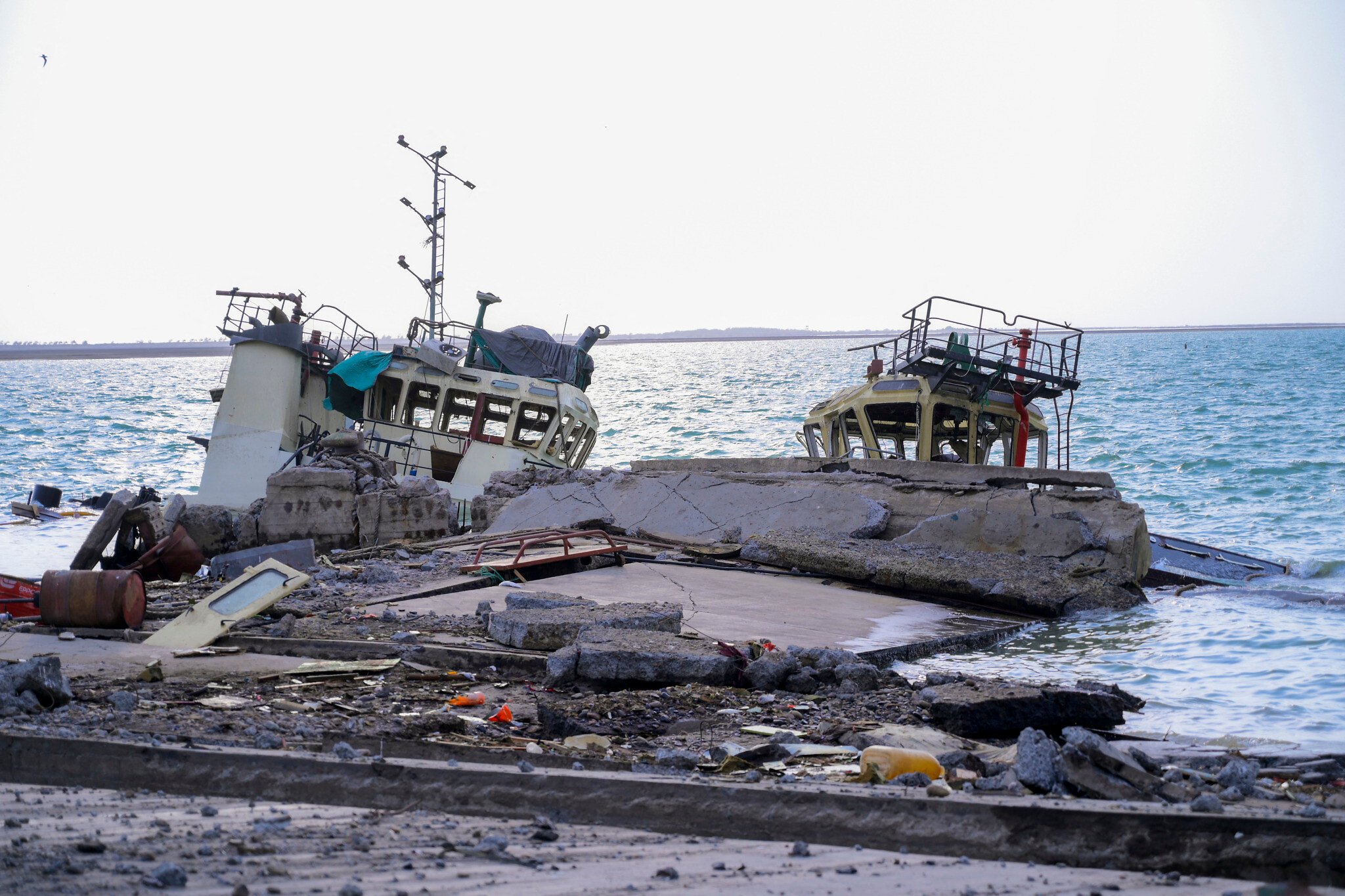
Smoke rises from the Hodeidah port in western Yemen following an Israeli airstrike, May 16, 2025. (Social media: used in accordance with Clause 27a of the Copyright Law)

Smoke rises from the Hodeidah port in western Yemen following an Israeli airstrike, May 16, 2025. (Social media: used in accordance with Clause 27a of the Copyright Law)

Israeli fighter jets carried out a wave of airstrikes in Yemen on Friday afternoon, targeting two Houthi-controlled ports in the west of the country, and threatened to kill the terror group’s leader, in response to the Iran-backed group’s ongoing missile and drone attacks on Israel.

Israel had waited until the end of US President Donald Trump’s visit to the region before launching its reprisal strikes on the Houthis. Since the Israel Defense Force’s last strike on Yemen, on May 6, the Houthis launched at least seven missiles and two drones at Israel, the latest of them on Thursday night.

Fifteen fighter jets were involved in the strike on Friday, dropping some 35 munitions on the Hodeidah and Salif ports, destroying infrastructure, the military said. IAF refuelers and spy planes also participated in the operation.

Earlier this week, the IDF issued two evacuation warnings for the two ports in western Yemen, along with a third port, Ras Isa, the latter of which was not targeted on Friday.

“These ports are used for the transfer of weapons and are another example of the cynical exploitation of civilian infrastructure by the Houthi terror regime to advance terror,” the military said in a statement.

The two ports have been targeted by the Israeli Air Force before, as was Yemen’s Sanaa International Airport on May 6.

The IDF said the strikes are intended to “deepen the damage to the Houthis’ terror capabilities,” and “neutralize” the ports, to prevent the group from bringing in more Iranian weapons and to harm the group economically.

The military estimated it would take the Houthis about a month to restore the ports. Until then, it would be unable to dock ships longer than 80 meters there.

“In light of the Houthi terror regime’s use of these ports for terror purposes, the IDF reiterates its warning to those present at the ports to distance themselves and evacuate the area,” the military said.

Prime Minister Benjamin Netanyahu, Defense Minister Israel Katz and IDF Chief of Staff Lt. Gen. Eyal Zamir huddled in the Israeli Air Force underground command center during the strikes.

Katz, in a statement, threatened to eliminate Houthi leader Abdul-Malik al-Houthi if the Iran-backed group continues to fire on Israel.

“The IDF now struck and severely damaged the ports in Yemen that are under the control of the Houthi terror group. The airport in Sanaa also remains destroyed,” Katz said.

L-R: Defense Minister Israel Katz, Prime Minister Benjamin Netanyahu, and IDF Chief of Staff Lt. Gen. Eyal Zamir are seen at the IAF’s underground command center at the Kirya base in Tel Aviv, during strikes in Yemen, May 16, 2025. (Shira Keinan/Defense Ministry)

“As we said, if the Houthis continue to fire missiles on Israel, they will suffer painful blows, and we will also strike the terror chief, just as we did to Deif and the Sinwars in Gaza, to Nasrallah in Beirut and to Haniyeh in Tehran,” he said, referring to the leaders of Hamas and Hezbollah that Israel has assassinated (it is not yet confirmed that Hamas Gaza leader Muhammad Sinwar, brother of slain Hamas chief Yahya Sinwar, was killed in this week’s strike that targeted him).

“We will hunt down and eliminate Abdul-Malik al-Houthi in Yemen as well. We will defend ourselves by our own strength against any enemy,” Katz added.

Houthi supporters chant slogans and hold pictures of Abdul-Malik al-Houthi, the leader of the Houthi movement, during an anti-US and anti-Israel rally in Sanaa, Yemen, March 17, 2025. (AP Photo/Osamah Abdulrahman)

Trump announced earlier in May that he’d reached a ceasefire with Yemen’s Houthis that would halt attacks on US vessels, though the Houthis vowed to continue attacking Israel.

The Houthis — whose slogan calls for “Death to America, Death to Israel, [and] a Curse on the Jews” — began attacking Israel and maritime traffic in November 2023, a month after the October 7 Hamas massacre.

Smoke trails, apparently from the interception of a Houthi missile fired from Yemen, are seen above Kibbutz Baram in northern Israel, May 2, 2025. (Michael Giladi/Flash90)

The Houthis held their fire when a ceasefire was reached between Israel and Hamas in January 2025. By that point, they had fired over 40 ballistic missiles and dozens of attack drones and cruise missiles at Israel, including one that killed a civilian and wounded several others in Tel Aviv in July, prompting Israel’s first strike in Yemen.

Since March 18, when the IDF resumed its offensive against Hamas in the Gaza Strip, the Houthis have launched 34 ballistic missiles and at least 10 drones at Israel. Several of the missiles have fallen short.

The sirens warning of missile attacks have sent hundreds of thousands of Israelis rushing to shelters at all hours of the day and night.


Tehran ‘must stop sponsoring terror, halt its bloody proxy wars,’ US president says at Gulf Cooperation Council meeting in Riyadh; Iran’s FM calls remarks ‘deceitful’

US President Donald Trump speaks during the Gulf Cooperation Council (GCC) Summit in Riyadh, Saudi Arabia, May 14, 2025. (Alex Brandon/AP)

US President Donald Trump speaks during the Gulf Cooperation Council (GCC) Summit in Riyadh, Saudi Arabia, May 14, 2025. (Alex Brandon/AP)

US President Donald Trump told Gulf leaders on Wednesday that he urgently wants “to make a deal” with Iran to wind down its nuclear program, but that Tehran must end its support of proxy groups throughout the region as part of any potential agreement.

Iran “must stop sponsoring terror, halt its bloody proxy wars, and permanently and verifiably cease pursuit of nuclear weapons,” Trump said in remarks at a meeting of leaders from the Gulf Cooperation Council hosted by Saudi Crown Prince Mohammed bin Salman in Riyadh. “They cannot have a nuclear weapon.”

The US and Iran have engaged in four rounds of talks since early last month, focused on Iran’s nuclear program. Trump has repeatedly said he believes brokering a deal is possible, but that the window is closing.

The president’s strongly worded push on Iran to cease support of Hamas in Gaza, Hezbollah in Lebanon, and the Houthis in Yemen comes after its proxy network suffered significant setbacks in the 19 months since Hamas launched its devastating October 7, 2023, attack on Israel, triggering war in the Gaza Strip.

In Iran, Foreign Minister Abbas Araghchi called Trump’s remarks “deceitful” but did not directly address the US leader’s call on Iran to cease support of proxy groups.

“What he stated about willing of the regional nations for a progressive, flourishing path, is the same path that people of Iran decided through their revolution, indeed, for having a fully independent, democratic, free, wealthy and advanced country,” Araghchi said.

Iranian Foreign Minister Abbas Araghchi, left, speaks with his Emirati counterpart Sheik Abdullah bin Zayed al-Nahyan during a meeting, in Abu Dhabi, United Arab Emirates, May 12, 2025. (Iranian Foreign Ministry via AP)

Both Hezbollah and the Houthis attacked Israel with rockets and drones in support of Gaza shortly after the October 7 onslaught. The fighting with Hezbollah escalated into open war in September, which ended with a ceasefire last November after Israel decimated the terror group’s leadership and resources.

The Houthis are still firing at Israel and though most missiles and drones have been thwarted by air defense systems — including a missile on Wednesday morning — some have slipped through, killing a person in Tel Aviv and causing damage on other occasions. Last week, a missile hit within the grounds of Ben Gurion Airport, prompting international carriers to halt flights to Israel. Retaliatory Israeli airstrikes have destroyed significant Houthi-controlled infrastructure in Yemen.

Trump in March ordered the US to carry out intensive strikes on the Houthis, citing the group’s attacks on shipping in the Red Sea as part of its campaign against Israel, disrupting a vital global sea route. Earlier this month, he announced a ceasefire agreement had been reached under which the Houthis agreed to no longer attack US Navy or American ships in the Red Sea, though they said they would continue attacking Israel.

In Riyadh, Trump also said that he believed the moment was ripe “for a [Lebanese] future free from the grip of Hezbollah terrorists.” The terror group is severely weakened after its war with Israel, in which much of its top leadership was killed, and after losing a key ally with the fall of former Syrian president Bashar al-Assad, whose country had served as a conduit for Iran to send arms.