by Itamar Marcus

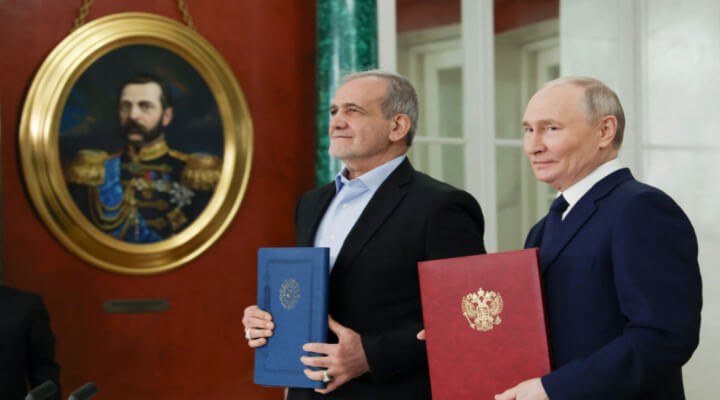
Russian President Vladimir Putin and Iranian President Masoud Pezeshkian attend a ceremony to sign an agreement of comprehensive strategic partnership between the two countries, at the Kremlin in Moscow, Russia, Jan. 17, 2025. Photo: Sputnik/Vyacheslav Prokofyev/Pool via REUTERS
The Palestinian Authority (PA) has unequivocally aligned itself with the anti-American axis led by China and Russia. This is a deceitful betrayal of the United States and Western European nations, whose billions in aid have kept the PA out of financial collapse and sustained its very existence.
This fundamental alliance was on full display during PA leader Mahmoud Abbas’ participation in a major event held in Moscow on May 9, during which he warmly embraced Russian President Vladimir Putin as seen in the picture below.
The official PA daily was proud to report that Abbas’ attendance was at the “official invitation” of Putin, and “he also participated in the official dinner that Putin held in honor of [world] leaders” [Official PA daily Al-Hayat Al-Jadida, May 10, 2025].

[Official PA daily Al-Hayat Al-Jadida, May 9, 2025]
The event was the 80th Moscow Victory Day Parade, celebrating Nazi Germany’s surrender in World War II. The combination of Abbas, Moscow, and the Nazis is highly ironic, given that Abbas previously was in Moscow as a student, where he wrote a doctoral thesis on his Holocaust denial.Abbas met with both Putin and Chinese President Xi Jinping at the event, warmly shaking hands with them and stressing the PA’s “strategic partnership” with their countries.


In his meeting with Xi, Abbas thanked the Chinese leader for the important “strategic partnership between the State of Palestine and its friend the People’s Republic of China.”:
Abbas expressed to the Chinese president his gratitude and appreciation for China’s positions that support our Palestinian people and its just cause in the international forums. He also gave thanks for the humanitarian aid and development aid that China presents to the Palestinian people.
The president emphasized the importance of the strategic partnership between the State of Palestine and its friend the People’s Republic of China. [emphasis added] [Official PA daily Al-Hayat Al-Jadida, May 10, 2025]
Speaking with Putin, the PA chairman not only thanked Russia for its support, but also urged it to “develop” further bilateral ties “in various fields”:
During his meeting with … Putin … the president praised the historical relations between Palestine and Russia. He expressed his appreciation for Russia’s fixed positions in favor of the Palestinian people and its just rights …
He also discussed with his Russian counterpart the strengthening of the historical ties of friendship between the two states and ways to develop them in various fields, in a way that serves the interests of the two peoples. [Official PA daily Al-Hayat Al-Jadida, May 9, 2025] [Official PA daily Al-Hayat Al-Jadida, May 11, 2025]
This overt embrace of the anti-US axis further solidifies a position that has been repeatedly reiterated by the PA. For example, during a visit to Russia in May 2024, Abbas’ advisor Mahmoud Al-Habbash called for a “new multipolar world order” comprised of “the Islamic world, Russia and China.”
In a similar vein, in a meeting with the Chinese ambassador this April, Fatah General Commissioner for Arab and China Relations Abbas Zaki called China the “savior of humanity” against the threat of “the Zionist-American alliance.”
Given Abbas’ call to further “develop” ties with Russia and China, it can only be assumed that the PA will continue to take a more pronounced position in support of America’s opponents. Abbas already displayed this stance when he recently cursed America, saying: “May their father be cursed.”
The author is the Founder and Director of Palestinian Media Watch, where a version of this article first appeared.