United States Special Envoy to the Middle East Steve Witkoff visits at Hostage square in Tel Aviv, May 13, 2025. (Photo by Miriam Alster/Flash90)
The U.S.-brokered plan would see hostages freed while Israel keeps the option to resume fighting.
By World Israel News Staff
A new proposal for a ceasefire and hostage release deal between Israel and Hamas would see a pause in the fighting for 60 days, in exchange for the release of nine living Israeli captives, and includes an option for the war to resume at the end of the truce, according to a report.
Hebrew-language outlet Channel 12 News reported the terms of the new truce being floated by U.S Special Envoy to the Middle East Steve Witkoff, which would secure the release of captives without the official declaration of an end to the war – which has been a major sticking point for Hamas.
The terror group has so far held firm in their stance that it will only release hostages if Israel commits to a full withdrawal from the Gaza Strip and announces that the war, which began after the horrific October 7th, 2023 massacres, is over.
Israel has maintained that any ceasefire deal should grant Israel the ability to continue fighting Hamas after the expiration of the agreement.
Channel 12 reported that the nine hostages would be freed during one week, though it was unclear if that would happen at the beginning, middle, or end of the ceasefire.
The report did not indicate how many Palestinian prisoners would be released in exchanged for the hostages, although based on previous deals, that number would likely be in the hundreds.
The deal would also include the return of the bodies of 18 deceased hostages, though the report did not specify if that would necessitate freeing live Palestinian prisoners.
The proposal asks Israel to commit to negotiating a permanent end to the war during the ceasefire period, as well as an IDF withdrawal from some Gazan territory seized in recent days.
The United Nations would resume responsibility for distributing humanitarian aid to Gazan civilians during the truce period, according to the report.
The Israeli government has not publicly commented on the most recent U.S. ceasefire proposal, nor confirmed the validity of the Channel 12 report outlining its terms.
Lebanon is making significant headway in dismantling Hezbollah’s military infrastructure in the southern part of the country, according to a report published last night by The Wall Street Journal.
The report states that the Lebanese army has successfully dismantled the majority of Hezbollah’s strongholds in the south. This development was made even more striking by the reported cooperation with Israeli intelligence services.
These operations are part of the new Lebanese government’s broader efforts to enforce the ceasefire agreement reached with Israel last November, following a period of intense border clashes.
U.S. and Israeli officials cited in the article expressed unexpected optimism over the Lebanese campaign, describing it as a meaningful step toward maintaining the delicate truce.
“The state must hold exclusive control over all weapons throughout Lebanon,” Prime Minister Nawaf Salam told The Wall Street Journal. Salam added that his government has already completed approximately 80% of the mission to disarm non-state groups in the southern region.
A senior officer in the Israel Defense Forces noted, “We’re seeing areas where the Lebanese army is performing more effectively than anticipated. The IDF welcomes this development and hopes it continues.”
Just over two weeks ago, it was also reported that Lebanon, with backing from the United States, had taken action to curb Hezbollah’s presence at Beirut International Airport. Lebanese officials said that dozens of employees suspected of Hezbollah ties were dismissed, and Prime Minister Salam confirmed that several smugglers had been arrested as part of a renewed push to enforce existing laws.
The fact that they have been able to maintain a daily attack on Israel using ballistic missiles for a year showcases their dangerous capabilities and threat to the region.
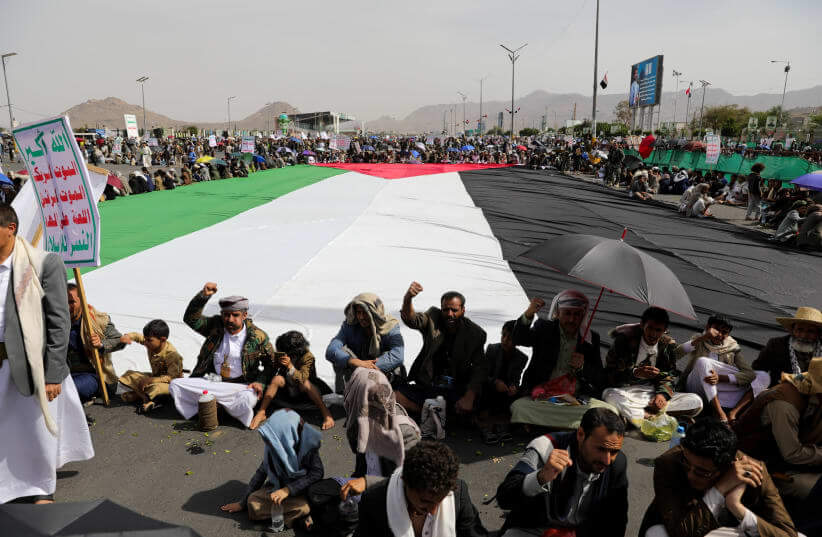
By SETH J. FRANTZMANUpdated: MAY 28, 2025 11:09Houthi supporters protest around a Palestinian flag in Sanaa, Yemen May 23, 2025(photo credit: REUTERS/KHALED ABDULLAH)
The Iran-backed Houthis in Yemen have continued their ballistic missile attacks on Israel. The group is attempting to keep up an almost-daily level of rocket fire at Israel. On May 4, a Houthi missile fell near Ben-Gurion International Airport. The group has not been able to penetrate Israel’s air defenses since the May 4 incident. Nevertheless, the Houthis continue to boast of new accomplishments.
The Houthis launched missiles at Israel on May 27, setting off alarms near the Dead Sea. On May 25, alarms sounded in Jerusalem and other areas of the West Bank. Two days earlier, sirens sounded across Tel Aviv. On May 22, a missile threatened central Israel and Jerusalem.
There were also attacks on May 22, 18, 15, 14, 13, 9, and the attack on the 4th. Israel’s early warning system has been improved, giving people more time to seek shelter by telling them roughly what region is affected, prior to the alarms sounding. Nevertheless, millions of Israelis continue to be sent to shelters almost every day.
The Houthis said that they launched two missiles targeting Ben-Gurion Airport and “another vital target in Tel Aviv,” according to the Houthi high command on May 27. “The Yemeni Armed Forces have carried out two missile attacks on Ben Gurion Airport and another vital target in Tel Aviv, spokesperson Brigadier General Yahya Saree said,” according to Iran’s state IRNA media.
The Houthis claimed they were retaliating for the “genocide in Gaza” as well as the “storming of Al-Aqsa Mosque on Monday.” This was a reference to events surrounding Jerusalem Day.
An Iron Dome launcher fires an interceptor missile as rockets are fired from Gaza, in Sderot, Israel, May 10, 2023. (credit: Ammar Awa/Reuters)
“The genocide against our brothers in the Gaza Strip, along with the siege and starvation, is a crime unprecedented in human history. This necessitates that all free people from our nation and the world take action to uphold justice, defend humanity, and fulfill their duty towards the oppressed Palestinian people,” the Houthi statement claimed.
Is the Houthis’ Palestine 2 ballistic missile really hypersonic?
The group also claimed to have used a missile it dubs the Palestine 2 hypersonic ballistic missile. There is no evidence that the missile is hypersonic. The group then said that the “second operation used a Zulfiqar ballistic missile, striking a key target in the eastern occupied territories.”
Houthi missiles are modelled on Iranian ballistic missiles. The Houthis claim their operations are “successful” because they claim that “millions of Israeli settlers rush to shelters.” They also claimed to have halted air traffic temporarily at the airport.
The Houthis appear to be hinting that they know their attacks have diminishing returns. Israel is used to the daily attacks. Israel is also not retaliating very often for the attacks.
The US attempted to bomb the Houthis into submission between March 15 and early May. US President Donald Trump, realizing this was a bombing campaign conflict that was likely going nowhere, called off the strikes and made a deal with the Houthis that was brokered by Oman.
The Houthi claims of hypersonic missiles come after Iran also claimed to have rolled out a “hypersonic” missile in 2023. The Fattah missile was designed to be launched such that it is a multi-stage missile with a re-entry portion that is on top of a medium-range ballistic missile. What this means is that it can exit the atmosphere and return.
It is not clear if the second stage re-entry vehicle part of the missile, which contains the warhead, can maneuver. Maneuverability is what makes hypersonic missiles dangerous. Any missile can be hypersonic by reaching speeds over Mach 5. However, speed alone is not what makes hypersonic missiles an emerging threat.
These hypersonic missiles are another example of Houthi exaggeration
It is likely that the Houthis’ claim of “hypersonic” achievements is based only on speed, not because their missiles can maneuver or achieve other threat vectors that would pose a challenge to air defenses.
This is an example of Houthi exaggeration. Nevertheless, the fact that they have been able to maintain a daily attack on Israel using ballistic missiles for a year showcases their dangerous capabilities and threat to the region.
The Houthis don’t appear like they will back down. They have suffered some airstrikes, but they are rebuilding their airports and ports that have been targeted. It doesn’t appear that the missiles themselves, apparently hidden in mountains with launch vehicles that can be easily rolled out or disguised, have been targeted or neutralized.
It is hard to find ballistic missiles. The so-called “Great Scud Hunt” of the 1991 Gulf War revealed how complex an operation it is to track down mobile missile launchers.
These days missiles can be hidden in things that resemble sea containers, and placed on the back of a truck. The Houthis have both solid and liquid-fueled missiles. Solid-fueled missiles can be launched faster than liquid-fueled missiles.