Recep Tayyip Erdoğan of Turkey meets with Syrian leader Ahmed al-Sharaa on February 4th, 2025. (X Screenshot)
Assuaging Israeli concerns over Turkish influence in Syria, Trump says he can mediate between Jerusalem and Ankara.
By World Israel News Staff
President Donald Trump addressed Israeli concerns over Turkey’s presence in Syria, saying that he would be able to “work something out” between Israel and Turkey, should both sides make “reasonable demands.”
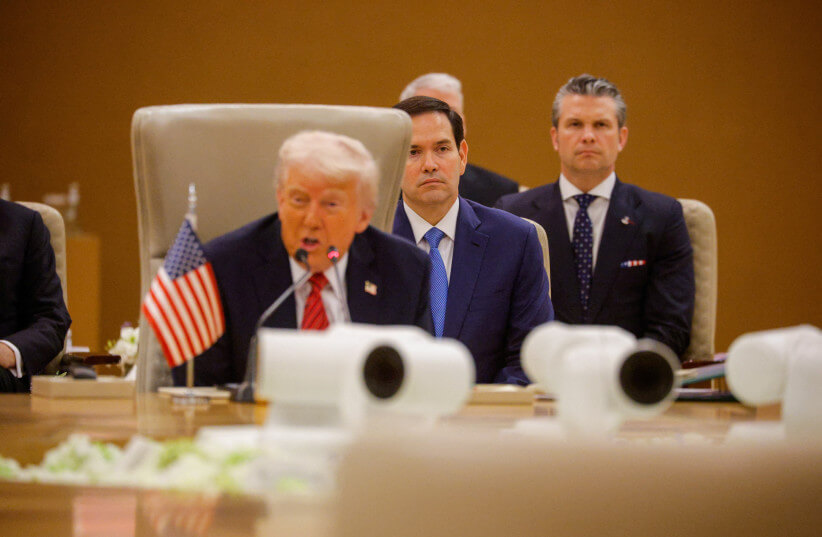
Speaking at a press conference shortly after meeting with Prime Minister Benjamin Netanyahu on Monday at the White House, Trump stressed his strong relationship with Turkish President Recep Tayyip Erdogan.
Referring to Erdogan as “very smart,” Trump said he had phoned the Turkish leader after Islamist groups, backed by Ankara, successfully ousted Syrian president Bashar al-Assad from power in November 2024.
“I said, ‘Congratulations, you’ve done what nobody’s been able to do in 2,000 years. You’ve taken over Syria.’ With different names, but same thing,” Trump recounted.
“I told [Netanyahu]… ‘Bibi if you have a problem with Turkey, I really think I’m going to be able to work it out,’” he continued.
“You know, I have a very, very good relationship with Turkey and with their leader, and I think we’ll be able to work it out,” he added.
“As long as you are reasonable. You have to be reasonable.”
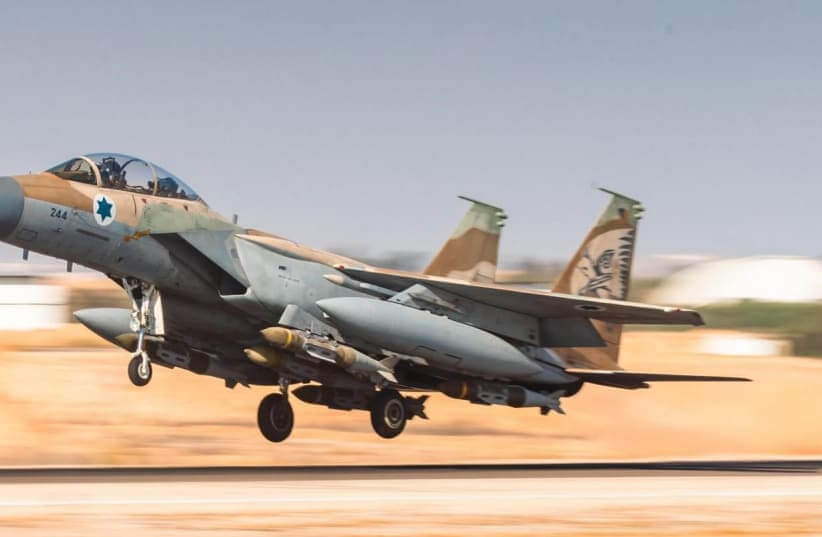
Israel has carried out regular bombing campaigns against Iranian assets in Syria for years, and is concerned that a Turkish military buildup in the country could limit the IAF’s activities in the country.
In recent years, Erdogan has spouted increasingly unhinged anti-Israel rhetoric, including calling Netanyahu a “child-killing vampire.”
Erdogan also called for Allah to destroy Israel in a public Ramadan prayer last month.
At the conference, Netanyahu praised Trump’s offer to mediate between Israel and Turkey regarding Syria.
“We’ve had neighborly relations with Turkey that have deteriorated, and we don’t want to see Syria being used by anyone, including Turkey, as a base for attack in Israel,” Netanyahu said.
“We discussed how we can avoid this conflict in a variety of ways, and I think we can’t have a better interlocutor than the president of the United States for this purpose,” he added.
Leaders of France, Egypt, and Jordan agree that the Palestinian Authority should oversee post-war governance in Gaza, rejecting any future political role for Hamas and opposing the displacement of Palestinian Arabs.
King Abdullah, Sisi and Macron meet in CairoAnadolu Agency/Reuters
During a high-level summit in Cairo on Monday, French President Emmanuel Macron, Egyptian President Abdel Fattah Al-Sisi, and Jordan’s King Abdullah II issued a unified call for the Palestinian Authority (PA) to assume control of Gaza once the conflict between Israel and Hamas comes to an end, AFP reported.
The leaders made their stance clear in a joint statement, saying, “Governance, law and order, and security in Gaza, as well as in all Palestinian territories, must be the sole responsibility of a strengthened Palestinian Authority.”
President Macron, speaking alongside Sisi in the Egyptian capital, made clear his government’s position against any forced relocation of Gaza’s population. He endorsed an Arab League-backed initiative for reconstruction and emphasized its potential to serve as a foundation for new Palestinian Arab leadership in the territory.
“Our government has done crucial work on this plan, which offers a realistic path to the reconstruction of Gaza and should also pave the way for new Palestinian governance,” Macron said.
Macron reiterated his firm opposition to any future role for Hamas in Gaza’s governance, stating, “Hamas must have no role in this governance (of Gaza), and must no longer constitute a threat to Israel.”
While Hamas has hinted at a willingness to delegate civil administration to independent technocrats, it has not agreed to disarm or relinquish power completely.
The trilateral summit also called for the immediate resumption of a ceasefire in the Gaza Strip. Egypt, Qatar, and the United States had brokered the previous agreement in January, but the ceasefire ended after Hamas refused to free more hostages and accept an outline proposed by US envoy Steve Witkoff.
Macron’s presence in Cairo signaled France’s alignment with Egypt and Jordan, who have vocally opposed a proposal by US President Donald Trump suggesting that the US take over Gaza and rebuild it after the war, while its population relocates to countries located nearby.
President Sisi emphasized that peace cannot be achieved without addressing Palestinian Arab aspirations. “There will not be lasting peace and permanent stability in the Middle East without a just solution,” he said.
King Abdullah echoed this sentiment, calling for “a just and comprehensive peace based on the two-state solution,” advocating for the establishment of a Palestinian state alongside Israel
US President Donald Trump said on Monday that Iran would be in “great danger” if ongoing direct talks between the US and the Middle East country fail.
By AMICHAI STEIN, REUTERSUpdated: APRIL 8, 2025 07:14US President Donald Trump and Prime Minister Benjamin Netanyahu at the White House, April 7, 2025.(photo credit: Avi Ohayon / GPO)
Iran and the United States will meet in Oman on April 12 for indirect high-level talks, Iranian Foreign Minister Abbas Araghchi said on Tuesday.
Araghchi, Iran’s seasoned top diplomat, will lead Tehran’s delegation in the upcoming indirect talks with the US in Oman, a source told Iran Nuances. The US will be represented by Presidential Envoy Steve Witkoff.
“It is as much an opportunity as it is a test. The ball is in America’s court,” Araghchi said in a post on X.
US President Donald Trump said on Monday that Iran would be in “great danger” if ongoing direct talks between the US and the Middle East country fail.
“I think if the talks aren’t successful with Iran, I think Iran’s going to be in great danger,” Trump said. “Iran cannot have a nuclear weapon, and if the talks aren’t successful, I actually think it will be a very bad day for Iran.”
Should the talks proceed, they would mark the first face-to-face interaction between American and Iranian officials since Trump withdrew from the 2015 nuclear deal seven years ago.
A staff member removes the Iranian flag from the stage during the Iran nuclear talks in Vienna, Austria July 14, 2015 (credit: REUTERS)
Tehran denies talks reports
Before Araghchi’s announcement, three senior Iranian officials told The New York Times that Trump’s account was not entirely accurate.
According to them, the discussions were expected to begin indirectly, with each delegation in separate rooms while Jordanian diplomats shuttle messages between the sides—a format similar to previous negotiations mediated by European officials during the Biden administration.
“The Nour news agency, which is affiliated with the Iranian government, said: ‘Trump’s move can be seen as part of a psychological and media game aimed at portraying the US as the “party seeking negotiations” and shifting the burden of the lack of dialogue onto Iran.'”
The Iranian sources added that Tehran could consider direct talks if initial indirect discussions show progress.
Hours before the two leaders’ announcement, Iranian Foreign Ministry spokesperson Esmail Baghaei said Iran was awaiting a US response to Tehran’s proposal for indirect negotiations. He said the Islamic Republic believed it was making a generous, responsible and honorable offer.
After Trump spoke, a senior Iranian official, speaking on condition of anonymity, told Reuters: “The talks will not be direct … It will be with Oman’s mediation.” Oman, which maintains good relations with both the US and Iran, has been a longtime channel for messages between the rival states.
Iran’s Supreme Leader Ali Khamenei has refused to permit direct nuclear negotiations with the United States since Trump abandoned the previous accord. Any face-to-face meeting would therefore represent a notable shift. Still, Iranian officials are unlikely to agree to dismantle the country’s extensive nuclear infrastructure, which has advanced to a stage where bomb-grade fuel could be produced within weeks and a deliverable weapon in a matter of months.
The talks come amid growing instability. Iran’s air defenses around key nuclear facilities were compromised after Israeli airstrikes last October. In addition, Iran can no longer count on proxy groups—including Hamas, Hezbollah, and the ousted Syrian government—to respond militarily against Israel.
Within Iran, more voices are calling for the country to develop a nuclear weapon, particularly after Iranian weaknesses were exposed during a missile attack on Israel last year.
Sitting beside Trump, Netanyahu stated that any agreement must follow “the Libyan model”—meaning Iran would need to fully dismantle and export its nuclear assets. However, while Libya’s nuclear equipment was handed over in 2003 before it was even unpacked, Iran’s program has been operational for years, is dispersed across the country, and much of it is buried underground.
The 2015 nuclear agreement required Iran to remove 97% of its enriched uranium and retain only minimal quantities alongside its fuel-production equipment. At the time, then-president Barack Obama and senior officials described the deal as the most achievable option.
Nonetheless, when Trump exited the deal, Iran retained both the equipment and knowledge to rapidly restart its program. The country is now believed to have enough material for at least six nuclear weapons.
In early February, The New York Times reported that a covert Iranian team is researching a faster—though cruder—method of constructing a nuclear device. Trump is likely to have been briefed on this intelligence, which surfaced near the end of the Biden administration and has added urgency to diplomatic efforts.
US officials have made clear that they will not engage in prolonged negotiations with Tehran.