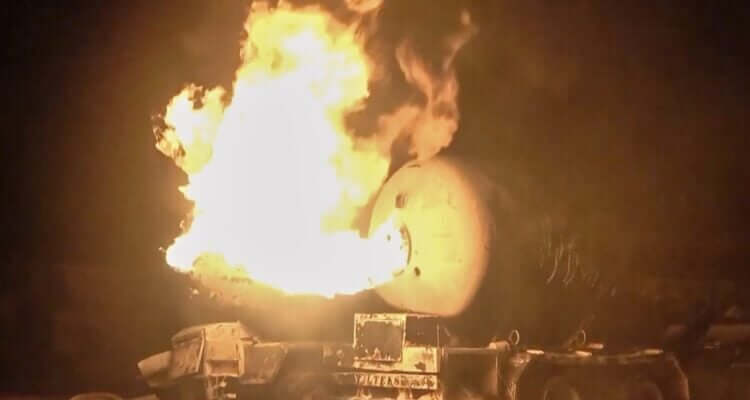
In this photo taken from video released by Al Masirah TV channel shows a burning oil tanker after U.S. airstrikes targeted the Ras Isa oil port held by Yemen’s Houthi rebels in Hodeida, Yemen, Friday, April 18, 2025. ( Al Masirah TV via AP)
Houthi missile attack last Friday prompts Israel to hit back with raids on western Yemen.
By Lauren Marcus, World Israel News
Israeli airstrikes targeted three ports in Yemen controlled by the Houthis, two days after the terror group fired a missile at the Jewish State that sent millions of Israelis scrambling to bomb shelters.
“Israeli aggression aircraft launched multiple air raids on Al Hudaydah Province,” a Houthi source told a Yemeni news outlet early Monday morning, without providing details on the number of casualties or damage inflicted in the attack.
Hours earlier, on late Sunday evening, the IDF’s Arabic-language spokesman Avichay Adraee released an urgent evacuation notice for three sites, all along the Red Sea coastline in western Yemen.
“Warning to all those present at the seaports under the control of the Houthi regime: Ras Isa port, Al Hudaydah port, and Salif port,” Adraee wrote on his official X account.
“This is an urgent and important warning. Due to the Houthi regime’s use of these ports for its operations, we urge everyone in these areas to evacuate immediately to ensure your safety,” the post added.
Last Sunday, a Houthi-launched missile struck the grounds of Ben-Gurion Airport in central Israel.
The strike triggered widespread cancellations of flights in and out of Israel. The flight suspensions came just weeks after several international airlines had resumed service following the October 7th attacks.
Two days later, the IDF launched a massive attack on Yemen’s Sana’a airport, completely disabling the transportation hub.
The Trump administration recently announced a ceasefire between Washington and the Houthis.
Shortly after the truce was announced, a senior Houthi spokesman clarified that the truce excluded Israel.
“To all Zionists, from now on, stay in your shelters or leave your country immediately, because your failed government will no longer be able to protect you,” Houthi Supreme Political Council president Mahdi al-Mashat said in a speech last week.
“The aggressor will realize that the price he will pay is high, and no aggression will deter us from our decision to support Gaza until the aggression stops and the siege is lifted.”
Witkoff was meant to travel to Saudi Arabia with Trump directly, but then decided to come to Israel once Edab Alexander’s release was secured.
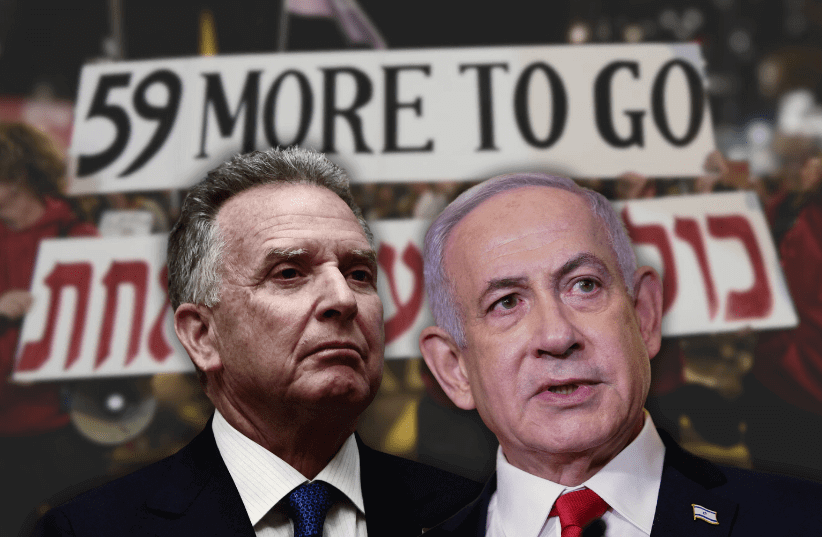
By AMICHAI STEINUpdated: MAY 12, 2025 09:43’59 more to go’: An illustrative image shows US Special Envoy for the Middle East Steve Witkoff and Israeli Prime Minister Benjamin Netanyahu(photo credit: LIOR SEGEV, REUTERS/EVELYN HOCKSTEIN, REUTERS/Nathan Howard)
US Middle East Envoy Steve Witkoff will arrive in Israel on Monday, where he will meet with Prime Minister Benjamin Netanyahu around noon.
Witkoff will also meet with Strategic Affairs Minister Ron Dermer and additional Israeli officials.
Netanyahu will request to meet for two to three hours due to recent developments, mainly the expected release of Israel-American hostage Edan Alexander.
Earlier on Monday, the Prime Minister’s Office commented on the new developments, saying that Israel was able to secure the release of Alexander without committing to a ceasefire due to the support of the United States and IDF military pressure in the Gaza Strip.
Hostage Edan Alexander in a Hamas propaganda video, April 13, 2025. (credit: COURTESY HOSTAGE FAMILY FORUM)
“The expected release of IDF soldier Edan Alexander without anything in return will be possible due to the vigorous policy that we have led with the backing of President Trump, and thanks to the military pressure of IDF soldiers in the Gaza Strip,” the office stated.
“Israel has not committed to a ceasefire of any kind or the release of terrorists, but only to a safe corridor that will allow for the release of Edan.”
“We are in the midst of critical days in which Hamas has been presented with a deal that would enable the release of our hostages. The negotiations will continue under fire, during preparations for an intensification of the fighting,” the office concluded.
Hamas, Trump, and Netanyahu approve Alexander’s release
Hamas approved the release of Alexander on Sunday night, which was promptly confirmed by Trump and Netanyahu.
Trump’s hostage envoy, Adam Boehler, is traveling to Israel with Edan Alexander’s parents to Israel to meet their son after his release from Hamas captivity.
After initial success in April, the talks in May have hit a snag. It is not clear if things can be salvaged this week.
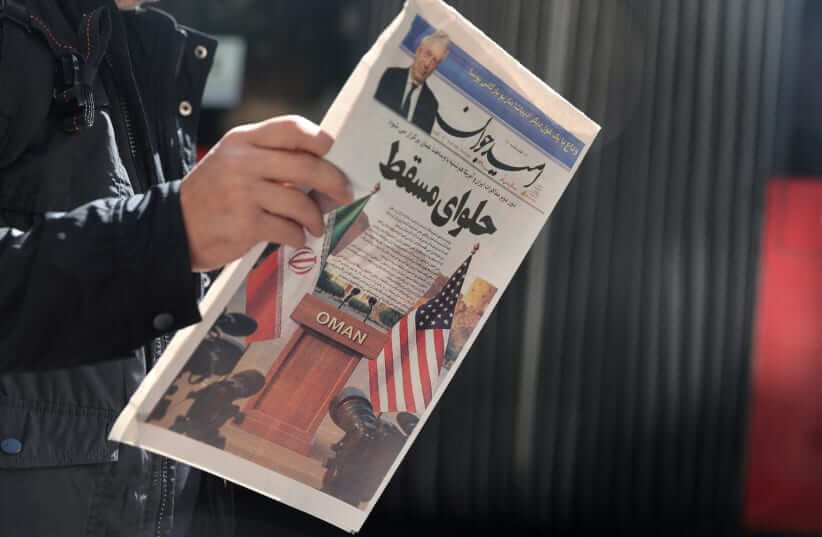
By SETH J. FRANTZMANAn Iranian man holds a newspaper with a cover photo of Iran and US flags in Tehran, Iran. April 19, 2025.(photo credit: MAJID ASGARIPOUR/WANA (WEST ASIA NEWS AGENCY) VIA REUTERS)
Iran is increasingly concerned that nuclear talks with the US will collapse. This message comes from Iran and other observers.
Iran went into the talks with some suspicion and divisions between the optimism that underpinned the Iranian president’s approach and the pessimism that underpinned the Supreme Leader’s views of the same talks.
For this reason, Iran insisted on “indirect” talks in Oman, which soon moved to Italy and then back to Oman. Oman is the host country, and Oman played a key role in the ceasefire that ended US airstrikes on the Houthis.
However, after initial success in April, the talks in May have hit a snag. It is not clear if things can be salvaged this week.
US President Donald Trump is heading to the Gulf, and therefore, the talks come at a sensitive time. Trump and his envoy, Steve Witkoff, could suddenly pull a rabbit out of the hat and proceed in a way that is acceptable to Iran. On the other hand, recent messaging from Washington has spoken about dismantling Iran’s nuclear program and preventing enrichment.
US Middle East envoy Steve Witkoff speaks to members of the media outside the West Wing of the White House last month. (credit: Leah Mills/Reuters)
Iran won’t accept these terms.
What do we know about Iran’s official messaging? “Iran insists on its right to peaceful use of nuclear energy, including enrichment,” Iranian state media said on May 11 ahead of a new round of talks. “The [Iranian] Foreign Minister says that Iran has declared the acquisition and use of nuclear weapons as forbidden and has always been a committed member of the international non-proliferation regime.” Toward this end Iranian Foreign Minister Abbas Araghchi said that Iran “has declared the acquisition and use of nuclear weapons as forbidden and has always been a committed member of the international non-proliferation regime, but at the same time, it insists on its right to peaceful uses of nuclear energy, including enrichment.”
Araghchi made this statement at a conference in Doha. Qatar is very friendly toward Iran, and Doha also enjoys close ties with the West.
Doha would prefer that the Iran deal move forward. “We are not seeking nuclear weapons, and weapons of mass destruction have no place in Iran’s security doctrine. That is why we were among the initiators of creating a nuclear-weapon-free zone in the West Asian region,” Iran’s top diplomat said. “It is necessary for Western countries and all those who claim to oppose nuclear weapons to refrain from double standards. We cannot claim to be concerned about the peaceful nuclear energy of Iran and other countries in the region, but allow an occupying, aggressor, and genocidal regime to possess a large arsenal of nuclear weapons,” he added.
Iran looks for other avenues to secure nuclear security amid US talks
Iran hints that it is balancing talks with the US and its own discussions with Europe, Russia, and China. Araghchi also met with his Saudi counterpart, Faisal bin Farhan Al Saud. “During the meeting on Saturday, the two officials addressed key diplomatic issues and explored ways to enhance cooperation in tackling regional and international challenges,” IRNA said.
This is important because it comes ahead of Trump’s coming to the region and meeting with Gulf leaders. After stopping in Saudi Arabia, the top Iranian diplomat headed for Doha, where he made the comments about the Iran nuclear talks.
Iran is already drawing up scenarios for possible “failure” in the talks, Al-Ain media in the UAE reported on May 11. This report noted that the previous round of talks scheduled to take place in Rome on May 3 had been postponed. On May 4 the Houthis launched a long range missile that struck near Israel’s Ben-Gurion International airport. Israel also approved plans for a new operation in Gaza, the same day. On May 5 and 6 Israel carried out strikes in Yemen and the US announced a ceasefire in Yemen, illustrating how fast things are moving.
An Iranian official told CNN: “The indirect talks with the United States, which aim to address Tehran’s nuclear program and lift sanctions, are not serious on the American side and were likely designed from the beginning to be a trap to drag the situation towards tension.” This illustrates how Iran is preparing for a possible train wreck ahead.
Tehran thinks it is being played. It watches the media interviews with US officials and the differing statements from Washington and its assessment has gone from optimism in mid-April, to deep pessimism today.
Iran thinks the US is not actually ready to discuss technical issues related to the program. Tehran also may believe this is a set-up, to create the pretext for failure to justify conflict. Iran’s regime believes Israel and pro-Israel voices are trying to sabotage the talks, a point that Iran’s foreign minister made last week as he headed for Pakistan.
Indeed, Iran likely views Pakistan as a model for how to possess nuclear weapons and deter adversaries. Iran, like Pakistan, is a friend of China. Iran likely saw how Pakistan was able to get the US to press for a ceasefire and how Pakistan used the conflict to its benefit. Iran may be friendly with India, but it learns tactics and strategy from Islamabad as well.
Iranian sources told the US media that “the United States provides brief, general answers to questions and ignores key proposals. This situation has led Iran to conclude that negotiations are unlikely to yield the desired outcome of sanctions relief and economic benefits. As a result, Tehran has been preparing the necessary scenarios over the past month.” Uranium enrichment on Iranian soil is a red line for Iran in the negotiations, the CNN report noted.
Iran is likely concerned that Witkoff’s messaging appears to have changed. Witkoff has hardened his stance, according to recent reports, insisting that Iran won’t dismantle its enrichment facilities.
What might come next? Iran will want to see if it can get to the next stage of technical talks. If not, then Iran may move away from an agreement and see if its friends in other countries can speak to the US. Iran likely knows that the Trump administration doesn’t want to get involved in another war. However, Iran also wants sanctions relie