Israel said early Sunday that it was delaying the release of hundreds of Palestinian prisoners who had been slated to go free Saturday until Jerusalem receives assurances regarding the end of “humiliating ceremonies” staged by Hamas when hostages are handed over.
The statement by Prime Minister Benjamin Netanyahu’s office came after over 600 inmates had reportedly already boarded buses to leave Ofer prison, in the largest single-day release of the first stage of the ongoing Gaza ceasefire. Instead, the inmates were told to disembark, their release on indefinite hold.
The prisoners had been slated to be let go as part of a deal for the release of six hostages who were freed by Hamas earlier in the day. But with Israelis fuming over the handling of the transfer of the bodies of mother Shiri Bibas and her two small children murdered in captivity, and new anger sparked by a propaganda video showing hostages being brought to a ceremony where others were being freed, Netanyahu said Israel would demand an end to the gauche fanfare before resuming freeing prisoners.
“In light of the repeated violations by Hamas — including the ceremonies that demean our hostages’ dignity and the cynical use of our hostages for propaganda purposes — it has been decided to delay the release of terrorists planned for yesterday until the next release of hostages is guaranteed, and without the humiliating ceremonies,” read a statement from the Prime Minister’s Office sent just after 1 a.m. Sunday.
Israel’s announcement abruptly put the future of the truce into further doubt.
Hamas condemned the decision, saying the claim that the hostages’ handover ceremonies are “humiliating” is false and a pretext for Israel to evade its obligations under the Gaza hostage release and ceasefire agreement.
“[Prime Minister Benjamin] Netanyahu’s decision reflects a deliberate attempt to disrupt the agreement, represents a clear violation of its terms, and shows the occupation’s lack of reliability in implementing its obligations,” Ezzat El Rashq, a member of the Hamas political bureau, said in a statement.
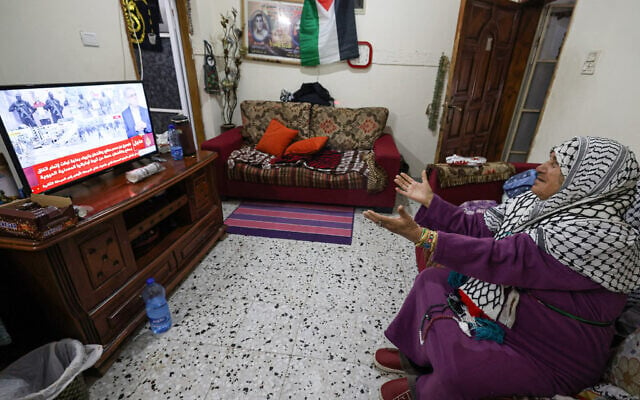
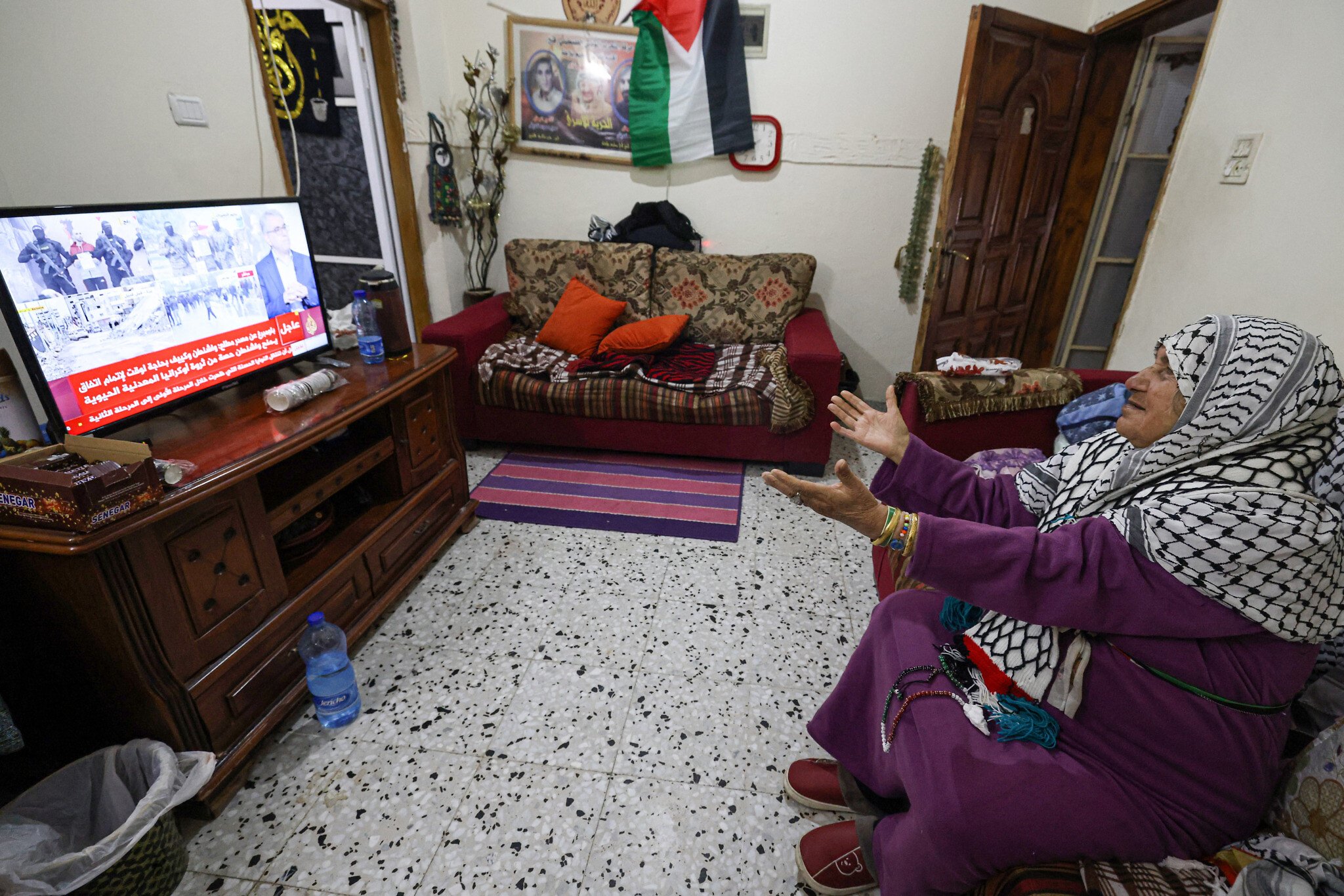
The mother of Palestinian prisoner Khaled Khdeish, who was set to be released alongside hundreds of Palestinian prisoners on Saturday, watches the news awaiting information on his release at her home in the Balata camp, east of Nablus in the West Bank on February 22, 2025. (Jaafar ASHTIYEH/AFP)
The Palestinian Authority’s commission for prisoners’ affairs confirmed the delay “until further notice.” Associated Press video in the West Bank showed prisoners’ families, waiting outdoors in near-freezing weather, apparently dispersing. One woman was shown walking away in tears.
Israel’s government didn’t respond to questions about the delay in releasing prisoners. Hamas accused Israel of violating the ceasefire deal, with spokesperson Abdel Latif Al-Qanou accusing Netanyahu of “deliberately stalling.”
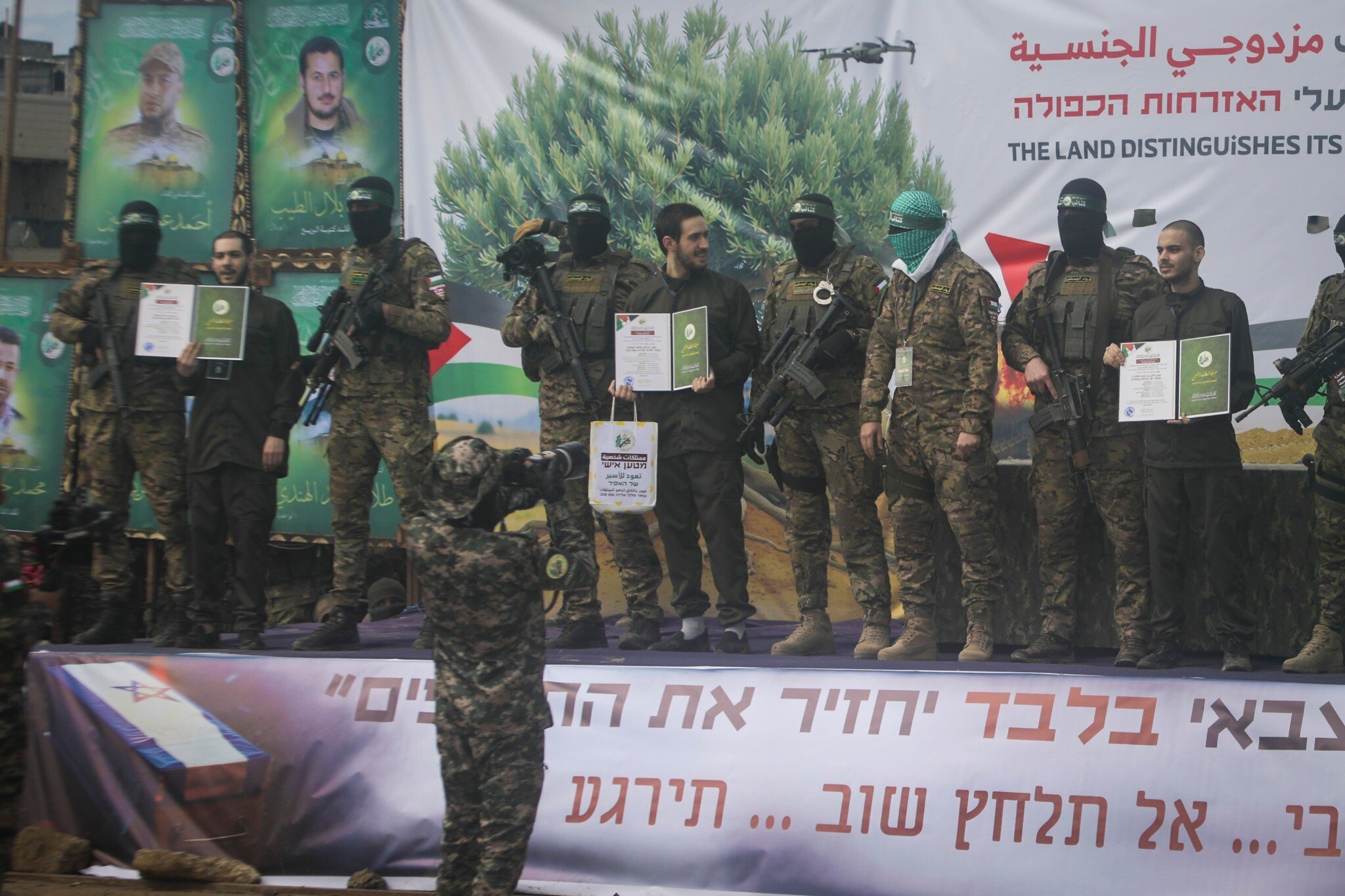
Five of the six hostages freed Saturday had been escorted by masked, armed Hamas members in front of a crowd — a display that the UN and Red Cross have criticized as cruel after previous handovers.
The six — Tal Shoham, Omer Shem Tov, Omer Wenkert, Eliya Cohen, Avera Mengistu and Hisham al-Sayed — were the last living hostages expected to be freed under the ceasefire’s first phase, with a week remaining in the initial stage. Talks on the ceasefire’s second phase are yet to start.
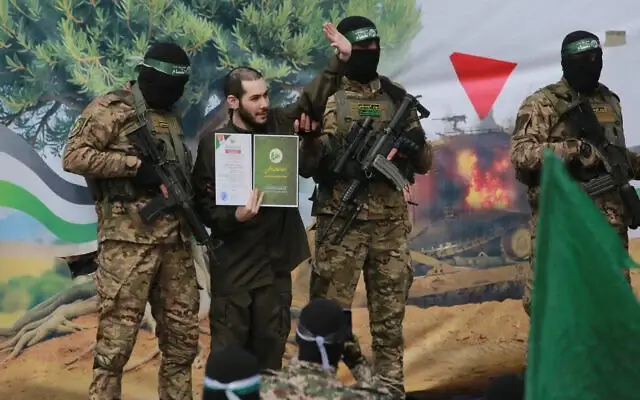
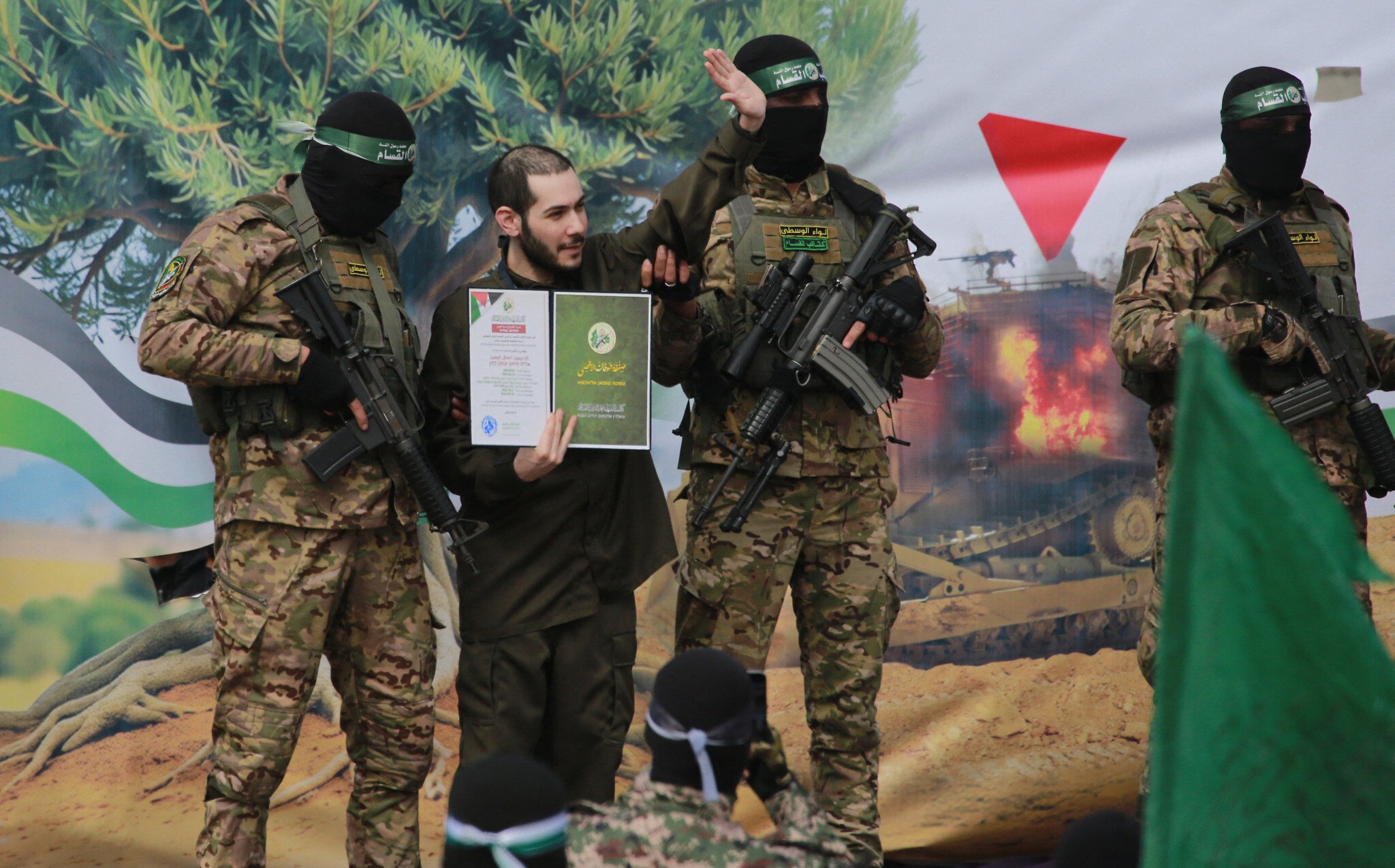
All but al-Sayed, who like Mengistu had been held in Gaza for around a decade, were handed over in staged ceremonies. In one, Omer Wenkert, Omer Shem Tov and Eliya Cohen were posed alongside Hamas fighters. A beaming Shem Tov, acting under duress, kissed two gunmen on the head and blew kisses to the crowd.
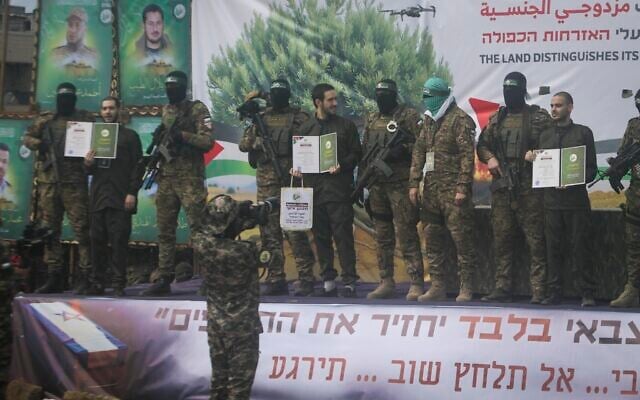
Israeli hostages, from left to right, Eliya Cohen, Omer Shem and Omer Wenkert, are told to show Hamas-issued certificates before being handed over to the Red Cross in Nuseirat, central Gaza Strip, Saturday, February 22, 2025. (AP/Jehad Alshrafi)
The hostages were dressed up in fake army uniforms, though they were not soldiers when abducted.
The army later said al-Sayed had been released. The Bedouin Israeli entered Gaza in 2015, a year after Mengistu. Both had suffered from mental illness, according to their families, and were largely unresponsive after returning to Israel.
Israel had been slated to free 602 inmates, including 50 prisoners serving life sentences for deadly attacks against Israelis, and 60 serving long prison terms.
The roster included the longest-serving inmate likely set to be freed: Nael Barghouti, who has spent a total of 44 years in Israeli custody for killing 27-year-old Israeli bus driver Mordechai Yekuel in his vehicle near Ramallah in 1978. After 33 years in prison, Barghouti was freed in the 2011 Gilad Shalit prisoner exchange, but was arrested three years later and convicted on terrorism charges.
In total 47 Palestinian prisoners re-arrested after the Shalit deal were set to be freed in this exchange.
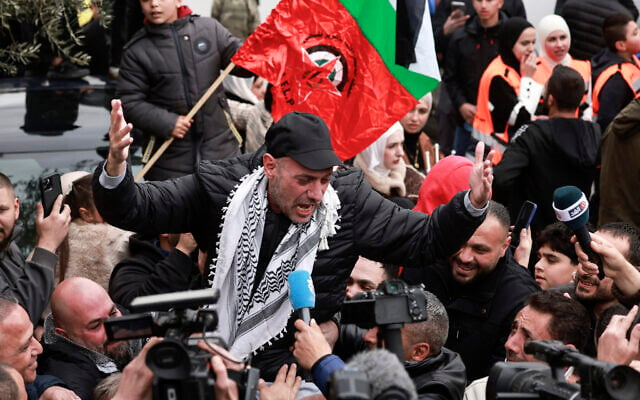
A former Palestinian prisoner released by Israel is cheered by a crowd after stepping out of a bus in the West Bank city of Ramallah on February 8, 2025.(Jaafar Ashtiyeh/AFP)
Also set for release was Ammar Zaban, a prominent figure in Hamas who headed the al-Aqsa Martyrs’ Brigades during the Second Intifada.
Zaban, who will be deported, was sentenced to 27 life terms for his involvement in numerous terror attacks, including the 1997 suicide bombing in Jerusalem’s Mahane Yehuda market, which killed 16 people.
Nearly 100 of the ex-inmates were slated for deportation upon their release. An additional 11 prisoners detained before the war’s outset would be sent to Gaza, while 43 will return to their homes in the West Bank and East Jerusalem.
Another 445 inmates who were detained in Gaza following October 7 but were never charged were set to be free.
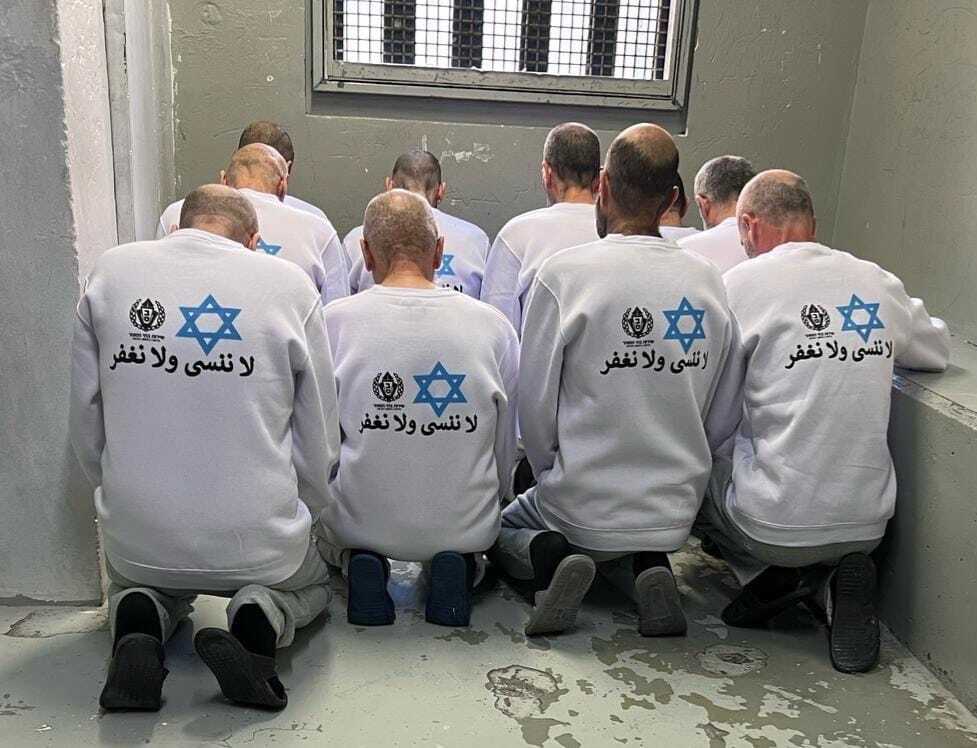
Ahead of the release, Israel Prison Service chief Kobi Yaakobi instructed guards to dress Palestinian prisoners slated for release with shirts sporting a verse from Psalms written in Arabic: “I pursued my enemies and overtook them, and did not turn back until their destruction.”
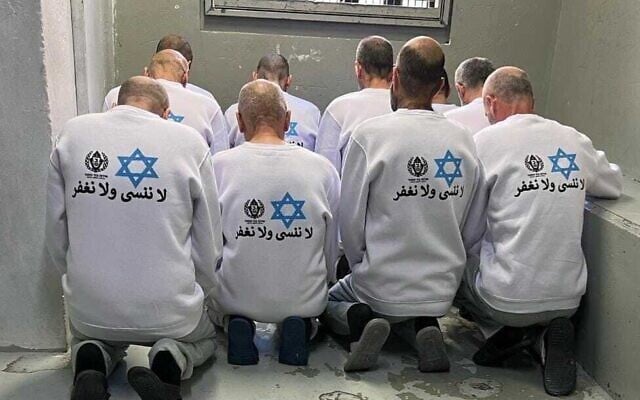
The Israel Prison Service dresses Palestinian prisoners set for release in shirts featuring its logo, a Star of David and the sentence in Arabic: ‘We will not forget or forgive,’ February 15, 2025. (Israel Prison Service)
Prisoners were also made to wear bracelets that read, “The eternal people do not forget. I pursued my enemies and overtook them.”
Twenty-three minors and one woman detained in the Strip were also set to be released in exchange for the bodies of Shiri Bibas, and her young boys Ariel and Kfir, according to Haaretz.
Israel says Ariel, 4 when he was abducted, and Kfir, who was 10 months old, were murdered by their captors in November 2023 after being kidnapped from their Nir Oz home on October 7. Shiri Bibas was also killed, though her body was only returned to Israel late Friday after Hamas initially sent the remains of a Gaza woman instead. Husband and father Yarden Bibas was kidnapped separately and released alive earlier this month.
Netanyahu had vowed revenge for “a cruel and malicious violation” after it was discovered that Shiri Bibas’s body had not been returned as promised. On Saturday evening, he lauded the release of the six living hostages today, calling it a “moment of joy and relief” for their families and Israel, but said Israel “will not forget and will not forgive” the murders of the three members of the Bibas family.
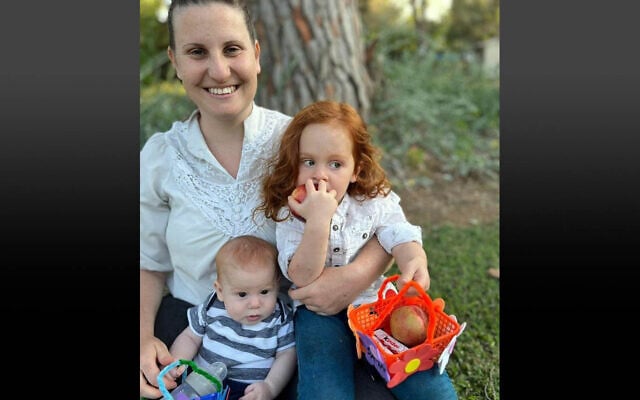
Shiri Bibas, Kfir Bibas and Ariel Bibas (Courtesy)
Defense Minister Israel Katz warned the murders will “not be taken lightly.”
On Thursday, Hamas had put the Bibas’s coffins on a stage in Khan Younis in front of a giant poster of Netanyahu as a vampire, alongside the coffin of octogenarian peace activist Oded Lifshitz, also killed in captivity, as they paraded the four victims before cheering crowds, drawing widespread revulsion at the display.
Israeli officials had said Saturday night that the release of the prisoners would be delayed until Netanyahu finished holding security consultations regarding the return of the remaining Israeli hostages. An official said the meeting was focused “on the goal of returning all our hostages, alive and dead.”
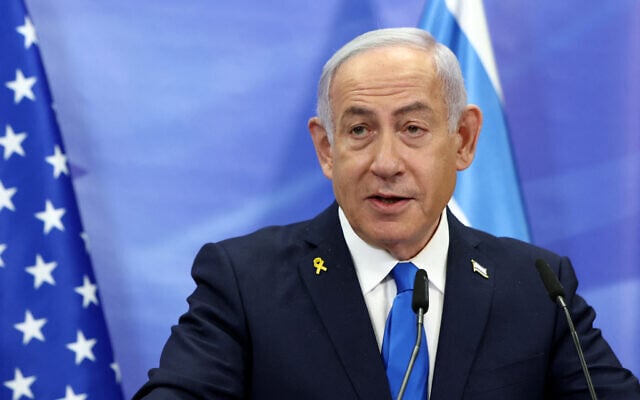
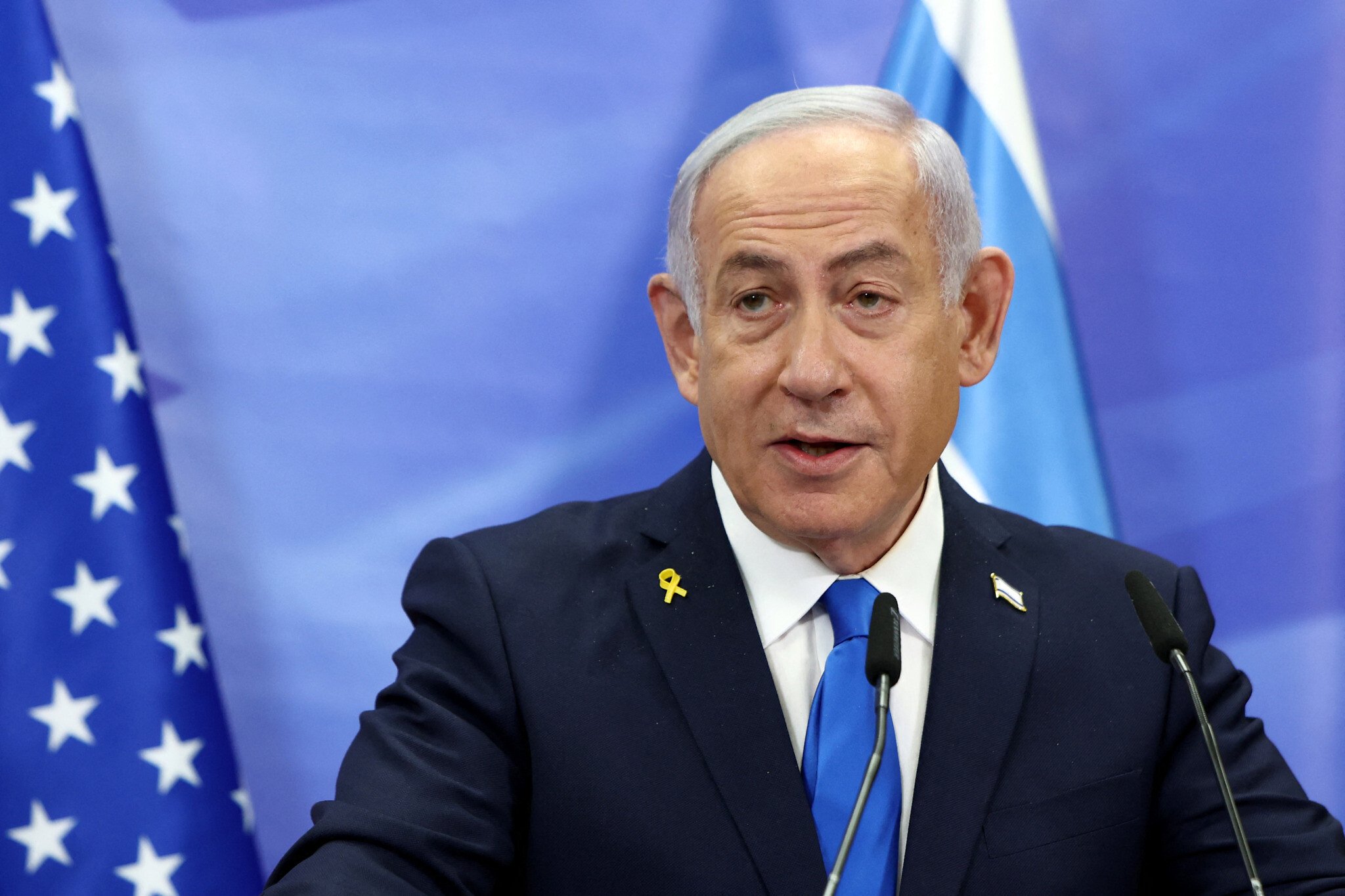
Prime Minister Benjamin Netanyahu speaks during a joint press conference with the US secretary of state, at his office in Jerusalem on February 16, 2025. (Evelyn Hockstein / POOL / AFP)
Under the ceasefire deal’s current first stage, Hamas is still slated to hand over four bodies of hostages killed in captivity in exchange for more prisoners. Some 2,000 inmates in total are set to be released as part of the first stage, a price that some in Israel, including far-right allies of Netanyahu, have said is too high, especially given the large number of terror convicts serving time for deadly attacks.
A second stage of the ceasefire, which would involve the release of remaining hostages for yet more prisoners, has yet to be worked out, with Israel indicating it could instead resume fighting in Gaza.
Hamas has said it won’t release the remaining captives without a lasting ceasefire and full Israeli withdrawal from Gaza. Netanyahu, with the backing of US President Donald Trump’s administration, says he’s committed to destroying Hamas’ military and governing capacities and returning all hostages, goals widely seen as mutually exclusive.
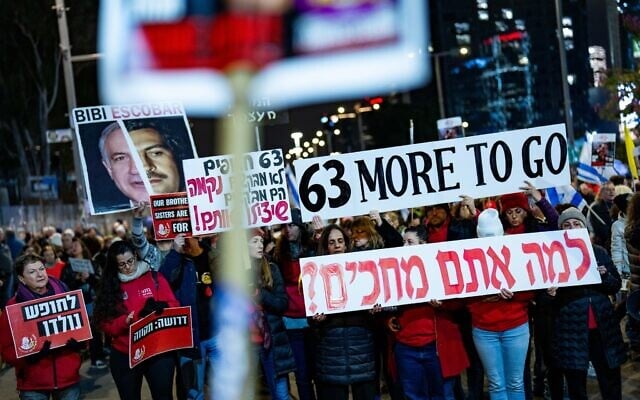
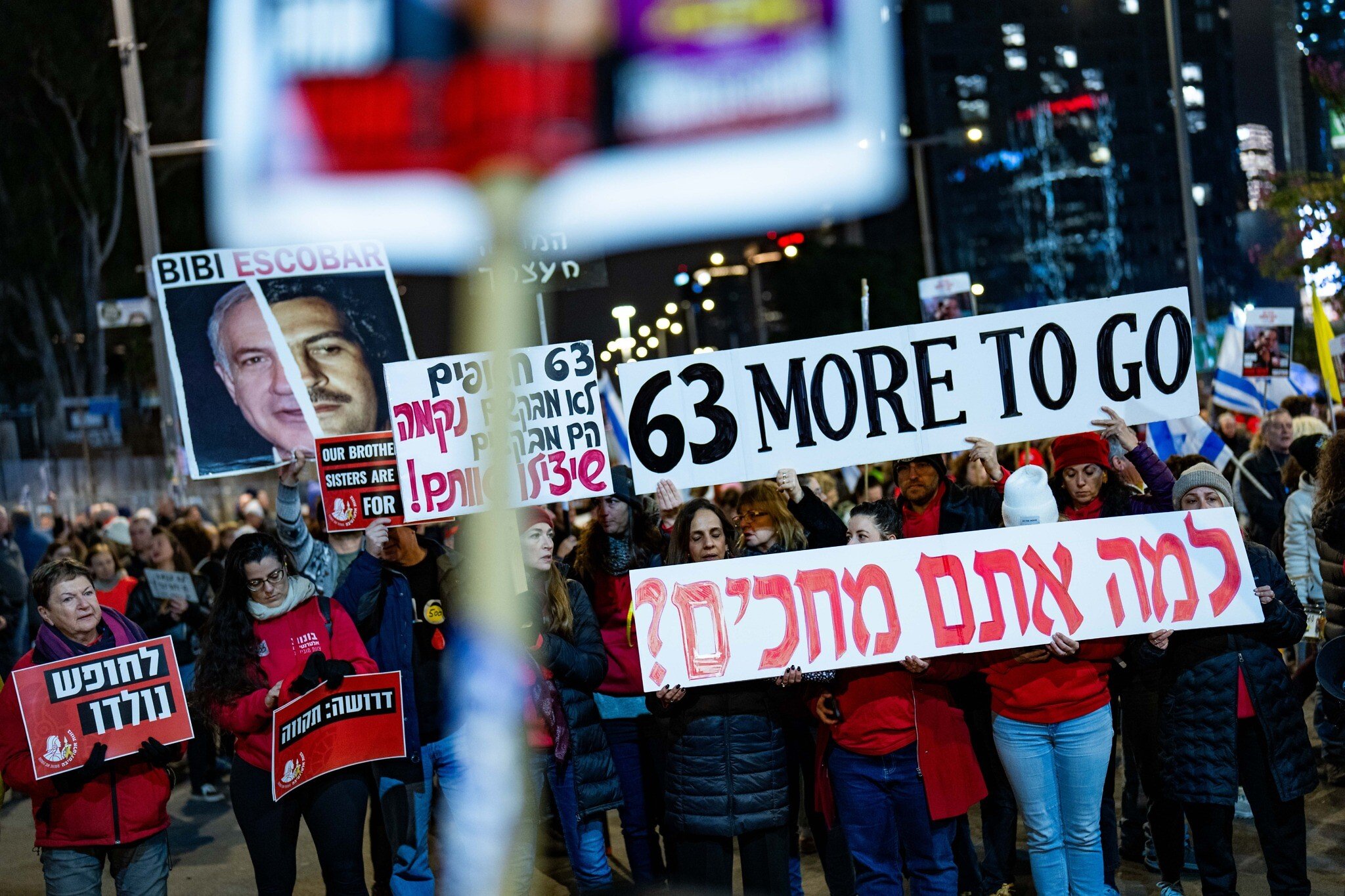
Demonstrators protest for the release of Israelis held hostage in the Gaza Strip, outside Hakirya Base in Tel Aviv, February 22, 2025. (Erik Marmor/Flash90)
Families and others rallied Saturday night in Tel Aviv to pressure Netanyahu’s government for a deal.
“How is it possible that President Trump and special envoy [Steven] Witkoff are more committed to the return of Israeli hostages than you are?” said Naama Weinberg, cousin of deceased hostage Itay Svirsky. “Netanyahu, these are your citizens who were abandoned on your watch!”
Witkoff was slated to meet Saturday night with Strategic Affairs Minister Ron Dermer, the Walla news site reported.