By REUTERS Donald Trump meets Jordan’s King Abdullah on Tuesday for what is likely to be a tense encounter following the US president’s Gaza redevelopment idea and threat to cut aid to the US-allied Arab country if it refuses to resettle Palestinians.
Trump’s proposal, floated one week ago, for the US to take over Gaza, move its shell-shocked residents and transform the war-ravaged territory into the “Riviera of the Middle East” drew a negative response from the Arab world.
The concept has introduced new complexity into a sensitive regional dynamic, including a fragile ceasefire between Israel and the Palestinian terrorist group Hamas.
Hamas on Monday said it would stop releasing Israeli hostages from Gaza until further notice, saying Israel was violating the agreement to end strikes that have pummeled Gaza. Trump later proposed canceling the ceasefire if Hamas doesn’t release all remaining hostages it took on October 7, 2023, by the weekend.
King Abdullah has said he rejected any moves to annex land and displace Palestinians. On Tuesday, he is expected to tell Trump such a move could spur radicalism, spread chaos in the region, jeopardize peace with Israel and threaten the country’s very survival.
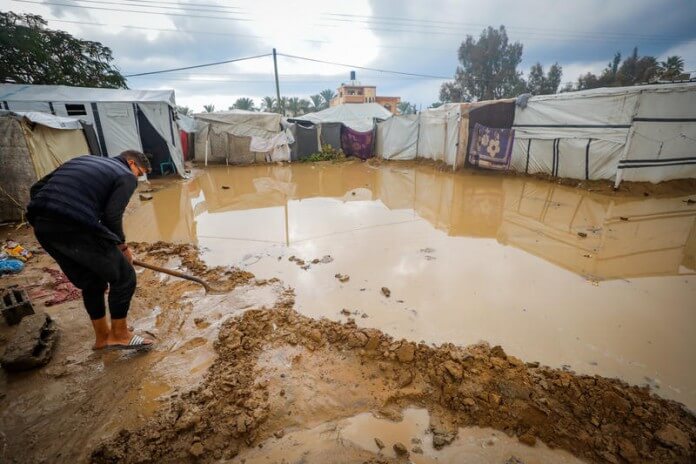
Displaced Gaza Arabs near their flooded tents in Deir al-Balah, in the central Gaza Strip, January 23, 2025.
President Donald Trump warned on Monday that if all Israeli hostages in Gaza are not returned by Saturday at noon, he would propose canceling the Israel-Hamas ceasefire and allowing “all hell to break loose.”
Earlier on Monday, Hamas threatened to delay the next scheduled hostage release, set for Saturday, “until further notice,” accusing Israel of violating the ceasefire agreement (Hamas Freezes Next Hostage Release).
Trump called Hamas’s statement “terrible” and said he would “leave it up to Israel” to decide what should ultimately happen to the ceasefire.
After the Hamas announcement, Defense Minister Israel Katz ordered the IDF to “prepare at the highest level of alertness for any possible scenario in Gaza and to protect the settlements.”
“Hamas’s announcement of the cessation of the release of the Israeli hostages is a complete violation of the ceasefire agreement and the deal for the release of the hostages,’ said Katz, vowing, “We will not allow a return to the reality of October 7.”
President Trump, for his part, told reporters in the Oval Office, “As far as I’m concerned if all of the hostages aren’t returned by Saturday at 12 o’clock – I think it’s an appropriate time – I would say, cancel it and all bets are off and let hell break out.”
“I’d say they ought to be returned by 12 o’clock on Saturday, and if they’re not returned – all of them, not in drips and drabs, not two and one and three and four and two. Saturday at 12 o’clock, and after that, I would say, all hell is going to break out.”
When asked what “all hell” means for Gaza, Trump said, “You’ll find out, and they’ll find out — Hamas will find out what I mean. These are sick people.”
He then added, “I’m speaking for myself. Israel can override it, but for myself, Saturday at 12 o’clock, and if they’re not – if they’re not here, all hell is going to break out.”
Trump told the reporters he had not yet spoken to Prime Minister Benjamin Netanyahu about the timeline he suggested.
According to Kan11 News, citing two sources involved in the negotiations, the crisis with Hamas revolves around humanitarian aid, including tents, caravans, and medical equipment, which Israel is allegedly not delivering to Gaza. However, Israel estimates that the issue will be resolved in the coming days and that the ceasefire scheduled for Saturday will proceed as planned.
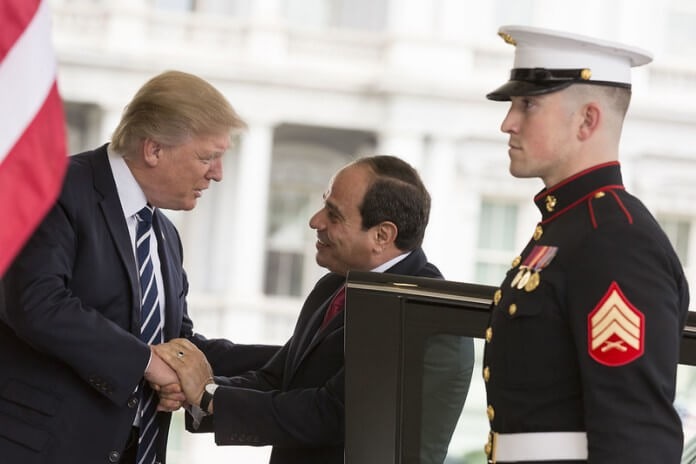
President Donald Trump with Egyptian President Abdel Fattah Al Sisi at the White House, April 3, 2017.
On Monday, President Donald J. Trump warned that he would cut aid to Jordan and Egypt if they rejected his demand to permanently accept the majority of Gaza Arabs in their territories. The warning escalated Trump’s pressure on his two Mid-Eastern allies to support his plan of relocating Gaza’s entire population for the duration of redevelopment works in the Strip and longer.
Earlier, Egyptian and Jordanian officials expressed concerns that a large-scale displacement of Gaza’s residents into their countries could lead to the formation of terrorist strongholds along their borders with Israel.
Both nations have warned of potential repercussions from President Trump’s proposal to expel Gaza’s population to their territories.
Egyptian security officials fear that the arrival of hundreds of thousands of Hamas operatives through the Rafah crossing into the Sinai region could destabilize the border and jeopardize the peace agreement between Egypt and Israel.
You’ll note that, much like Israel, the Egyptians don’t believe there are “uninvolved civilians” in Gaza since they are all members or affiliates of Hamas. Since the Arab Spring of 2010, Egypt has been fighting the growing influence of the Muslim Brotherhood, of which Hamas is an extremist terrorist offshoot.
In Jordan, authorities emphasize that the kingdom’s political climate is already fragile, particularly after the Muslim Brotherhood’s significant gains in last September’s parliamentary elections.
The Society of the Muslim Brothers, commonly known as the Muslim Brotherhood, is a transnational Sunni Islamist organization founded in Egypt in 1928 by Islamic scholar and schoolteacher Hassan al-Banna. Al-Banna’s ideology has had a lasting impact beyond Egypt, shaping various Islamist movements, including charitable organizations and political parties worldwide.
The Muslim Brotherhood has received primary state support from Qatar and Turkey under Erdogan’s AKP government. As of 2015, several countries, including Bahrain, Egypt, Russia, Syria, Saudi Arabia, and the United Arab Emirates, have designated the Brotherhood as a terrorist group.
In 2023, aid to Egypt (population 112.7 million) from all US agencies totaled $1.43 billion, with $1.44 billion requested for 2024. Currently, Egypt ranks third in the region, after Israel and Jordan, in terms of assistance funds requested for 2024 (figures for 2025 are not available).
As to Jordan (population 11.34 million), in 2022, the US signed a seven-year, $10.15 billion MOU reflecting the commitment of the United States to Jordan’s stability and prosperity. The MOU is the largest and longest such agreement in the 75-year history of bilateral relations between Jordan and the United States (figures for 2025 are not available).
As noted, both Jordan and Egypt, both key recipients of US military and economic aid, have firmly rejected any proposal to relocate Gaza Arabs within their borders, and President Trump warned that their lavish aid could be in jeopardy.
“If they don’t agree, I could conceivably withhold aid,” Trump told reporters one day ahead of his Tuesday meeting with King Abdullah II of Jordan.
He added: “I think I could make a deal with Jordan. I think I could make a deal with Egypt.”
In an interview with Bret Baier on Fox News, Trump shared his most detailed vision yet for relocating Gaza’s population to Jordan, Egypt, and other nations.
“We’ll build safe communities a little bit away from where they are, away from all of this danger,” Trump pitched his message. “In the meantime, I would own this. Think of it as a real estate development for the future. It would be a beautiful piece of land.”
The relocated Gazans “would have much better housing” than they do today, Trump stressed, and would presumably not ask or need to return.
“I’m talking about building a permanent place for them,” Trump promised.