If Hamas leaders in Doha knew, then it raises questions about why Qatar, a US ally, didn’t know about the plan. If Doha did know then it raises concerning questions about why Israel wasn’t informed.

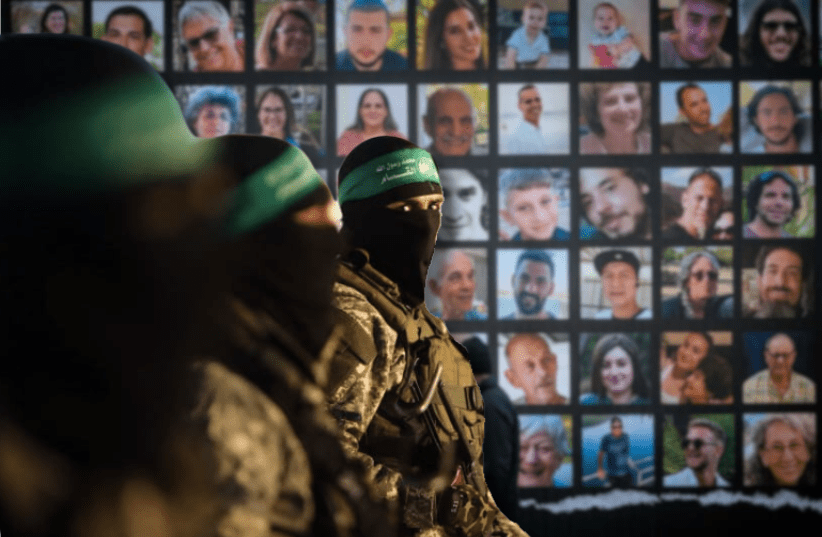
Illustrative image of Hamas leader Yahya Sinwar in front of an image depicting smoke rising after Israeli strikes in Khan Younis, Gaza.
(photo credit: Abed Rahim Khatib/Shutterstock, REUTERS/IBRAHEEM ABU MUSTAFA)
Hamas planned its October 7 mass attack to happen in 2022 but postponed the plans for a variety of reasons, according to conclusions drawn based on new documents discovered in Gaza.

The documents, which are multiple pages long and also include minutes of meetings and numerous images that Hamas had collected of Israeli targets, illustrate how advanced the Hamas planning became by 2022. It also illustrates how Hamas was thinking in terms of several different types of attacks. It is unclear how far Hamas progressed in some of the plans. Lastly, the documents appear to illustrate that Hamas was deeply invested in coordinating with Iran, and Hezbollah and informed its Doha-based leadership.

 The reports on these documents raise numerous questions.

The Jericho Wall plan

Hamas’s plans go back many years, this was already known. In fact, Israel had obtained hints of this plan, dubbed the “Jericho Wall” plan – which was known to Israel prior to October 7.

Israeli officials dismissed this plan and also dismissed warnings from IDF women observers about Hamas preparations, but the fact is that aspects of the Hamas plan were known.

 The change in the date of the commemoration is far from being innocent. The house in Kibbutz Be'eri that was destroyed on October 7th. (credit: ORI SELA)Enlrage image
The change in the date of the commemoration is far from being innocent. The house in Kibbutz Be’eri that was destroyed on October 7th. (credit: ORI SELA)

The new evidence sheds light on how Hamas seems to have been sharing this plan a lot before the attack. This raises questions about why regional intelligence agencies and also Western intelligence agencies didn’t pick up on it.

Iran has denied prior knowledge of the plan in the past. In addition, reports have sought to claim that the Hamas leadership in Doha did not know about the genocidal attack.

Doha had told Israel prior to October 7 that Hamas only wanted cash and was deterred. If Hamas leaders in Doha knew, then it raises questions about why Qatar, a US ally, didn’t know about the plan. If Doha did know then it raises concerning questions about why Israel wasn’t informed.

Hamas leaders seemed to know about this plan, outside of a small circle. The reports indicate Khalil al-Hayya, a Hamas member knew about it. Hayya met with top Islamic Revolutionary Guard Corps (IRGC) commander Mohammed Said Izadi in Lebanon. The fact that Hamas was holding meetings with the IRGC and this didn’t set off any alarm bells seems to be concerning. Other key Hamas members who were in on the plan included Yahya Sinwar, Sinwar’s brother Mohammed, Mohammed Deif and Marwan Issa. Issa and Deif have been killed in the war.

Hamas’s plans progressed from its demands for support from Iran that were made in June 2021, right after the ten-day conflict that year, through April and November 2022. The steam kept building through August 2023. Hamas wanted calm to cover up its plans. It succeeded in obtaining this. Israel was distracted by elections in 2022 as well as Hezbollah threats which forced Israel into a US-brokered maritime deal with Lebanon. Israel was also distracted with internal domestic politics in 2023, as well as a rising terror wave in the West Bank.

What we know now

Overall, the new documents tell us a few things. It tells us that Hamas did try to coordinate with the IRGC in Iran and with Hezbollah.

Iran likely coordinated with militias in Iraq and Yemen to prepare for the “big project,” as Hamas called the lead-up to the war. Ismail Haniyeh in Doha knew of the plans. Ismail Qaani, head of the Quds Force of the IRGC, knew of the plans.

However, other aspects of these documents raise questions. Hamas was planning the October 7 operation for years. It also apparently thought up other plans such as major attacks in Tel Aviv. How far advanced were those plans? This question leaves one wondering about Hamas’ overall planning process.

The fact Hamas kept minutes of the meetings and put them on a computer as well as having Hamas members speak with Hezbollah and the IRGC in meetings seems to make one question Hamas’ operational security.

Storing the minutes of a secret terrorist meeting and plans on a computer is a sure way for those plans to be found, unless the computer is never hooked up to the internet or a network. All of this leaves questions about why no other governments in the region were more keyed into the Hamas plans.

While it stands to reason many governments don’t monitor Hamas communications, some of them do monitor Hezbollah or the IRGC. In addition, Hamas leaders reside in Doha, a US ally.

The discovery of Hamas’s plans, which were apparently found back in January in Khan Yunis, the home town of Yahya Sinwar, leave many questions about October 7 unanswered: What it does tell us is that Hamas wanted close coordination with Iran?

It was always assumed that Iran was pushing the multi-front war and unification of the “arenas” to surround Israel.

Hamas is now portrayed as a more senior partner than in the past. Hamas drove Hezbollah towards war with Israel. That is important and shows why many countries should have paid closer attention to the rising Hamas danger.

The documents also make it look increasingly like the Great Return March protests in 2018 and the 2021 short conflict were dry-runs for the October 7 attack.

It also raises questions about whether the maritime deal in which Israel was pushed to appease Hezbollah, helped make Hamas think Israel was weak.

The desire to derail normalization with Saudi Arabia and to attack Israel before new laser air defenses were rolled out also apparently played into Hamas thinking and timing.


We assess that the Supreme Leader has not made a decision to resume the nuclear weapons program that Iran suspended in 2003,” said the ODNI spokesperson.

 An Iranian missile is displayed during a rally marking the annual Quds Day, or Jerusalem Day, on the last Friday of the holy month of Ramadan in Tehran, Iran April 29, 2022. (photo credit: MAJID ASGARIPOUR/WANA (WEST ASIA NEWS AGENCY) VIA REUTERS)
An Iranian missile is displayed during a rally marking the annual Quds Day, or Jerusalem Day, on the last Friday of the holy month of Ramadan in Tehran, Iran April 29, 2022.
(photo credit: MAJID ASGARIPOUR/WANA (WEST ASIA NEWS AGENCY) VIA REUTERS)
The United States still believes that Iran has not decided to build a nuclear weapon despite Tehran’s recent strategic setbacks, including Israel’s killing of Hezbollah leaders and two largely unsuccessful attempts to attack Israel, two US officials told Reuters.

The comments from a senior Biden administration official and a spokesperson for the Office of the Director of National Intelligence (ODNI) added to public remarks earlier this week by CIA Director William Burns, who said the United States had not seen any evidence Iran’s leader had reversed his 2003 decision to suspend the weaponization program.

“We assess that the Supreme Leader has not made a decision to resume the nuclear weapons program that Iran suspended in 2003,” said the ODNI spokesperson, referring to Iran’s leader Ayatollah Ali Khamenei.

The intelligence assessment could help explain US opposition to any Israeli strike on Iran’s nuclear program in retaliation for a ballistic missile attack that Tehran carried out earlier this month.

President Joe Biden said after that attack he would not support an Israeli strike on Iranian nuclear sites, but did not explain why he had reached that conclusion. His remarks drew fierce criticism from Republicans, including former President Donald Trump.

 WOULD WAR with Iran lead to Israel’s destruction, or does Israel have no choice but to attack? (credit: LIGHTSPRING/SHUTTERSTOCK)Enlrage image
WOULD WAR with Iran lead to Israel’s destruction, or does Israel have no choice but to attack? (credit: LIGHTSPRING/SHUTTERSTOCK)

US officials have long acknowledged that an attempt to destroy Iran’s nuclear weapons program might only delay the country’s efforts to develop a nuclear bomb and could even strengthen Tehran’s resolve to do so.

“We’re all watching this space very carefully,” the Biden administration official said.

Iran’s mission to the United Nations in New York did not immediately respond to a request for comment but Tehran has repeatedly denied ever having had a nuclear weapons program.

Key Iran ally weakened

In the past weeks, Israel’s military has inflicted heavy losses on Hezbollah, the most powerful member of the Iran-backed network known as the Axis of Resistance. The group’s setbacks have included the killing of its leader Hassan Nasrallah in an Israeli airstrike last month.

The weakening of a key Iranian ally has prompted some experts to speculate that Tehran may restart its efforts to acquire a nuclear bomb to protect itself.

Beth Sanner, a former U.S deputy director of national intelligence, said the risk of Khamenei reversing his 2003 religious dictum against nuclear weapons is “higher now than it has been” and that if Israel were to strike nuclear facilities Tehran would likely move ahead with building a nuclear weapon.

That would still take time, however.

“They can’t get a weapon in a day. It will take months and months and months,” said Sanner, now a fellow with the German Marshall Fund.

Iran is now enriching uranium to up to 60% fissile purity, close to the 90% of weapons-grade, at two sites, and in theory, it has enough material enriched to that level, if enriched further, for almost four bombs, according to a yardstick of the International Atomic Energy Agency (IAEA), the U.N. watchdog.

The expansion in Iran’s enrichment program has reduced the so-called breakout time it would need to produce enough weapons-grade uranium for a nuclear bomb to “a week or a little more,” according to Burns, from more than a year under a 2015 accord that Trump pulled out of when president. Actually making a bomb with that material would take longer. How long is less clear and the subject of debate.

Possible Israeli attack

Israel has not yet disclosed what it will target in retaliation for Iran’s attack last week with more than 180 ballistic missiles, which largely failed thanks to interceptions by Israeli air defenses as well as by the US military.

The United States has been privately urging Israel to calibrate its response to avoid triggering a broader war in the Middle East, officials say, with Biden publicly voicing his opposition to a nuclear attack and concerns about a strike on Iran’s energy infrastructure.

Israel, however, views Iran’s nuclear program as an existential threat.

The conflicts in the Middle East between Israel and Iran and Iran-backed groups in Lebanon, Gaza and Yemen have become campaign issues ahead of the Nov. 5 presidential election, with Trump and his Democratic rival, Vice President Kamala Harris, positioning themselves as pro-Israel.

 ISRAEL IS weighing up its response to the Iranian attack last weekend, but should it focus on Iran’s nuclear capabilities or strike at Iranian oil facilities? (credit: Majid Asgaripour/WANA via Reuters)Enlrage image
ISRAEL IS weighing up its response to the Iranian attack last weekend, but should it focus on Iran’s nuclear capabilities or strike at Iranian oil facilities? (credit: Majid Asgaripour/WANA via Reuters)

Speaking at a campaign event last week, Trump mocked Biden for opposing an attack on Iran’s nuclear sites, saying: “That’s the thing you wanna hit, right?”

Avi Melamed, a former Israeli intelligence officer and government official, said Iran still had space to compensate for setbacks dealt to its proxies and missile force without having to resort to developing a nuclear warhead.

“The Iranians have to recalculate what’s next. I don’t think at this point they will rush to either develop or boost the (nuclear) program toward military capacity,” he said.

“They will look around to find what maneuvering space they can move around in.”


The Iranian regime appears to be blocking initiatives to send forces to Lebanon, likely because it recognizes that the damage from such a move would outweigh the potential benefits.

Illustrative image of Ayatollah Ali Khamenei in front of the Israel-Lebanon border.
(photo credit: MARC ISRAEL SELLEM/THE JERUSALEM POST, Office of the Iranian Supreme Leader/WANA/Handout via Reuters)
In the Iranian media discourse since the assassination of Nasrallah, initiatives from various factions have emerged, calling for the deployment of forces to support Hezbollah’s fight against Israel.

The Iranian regime appears to be blocking these initiatives, likely because it recognizes that the damage from such a move would outweigh the potential benefits.

But the question remains: Will Iran send forces to Lebanon to fight against Israel?

The ideological and emotional connection with Nasrallah

Since the assassination of Hezbollah Secretary-General Hassan Nasrallah, along with Quds Force Commander in Lebanon Abbas Nilforoushan, on September 27, initiatives have surfaced within the Iranian regime and its supporters, calling for the Islamic Republic to send volunteer forces to Lebanon to aid Hezbollah in its time of crisis.

The unprecedented blows Israel has dealt to Hezbollah not only place the terrorist organization in a difficult situation but also create a problematic scenario for Iran.

Hezbollah leader Hassan Nasrallah speaks, July 29, 2024 (credit: SHUTTERSTOCK)Enlrage image
Hezbollah leader Hassan Nasrallah speaks, July 29, 2024 (credit: SHUTTERSTOCK)

The Lebanese arena, and Hezbollah in particular, represent the most successful model of exporting the Islamic Revolution. Hezbollah is seen as “the jewel in the crown” of Iran’s proxy network, which it has cultivated since the early 1980s.

Beyond Hezbollah’s strategic importance to Iran’s national security concept, many within the Iranian regime had an ideological and emotional connection with Nasrallah, a relationship that developed over many years.

These ties grew when Nasrallah studied in religious seminaries at the leading spiritual center in Iran, the city of Qom, in the second half of the 1980s, before Nasrallah was appointed Hezbollah leader following Abbas Musawi’s assassination by the IDF in 1992.

Since then, his personal connections have grown stronger. This was driven by his close collaboration with Quds Force Commander Qassem Soleimani, who assumed the role in 1998.

Nasrallah’s landmark achievement in 2000, with the IDF’s withdrawal from southern Lebanon, further solidified his position, and his rise as a senior figure in Iran’s proxy network intensified even more after Soleimani’s assassination by the US in 2020.

‘Iran cannot be indifferent to the blows Hezbollah is suffering’

In light of this, it was Ayatollah Mohammad Hassan Akhtari (born 1939) who, on September 28, the day after Nasrallah’s assassination, proposed to the regime to send volunteer forces to Lebanon and the Syrian Golan.

Akhtari, known as one of Hezbollah’s founding fathers, played a senior role in establishing and nurturing the organization while serving as Iran’s ambassador to Syria from 1986 to 1997.

Currently, Akhtari heads the “Committee for the Support of the Islamic Revolution of the Palestinian People,” under the office of the Iranian president, established through the 1990 law to promote support for the Palestinian struggle against Israel.

Akhtari explained that Iran cannot remain indifferent and must participate directly in the fighting; thus, it should send young volunteers to Lebanon and the Syrian Golan to fight against Israel.

The Basij, a volunteer paramilitary militia within the IRGC, also opened social media accounts to register citizens for deployment to Lebanon.

On September 30, a group of students and residents from Qom arrived at Tehran’s airport and demanded that the regime send them to fight in Lebanon.

Subsequently, Mohsen Rafighdoost, one of the founders of the Revolutionary Guards, stated in a media interview on October 3 that the option of sending military forces to Lebanon and the Syrian Golan is on the table for Iranian decision-makers.

The regime restrains initiatives to send forces to Lebanon and the Syrian Golan

However, the Iranian authorities quickly clarified that they had no intention of responding to these calls. On September 30, Iranian Foreign Ministry spokesman Nasser Kanaani announced that Tehran would not send volunteer forces to Lebanon, explaining that Lebanon has the capacity to defend itself.

The deputy commander of the Revolutionary Guards, Mohammad Reza Naqdi, added on October 6 that Tehran does not intend to send forces to Lebanon, stating that the commanders of the resistance front have not reported a manpower shortage and, therefore, they have not requested such assistance from Iran.

A senior official in Iran’s religious seminaries echoed this sentiment in a media interview on October 6, explaining that the physical presence of Iranian elements in Lebanon would not be beneficial at this time and, therefore, no volunteers should be sent to Lebanon unless Iran’s leader, Khamenei, approves it.

 IRAN’S SUPREME Leader Ayatollah Ali Khamenei attends Friday prayers and a memorial ceremony for Hassan Nasrallah in Tehran earlier this month. (credit: Office of the Iranian Supreme Leader/West Asia News Agency/Reuters)Enlrage image
IRAN’S SUPREME Leader Ayatollah Ali Khamenei attends Friday prayers and a memorial ceremony for Hassan Nasrallah in Tehran earlier this month. (credit: Office of the Iranian Supreme Leader/West Asia News Agency/Reuters)

In the past year, following assassinations attributed to Israel targeting senior Quds Force officials, particularly Hassan Mahdavi, the Quds Force commander in Syria and Lebanon, Khamenei has led a significant shift in Iran’s security strategy.

In April, he decided to attack Israel directly with ballistic missiles, cruise missiles, and drones. In early October, he again led a direct attack on Israel, this time consisting of around 200 ballistic missiles.

Before this, for decades, Iran overwhelmingly preferred to attack Israel indirectly through its proxy network.

Earlier, in the second half of the last decade, Khamenei had already sent thousands of fighters from the Quds Force, the Iranian army, and even the Iranian police and Basij to the battlefield in Syria and Iraq to fight against ISIS, which posed an existential threat to Iran.

However, the shift Khamenei is leading is not all-encompassing and does not include sending fighters for direct combat against Israel.

It appears Khamenei is aware that such a move would place Iran squarely in the spotlight in the fight against Israel and push Israel to launch significant attacks on Iranian territory.

This goes beyond the risky gamble Khamenei already took with his recent missile strike, which presents Israel with an excellent opportunity to strike back at Iran with considerable international legitimacy.

Moreover, sending fighters would leave Iran exposed to attacks from Israeli troops on the ground and other retaliatory strikes from Israel.

Khamenei, whose entire regime, and especially the nuclear program, are his life’s work, would not want to put them at high risk.

Reformists have voiced concern through their media outlets, warning that Khamenei might be dragging Iran into an Israeli trap designed to provoke Iran into a full-scale regional war involving the US.

Therefore, while the initiatives to send forces to Lebanon and the Syrian Golan may continue, Khamenei is expected to manage the risks carefully and avoid escalating beyond the already high level of risk he has placed on Iran.

Dr. Yossi Mansharof is a researcher of Iran, Hezbollah, and Shia militias at the Misgav Institute for National Security and Zionist Strategy.