SEPTEMBER 25, 2024 19:06Updated: SEPTEMBER 25, 2024 23:52
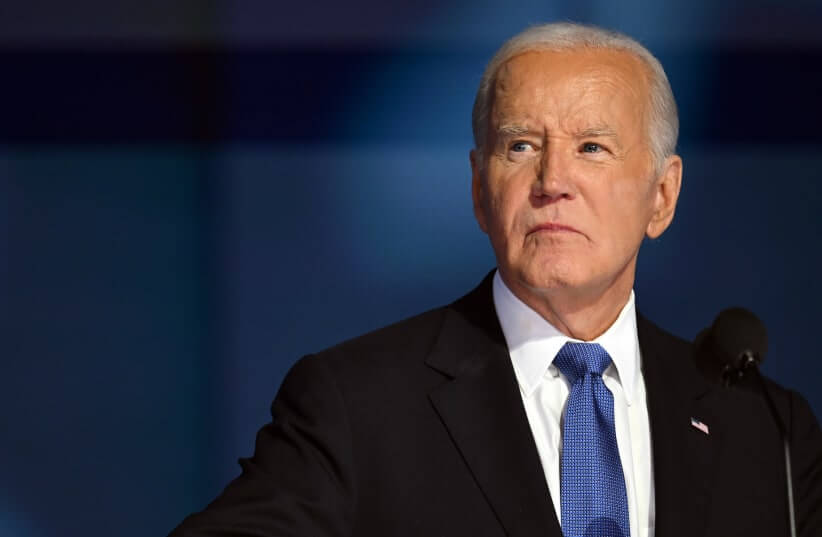
President Joe Biden speaks onstage during the first day of the Democratic National Convention at the United Center on August 19, 2024 in Chicago, Illinois.(photo credit: Brandon Bell/Getty Images)
US President Joe Biden said on Wednesday an all-out war was possible in the Middle East, but there was also the possibility of a settlement in Israel’s conflicts in Gaza and with Hezbollah, Reuters reported on Wednesday.
“An all-out war is possible, but I think there’s also the opportunity – we’re still in play to have a settlement that can fundamentally change the whole region,” Biden said in an appearance on ABC’s “The View.”
Biden acknowledged his long-time divisions with Prime Minister Benjamin Netanyahu, recounting a story from when the prime minister worked at the Israeli embassy in the US.
“He has an 8×10 picture he asked me to sign. I said, ‘Bibi, I love you, but don’t agree with the damn thing you say or do,” Biden said. “I don’t agree with his position. There needs to be a two-state solution.”
“Ultimately, it needs to happen, and there’s a way to do it,” Biden said.
Smoke rises during an exchange of fire between the IDF and terrorists from the Hezbollah organization on the border between Israel and Lebanon, December 27, 2023. (credit: AYAL MARGOLIN/FLASH90)
There’s a possibility of dealing with the West Bank if Israel can come to a ceasefire in Lebanon, he said.
‘Desire for a change in the region’
“We also have Gaza to deal with, but it’s possible,” he added.
Biden said he’s using every bit of energy to “get this done.”
“There’s a desire to see change in the region,” he said.
Hezbollah’s rockets reach Tel Aviv and Eilat as Israel ramps up strikes on Lebanon, preparing for a potential ground invasion amid rising casualties.
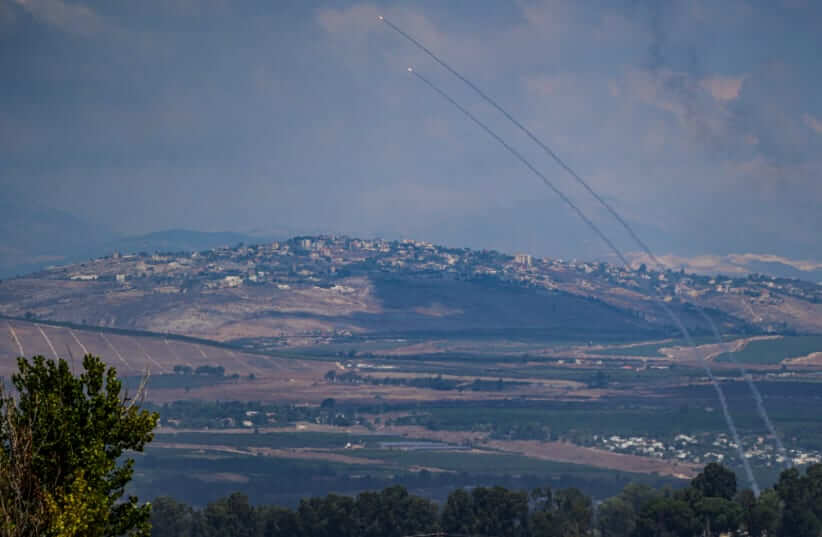
By YONAH JEREMY BOBUpdated: SEPTEMBER 25, 2024 22:54An Israeli anti missile system intercept rockets fired from Lebanon, near the Israeli border with Lebanon, northern Israel, September 4, 2024.(photo credit: AYAL MARGOLIN/FLASH90)
Hezbollah sent more than half of the country scurrying into bomb shelters on Wednesday due to aerial attacks that targeted Tel Aviv, Zichron Ya’acov, and other areas that it had not yet threatened in the current war.
While there were no deaths and few direct hits – in relative terms – from the salvos of around 100 rockets, rocket sirens covered the country as it is not always clear where a rocket might hit, especially the long-range ones.
Only one long-range rocket was fired at Tel Aviv early Wednesday morning, which was shot down by David’s Sling, the IDF’s mid-range aerial defense layer in between the Arrow (long-range defense) and Iron Dome (short-range defense).
About five rockets were fired at the Zichron Ya’acov area. Some were intercepted and some landed in open areas.
Israel’s Iron Dome anti-missile system operates for interceptions as rockets are launched from Lebanon towards Israel, amid cross-border hostilities between Hezbollah and Israel, as seen from Haifa, Israel, September 23, 2024. (credit: REUTERS/Ronen Zvulun)
All fronts are still active
The IDF confirmed on Wednesday evening that two UAVs were detected in the airspace above Eilat. One drone was intercepted by the Israel Navy Sa’ar 5 corvette, while the second drone struck Eilat.
Magen David Adom (MDA) paramedics provided medical treatment to a 68-year-old man with minor injuries from glass shards, while a 28-year-old man sustained minor injuries to his hands. Both were taken to the hospital, were given tetanus shots, and were expected to be released later that night.
Pro-Iranian proxy group, Islamic Resistance in Iraq, said it was responsible for the attack on Eilat on Wednesday evening.
Hezbollah’s increased firing range comes after five days when a third of the country in the North – including Haifa—has been under attack. This comes after around 11 months of attacks affecting “only” the areas very close to the border.
Two people were wounded at Kibbutz Sa’ar near Nahariya after a barrage of 30 rockets shot towards the Western Galilee and east of Haifa.
According to MDA, a 35-year-old man was seriously wounded by shrapnel in his upper body and a 52-year-old man was moderately wounded. Both were taken to the Galilee Medical Center in Nahariya for treatment.
Approximately 40 rockets were fired at Safed, one of which struck an assisted living facility in the area, the IDF announced on Wednesday. No casualties were reported.
Safed has had occasional sirens until now, but this week it was battered far worse than it had been for the last 11 months, making it look more like the front lines of northern border towns, which have been mostly evacuated since October 2023, after Hezbollah initiated aerial attacks in a show of solidarity with Palestinians in Gaza.
Since that early morning rocket and by press time, there have been no additional rockets fired at Tel Aviv, potentially signaling that Hezbollah was demonstrating its capabilities but not yet moving to a full assault.
IDF busy at work
While Hezbollah increased its firing range on Wednesday, the IDF kept up heavy pressure on the Lebanese terror group – though reduced compared to Monday.
IDF spokesperson R.-Adm. Daniel Hagari updated the country on Wednesday night that over 2,000 Hezbollah targets – including hundreds of terrorists – had been struck so far in Lebanon. Included in these are those involved in the strikes on Safed and Nahariya.
Hagari also said that nearly 70 Hezbollah intelligence centers were also struck, including the organization’s intelligence headquarters and a variety of rockets and other terror assets.
More specifically, according to the IDF, the 60 attacks on Hezbollah’s intelligence network will immediately and directly impact the group’s ability to collect intelligence, coordinate intelligence efforts, and hurt its various tools for evaluating the broader battlefield picture.
A map of those areas attacked showed many targets in southern Lebanon – a few deep into the Bekaa Valley, a few in central Lebanon, and one on the west coast.
The simultaneous attack appeared focused on achieving shock and confusion across Lebanon.
Hagari also showed several photos of rocket storage and launch sites located in civilian homes.
In several pictures, the distinct grid pattern of the launchers is clearly visible in the rubble.
“The weapons used in these attacks – including advanced, strategic missiles and UAVs – have been systematically embedded by Hezbollah inside Lebanese civilian areas and homes over the years,” Hagari said.
Attacking Hezbollah’s intelligence network
Given the blow to Hezbollah’s communications from the beeper and walkie-talkie explosions since the middle of last week, as well as the numerous top commanders killed since Friday, bringing down Hezbollah’s intelligence network could leave it substantially blind on the developing battlefield.
This could make it harder for Hezbollah to know which rockets can still be fired and which have been destroyed, and make it more difficult to defend against a future potential IDF ground invasion.
IDF Northern Commander Maj.-Gen. Uri Gordin told his forces on Wednesday that “we need to be very ready to go into action and to invade” Lebanon in the rising escalation against Hezbollah.
Speaking to the 7th Armored Brigade, Gordin emphasized that their actions must change the security reality for Israel’s 60,000 northern residents who have been evacuated from their homes for nearly a year.
Gordon added, “We have entered a new phase in the conflict, and now we are fighting as part of Operation Northern Arrows,” the official name given to the operations in Lebanon. It “began with very harsh strikes against Hezbollah’s capabilities, with an emphasis on its [long-range] firepower, as well as significant harm to its commanders and operatives.”
Likewise, IDF chief of staff Lt.-Gen. Herzi Halevi told the 98th Division and 7th Armored Brigade that the Israeli Air Force (IAF) was clearing the way for a potential ground invasion.
He said that, very soon, “your military boots for the invasion could enter enemy territory, villages which Hezbollah set up as its military position, with its tunnels, lookouts, and vectors [with which] to raid our territory… you would enter with force, and in the encounter with Hezbollah operatives there, they will see what it means to encounter professional and talented fighters.”
Thickening the northern border
The IDF also announced on Wednesday that it was calling up two additional brigades to reinforce the two divisions on the northern border.
While some interpreted this move as another imminent sign of an invasion, two divisions and two brigades are still less than half of the five full divisions the IDF used to invade Gaza.
Earlier on Wednesday, former IDF intelligence chief Amos Yadlin suggested that the military should wear down Hezbollah with air power for two weeks – before beginning a ground forces invasion.
However, other sources told The Jerusalem Post that the key parts of any ground invasion should be wrapped up by around the start of November so as to avoid major maneuvers in Lebanon’s mountainous winter weather.
Yet other sources have said that an invasion grows increasingly likely and could happen faster than expected. However, the plan, as of Wednesday, remains to wait a period of a week or two for a diplomatic solution – now that the IDF has flexed its muscles.
Western powers are still hoping to convince Israel to forego a ground invasion in favor of diplomacy.
Meanwhile, all IDF political and defense officials acknowledged that even in the event of a ground invasion, eventually diplomacy will be needed to solidify any long-term gains from the use of military force.
Lebanese Health officials said that on Wednesday alone, 51 Lebanese people were killed and 223 were wounded, raising the total death toll since last week to over 600.
Sanctioning Ben Gvir and Smotrich is at the top of a list that would get longer if Harris wins, US officials tell ToI; could also include leveraging US security aid to Israel
US President Joe Biden, right, meets with Prime Minister Benjamin Netanyahu, left, in the Oval Office of the White House in Washington, July 25, 2024. (AP Photo/Susan Walsh)
US officials have been deliberating steps that the administration could take during the lame-duck period to curb the effort by Prime Minister Benjamin Netanyahu’s government to expand Israel’s footprint in the West Bank, a current and a former senior US official told The Times of Israel this week.
The nearly three-month period from the November 5 presidential election to the January 20 inauguration will come with additional “political flexibility,” which will allow space for more confrontational policies vis-a-vis the Israeli government, said the current US official.
The list of steps US President Joe Biden could take would be longer if Vice President Kamala Harris wins the election since she is less likely to reverse them, a former senior US official explained. The official added that Harris would also be shielded from any political backlash of such moves due to them being seen as part of her predecessor’s legacy.
The former senior US official acknowledged that certain steps would be less likely taken if former president Donald Trump wins the election because he would be able to roll them back upon returning to office. However, some policies still might be implemented anyway because they would set a precedent that would give other Western countries the legitimacy to follow suit, as was the case with the sanctions that the Biden administration began implementing against extremist settlers in the West Bank.
Sanctioning Ben Gvir and Smotrich
While no formal list has been compiled, one idea raised by a large number of Biden aides has been to sanction far-right Israeli cabinet members National Security Minister Itamar Ben Gvir and Finance Minister Bezalel Smotrich under that same executive order targeting individuals and entities destabilizing the West Bank, said the current and former US officials.
The White House considered making this move already in July, but Biden decided against the idea, arguing that the US should not be sanctioning the ministers of Democratically elected countries, US officials told The Times of Israel at the time.
Religious Zionist party head MK Bezalel Smotrich with Head of the Otzma Yehudit party MK Itamar Ben Gvir at a vote in the assembly hall of the Knesset, the Israeli parliament in Jerusalem, on December 28, 2022. (Olivier Fitoussi/Flash90)
The current US official speaking to The Times of Israel this week speculated that there would be another push to convince the president to take the unprecedented step. They argued that Biden would likely be more open to the idea since his frustration with the Israeli government has peaked over the lack of ceasefire in Gaza.
The White House views Hamas as chiefly responsible but also feels that Netanyahu shares much of the blame for impasses that suited the positions of Ben Gvir and Smotrich, who have threatened to collapse the government if a hostage deal is reached.
“When he entered office, the president wasn’t at a place where he would back sanctions against Israeli extremists, and he ended up moving on that because of the situation on the ground. That same shift can happen on other issues,” said a current US official.
Proponents in the administration of sanctioning the two ministers point to allegations that Ben Gvir has ordered police not to crack down on rampant settler violence, that he has armed settlers throughout the West Bank and that he has upended the status quo on the flashpoint Temple Mount, among other destabilizing moves.
Smotrich, meanwhile, has used his position as minister in charge of settlement affairs in the Defense Ministry to usher a massive influx in both the construction of settlements and illegal outposts across the West Bank. As finance minister, he has withheld hundreds of millions of shekels from the Palestinian Authority, bringing it to the brink of financial collapse, which could create a vacuum the Biden administration fears would be filled by terror groups.
The administration is currently concerned that Smotrich will not sign a waiver granting indemnity to Israeli banks that carry out transactions with Palestinian ones in what risks crumbling of the Palestinian economy.
With their support for annexing large parts of the West Bank and collapsing the PA, Ben Gvir and Smotrich are seen as major obstacles to the two-state solution, which is why a growing number of Biden aides back crossing the threshold from sanctioning Israeli civilians to Israeli officials, the two sources told The Times of Israel.
If that step isn’t taken, a current US official said one should expect an intensification of the sanctions to possibly include organizations such as Amana and Nahala, which are responsible for building settlements and outposts, and have already been included on lists as potential designees during previous rounds this year.
An Israeli, allegedly from the illegal settlement outpost of Meitarim Farms, films Palestinians in their homes in the West Bank village of Khirbet Zanuta August/September 2024 (Courtesy Haqel)
Settlement labeling
However this is only one of the few steps that Biden aides are considering taking during the lame-duck period that are broadly aimed at preserving and advancing prospects for a two-state solution.
Another one is to reverse a lame-duck decision taken by Trump in 2020 requiring goods made in Israeli-controlled areas of the West Bank to be labeled as “Made in Israel.” While the move was aimed at presenting the West Bank settlements as an equal part of Israel, it also applied to Palestinian towns in Area C of the West Bank.
That was a move that some Biden aides thought would’ve been taken much earlier in the president’s term, but fell through the cracks, the former senior US official said, acknowledging that it was less likely to be approved if Trump wins, given the likelihood of its reversal.
The concern in the past about labeling settlement products was that opponents would conflate it with a boycott of Israel, but proponents argue that it can be framed as a step that separates the settlements from the rest of the country.
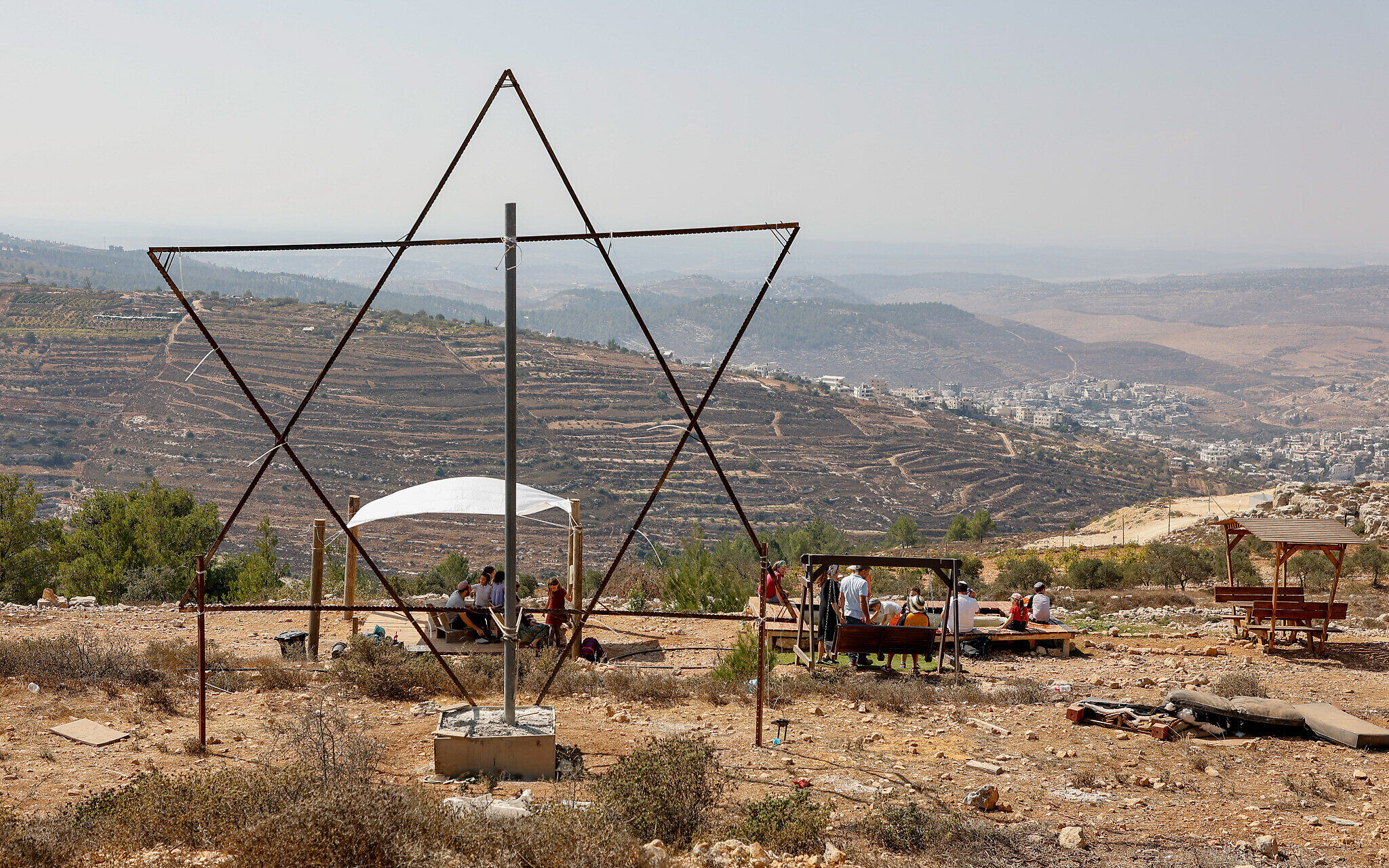
Israelis mark the Sukkot holiday in front of a large Star of David in the West Bank settlement of Sde Boaz, in Gush Etzion, October 11, 2022. (Gershon Elinson/Flash90)
Reopening the consulate
Biden came into office pledging to reopen the US Consulate in Jerusalem, the de facto mission to the Palestinians that Trump shuttered in 2019.
The move required a degree of approval from the Israeli government, which repeatedly rejected the idea. The administration sufficed with establishing an Office of Palestinian Affairs in 2022, which was still part of the US Embassy to Israel but was allowed to send diplomatic cables directly to Washington without being filtered by the US ambassador to Israel.
The lack of follow-through on Biden’s election promise has been a major sticking point for the PA, which some US officials would still like to remedy if Harris wins in November.
The former senior US official said the White House could dangle one last visit from Biden to Israel to participate in the corner-stone laying ceremony for the yet-to-be-built US embassy compound in exchange for Jerusalem lifting its opposition to reopening the consulate.
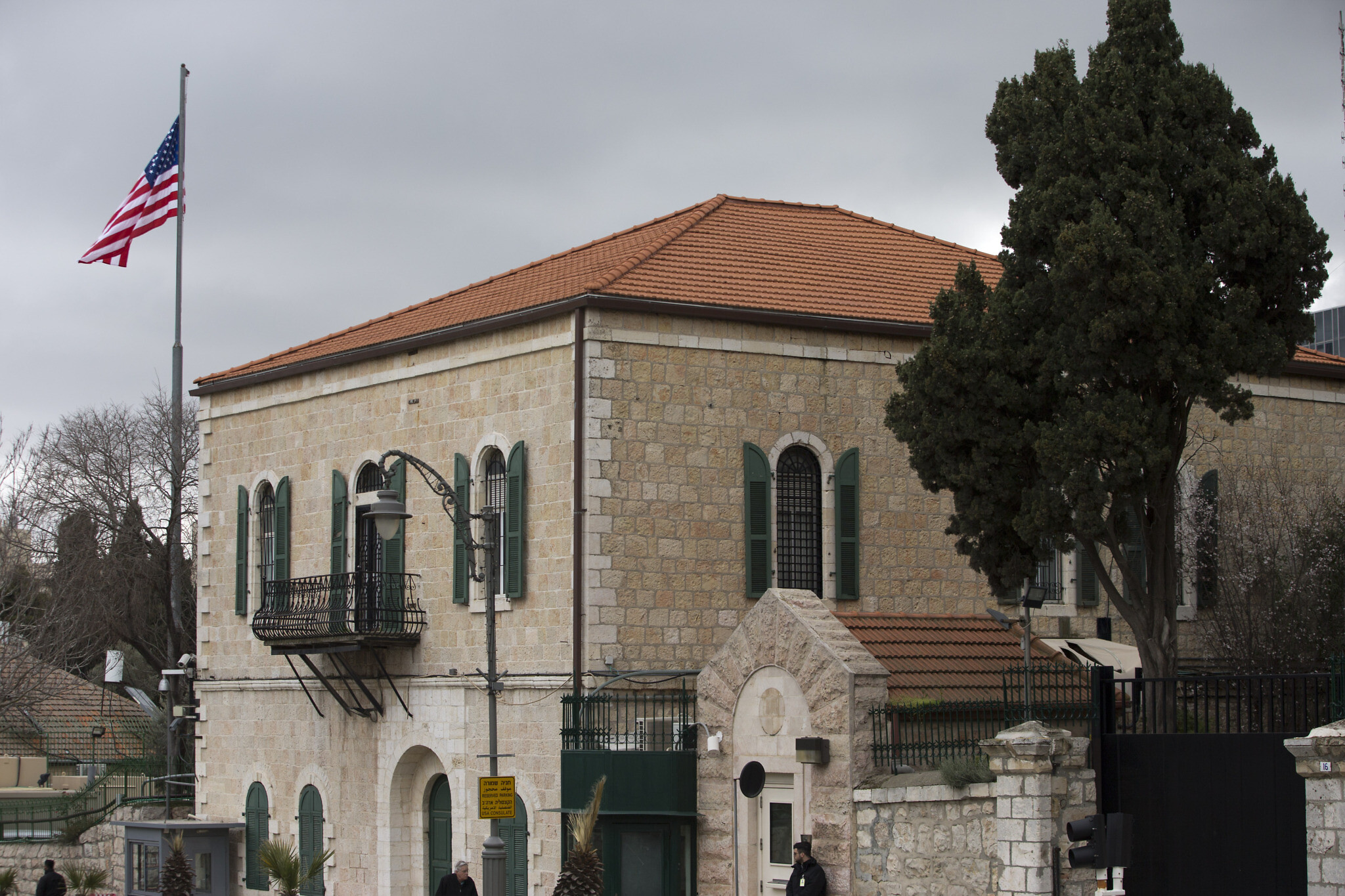
A flag of the United States flies outside the then-US consulate building in Jerusalem, on March 4, 2019. (Ariel Schalit/AP)
Leveraging US aid to Israel
One move that has not received as much public attention, but the former senior US official said could prove effective, would be for the US to threaten to change a clause in the Memorandum of Understanding on US security assistance to Israel that allows Jerusalem to spend up to 25 percent of the aid on weapons made in Israel.
Israel is the only country that isn’t required to spend the entirety of assistance it receives from Washington in the US. The former US official said Netanyahu’s aides pushed for this clause to be included in the MoU before it was signed in 2008 because many of the weapon manufacturing plants in Israel are managed by members of Netanyahu’s Likud Party.
While the MoU has already been signed, it is not legally binding, is subject to changes and has already seen minor violations by Israel, the former senior US official said, arguing that the US should threaten to remove the clause in question in order to pressure Netanyahu to take steps that advance a two-state solution.
A ‘realistic’ two-state solution
While the current and former US officials were skeptical that Biden would unilaterally recognize a Palestinian state or allow a resolution to be passed against Israel at the UN Security Council during the lame-duck period, they did think the president could approve a top member of his administration giving a high-level speech laying out Washington’s view on the need for a two-state solution and what a “realistic” proposal could look like.
It could be fashioned by the address former secretary of state John Kerry gave during the lame-duck period of Obama’s second term in December 2016 — a speech that was not received well by Netanyahu, who was still prime minister then.
The current and former senior US officials offered several other ideas of steps that Biden could approve after the presidential election but didn’t want them publicized due to fear that this could harm their chances of being implemented.