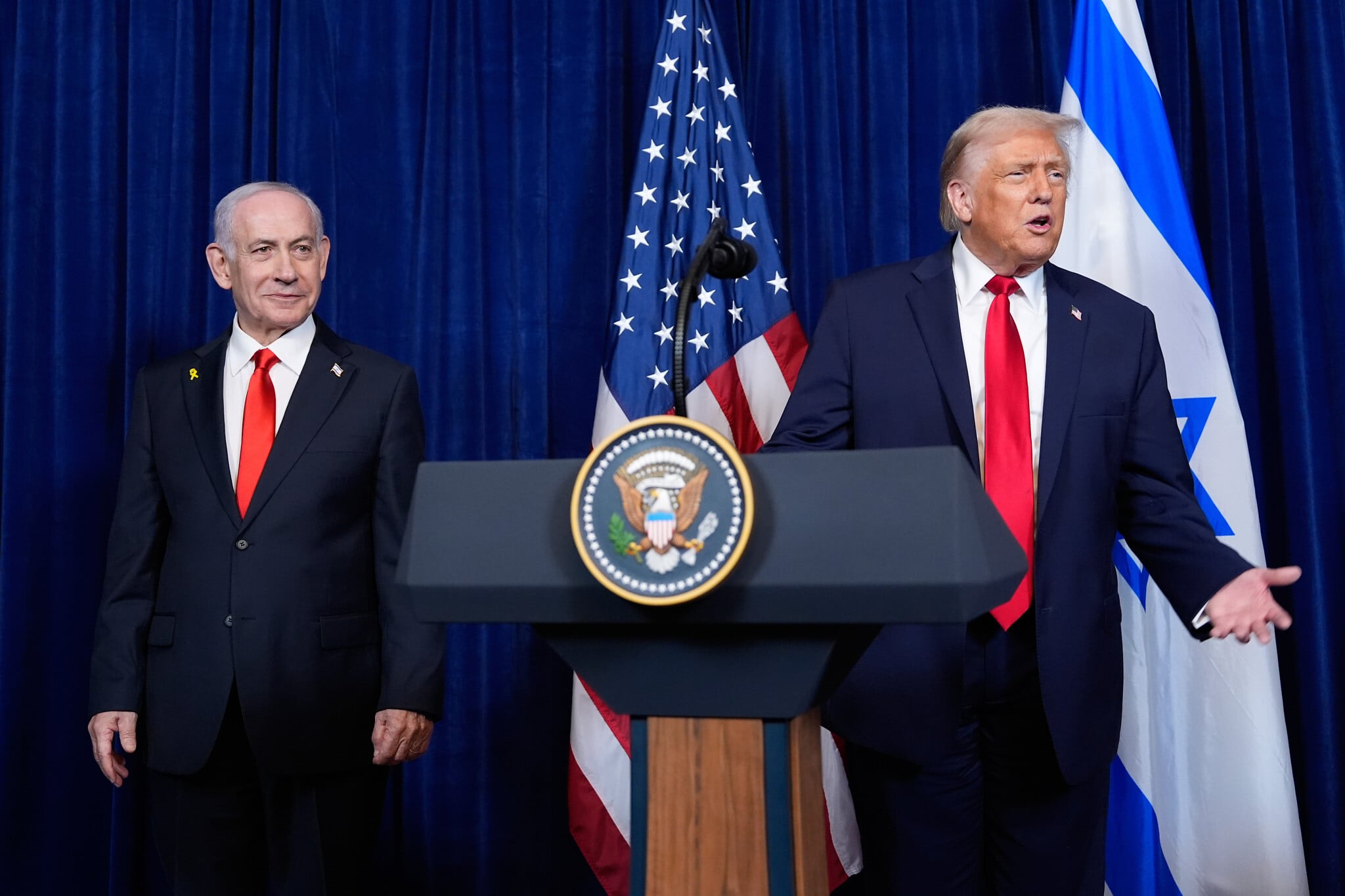
American president stopped short of condemning alliance in recent speech, but tensions over potential Strait of Hormuz operations have officials fearing gap no longer bridgeable

US President Donald Trump pauses as he finishes speaking about the Iran war from the Cross Hall of the White House on Wednesday, April 1, 2026, in Washington. (AP/Alex Brandon)

US President Donald Trump pauses as he finishes speaking about the Iran war from the Cross Hall of the White House on Wednesday, April 1, 2026, in Washington. (AP/Alex Brandon)

WASHINGTON/BRUSSELS/PARIS (Reuters) — The NATO alliance has in recent years survived existential challenges – ranging from the war in Ukraine to multiple bouts of pressure and insults from US President Donald Trump, who has questioned its core mission and threatened to seize Greenland.

But it is the US-Israeli war with Iran, thousands of miles from Europe, that has nearly broken the 76-year-old bloc and threatens to leave it in its weakest state since its creation, say analysts and diplomats.

Trump, enraged that European countries have declined to send their navies to open up the Strait of Hormuz to global shipping following the start of the air war on February 28, has declared he is considering withdrawing from the alliance.

“Wouldn’t you if you were me?” Trump asked Reuters in a Wednesday interview.

In a speech on Wednesday night, Trump criticized US allies but stopped short of condemning NATO, as many experts thought he might.

But combined with other barbs aimed at Europeans in recent weeks, Trump’s comments have provoked unprecedented concern that the US will not come to the aid of European allies should they be attacked, whether or not Washington formally walks away.

An Italian soldier poses for a photo in Rovajaervi Training Area during the NATO Arctic exercises Cold Response 26 in Rovaniemi, Finland, on March 17, 2026. (AP/Aino Vaananen)

The result, say analysts and diplomats, is that the alliance created in the Cold War, which has long served as the basic fabric of European security, is fraying and the mutual defense agreement at its core is no longer taken as a given.

“This is the worst place (NATO) has been in since it was founded,” said Max Bergmann, a former State Department official who now leads the Europe, Russia, and Eurasia Program at the Center for Strategic and International Studies in Washington.

“It’s really hard to think of anything that even comes close.”

That reality is sinking in for Europeans, who have counted on NATO as a bulwark against an increasingly assertive Russia.

As recently as February, NATO Secretary-General Mark Rutte had dismissed the idea of Europe defending itself without the US as a “silly thought.” Now, many officials and diplomats consider it the default expectation.

NATO Secretary General Mark Rutte (r), and United States Undersecretary of Defense for Policy Elbridge Colby address the media at NATO headquarters in Brussels, on February 12, 2026. (AP/Geert Vanden Wijngaert)

“NATO remains necessary, but we must be capable of thinking of NATO without the Americans,” said General Francois Lecointre, who served as France’s armed forces chief from 2017 to 2021.

“Whether it should even continue to be called NATO – North Atlantic Treaty Organization – is a valid question.”

White House spokeswoman Anna Kelly said: “President Trump has made his disappointment with NATO and other allies clear, and as the President emphasized, ‘the United States will remember.’”

A NATO representative did not immediately respond to a request for comment.

This time it’s different

NATO has been challenged before, not least during Trump’s first term from 2017 to 2021, when he also considered withdrawing from the alliance.

But while many European officials until recently believed that Trump could be kept on board with pomp and flattery, fewer now hold that belief, according to conversations with dozens of former and current US and European officials.

Germany’s Defense Minister Boris Pistorius, right, speaks with French Defense Minister Catherine Vautrin during a meeting of the North Atlantic Council in Defense Ministers Session at NATO headquarters in Brussels, on February 12, 2026. (AP Photo/Geert Vanden Wijngaert)

Trump and his officials have expressed frustration over what they see as NATO’s unwillingness to help the United States in a time of need, including by not directly assisting with the Strait of Hormuz and by restricting US use of some airfields and airspace. US officials have declared that NATO cannot be a “one-way street.”

European officials counter that they have not received US requests for specific assets for a mission to open the strait and complain that Washington has been inconsistent about whether such a mission would operate during or after the war.

“It’s a terrible situation for NATO to be in,” said Jamie Shea, a former senior NATO official who is now a senior fellow at the Friends of Europe think tank.

“It is a blow to the allies who, since Trump returned to the White House, have worked hard to show that they are willing and able to take more responsibility (for their own defense).”

Soldiers land on the beach during an amphibious landing operation conducted by the Allied Reaction Force during NATO-led military exercises on Wessek Beach in Putlos, Germany, on February 18, 2026. (AP/Virginia Mayo)

Trump’s latest comments follow other signs of an increasingly unsteady alliance.

Those include his stepped-up threats in January to wrest Greenland away from Denmark and recent moves by the US that Europeans see as particularly accommodating toward Russia, which NATO defines as its principal security threat.

The administration has remained essentially mum amid reports that Moscow has provided targeting data for Iran to attack US assets in the Middle East and has lifted sanctions on Russian oil in a bid to ease global energy prices that have spiked during the war.

At a meeting of G7 foreign ministers near Paris last week, US Secretary of State Marco Rubio and Kaja Kallas, the foreign policy chief of the European Union, had a tense exchange, according to five people familiar with the matter, underlining the increasingly fraught transatlantic relationship.

Kallas asked when US patience with Russian President Vladimir Putin would run out over Ukraine peace negotiations, prompting Rubio to respond with irritation that the US was trying to end the war while also providing support to Ukraine, but the EU was welcome to mediate if it wanted to.

From bottom centre to left: EU High Representative and Vice-President for Foreign Affairs and Security Policy Kaja Kallas, Germany’s Foreign Minister Johann Wadephul, South Korea’s Foreign Minister Cho Hyun, Britain’s Foreign Secretary Yvette Cooper, India’s Foreign Minister Subrahmanyam Jaishankar, U.S. Secretary of State Marco Rubio, France’s Foreign Affairs Minister Jean-Noel Barrot, Canada’s Foreign Minister Anita Anand, Saudi Arabia’s Foreign Minister Faisal bin Farhan, Italy’s Foreign Minister Antonio Tajani, Brazil’s Foreign Minister Mauro Vieira and Japan’s Foreign Minister Toshimitsu Motegi attend talks during a G7 Foreign Ministers’ meeting with Partner Countries in Cernay-la-Ville outside Paris, Friday, March 27, 2026. (Stephanie Lecocq/Pool Photo via AP)

Legally, Trump may lack the authority to withdraw from NATO. Under a law passed in 2023, a US president cannot exit the alliance without the consent of two-thirds of the US Senate, a nearly impossible threshold.

But analysts say that, as commander-in-chief, Trump can decide whether the US military will defend NATO members. Declining to do so could imperil the alliance without a formal withdrawal.

To be sure, not everyone sees the current crisis as existential. One French diplomat described the president’s rhetoric as a passing temper tantrum.

Trump has changed his position on NATO before.

In 2024, he said on the campaign trail that he would encourage Putin to attack NATO members that do not pay their fair share on defense. By the last annual NATO summit, in June 2025, the alliance was in his good graces, with Trump delivering a speech effusively praising European leaders as people who “love their countries.”

Next week, Rutte, the NATO secretary-general, who has a strong relationship with Trump, is set to visit Washington in an effort to change Trump’s view once again.

US President Donald Trump, right, meets with NATO Secretary General Mark Rutte during a meeting on the sidelines of the Annual Meeting of the World Economic Forum in Davos, Switzerland, January 21, 2026. (AP/Evan Vucci)

Analysts say European nations have good reason to keep the US engaged in NATO despite doubts over whether Trump would come to their defense. Among other reasons, the US military provides a range of capabilities NATO can’t easily replace, such as satellite intelligence.

Even if Trump and the Europeans find a way to stay together in NATO, diplomats, analysts and officials say, the transatlantic alliance that has been central to the global order since World War Two may never be the same.

“I do think we’re turning the page of 80 years of working together,” said Julianne Smith, the US ambassador to NATO under Democratic president Joe Biden.

“I don’t think it means the end of the transatlantic relationship, but we’re on the cusp of something that’s going to have a different look and feel to it.”


Wall Street Journal says Abu Dhabi wants US to occupy islands held by Iran in waterway, is also pushing UN Security Council resolution to green-light use of force

Fishing boats dot the sea as cargo ships, in the background, sail through the Arabian Gulf toward the Strait of Hormuz off the United Arab Emirates, Friday, March 27, 2026. (AP Photo)

Fishing boats dot the sea as cargo ships, in the background, sail through the Arabian Gulf toward the Strait of Hormuz off the United Arab Emirates, Friday, March 27, 2026. (AP Photo)

The United Arab Emirates is pushing for the US to forcefully reopen the Strait of Hormuz and is willing to assist in such a military operation, The Wall Street Journal reported Tuesday night.

The report said the Gulf state is also seeking a UN Security Council Resolution that would green-light such an operation, as it faces continued Iranian attacks.

An Emirati official told the Journal that the country’s diplomats have urged the US, along with unspecified European and Asian military powers, to establish a coalition to forcefully open Hormuz, and the UAE is looking into what military contributions it can make to help break Iran’s grip on the strait.

The UAE has also suggested the US should occupy Iranian-held islands in the Hormuz, including Abu Musa, which is claimed by Abu Dhabi, Arab officials said.

The UAE’s foreign ministry did not deny the report, saying that there was a “broad global consensus that freedom of navigation in the Strait of Hormuz must be preserved.”

While privately grumbling that they were not given adequate advance notice of the US-Israeli attack in February and complaining the US had ignored their warnings that the war would have devastating consequences for the entire region, some regional allies are making the case to the White House that the moment offers a historic opportunity to cripple Tehran’s clerical rule once and for all.

A man walks away after watching as a black plume of smoke rises from a warehouse in the industrial area of Sharjah City, United Arab Emirates, after an Iranian strike, March 1, 2026. (AP Photo/Altaf Qadri)

Officials from Saudi Arabia, the United Arab Emirates, Kuwait and Bahrain have conveyed in private conversations that they do not want the military operation to end until there are significant changes in the Iranian leadership or there’s a dramatic shift in Iranian behavior, according to the officials, who spoke to AP on Tuesday on condition of anonymity.

Attacks were reported in several Gulf countries early on Wednesday, with drones hitting fuel tanks at Kuwait’s international airport, causing a big blaze, and authorities in Bahrain reporting a fire at an undisclosed company facility from an Iranian attack.

A tanker was hit by an unknown projectile near the Qatari capital Doha, causing damage to the hull at the waterline, the United Kingdom Maritime Trade Operations said, adding the crew was safe.

US President Donald Trump and his Secretary of State Marco Rubio said Tuesday that the end of the war with Iran could be near, with Washington signaling potential for both direct talks with Tehran’s leadership and a winding down of the conflict even without a deal.

At the same time, the US has sent Marines to the region in anticipation of possible ground-based operations, including in Hormuz.

While the United States has said talks with Iran were ongoing, Iranian Foreign Minister Abbas Araghchi said on Tuesday that he has been receiving direct messages from US special envoy Steve Witkoff, but those do not constitute “negotiations,” Qatar’s Al Jazeera TV cited him as saying.

AP contributed to this report.


Published Tue, Mar 31 20267:37 AM EDT
  • President Donald Trump singled out the U.K. and France for criticism over their stance on the Iran war.
  • The president has expressed his disdain for European allies that have refused to take part in the U.S. and Israel’s military operation.
  • Defense Secretary Pete Hegseth later piled on, saying other countries “might want to start learning how to fight for yourself.”
  • Europe tends to view the Iran war as one of choice and is wary of getting involved.
US President Donald Trump speaks during the Future Investment Initiative (FII) Summit in Miami Beach, Florida, on March 27, 2026. (Photo by Mandel NGAN / AFP via Getty Images)
U.S. President Donald Trump speaks during the Future Investment Initiative (FII) Summit in Miami Beach, Florida, on March 27, 2026.
Mandel Ngan | AFP | Getty Images

President Donald Trump on Tuesday warned the U.K. and France that the U.S. “won’t be there to help you anymore,” as he vented his frustration over the close allies’ refusal to join military action against Iran.

Posting on Truth Social, Trump said, “the Country of France wouldn’t let planes headed to Israel, loaded up with military supplies, fly over French territory.”

“France has been VERY UNHELPFUL with respect to the ‘Butcher of Iran,’ who has been successfully eliminated! The U.S.A. will REMEMBER!!!,” he said in one post.

In another post, the president singled out the U.K. for criticism while urging other countries to take action in the Strait of Hormuz, the vital oil route that Iran has effectively blocked during the war.

“All of those countries that can’t get jet fuel because of the Strait of Hormuz, like the United Kingdom, which refused to get involved in the decapitation of Iran, I have a suggestion for you,” Trump wrote.

“Number 1, buy from the U.S., we have plenty, and Number 2, build up some delayed courage, go to the Strait, and just TAKE IT.”

“You’ll have to start learning how to fight for yourself, the U.S.A. won’t be there to help you anymore, just like you weren’t there for us. Iran has been, essentially, decimated. The hard part is done. Go get your own oil!,” he wrote.

Defense Secretary Pete Hegseth piled on at a press briefing later Tuesday morning.

“There are countries around the world who ought be prepared to step up on this critical waterway as well,” he said. “It’s not just the United States Navy. Last time I checked, there was supposed to be a big, bad Royal Navy that could be prepared to do things like that as well.”

When asked if reopening the strait is a core objective for the U.S. to end the war, Hegseth said defeating Iran’s navy remains a key goal, but clearing the waterway is not just the U.S.′ “problem set.”

“I think other countries should pay attention” to Trump’s words, Hegseth said, referring to the Truth Social posts. “He’s pointing out, you know, might want to start learning how to fight for yourself.”

Hegseth also downplayed Trump’s repeated insistence that the U.S. is ahead of schedule in achieving its objectives in Iran within a four-to-six-week time frame.

Trump “said four to six weeks, six to eight weeks, three — It could be any, any particular number, but we would never reveal precisely what it is, because our goal is to finish those objectives, and we’re well on our way,” the secretary said.

The Trump administration initially predicted the war would last “days.”

Trump has previously shared his disdain for European allies that have refused to take part in the U.S. and Israel’s military operation against Iran, particularly after they expressed their misgivings at getting involved in what would be highly dangerous efforts to reopen the Strait of Hormuz for international shipping.

Satellite image shows smoke rising from UAE's Fujairah port, amid the U.S.-Israeli conflict with Iran, in Fujairah, United Arab Emirates, March 15, 2026. Nasa Worldview/Handout via REUTERS    THIS IMAGE HAS BEEN SUPPLIED BY A THIRD PARTY. MANDATORY CREDIT.
Satellite image shows smoke rising from UAE’s Fujairah port, amid the U.S.-Israeli conflict with Iran, in Fujairah, United Arab Emirates, March 15, 2026.
Nasa Worldview | Via Reuters

The maritime passage has been almost completely shut by Iran since the war began in late February, effectively halting the shipping of Gulf oil and gas through the strait. A number of tankers attempting to navigate the strait have been attacked.

Trump lambasted NATO over its reluctance to help the U.S. against Iran, telling reporters last week that the military alliance was “making a very foolish mistake.”

“I’ve long said that, you know, I wonder whether or not NATO would ever be there for us. So … this was a great test, because we don’t need them, but they should have been there,” Trump told reporters in the Oval Office.

Having to go it alone with Israel for now, Trump has vacillated between conciliatory and escalatory positions on the war, teasing a potential peace deal with Tehran while threatening the Islamic Republic with more intense attacks.

On Monday, Trump threatened to expand attacks to Iran’s civilian energy infrastructure, including water desalination plants, if Tehran failed to reopen the Strait of Hormuz. For its part, Tehran continues to demonstrate its ability to dominate and derail maritime traffic in the strait, hitting a fully laden Kuwaiti oil tanker in the anchorage area of the port in Dubai, United Arab Emirates, earlier Tuesday.

Correction: This story has been updated to correct a quote from Defense Secretary Pete Hegseth.

Choose CNBC as your preferr