In total, 18 suspects were arrested during the flag march for violent offenses, assaults, threats, and disorderly conducts.

 Itamar Ben-Gvir seen during Jerusalem Day celebrations outside the Jerusalem Great Synagogue, June 5, 2024 (photo credit: YONATAN SINDEL/FLASH90)
Itamar Ben-Gvir seen during Jerusalem Day celebrations outside the Jerusalem Great Synagogue, June 5, 2024
(photo credit: YONATAN SINDEL/FLASH90)
National Security Minister Itamar Ben-Gvir affirmed total Israeli sovereignty in Jerusalem during a speech at the flag mark during Jerusalem Day on Wednesday.

“We are sending a message to Hamas,” Ben-Gvir said. “Jerusalem is ours. Damascus Gate is ours. The Temple Mount is ours.”


“We call on the Prime Minister to be strong. We won’t surrender, we won’t give up, and we won’t stop,” he declared on a stage in front of thousands of participants in the march.
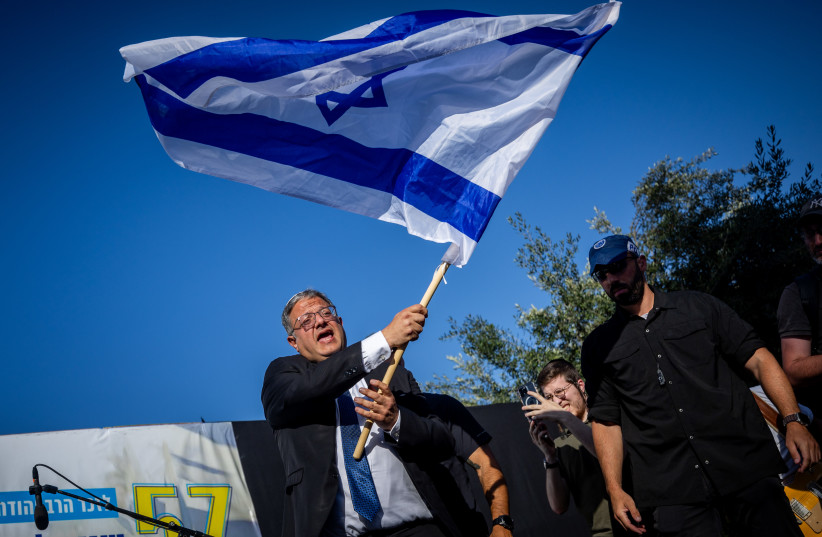
 Itamar Ben-Gvir seen during Jerusalem Day celebrations outside the Jerusalem Great Synagogue, June 5, 2024 (credit: YONATAN SINDEL/FLASH90)Enlrage image
Itamar Ben-Gvir seen during Jerusalem Day celebrations outside the Jerusalem Great Synagogue, June 5, 2024 (credit: YONATAN SINDEL/FLASH90)

In response to these statements, the Prime Minister’s Office responded, saying:

“The status quo at the Temple Mount has not changed and will not change.”

Hamas also published a response to Ben-Gvir’s statements from its head of the Political Bureau, Ismail Haniyeh, saying: “The rampage of settlers in Jerusalem confirms that Jerusalem is the focus of the conflict, and our people will not rest until the occupation ends and an independent Palestinian state is established with Jerusalem as its capital.”

Throughout the duration of the flag march, there were multiple incidents of violence and arrests.

“Throughout the day thus far, 18 suspects have been arrested on suspicion of violent offenses, assault, threats, and disorderly conduct,” the Jerusalem Police announced in a statment. “Earlier, some of the blocked roads were reopened, and the police continue to operate to maintain security and order.

Earlier, Jerusalem District police officers located and arrested five suspects, aged 16, who participated in the parade and threw objects toward journalists near the area of Damascus Gate – Sha’ar Shechem. The arrested suspects were transferred for interrogation at a Jerusalem District station. We strongly condemn any attempt to harm journalists and any other individuals.

Earlier Wednesday morning and in the afternoon, the police arrested 13 suspects of various ages involved in various violent incidents in the Old City, including possession of a knife and threats against police officers. These suspects were transferred for interrogation by the police.

Police activity continues at this hour throughout the city by thousands of officers, and thus far, the various events have proceeded as planned, with isolated incidents being addressed promptly and appropriately.”

Reporters were subject to violence

Police removed Yediot Aharonot police correspondent from Damascus Gate by force while he was covering the event.


In a post on X, he said, “Today, the journalists were the focus of the police and the marchers. During the flag march, the police decided that it was inappropriate for newspapers to cover from the steps of the Damascus Gate and began pushing us towards a nearby garden. During the fight, as you can see, the policeman started pinching me in the stomach. They thought they wouldn’t see, but here is the picture in front of you.”


Earlier Wednesday, Kan News reported that Haaretz journalist Nir Hasson and several cameramen were attacked in Jerusalem’s Old City while covering the flag march for Jerusalem Day.

According to the report, Hasson and the cameramen were attacked by a group of around 30 youths, who kicked them and knocked them to the ground.

Hasson was attacked while covering violent events in the area.

Hezbollah is using attacks to test Israel’s capabilities

“Hezbollah’s precision strikes on Hurfeish reveal a deadly evolution in their tactics. What does this mean for Israel’s defenses?

SETH J. FRANTZMAN

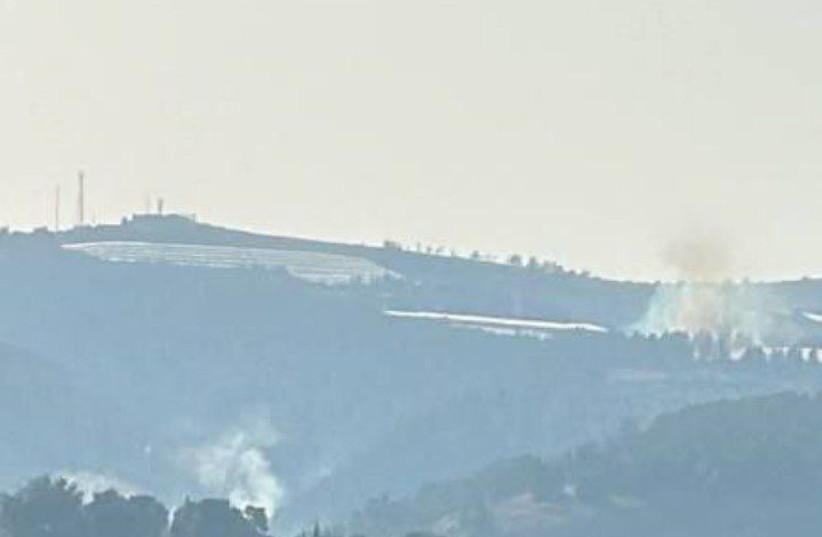
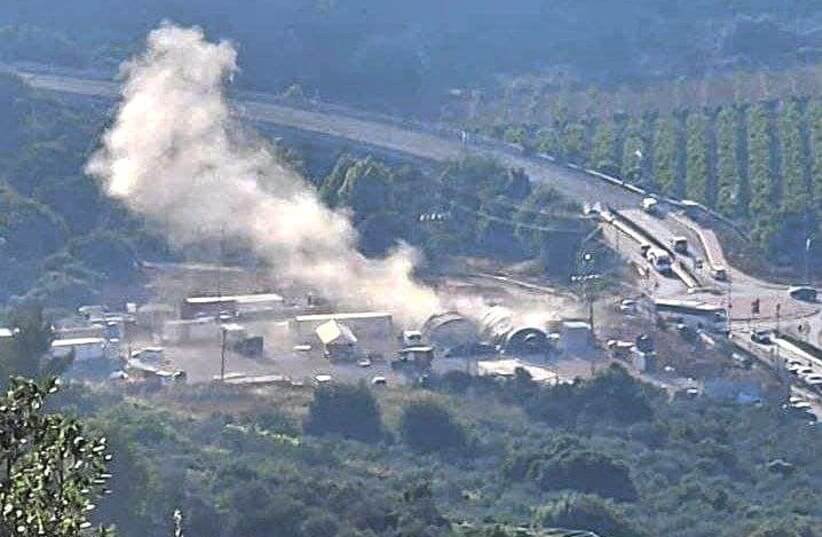
 An image taken from Hezbollah's Telegram channel purporting to show the Lebanon-based terror organization's attack on Hurfeish. June 5, 2024. (photo credit: Hezbollah Telegram)

The attack on Hurfeish on Wednesday is a dangerous escalation. The wounding of numerous people illustrates how Israel’s enemies seek to improve their weapons and also test different types of methods of attack.

In order to understand how this has unfolded, we need to understand what the adversary has up its sleeve. Hezbollah’s recent escalation against Israel is part of a campaign of almost eight months in which it has used rockets, missiles, and drones to attack Israel. By April, six months into the war in Gaza and after six months of Hezbollah attacks, the total number of projectiles launched by Hezbollah had reached 3,000. Today, the number has likely reached up to 4,000.

However, Hezbollah’s goal these days is not just to launch rockets. Rockets are a statistical weapon, like artillery, meaning that you launch a bunch of them and you hope that some of them hit the target. Hezbollah’s arsenal of rockets may be 150,000 projectiles but a lot of these weapons are simple older “dumb” rockets. These types of weapon systems don’t win wars. In fact, rockets are primarily good for harassing fire or attacking civilians.

Hezbollah’s arsenal getting deadlier

Hezbollah has improved its arsenal in recent years. It acquired precision-guided munitions and it has a large number of anti-tank missiles, as well as drones. It’s important to understand that when Hezbollah carries out its attacks these days it is using a number of precision weapons.

The precision weapons allow Hezbollah to strike exactly what it wants to strike. It also can follow up certain types of attacks by using a mix of weapons. For instance, it could use dumb rockets to set off sirens in one place and then use precision drones to strike a certain area where it has monitored people seeking shelter. Hezbollah published videos of these types of incidents so it is no longer hiding what it is up to.

 An image taken from Hezbollah's Telegram channel purporting to show the Lebanon-based terror organization's attack on Hurfeish. June 5, 2024. (credit: Hezbollah Telegram)

An image taken from Hezbollah’s Telegram channel purporting to show the Lebanon-based terror organization’s attack on Hurfeish. June 5, 2024. (credit: Hezbollah Telegram)

Hezbollah also uses language in its statements distributed to pro-Iranian media such as Al-Mayadeen to explain how it uses certain types of weapons. The type of language in Hezbollah statements indicates the terrorist group is carefully choosing the mix of weapons it uses. This is a deadly cocktail.

IT ILLUSTRATES that Hezbollah is trying to test Israel’s response and Israel’s defenses. For instance, Hezbollah has frequently targeted Iron Dome sites, according to Hezbollah’s own claims. It has also launched drones increasingly out to sea in the Mediterranean and then had the drones turn back for the coastline, heading toward Acre or Nahariya. Hezbollah has said it is trying to target a site of Israel’s Rafael Advanced Defense Systems, the maker of Iron Dome. The site is on the coast of Israel and this is linked to Hezbollah’s launching of drones out to sea.

Furthermore, Hezbollah often targets what it says is an Iron Dome site in the Hula Valley. It has also targeted an Israeli surveillance balloon near Golani junction, far from the Lebanon border. It has also targeted Israeli communication towers and the air traffic control base on Mount Hermon.

Hezbollah also says it has targeted Israel’s Northern Command base in Safed and the Gibor Base of the 769 brigade in Safed, as well as the headquarters of the 91st division and the Biranit camp near the Lebanese border. In each case, Hezbollah resorts to weapons it thinks will have the most impact. Sometimes it has resorted to Burkan heavy rockets, which are not precise but cause a lot of damage. In other cases, such as targeting IDF soldiers in Arab Al-Aramshe last month, Hezbollah used several projectiles, including drones.

Hezbollah claimed it targeted an area near Al-Kosh on June 5 using a “swarm” of drones. It says it targeted IDF soldiers near the Druze village Hurfeish. “The Israeli media reported that Hezbollah targeted a gathering of soldiers in Hurfeish, and that when the Army’s rescue and ambulance forces arrived, the place was targeted for the second time, confirming that the bombing of the base was carried out using missiles and drones,” Al-Mayadeen said. This is how Hezbollah launders claims through Israeli media and then back to pro-Iran media in Lebanon.

Sirens did not sound in Hurfeish prior to the attack. Al-Mayadeen ascribes this to “Hezbollah’s success in targeting the army’s radar system and the Iron Dome batteries.” Hezbollah is also openly expanding its attacks, threatening areas beyond the border. Hezbollah knows that the communities on the border have been evacuated since October. It is now escalating against Hurfeish, Nahariya, and Acre, as well as Katzrin in the Golan. This is calculated and not random.

Hezbollah is now trying to figure out what weapons mix may be used against Israel’s defenses. The goal for Hezbollah is for it to do what the Houthis did between 2015 and 2020 fighting Saudi Arabia. The Houthis were a test-bed for Iran and Iranian weapons such as ballistic missiles, cruise missiles and also drones. Hezbollah is now the test bed and this is part of a larger Iranian strategy in the region to test weapons against Israel. Hezbollah is testing them and the tests are becoming increasingly dangerous and deadly.


by Debbie Weiss

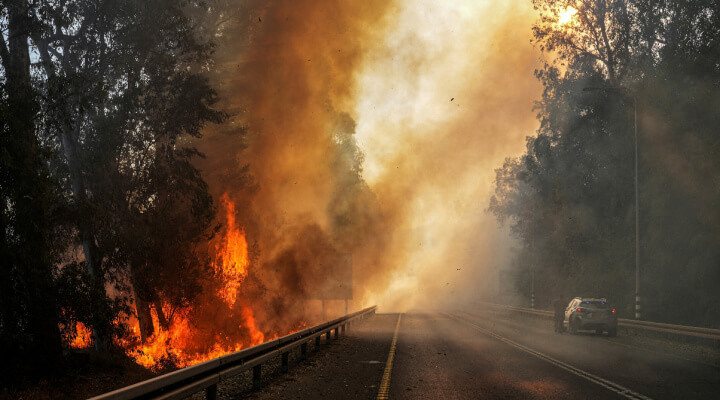
Flames seen at the side of a road, amid ongoing cross-border hostilities between Hezbollah and Israeli forces, close to the Israel border with Lebanon, in northern Israel, June 4, 2024. Photo: REUTERS/Ayal Margolin

An explosives-laden drone launched by Hezbollah from Lebanon injured 11 people in a northern Israeli town on Wednesday, further raising the specter of a new front opening amid rapidly escalating tensions between Israel and the Iran-backed terror group.

Hezbollah, which wields significant political and military influence across Lebanon, took responsibility for launching “several projectiles” at Israel, it said, including two that hit a soccer field in the Druze town of Hurfeish, where sirens were not activated. At least one person was critically wounded and a further 10 evacuated to a hospital. The Israel Defense Forces (IDF) said it was investigating why the incoming projectile alert sirens did not sound.

Early reports from military sources indicate the drone attacks occurred in quick succession, with the second appearing to intentionally target emergency responders rushing to aid victims of the initial blast, a tactic repeatedly used by Hezbollah terrorists during the current conflict.

The attack came hours after Prime Minister Benjamin Netanyahu warned that Israel was prepared with an “intensely powerful” response to Hezbollah.

“Whoever thinks that he will attack us and that we will stand idly by is gravely mistaken,” Netanyahu said. He made his remarks during a tour of Israel’s charred north 48 hours after projectiles from Hezbollah had sparked several massive fires in the area, burning entire villages.  More than 4,500 missiles and drones have been fired from Lebanon since the beginning of the Israel-Hamas war to the Jewish state’s south in Gaza.

Israeli President Isaac Herzog offered prayers for the full recovery of the victims of the Hurfeish attack.

“The world needs to wake up and understand that Israel has no alternative but to safeguard its citizens, and should not be shocked when Israel responds aggressively,” Herzog said.

Israel has stepped up its own attacks against Hezbollah, targeting “significant assets” as well as senior commanders of the group, the IDF said.

According to diplomatic sources, the US and France have been engaging in shuttle diplomacy between Israel and Lebanon for several months now, in an effort to develop a potential negotiated resolution to the conflict.

The key goal is to facilitate the withdrawal of Hezbollah’s presence to over 6 miles north of the Israeli border, beyond the Litani River and to allow either the Lebanese military or an international peacekeeping force to move into the vacated area along the border. As part of the proposed framework, Israel and Lebanon would also work to resolve longstanding border demarcation disputes between the two nations, The Wall Street Journal reported.

But Sarit Zehavi — a resident of northern Israel and the founder and director of Alma, a research center that focuses on security challenges relating to Israel’s northern border — told The Algemeiner that anything short of destroying Hezbollah would result in a “massacre” of a scale larger than Hamas’ Oct. 7 massacre across southern Israel.

“Everyone understands the cost of war here, but at the same time everybody understands that if it will end up with a ceasefire that would take us back to Oct. 6, this will mean another massacre of Israelis by Hezbollah since Hamas actually replicated the Hezbollah plan to occupy the Galilee,” Zehavi said.

The overwhelming sentiment, she said, is that authorities are failing to take adequate measures, both offensively and defensively.

Zehavi pointed to the lack of bomb shelters in the area and the threat of anti-tank missiles that has become a daily reality over the past eight months, with Hezbollah launching strikes that cannot be intercepted by the Iron Dome air defense system and that often arrive without rocket siren warnings.

Compounding concerns, she said, is an alarming surge in attack drone activity from Hezbollah, especially over the last two months, with numbers sharply increasing month-over-month.

“Hezbollah is deliberately escalating the situation to try to drag Israel into war,” Zehavi told The Algemeiner. “I believe this was Hezbollah’s aim from the beginning. It’s not deterred; it’s not interested in a ceasefire. If there will be a ceasefire in Gaza, Hezbollah will follow, but only in order to recover and to execute a massacre at its most convenient timing.”

More than 80,000 Israelis evacuated Israel’s north in October and have since been unable to return to their homes. The majority of those spent the past eight months residing in hotels in safer areas of the country.

One of them, Avi Vanunu, said that unless Israel embarked on a full-scale invasion of Lebanon soon, returning home to his border town of Kiryat Shmona wouldn’t be possible “even in ten years’ time.”

“I don’t even know if my house is still standing or if it was hit by a rocket,” he  told The Algemeiner. “Tonight’s attack [on Hurfeish] just proves: It’s us or them.”

The only comfort he took, Vanunu said, was in the fact that Hurfeish was a Druze village, with many residents who had served as Border Police officers and in the IDF in senior positions.

“This won’t pass easily,” he said. “Just look at how they reacted after that Druze boy was kidnapped.”

Vanunu was referring to a Nov. 2022 incident in which the body of a Druze Israeli teen was stolen by terrorists from a hospital in the Palestinian city of Jenin, prompting widespread anger and several revenge attacks from members of the Druze community, including kidnapping Palestinian laborers in Israel and throwing explosive devices in West Bank towns.

Maj. Shadi Khalloul (res), an expert on Hezbollah and Lebanon, called the efforts to push Hezbollah away to past the Litani River “a joke.”

“It’s deceiving Israeli citizens again. It’s dangerous. We should fully destroy [Hezbollah],” Khalloul, who also serves as the president of the Aramaic Christian Galilee Center, told The Algemeiner, warning that If Israel failed to do so, the terror group would be prepared to “destroy Israel together with a nuclear Iran.”