US President Joe Biden’s speech Friday, laying out many of the details of Israel’s own proposal for a hostage-ceasefire deal with Hamas, has created an immensely fateful moment for Israel, and a defining choice for Prime Minister Benjamin Netanyahu.
Urging Hamas to take the offer, Biden attempted to call the terror group’s bluff: “Hamas says it wants a ceasefire. This deal is an opportunity to prove whether they really mean it. Hamas needs to take the deal… [and end] this war that they began.”
But it’s not so simple, of course. Hamas will only take the deal if it thinks it can survive and rebuild and resume its efforts to destroy Israel. It will only take the deal, in other words, if it believes it can avoid precisely what Biden specified would be the consequences: “a better ‘day after’ in Gaza without Hamas in power” and a Gaza rebuilt “in a manner that does not allow Hamas to rearm.”
By urging Israel’s leadership to “stand behind this deal,” meanwhile, Biden hinted at the challenge he was presenting to Netanyahu at what he called “truly a decisive moment.”
“A comprehensive approach that starts with this deal will bring hostages home and will lead to a more secure Israel,” Biden argued. Once concluded, the “ceasefire and hostage deal” would unlock for Israel “the possibility of a great deal more progress, including calm along Israel’s northern border with Lebanon,” “a potential historic normalization agreement with Saudi Arabia” and “a regional security network to counter the threat posed by Iran.”
With so much potential benefit, why then would the president have felt the imperative to implore Netanyahu to stick with a proposal that the prime minister and his war cabinet colleagues, Defense Minister Yoav Gallant and Minister Benny Gantz, had themselves unanimously approved and only just conveyed to Hamas? (The proposal set out by Biden is indeed “a deal we agreed to,” Netanyahu’s adviser Ophir Falk confirmed on Saturday, in case anyone believed the US president was misrepresenting that core fact.)
The answer is a matter of Netanyahu’s personal interests, his domestic political needs, and genuinely destiny-shaping national priorities.
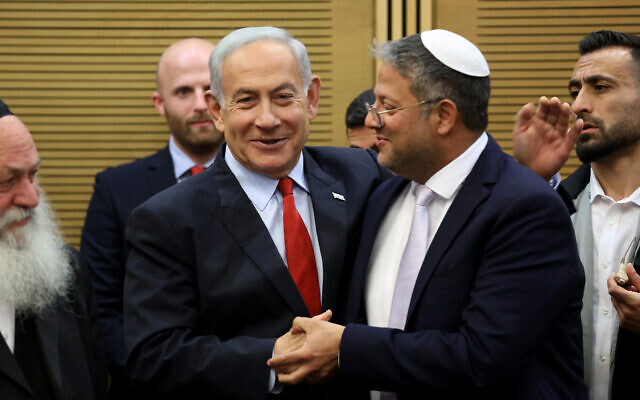
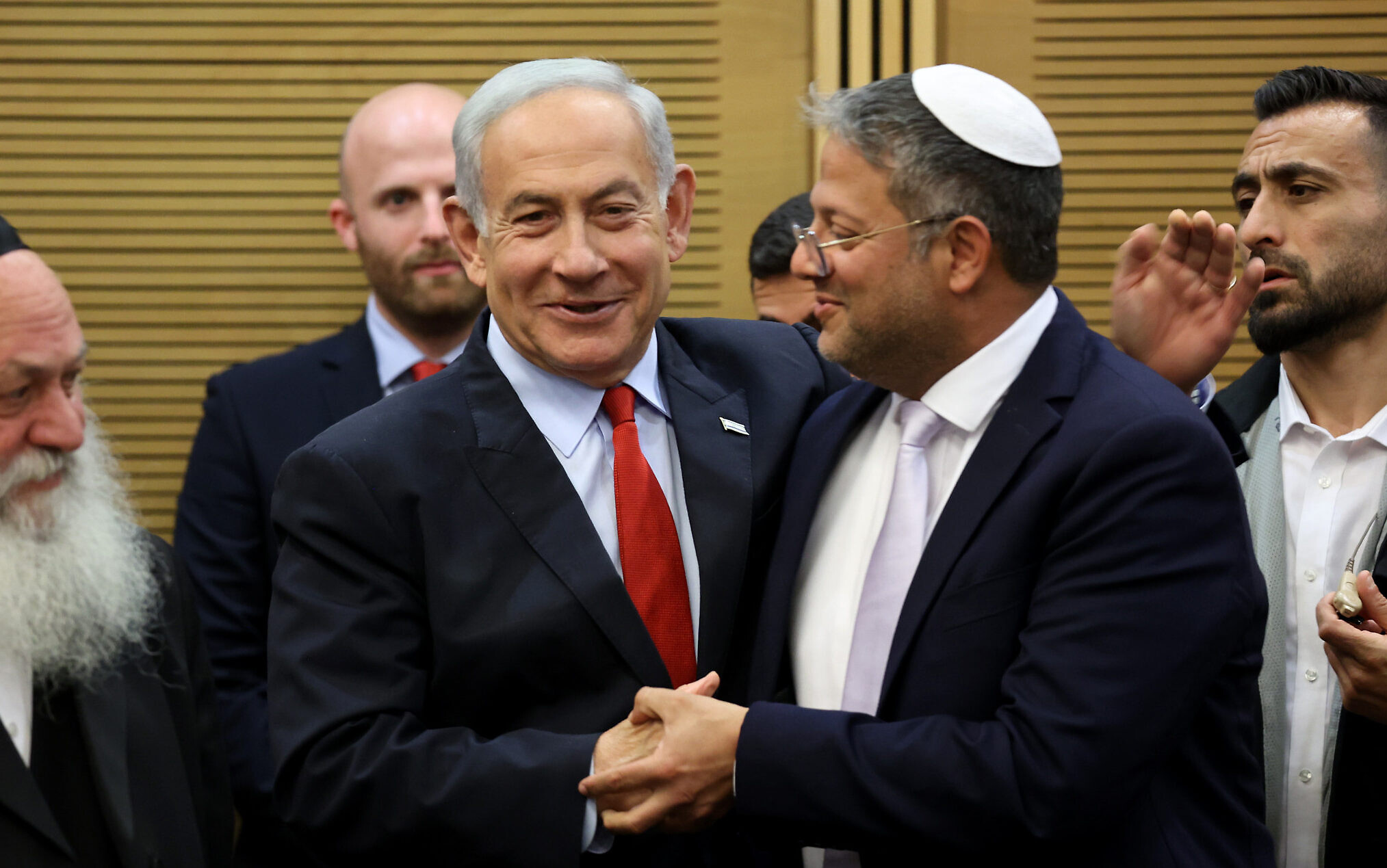
Prime Minister Benjamin Netanyahu, left, greets National Security Minister Itamar Ben Gvir at the Knesset on May 23, 2023. (Gil Cohen-Magen/AFP)
Netanyahu’s moment of truth
Personally, advancing his war cabinet’s proposal gives Netanyahu the prospect of avoiding arrest on the order of the International Criminal Court. It guarantees him a rapturous bipartisan welcome for his imminent joint address in Congress (an invitation confirmed, not coincidentally, shortly after Biden delivered his speech). And it offers him the potential to remake his entire legacy — from the prime minister who failed to prevent the catastrophe of October 7, to the leader who battled back from that disaster and, the way Biden tells it, set Israel on course to long-term security and regional integration.
As for his domestic political dilemma, that has already begun to play out.
Biden may have timed his address for the start of Shabbat in Israel in order to give Netanyahu a 24-hour breathing space during which he might begin to work out his political path ahead. And as soon as Shabbat was over, some “in the government coalition” indeed made clear, precisely as Biden had envisaged, that they “will not agree with this plan and will call for the war to continue indefinitely.” The heads of the coalition’s two far-right parties, Religious Zionism’s Bezalel Smotrich and Otzma Yehudit’s Itamar Ben Gvir, declared that the terms approved by a war cabinet they had themselves voted to establish were unacceptable. And they promised to bolt and thus bring down their own Netanyahu-led government.
National Unity head Gantz, by contrast, called for the urgent convening of the war cabinet in order to advance the process. Highlighting the return of the hostages as the most urgent of the war’s priorities, Gantz was potentially setting aside the ultimatum he delivered on May 18 to quit the coalition by June 8 if Netanyahu does not take urgent strategic decisions on the war. And Yair Lapid, the opposition leader, insisted that Israel “must do this deal, now… before the hostages die there [in Gaza],” and reiterated his promise to provide Netanyahu with a political safety net to ensure that the government does not fall over this issue.
Netanyahu’s political and indeed personal problem is that Ben Gvir and Smotrich have 14 seats between them, and his coalition will not long survive without them. Gantz is a rival, not an ally, whose party has just 8 Knesset seats, and Lapid will take down that safety net as soon as any hostage-ceasefire deal is completed. If and when the two far-right parties go, Netanyahu’s dependable majority goes with them.

Prime Minister Benjamin Netanyahu promises Muslim voters that he will ensure that there are direct flights between Israel and Saudi Arabia, March 23, 2021 (screen capture)
Which brings us to the fateful decision — for Israel — that Biden is pushing Netanyahu to face.
Hamas ‘destroyed’?
The president did not only spell out the extraordinary benefits Israel stands to gain if the deal goes through, and the dramatic, long-term improvement it could enable for Israel’s fundamental, even existential, regional and global reality. He also assured “the people of Israel” that “they can make this offer without any further risk to their own security, because they’ve devastated Hamas forces over the past eight months. At this point, Hamas no longer is capable of carrying out another October 7th — one of the Israelis’ main objectives in this war and, quite frankly, a righteous one.”
“We can’t lose this moment,” the president further said. “Indefinite war in pursuit of an unidentified notion of ‘total victory’ will only bog down Israel in Gaza, draining the economic, military, and human resources, and furthering Israel’s isolation in the world.”
Hamas has indeed been markedly reduced as a fighting force, and it could probably not have carried out another October 7 from very soon after October 7, once the IDF had belatedly mobilized. (Had Hezbollah chosen to join in, full force, in the early days of the war, however, there’s no knowing what the two terrorist armies could have achieved in a simultaneous conflict fought on two fronts.)
But as recently as last week, the US’s own intel was reportedly assessing that only 30-35 percent of Hamas’s gunmen have been killed and that some 65% of the terror group’s tunnels are still intact. It is simply not clear from the details of the Israeli proposal that Biden disclosed quite how Hamas is to be further dismantled, if at all.
And by extension, therefore, it is also not clear at this stage how Netanyahu could have squared approving the Israeli proposal, complete with what Biden specified as its provision for a “permanent end to hostilities” in the second phase of the deal, with the English-language statement on Saturday afternoon in which the prime minister insisted, “Israel’s conditions for ending the war have not changed: The destruction of Hamas military and governing capabilities, the freeing of all hostages and ensuring that Gaza no longer poses a threat to Israel.”
Israel, Netanyahu further stressed in that statement, “will continue to insist these conditions are met before a permanent ceasefire is put in place. The notion that Israel will agree to a permanent ceasefire before these conditions are fulfilled is a nonstarter.”
When, how and how much more is Hamas to be “destroyed,” if Israel’s hostage-ceasefire offer provides for a permanent end to hostilities?

Troops of the 401st Armored Brigade operate in southern Gaza’s Rafah, in a handout image published May 29, 2024. (Israel Defense Forces)
Biden provided a partial potential answer by saying, “If Hamas fails to fulfill its commitments under the deal, Israel can resume military operations.” Yet he rather undermined this reassurance when adding, in the very next sentence, “But Egypt and Qatar have assured me and they are continuing to work to ensure that Hamas doesn’t do that.” That would seem to imply that Hamas would still be capable of posing a substantive threat should it choose to do so.
Biden’s detailed exposition of the Israeli proposal’s three phases also did not include specific reference to Hamas’s demands for the release of all security prisoners recaptured since the 2011 Shalit prisoner exchange, or to Hamas’s insistence that it will choose which life-term murderous terrorists go free early in the deal in exchange for female hostage Israeli soldiers, or to Hamas’s rejection of Israel’s demand for a veto on major terrorists being released into the West Bank — a combination of Hamas demands that are plainly calculated to spark escalated terrorism against Israeli targets in and from the West Bank.
The missing details
Aides to the US president have indicated that the Israeli proposal is a highly detailed, four-and-a-half-page document that presumably addresses all these life-and-death aspects of a potential accord with a barbaric terrorist organization that has wreaked unthinkable harm on Israel and fully intends to do so again if it can.
“There will be differences on the specific details that need to be worked out,” Biden acknowledged. “That’s natural.”
But, he stressed, “if Hamas comes to negotiate ready to deal, then Israel’s negotiators must be given a mandate, the necessary flexibility to close that deal.”
Indeed, they must.

Hamas’s Gaza Strip leader Yahya Sinwar in a tunnel in southern Gaza’s Khan Younis, October 10, 2023 (IDF Spokesman)
First Netanyahu has to decide whether he is prepared to jettison the would-be Gaza-occupying extremists he brought into the heart of his government, and “stand behind” the proposal that he approved in the long-term vital interests of the nation. Then he has to ensure Israel’s negotiators have the mandate to finalize a hostage-ceasefire accord that does, in fact, bring home all the hostages and ensure that Hamas is dismantled.
But even that may not be enough. Because Israel’s proposal, as specified by Netanyahu and partly unveiled by Biden on Saturday night, requires Hamas to consent to its own effective demise. And why, one must ask, would it agree to do that?
A more limited goal?
All of the above brings us to the possibility — I stress, the possibility — that Biden himself and his team do not actually envisage the Israeli proposal playing out as specified, and are in fact seeking more immediate goals with only a vaguer hope of long-term fateful change.
The Israel-Hamas conflict is a zero-sum game: Israel wants to destroy Hamas; Hamas wants to survive and get back to destroying Israel. Neither side will agree to terms that definitively thwart its core goals.
By extension, therefore, complete clarity from Biden would have doomed the deal he is more realistically trying to achieve — which may be for the implementation of the first phase, but perhaps only the first phase, of a hostage-truce agreement.
That way, at least many of the living hostages get to come home from Hamas captivity.
That way, just possibly, too, a modicum of calm is restored at Israel’s northern border.
That way, more humanitarian aid enters Gaza. Global hostility to Israel recedes at least a little. Smotrich and Ben Gvir leave the coalition and Gantz stays. All good news from the Biden administration’s point of view and, it believes, from Israel’s too.
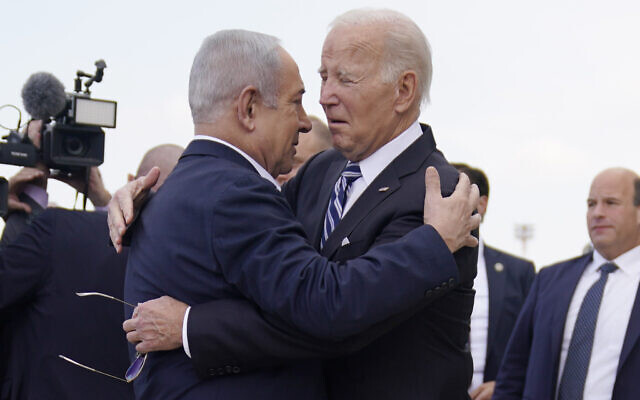
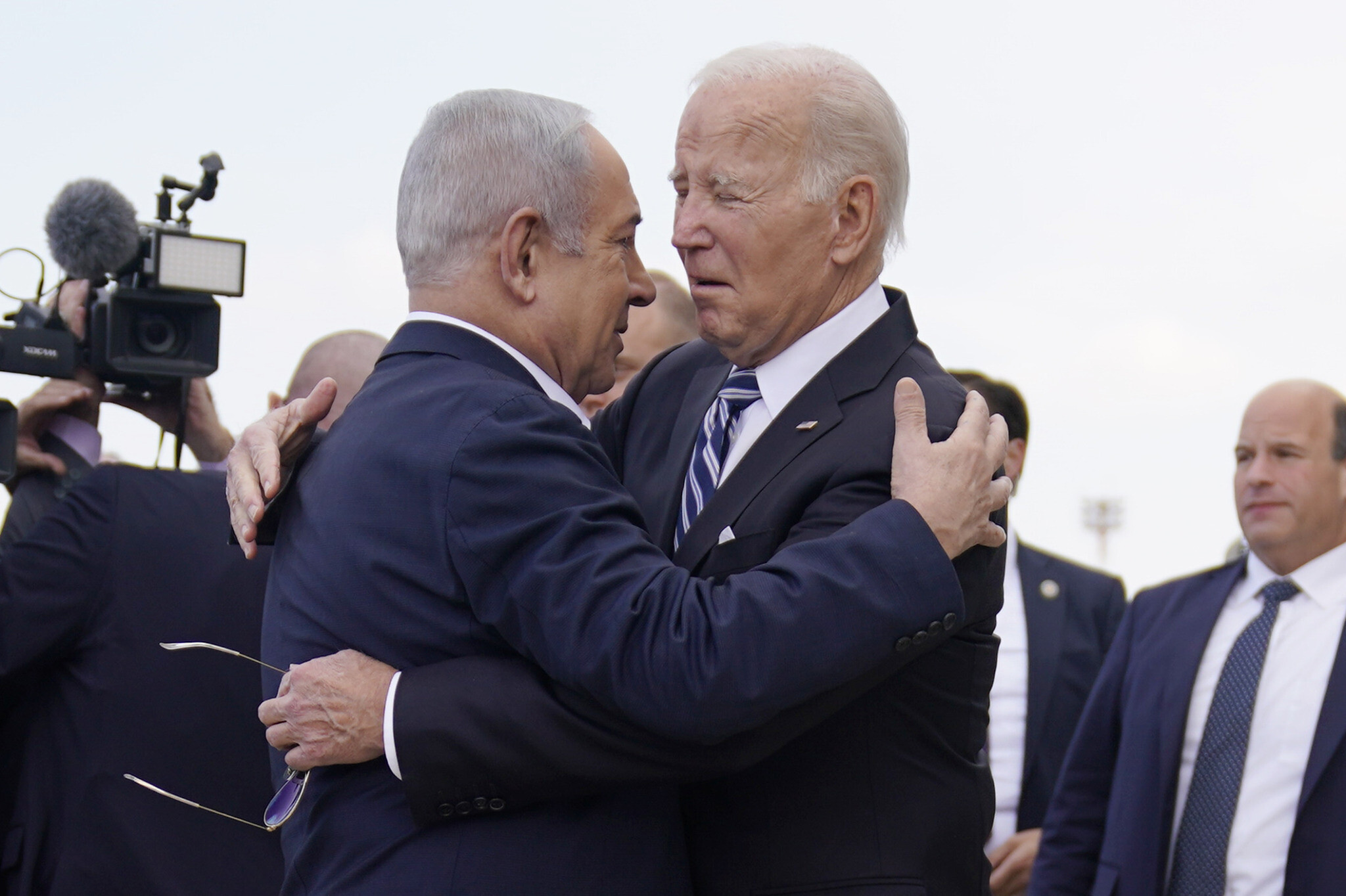
US President Joe Biden (left) is greeted by Prime Minister Benjamin Netanyahu after arriving at Ben Gurion International Airport, in Tel Aviv, October 18, 2023. (Evan Vucci/AP)
Even this more limited process does not obviate the danger of Hamas securing the release, early in phase one, of extremely dangerous terror chiefs into the West Bank, a marked escalation of terror from that front, and Hamas terminating the deal early, with very few hostages released.
But “let’s get phase one moving” could conceivably be the US game plan. With the additional hope that the start of the process could itself yield further benefits.
Sounds like a long shot? Maybe that’s all the American administration feels it has right now.