“Under the proposal, Israel will continue to insist these conditions are met before a permanent ceasefire is put in place. The notion that Israel will agree to a permanent ceasefire before these conditions are fulfilled is a non-starter.”

“Under the proposal, Israel will continue to insist these conditions are met before a permanent ceasefire is put in place. The notion that Israel will agree to a permanent ceasefire before these conditions are fulfilled is a non-starter.”

“I’m in favor of France recognizing a Palestinian state, but not necessarily tomorrow,’’ European Parliament member (MEP) Bernard Guetta told The Jerusalem Post.

Macron crossed the Rubicon last February when he said that recognition of a Palestinian state was no longer a taboo for France. Taking it even further this week, after the trilateral recognition, Macron said that he was ‘’totally ready’’ to recognize a Palestinian state, but considers that such a move should come “at a useful moment.’’
The question now at hand is, what would constitute “a useful moment’ for Macron’? Before October 7, such a statement would have probably meant waiting for some sort of direct or indirect dialogue between Israel and the Palestinians. This is not the case anymore. Macron could decide to go for recognition when, and if, Israel and Hamas reach a ceasefire agreement.
He could also decide that the moment for recognition has come upon further escalation of the humanitarian crisis in Gaza, or if another fatal incident takes place, such as the one in Tal al-Sultan on Sunday night. A strong decision against Israel at one of the international courts could also encourage such a move.
“I’m in favor of France recognizing a Palestinian state, but not necessarily tomorrow,’’ European Parliament member (MEP) Bernard Guetta told The Jerusalem Post. Guetta is number two on Macron’s Renaissance list for the upcoming elections.


“It is only by imposing this principle that France, the European Union, and the international community can recreate a new reality for the Palestinian Authority, with a renewal of negotiations.”
Macron made this latest statement on Palestinian recognition while in Germany, the first visit in 24 years by a French president to France’s neighbors on the other side of the Rhine River. The timing of his declaration was evidently not a coincidence.
By relaunching the French-German alliance, Macron is signaling to Chancellor Olaf Scholz that even Israel’s best friend must begin thinking in the direction of recognizing a Palestinian state. It would be easier for Macron to take such a step in conjunction with the Germans than on his own.
That being said, Israel has two elements working in its favor, at least in the very short run.
The first is the upcoming elections for the European Parliament, set for June 9. Recognition of a Palestinian state is the banner being raised by the European Left and extreme Left. In fact, for the French, the war in Gaza has emerged as a major issue in the European elections.
Much of the political discourse has been focused in recent weeks on Gaza, such as televised candidate debates – even more than on the economic integration of the European Union or the idea of a common defense strategy.
If Macron takes this step now, before the elections, he will be seen as weak, caving in to the demands of his political foes, at the height of the campaign.
The second element is the argument Jerusalem has been pushing forward in the past few months, that recognition now, after October 7, would be rewarding Hamas and its terrorists, sending the world a signal that their violence had paid off.
This is an argument many in France can identify with because of the reality they have been living in since the Islamic terror of 2015.
European analysts believe that Macron might not have a choice but to go ahead in the near future with recognizing a Palestinian state, should a mass of EU member states take the plunge. Israel’s traditional allies within the EU, such as Austria, are not expected to join, but there are several others who might advance on this in the coming weeks and months.
Slovenia has already said it will recognize a Palestinian state in June.
Belgium, Malta, and Portugal could also opt for recognition this summer if the war in Gaza continues at the same pace as now.
The more the war in Gaza goes on without a ceasefire agreement, the more likely it is that European countries will recognize a Palestinian state.
This is also the argument heard in Italy, where, unlike in France or Belgium, the war in Gaza has not become a major European elections topic.
Italian premier Giorgia Meloni was once considered an ally by Prime Minister Benjamin Netanyahu, much like other far-Right, nationalist leaders in Europe, although that is not really the situation anymore. Italian journalists who spoke to The Jerusalem Post all agreed that Meloni would follow Italian public opinion.
EU regulations demand that foreign affairs policies be adopted in unanimity by all 27 member states. For many years, Israel had felt safe on the recognition issue, knowing that EU member states were unable to reach a consensus on the topic.
The rift between the pro-Israeli camp and the pro-Palestinian camp was steady. But this analysis is now void.
The question Israelis have been asking themselves: “Is Europe lost?” is no longer relevant because two EU member states have de facto ditched their obligation to adopt such dramatic diplomatic measures unanimously. Each country will decide for itself.
Norway (not a member of the bloc), Ireland, and Spain said clearly, that the time had come to force a solution on Israel since Israel refuses to listen to the international community on Gaza and Rafah.
Other European countries are feeling the same. They could decide to act upon that soon.
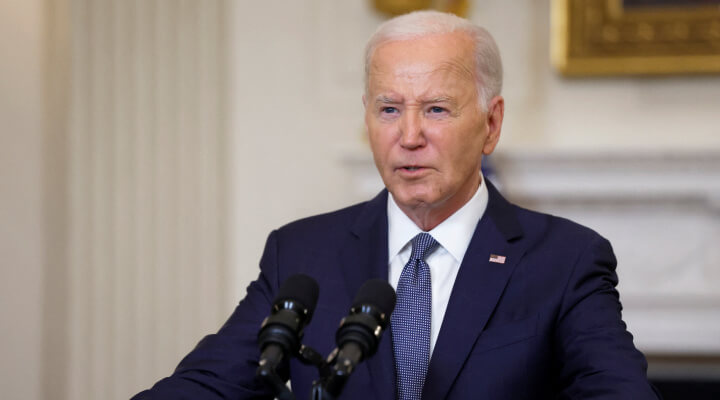

US President Joe Biden at the White House, Washington, DC, May 31, 2024. Photo: REUTERS/Evelyn Hockstein
US President Joe Biden on Friday outlined the details of a new plan to conclude the Israel-Hamas war that would seemingly leave the Palestinian terrorist group in control of the Gaza Strip.
Delivering a speech from the White House, Biden gave updates on his administration’s efforts to end the war in Gaza, laying out a proposed multi-phase plan that, in his words, would result in a “permanent cessation of hostilities” between the Jewish state and Hamas, which launched the war by invading southern Israel, murdering 1,200 people, and abducting over 250 hostages on Oct. 7.
Biden explained that his administration has engaged in “intensive diplomacy” with the governments of Israel, Qatar, Egypt, and other unspecified Middle Eastern countries to hammer out the details of a potential ceasefire plan.
“Israel has offered a comprehensive new proposal. It’s a roadmap to an enduring ceasefire and the release of all hostages. This proposal has been transmitted by Qatar to Hamas,” Biden said.
Israel’s proposal consists of three phases, Biden said. The first phase would last six weeks and include a “full and complete ceasefire” between Israel and Hamas and the “withdrawal of Israeli forces from all populated areas of Gaza.” The first phase would also include the “release of a number of hostages” in exchange for “the release of hundreds of Palestinian prisoners.”
The remains of killed hostages would also be returned to Israeli families, and Palestinian civilians would “return to their homes” within all areas of Gaza. Biden added that humanitarian assistance into the Gaza Strip “would surge, with 600 trucks carrying aid into Gaza every single day.” In addition, the president promised that “hundreds of thousands of temporary shelters” would be erected for Gazan refugees.
During this six-week period, Israel and Hamas would negotiate the “necessary arrangements” in order to transition to the second phase and a “permanent end” to the war, Biden explained. The negotiations during this transitional period would include measures to ensure Israel’s security. As long as negotiations continue, the ceasefire between Israel and Hamas would remain, Biden said.
The second phase of the proposal would guarantee the release of all “remaining living hostages” and the removal of all Israeli forces from Gaza. Israel would promise the “permanent cessation of hostilities” if Hamas abides by the proposal, Biden claimed.
The third phase consists of a “major reconstruction” of the war-torn enclave and the delivery of the final batches of dead hostages’ remains back to Israeli families.
Biden assured that Israel can make this offer to Hamas without an unnecessary risk to their security “because they’ve devastated Hamas forces over the past eight months.” He asserted that Israel’s military operations have rendered Hamas “no longer capable of carrying out another Oct. 7.” Israel would be allowed to continue with its war effort if Hamas breaks the terms of the agreement, Biden stipulated.
Biden added that a coalition consisting of Israeli and Palestinian leaders, Middle Eastern countries, and the international community would work together to rebuild Gaza “in a manner that does not allow Hamas to rearm.”
“I know that there are those in Israel who will not agree with this plan and will call for the war to continue indefinitely,” he continued. “Some are even in the government coalition, and they’ve made it clear they want to occupy Gaza. They want to keep fighting for years, and hostages are not a priority for them.”
Israeli officials across the political aisle have consistently said that freeing the hostages kidnapped on Oct. 7 is a top priority of their military campaign in Gaza, along with incapacitating Hamas to the point that it can no longer pose a threat to the Israeli people.
Notably, toward the beginning of his remarks, Biden said the plan his foreign policy team negotiated would ensure a Gaza “without Hamas in power.” It’s unclear how that would work if a disarmed version of the terrorist group is allowed to remain the governing body of Gaza. Israel has also repeatedly asserted that Hamas will not be allowed to retain power within Gaza following its Oct. 7 slaughter, which Hamas leaders have promised to carry out “again and again.”
Israeli Prime Minister Benjamin Netanyahu’s office released a statement following Biden’s speech, vowing not to end the war until Israel has achieved the “elimination of Hamas’ military and governmental capabilities” — seemingly opposing the idea of allowing Hamas to remain in power.
“The government of Israel is united in its desire to return the hostages as soon as possible and is working to achieve this goal,” the statement said. “The prime minister authorized the negotiating team to present a proposal to that end, which would also enable Israel to continue the war until all its objectives are achieved, including the destruction of Hamas’ military and governing capabilities. The actual proposal put forward by Israel, including the conditional transition from one phase to the next, allows Israel to uphold these principles.”
During his address, Biden claimed that if Israel did not accept the deal and continued the war effort, the Jewish state could find itself “bogged down in Gaza” for the long-term. The president warned that this could potentially drain the economic, military, and human resources” of Israel along with solidifying the Jewish state’s “isolation” in the broader international community.
Biden also stated that the end of the Israel-Hamas war could pave the way for a “normalization agreement” between the Jewish state and Saudi Arabia, adding that such an arrangement would allow Israel and the broader region to effectively combat any threats from Iran.
“It’s time for this war to end, and the day after to begin,” Biden said.
Biden’s press conference came one day after Hamas outlined a ceasefire proposal with terms Israel found unacceptable. Hamas said Thursday that it would refuse to negotiate a release of hostages until Israel unilaterally withdrew its forces. Israeli officials have said any deal must include the release of hostages before they halt their military campaign.
On Friday, Hamas released a statement following Biden’s remarks, praising the plan outlined in his speech and claiming the terror group is willing to work with Israel “constructively” to work toward a ceasefire.
“The movement affirms its position of readiness to deal positively and constructively with any proposal based on a permanent ceasefire, complete withdrawal from the Gaza Strip, reconstruction, the return of the displaced to all their places of residence, and the completion of a serious prisoner exchange deal if the occupation declares its explicit commitment to that,” Hamas said.
Scofield Biblical Institute and Theological Seminary Copyright 2010 – 2020