
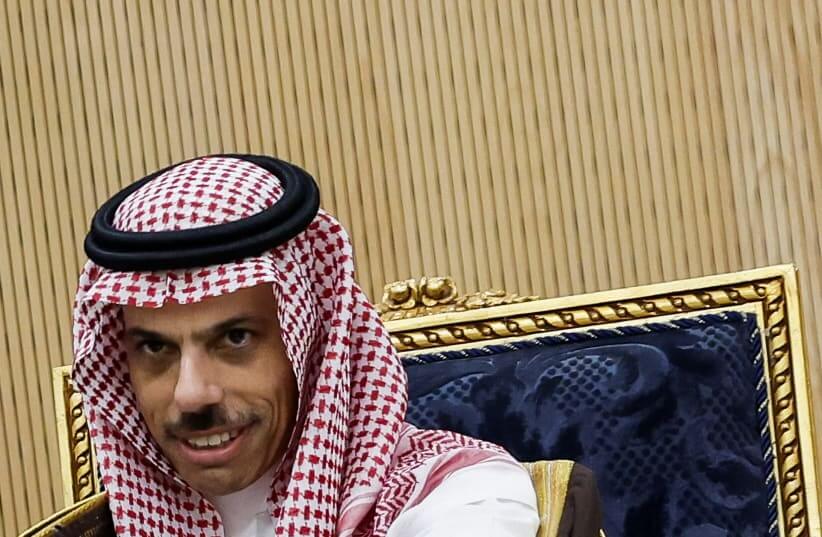
“I firmly believe,” Prince Faisal said on Sunday night, “that a two-state solution with the establishment of a credible Palestinian State serves … the interest of the Palestinians…”
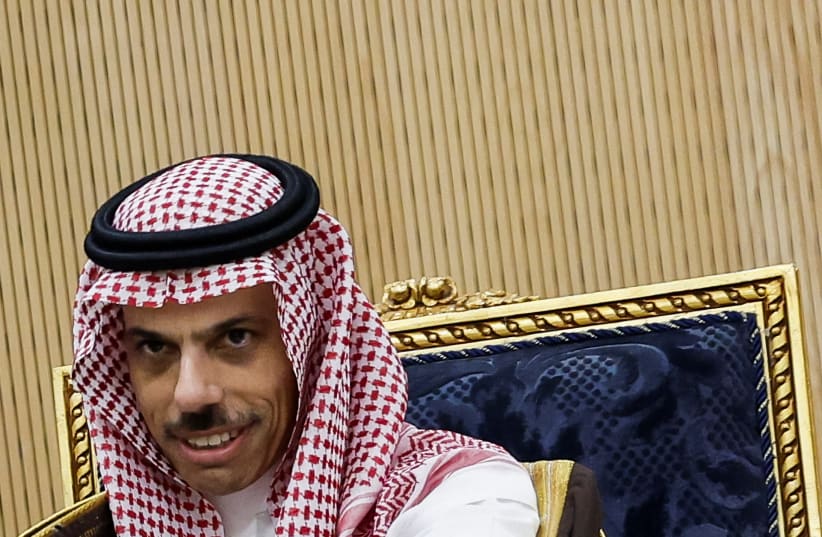
 Saudi Arabia's Foreign Minister Prince Faisal bin Farhan bin Abdullah looks on as he meets with US Secretary of State Antony Blinken (not pictured) at the GCC Secretariat, in Riyadh, Saudi Arabia, April 29, 2024. (photo credit: REUTERS/EVELYN HOCKSTEIN)
Saudi Arabia’s Foreign Minister Prince Faisal bin Farhan bin Abdullah looks on as he meets with US Secretary of State Antony Blinken (not pictured) at the GCC Secretariat, in Riyadh, Saudi Arabia, April 29, 2024.
(photo credit: REUTERS/EVELYN HOCKSTEIN)
Saudi Arabia is concerned by Israel’s refusal to accept a two-state resolution to its conflict with the Palestinians, Saudi Foreign Minister Faisal bin Farhan told reporters in Brussels as he lauded the three European countries that have unilaterally recognized Palestinian statehood.

“I firmly believe,” Prince Faisal said on Sunday night, “that a two-state solution with the establishment of a credible Palestinian State serves … the interest of the Palestinians and delivers [on] their right to self-determination.

“It is also in the interest of Israel and delivers the security that Israel needs and deserves.

“The fact that the current government in Israel doesn’t realize that, of course, is a matter of extreme concern,” he said.

He spoke in Brussels at a press conference with European Union foreign policy chief Josep Borrell and Norwegian Foreign Minister Espen Bathe Eide on the sidelines of two days of events on the Israeli-Palestinian conflict hosted by Brussels.

 Spanish Foreign Minister Jose Manuel Albares, Norway's Foreign Minister Espen Barth Eide and Ireland's Foreign Minister Micheal Martin gesture after a press conference in Brussels, Belgium May 27, 2024. (credit: REUTERS/Johanna Geron)Enlrage image
Spanish Foreign Minister Jose Manuel Albares, Norway’s Foreign Minister Espen Barth Eide and Ireland’s Foreign Minister Micheal Martin gesture after a press conference in Brussels, Belgium May 27, 2024. (credit: REUTERS/Johanna Geron)

They took place as the Norwegian, Irish, and Spanish unilateral recognition of Palestinian statehood was set to officially go into effect on Tuesday.

Prince Faisal, who attended the Brussels meetings said, it was important “to reinvigorate the two-state solution independent of Israel’s position because Israel doesn’t get to decide whether or not the Palestinians have a right to self-determination.”

The Norwegian, Irish, and Spanish unilateral recognition of Palestinian statehood, he said, “is not just symbolic.” It “re-emphasizes the viability of the two-state solution. … So we encourage others to do so,” Prince Faisal said.

Borrell stated that “the two-state solution is not a painful concession that Israel” must make nor is it “a security threat” to Israel.

“On the contrary, it is the only long-term guarantee for the security and prosperity of Israel.

“I know that the current Israeli government is not convinced of that” but its allies must work to advance it because it’s “the only solution that we can imagine to bring peace and security to the two people who are fighting for the same land.”

Netanyahu government hardens stance since October 7

Prime Minister Benjamin Netanyahu’s current government, which has opposed Palestinian statehood since it was sworn into office at the end of December 2022, has hardened that stance in the aftermath of the Hamas-led October 7 invasion of Israel.

It has argued that unilateral Palestinian recognition legitimizes that attack, in which over 1,200 people were killed and another 252 seized as hostages. Some 125 of those captives remain in Gaza.

Earlier this year the Israeli government and the Knesset declared their opposition to unilateral Palestinian statehood but did say it would support a negotiated process with the Palestinians that lead to two states.

Netanyahu’s critics on the Right, have held that the declaration which passed the Knesset by 99 to 120 votes, was a backhanded way of supporting negotiations for two states.

Neither Netanyahu nor his top officials, however, have been willing to state so publicly and have instead expressed concern that a Palestinian state would, in a manner akin to Gaza, become another terror stronghold.

The Israeli government’s vocal opposition to Palestinian statehood, coupled with the ten-year absence of any negotiated Israeli-Palestinian peace process, has pushed some European countries to change their position on Palestinian statehood.

Many Western and European countries had in the past believed that Palestinian statehood recognition should come at the end of a two-state process.

Now they view it as a supportive step to reinvigorate the process, particularly at a time when the United States is working to advance a normalization deal between Israel and Saudi Arabia.

Hamas urges global ‘uprising’ after Rafah strike

Hamas demands supporters organize “angry marches” after IAF strike kills two senior commanders.

By World Israel News Staff

Hamas encouraged Palestinians and their supporters in the Arab world and elsewhere to “rise up” against Israel, following an IAF airstrike on Rafah which killed two of the terror group’s senior commanders.

“In light of the horrific Zionist massacre this evening committed by the criminal occupation army… we call on the masses of our people in the West Bank, Jerusalem, the occupied territories and abroad to rise up and march angrily against the ongoing Zionist massacre against our people in the sector,” Hamas said in a statement.

Recent months have seen large anti-Israel protests in cities throughout the Middle East, Europe, and North America.

During those demonstrations, activists have frequently called for a “globalized intifada,” which Hamas demanded in its statement.

Such a movement would presumably see Jews throughout the world targeted with violence and harassment.

Hamas’ call for an international uprising came as the IDF continues operating in Rafah, a city in the southern Strip largely believed to be the last Hamas stronghold in the coastal enclave, despite intense international pressure to cease fighting in the area.

Late Sunday evening, the Israeli air force targeted a compound in the Tel Sultan neighborhood of Rafah.

Two senior Hamas commanders were killed, along with dozens of others. The Hamas-controlled Gaza Health Ministry said that 35 people had been killed and dozens others were wounded, claiming that most were women and children.

That claim is dubious, as Hamas is known to exaggerate civilian casualties, with the UN quietly halving the number of women and children estimated to be killed during the ongoing conflict.

The Israeli Air Force clarified that “the attack was carried out against terrorists who are a target for attack, in accordance with international law, using precision munitions, and based on intelligence indicating the use of the area by Hamas terrorists.”


Israel fears Russia will transfer digital weapons to Iran

Israeli security services fears that Russia will provide advanced cyber capabilities to the Iranians. In recent months, there has been a sharp increase in online attacks against Israeli targets.

May 26, 2024, 7:58 AM (GMT+3)

Cyber attack. Illustration

Israeli officials fear that Russia will transfer advanced cyber capabilities to Iran.

Israel Hayom reports that “powers like Russia have capabilities that are not available to terrorist bodies or other countries. Russia has other tools, which can cause significant damage to its enemies.”

“The cyber unit deals with defense, and the defense is always working. We are also prepared for significant attacks,” added a source familiar with the case.

Iran is known as a country with competent cyber infrastructures, but Russia is a cyber superpower, and one of the few countries in the world with particularly strong cyber capabilities. Israel is also considered a country with such capabilities.

Since the beginning of the war on October 7th, there has been an increase of hundreds of percent in significant cyber attacks on Israel.

The main targets of these attacks are the health system infrastructure, academia, bodies responsible for service and integration, and additional infrastructures. Israel is also preparing for attacks on the electricity, water, and other critical infrastructures.