Foggy weather and huge boulders complicated rescue efforts for the president’s helicopter, according to Iranian reports.
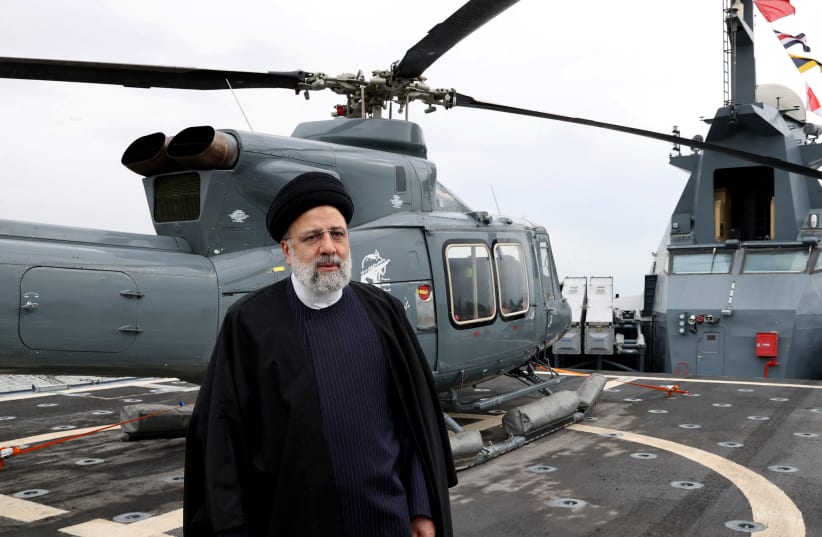
By TZVI JOFFREUpdated: MAY 19, 2024 18:35Iranian President Ebrahim Raisi visits the military equipment of IRGC Navy in Bandar Abbas, Iran, February 2, 2024.(photo credit: IRAN’S PRESIDENCY/WANA (WEST ASIA NEWS AGENCY)/HANDOUT VIA REUTERS)
The Islamic regime in Iran expressed concern for the lives of Iranian President Ebrahim Raisi and Foreign Minister Hossein Amir-Abdollahian after the helicopter they were traveling in suffered a “hard landing” on Sunday afternoon.
Details about the incident remained unclear as of Sunday afternoon, although reports indicated the accident involved the president’s helicopter and foggy weather. According to the Iranian IRNA news agency, the helicopter crashed in a forest area between the villages of PirDavood and Uzi in northwestern Iran.
According to the IRGC-affiliated Tasnim News Agency, emergency services were conducting searches to try and find the president’s helicopter, but the foggy weather and huge, 70-meter tall boulders in the area were complicating search efforts. Over 40 rescue teams were operating in the area as part of search efforts.
The reformist Ensaf News site cited an informed source as saying that the crash was “serious” and that there was a “high probability” of injuries in the accident.
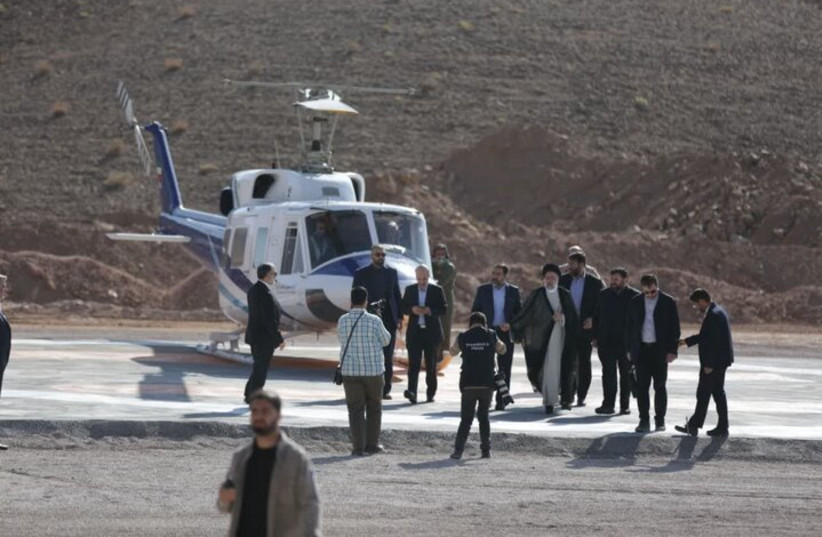
Iranian President Ebrahim Raisi seen before boarding a helicopter in Azerbaijan, May 19, 2024 (credit: MEHR NEWS AGENCY)
Iranian FM, regional leaders in helicopter with Raisi
Amir-Abdollahian and Mohammad Ali Ale-Hashem, the representative of the Guardianship of the Islamic Jurist in East Azerbaijan and the Imam of Friday Prayer in Tabriz, were reportedly in the helicopter with Raisi.
The Deputy Coordinator of Civil Affairs of East Azerbaijan said that there were three helicopters in the convoy, two of which landed safely and one of which fell, according to Iranian state media. The deputy coordinator added that he did not know any details about possible casualties or the exact cause of the accident.
Iranian media reported that some people were able to talk with Ale-Hashem shortly after the incident but that contact had since been lost.
Regime religious leaders held prayers for Raisi’s health in several locations across Iran, according to Iranian state media.
An emergency session of Iran’s Supreme National Security Council was held with Supreme Leader Ali Khamenei in attendance on Sunday evening in light of the situation, according to the Tehran Times.
Raisi had met with Azerbaijani Elham Aliyev earlier on Sunday on the Azerbaijani-Iranian border.
In defiance of the UN nuclear watchdog agency, Iran is set to produce weapons-grade uranium
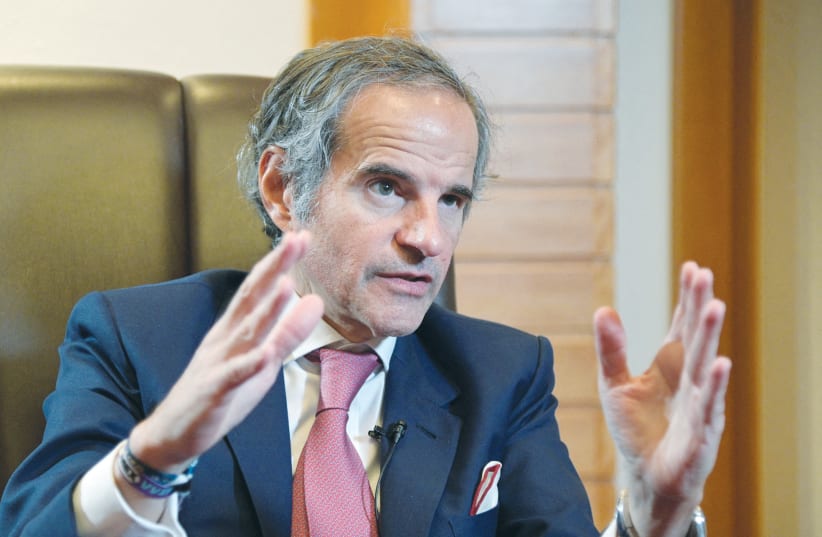
By GIORGIA VALENTE/THE MEDIA LINEUpdated: MAY 19, 2024 06:57IAEA CHIEF Rafael Grossi says Iran is not months but weeks away from possessing enough enriched uranium to develop a nuclear bomb, though he clarified that this does not signify that Tehran would avail itself of nuclear weapons at that point.(photo credit: REUTERS/Chris Gallagher/File Photo)
Iran may be mere weeks away from developing nuclear weapons, according to the director general of the UN’s nuclear agency,
Rafael Grossi, head of the International Atomic Energy Agency (IAEA), the UN’s nuclear oversight organization, flew to Iran last week to strengthen the UN’s supervision of Iranian nuclear activities.
Iran has agreed to provide the agency with information about its nuclear facilities and access to cameras at its nuclear sights. Since 2022, many surveillance cameras have been removed, and traces of uranium have been found in unexpected locations.
While in Iran, Grossi met with Mohammad Eslami, Iran’s nuclear chief.
Iran nearly has nuclear bomb
“Iran has never been closer to achieving a nuclear bomb,” Grossi told the press after his visit to Iran. “It is estimated that it may be a matter of weeks and not months away if [Supreme Leader Ali] Khamenei chooses to go this way.”
In 2018, Donald Trump’s administration decided to withdraw from the 2015 nuclear deal between Iran and the US. Under the deal, Iran agreed to limit its uranium stockpile and enrich uranium only to 3.67%, the purity needed to run nuclear power plants. In return, Iran received relief from sanctions imposed by the US, the EU, and the UN Security Council.
The US withdrawal from the nuclear deal has not stopped Iran’s nuclear plan. In fact, Tehran has used the withdrawal as an excuse to roll back cooperation with the IAEA and accelerate its uranium enrichment.
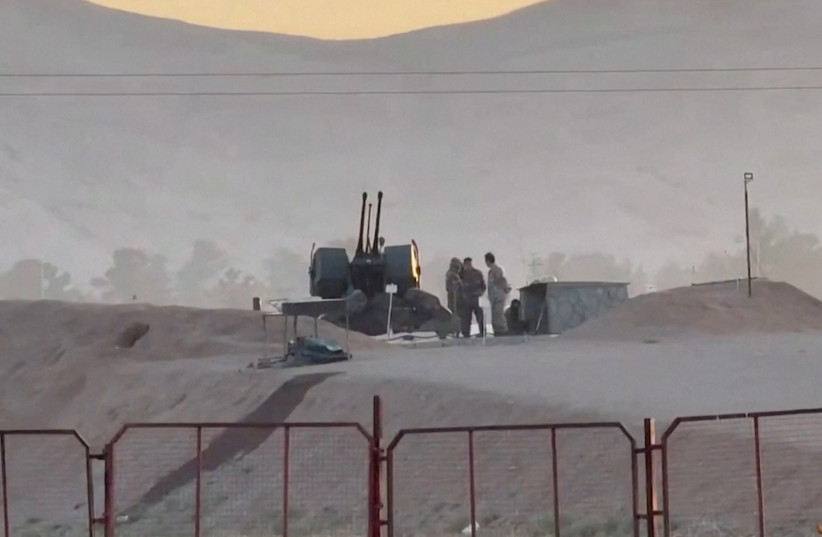
Military personnel stand guard at a nuclear facility in the Zardanjan area of Isfahan, Iran, April 19, 2024, in this screengrab taken from video. (credit: WANA/REUTERS)
Darya Dolzikova, a research fellow at the Royal United Services Institute’s Proliferation and Nuclear Policy program, told The Media Line that Iran has achieved 60% uranium purity and is approaching the weapons-grade purity level of 90%.
“This is quite concerning,” she said.
Steven Biegalski, the chair of the Nuclear and Radiological Engineering and Medical Physics Program at Georgia Institute of Technology, said that 60% purity is “far beyond” the purity needed for nuclear power plants.
“It is, of course, a huge concern,” he said. “They are clearly staging themselves to reach their goal in one or two weeks without having any significant international sanctions against them.”
Dolzikova said that while producing sufficient fissile material for a nuclear weapon could take about a week, producing additional weapons would take longer.
“Once the uranium is enriched, it must be put inside a nuclear weapon, and then it is mounted onto a delivery system,” she said. “So, to produce more of them it actually takes longer, up from six months to a year.”
Daryl G. Kimball, the executive director of the US-based Arms Control Association, explained that monitoring Iran’s nuclear capacity has been difficult because the country has not provided the IAEA with all the necessary information.
“There are certain facilities that this institution has no access to since Iran has decertified its inspectors from some of them,” Kimball stated.
He called for the US, France, Germany, and the UK to push Iran to resume cooperation with the IAEA.
Iran becoming a nuclear power would set off a chain reaction in the Middle East and around the world.
“Several other countries may develop a clandestine military nuclear capability,” Simon Henderson, the director of the Gulf and Energy Policy Program at the Washington Institute, told The Media Line. “Egypt, Turkey, Saudi Arabia, and the UAE are regarded as the most likely. Moreover, Iran is clearly showing, by continuing the nuclear program, not only the impossibility to stop this through international policies but mainly the limits of the American power, its main enemy.”
According to Kimball, an Israeli or American strike on Iranian nuclear facilities would not bring an end to Iran’s nuclear program. “This can even escalate in the country’s withdrawal from the Nuclear Non-Proliferation Treaty to pursue in the long run a nuclear arsenal, which may protect the regime from foreign threats.”
Iran’s nuclear plant in Natanz is enriching uranium at a faster rate than ever before, and the country’s stock of uranium fuel continues to increase.
Iran started building the new underground facility in Natanz to replace the aboveground centrifuge assembly center, which was struck by an explosion in 2020. Iran claimed it was Israel’s responsibility.
Kimball said the new facility was built deep underground in order to avoid being targeted.
Biegalski said that Iran has clearly disobeyed the UN’s limits, installing additional centrifuges to reach higher uranium enrichment.
“Without military action and only the use of policies, it is almost impossible to stop this process,” he said.
The Iranian government has consistently stated that it has no intention of creating nuclear weapons, but after last month’s escalation between Iran and Israel, Kamal Kharazi, Khamenei’s adviser, took a different tack.
“If the Zionist regime [Israel] will launch an attack on our nuclear sites, our deterrence will change. We have the capability to create nuclear weapons, and we may use them in the future to protect ourselves,” Kharazi said in an interview with Al Jazeera.
Riyadh state media says US national security adviser and Saudi crown prince discussed ‘semi-final version of draft,’ end to Gaza war, setting up Palestinian state
US National Security Advisor Jake Sullivan briefs reporters at the White House, May, 13, 2024. (Doug Mills/The New York Times via AP)
US President Joe Biden’s national security adviser met early Sunday with Saudi Arabia’s Crown Prince Mohammed bin Salman to discuss what the kingdom described as the “semi-final” version of a wide-ranging security agreement between the countries.
The agreements are considered a major part of Washington’s efforts to bring Riyadh around to recognizing the State of Israel for the first time — efforts complicated by the ongoing war in Gaza.
Saudi state media released no images of Jake Sullivan and Prince Mohammed’s meeting in Dhahran, a city in the kingdom’s far east that’s home to its state-run oil giant, the Saudi Arabian Oil Co. known as Saudi Aramco.
“The semi-final version of the draft strategic agreements between the kingdom and the United States of America, which are almost being finalized — and what is being worked on between the two sides in the Palestinian issue to find a credible path — were discussed,” the statement released after the talks said.
That included “a two-state solution that meets the aspirations and legitimate rights of the Palestinian people” and “the situation in Gaza and the need to stop the war there and facilitate the entry of humanitarian aid,” the statement added.
The US has said in the past that the deal hinges on a normalization component with Israel that would require the latter to also agree on a pathway for a future Palestinian state.
After his visit to Saudi Arabia, Sullivan is due to visit Israel, where he will meet with Prime Minister Benjamin Netanyahu to update him on his talks in Riyadh and also discuss Israel’s planned expanded military operation in Rafah, a US official told The Times of Israel.
Saudi Crown Prince and Prime Minister Mohammed bin Salman in Jeddah, Saudi Arabia, March 20, 2024. (Evelyn Hockstein/Pool Photo via AP)
Saudi Arabia has long called for an independent Palestinian state to be created along Israel’s 1967 borders, with East Jerusalem as its capital. However, that is likely untenable for Netanyahu, whose government hinges on support from hardliners who oppose a two-state solution and support Israeli settlements on lands Palestinians want for that state.
The war in the Gaza Strip and its influence on relations with Saudi Arabia gained urgency on Saturday when war cabinet minister Benny Gantz issued an ultimatum on a number of topics, including Saudi normalization, as a condition for keeping his National Unity party in the emergency government, which he joined after the war started. In response, the Prime Minister’s Office issued a statement saying that Netanyahu opposes “establishing a Palestinian state that will inevitably be a terror state.”
The war erupted on October 7 when the Palestinian terror group Hamas led a massive cross-border attack on Israel that killed 1,200 people. The terrorists who burst through the border with the Gaza Strip also abducted 252 people as hostages to Gaza.
Israel responded to the attack with a military offensive to destroy Hamas, topple its Gaza regime, and free the hostages.
During US Secretary of State Anthony Blinken’s last visit to Riyadh in April, he and his Saudi counterpart said that a final agreement on the US-Saudi component of the deal was close.
Saudi Arabia has long relied — like other Gulf Arab nations — on the US to be the security guarantor for the wider Middle East as tensions over Iran’s nuclear program in recent years have spilled over into a series of attacks. The proposal now being discussed likely would deepen that, and also reportedly includes access to advanced weapons and possibly trade deals as well.
Saudi Arabia has also pushed for nuclear cooperation in the deal that includes America allowing it to enrich uranium in the kingdom — something that worries nonproliferation experts, as spinning centrifuges opens the door to a possible weapons program. Prince Mohammed has said the kingdom would pursue a nuclear weapon if Iran had one. Iran in recent weeks has increasingly threatened it could do so.
Prime minister Benjamin Netanyahu sits during a press conference along with Minister Benny Gantz at the Defense Ministry headquarters in Tel Aviv, December 16, 2023. (Noam Revkin Fenton/Flash90)
Saudi Arabia, as the world’s largest oil exporter, is not an obvious candidate for a nuclear pact typically aimed at building power plants.
But the kingdom is seeking to generate substantial renewable energy and reduce emissions under an ambitious long-term plan, while critics say Riyadh might want nuclear expertise in case it someday wished to acquire nuclear weapons, despite safeguards enshrined in any deal with Washington to prevent this.
Iran, US communicate
Iran’s mission to the United Nations in New York, meanwhile, confirmed that Tehran had held indirect talks with US officials in Oman last week. Iran’s state-run IRNA news agency quoted the mission as describing the talks as “an ongoing process.”
“The negotiations have not been the first and will not be the last of their kind,” the mission said, according to IRNA.
Oman, a sultanate on the eastern edge of the Arabian Peninsula, has been the site of US-Iran talks in the past, including under Biden despite the tensions between the two nations.