
May 8, 2024 4:24 pm

 by Algemeiner Staff

US Defense Secretary Lloyd Austin testifies before a House Appropriations Defense Subcommittee hearing on US President Joe Biden’s proposed budget request for the Department of Defense on Capitol Hill in Washington, DC, US, April 17, 2024. Photo: REUTERS/Ken Cedeno

US Defense Secretary Lloyd Austin on Wednesday confirmed that the Biden administration halted the delivery of high payload munitions to Israel due to concerns over a possible Israeli military offensive in the Gaza city of Rafah.

“We’ve been very clear … from the beginning that Israel shouldn’t launch a major attack in Rafah without accounting for and protecting the civilians in that battle space,” Austin testified during a hearing of the US Senate Appropriations Committee.

According to US officials, the weapons delivery in question was supposed to contain 1,800 2,000-pound bombs and 1,700 500-pound bombs. Austin said on Wednesday that the US paused “one shipment of high payload munitions” without elaborating on the size or number of munitions.

Austin was the first senior Biden administration official to publicly outline a possible shift in US policy on arming Israel. The US is a close ally of Israel and its biggest arms supplier.

The paused delivery was the first time the US held up a weapons shipment for the Israel Defense Forces (IDF) since the outbreak of the Israel-Hamas war.

Hamas, the Palestinian terrorist group that rules Gaza, launched the ongoing war when it invaded southern Israel on Oct. 7, murdering 1,200 people and abducting 252 others as hostages. Israel responded with a military campaign aimed at freeing the hostages and incapacitating Hamas to the point that it can longer pose a major threat to the Israeli people from neighboring Gaza, a Palestinian enclave home to over 2 million people.

The US has been consistently supplying Israel with weapons since October. However, under heavy pressure from Democrats and progressive activists to oppose Israel’s war effort, President Joe Biden has adopted an increasingly critical posture toward the Jewish state. That transition peaked last month, when Biden threatened to pull back support for Israel due to the humanitarian situation in Gaza.

Austin argued on Wednesday that Israel didn’t need large bombs in a dense urban setting like Rafah.

A “small-diameter bomb, which is a precision weapon, it’s very useful in a dense, built-up environment … but maybe not so much a 2,000-pound bomb that could create a lot of collateral damage,” Austin said.

“We’ve not made a final determination on how to proceed with that shipment,” he added.

The US has sought to pressure Israel to forgo a significant military operation in Rafah, citing the potential for civilian casualties; Jerusalem has countered that a ground offensive is necessary to eliminate Hamas’ remaining battalions in the southern Gaza city.

Experts have told The Algemeiner that Israel must operate in Rafah, which Israeli officials have described as Hamas’ last bastion in Gaza, if the Jewish state wishes to achieve its war objective of eliminating the threat posed by the Palestinian terrorist group.

Israel this week began limited operations in Rafah, but it remains unclear when and if a full-scale military offensive will take place. Israeli forces have sent leaflets and other forms of messages to civilians in Gaza, urging them to evacuate to a humanitarian safe zone.

Austin stressed that US support for Israel is “ironclad.”

“We’re going to continue to do what’s necessary to ensure that Israel has the means to defend itself,” Austin said. “But that said, we are currently reviewing some near-term security assistance shipments in the context of unfolding events in Rafah.”

Republican lawmakers lambasted Austin and the Biden administration for the decision.

“If we stop weapons necessary to destroy the enemies of the State of Israel at a time of great peril, we will pay a price,” said US Sen. Lindsey Graham (R-SC), who argued Washington shouldn’t second-guess how Israel waged a war against Islamist terrorists committed to its destruction. “This is obscene. It is absurd. Give Israel what they need.”

Reps. Michael McCaul (R-TX) and Mike Rogers (R-AL) — the chairmen of the House Foreign Affairs and Armed Services committees, respectively — also slammed the Biden administration’s move.

“We are appalled that the administration paused crucial arms shipments to Israel. Withholding arms to Israel weakens Israel’s deterrence against Iran and its proxies like Hamas and Hezbollah,” the lawmakers said in a statement. “At a time when Israel continues to negotiate in good faith to secure the release of hostages, including American citizens, the administration’s shortsighted, strategic error calls into question its ‘unshakeable commitment’ as an ally. The administration must allow these arms shipments to move forward to uphold the United States’ commitment to Israel’s security and ensure that Israel can defend itself and defeat Hamas.”

Israeli officials have reportedly expressed “deep frustration” with the Biden administration over the weapons shipment pause. However, IDF spokesperson Rear Admiral Daniel Hagari said on Wednesday that the allies will resolve such issues “behind closed doors,” adding that coordination between the US and Israel has reached “a scope without precedent, I think, in history.”


Hamas counteroffer is “very far from Israel’s core demands,” says Netanyahu, calling proposal a bid to torpedo IDF operation in Rafah.

By David Rosenberg, World Israel News

Israeli Prime Minister Benjamin Netanyahu on Tuesday rejected Hamas’ counter-proposal issued to a draft of a hostage deal agreed upon last week by Israeli and Egyptian negotiators.

The Prime Minister doubled down on his government’s plans to carry out a comprehensive ground operation in Rafah with the aim of eliminating Hamas’ operation capacity in the Gaza Strip.

Speaking in a video statement, Netanyahu responded to claims by Hamas chief-in-exile Ismail Haniyeh Monday evening that his organization had accepted the Israeli-Egyptian framework for a hostage deal.

Later, however, Israeli officials responded that the Hamas proposal they had received via Egypt and Qatar had significant changes from the version proposed by Israel and Egypt, including clauses which could force the end of the current war.

In addition, Hamas intimated that some of the 33 Israeli hostages who would be freed as part of the deal are no longer alive.

The Israeli premier condemned the Hamas counterproposal, calling it a ruse designed to “torpedo” Israel’s planned entry into Rafah to destroy the terror group’s last remaining stronghold in the Gaza Strip.

“As the War Cabinet unanimously determined, the Hamas proposal was very far from Israel’s core demands,” Netanyahu said.

“We have already proven, in the previous release of hostages, that military pressure on Hamas is an essential condition for the return of our hostages. The Hamas proposal yesterday was designed to torpedo the entry of our forces into Rafah. That did not happen.”

“Israel will not allow Hamas to restore its regime of evil in the Strip. Israel will not allow it to rebuild its military capabilities in order to continue striving for our destruction. Israel cannot accept a proposal that endangers the security of our citizens and the future of our state.”

Speaking after IDF forces seized control of the Rafah crossing on the Gaza-Egyptian frontier, Netanyahu reiterated his pledge to move forward with the much-anticipated Rafah operation.

“Last night, with the consent of the War Cabinet, I directed [that the IDF] act in Rafah. They raised Israeli flags at the Rafah Crossing and took down the Hamas flags.”

“The entry into Rafah serves two of the main objectives of the war: Returning our hostages and eliminating Hamas.”

“The taking of the Rafah Crossing today is a very important step, an important step on the way to destroying Hamas’s remaining military capabilities, including the elimination of the four terrorist battalions in Rafah, and an important step to damaging Hamas’s governing capabilities, because as of this morning, we have denied Hamas the crossing that was vital to establishing its terrorist regime in the Strip.”


State Department says it’s on track to notify Congress by Wednesday deadline, as widening group of Democrats push for Israel to be found noncompliant with international law


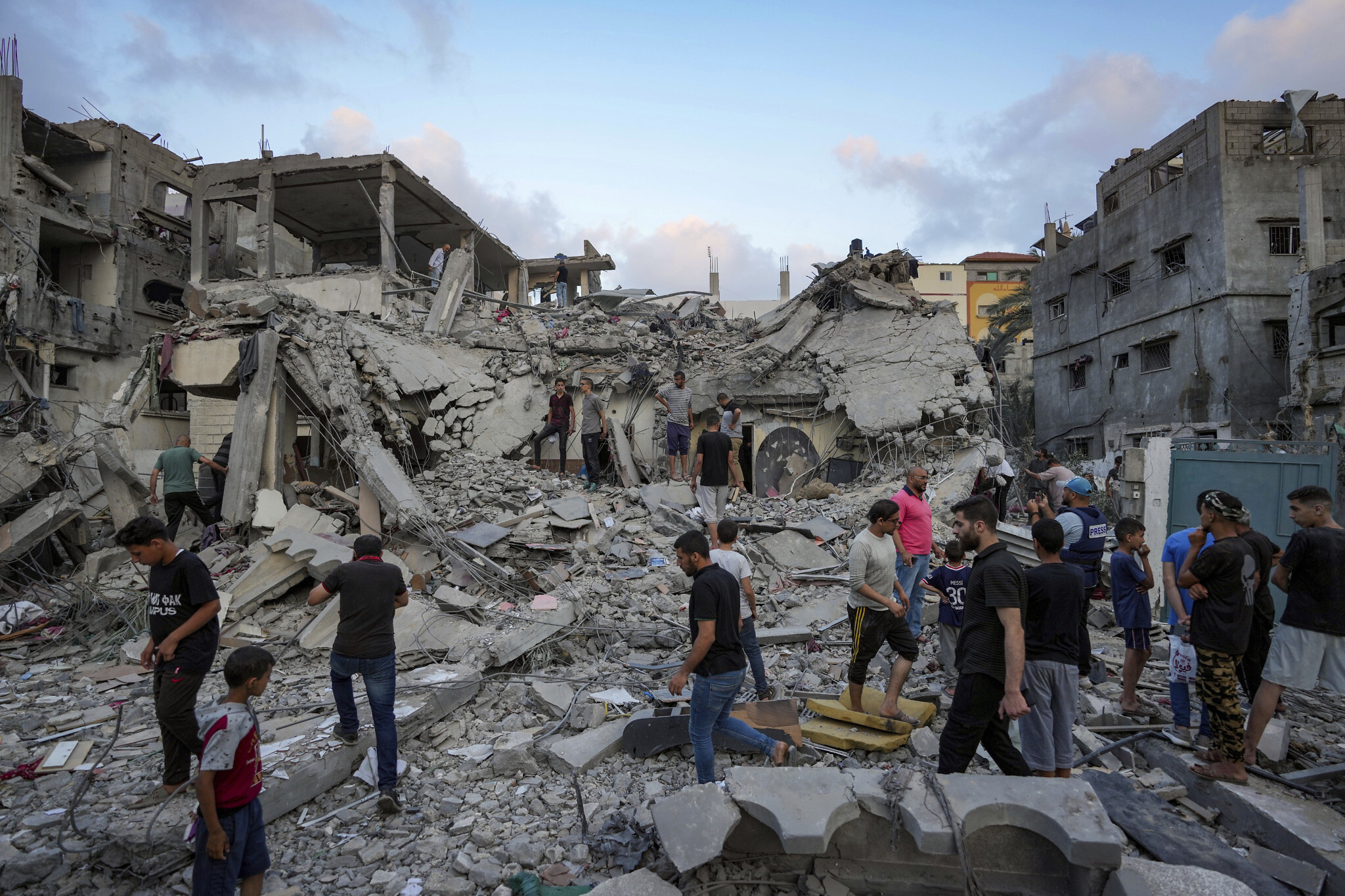
Palestinians look at the destruction after an Israeli airstrike in Deir al Balah, Gaza Strip, Tuesday, April 30, 2024. (AP Photo/Abdel Kareem Hana)

Palestinians look at the destruction after an Israeli airstrike in Deir al Balah, Gaza Strip, Tuesday, April 30, 2024. (AP Photo/Abdel Kareem Hana)

The US State Department is on track to deliver a report to Congress this week determining whether the Biden administration has accepted assurances from Israel that it is using American weapons in accordance with international law.

“That is our intention, to provide it on time,” State Department spokesperson Matthew Miller said on Monday, two days before a May 8 deadline.

The report to Congress, which will be released to the public, is part of a new policy instituted by US President Joe Biden in February requiring foreign aid recipients to provide written assurances that they are using that aid in compliance with international law and that they are not obstructing the assistance of humanitarian aid.

The order does not place any tangible new conditions on foreign assistance, given that recipients have always been required to use the aid in a manner consistent with the laws of war. But the White House has acknowledged that the memo was the result of pressure from progressive lawmakers who have not been convinced that Israel is abiding by these terms.

Israel provided its first written assurance of compliance with the directive, officially known as National Security Memorandum 20, in March. Miller said then that the US had to date not found Israel to have violated the memo but that assessments of Jerusalem’s compliance were ongoing.

In the lead-up to the Wednesday deadline, progressive lawmakers have been intensifying their pressure on the Biden administration to deem Israel out of compliance with international law in what would likely lead to a restriction on US military aid.

Palestinians celebrate in the streets following Hamas’s announcement that it accepted a ceasefire proposal, in Deir al-Balah, Gaza Strip on May 6, 2024. (AP Photo/Abdel Kareem Hana)

Eighty-eight Democrats signed a letter to Biden on Friday expressing “serious concerns regarding the Israeli government’s conduct of the war in Gaza as it pertains to the deliberate withholding of humanitarian aid.”

Israel’s restrictions on US-backed humanitarian aid delivery in Gaza “have contributed to an unprecedented humanitarian catastrophe,” the letter said, citing the US Agency for International Development.

Activists demonstrate outside the US Capitol in Washington, April 20, 2024, as the House prepares to vote on approval of $95 billion in foreign aid for Ukraine, Israel and other US allies. (AP Photo/J. Scott Applewhite)

Israel insists that it does not block relief entering Gaza and that any shortages are the result of the inability of aid agencies to distribute it to those in need. It has also pointed to a recent surge in aid that began last month. The uptick followed a threat from Biden to shift his policy regarding the war if Israel didn’t take immediate steps to improve the humanitarian situation in Gaza, which rights groups say is on the verge of famine.

On Sunday, Israel closed its Kerem Shalom aid crossing into Gaza after a Hamas rocket attack from Rafah killed four IDF troops stationed nearby. The White House said that Biden managed to convince Prime Minister Benjamin Netanyahu during a Monday call to reopen the crossing.

The House Democrats in their Friday letter urged Biden to warn Netanyahu that any impediment to Gaza aid delivery would risk future offensive military aid, while clarifying that defensive aid, such as Iron Dome missile interceptors, would continue.

Israeli soldiers drive a tank at a staging ground near the border with the Gaza Strip, in southern Israel, May 5, 2024. (AP Photo/Tsafrir Abayov)

The Wall Street Journal reported Tuesday that the Biden administration has delayed the sales of thousands of precision weapons to Israel in recent months.

The move, which included holding up MK-82 bombs, fuses and JDAM guidance kits to make the munitions more precise, came amid US pressure on Israel to hold off on a full-scale invasion of the southern Gaza city of Rafah. The sale of the munitions was originally agreed upon in February, the report said.

Over the weekend, the Axios news site reported that the Biden administration put a hold on an ammunition shipment to Israel for the first time since the war’s outbreak.

A White House National Security spokesperson declined to confirm the report, saying they don’t comment on individual cases.

However, the spokesperson noted that the US “has surged billions of dollars in security assistance to Israel since the October 7 attacks, passed the largest ever supplemental appropriation for emergency assistance to Israel, led an unprecedented coalition to defend Israel against Iranian attacks and will continue to do what is necessary to ensure Israel can defend itself from the threats it faces.”

Sen. Chris Van Hollen has been arguably the most vocal progressive opponent to accepting Israeli assurances regarding the Biden memo, telling Politico last week, “God help us if this [State Department] report somehow says that the delivery of humanitarian assistance has been compliant with international standards… Anybody with eyes to see and ears to hear knows that’s just not true.”

But the apprehension regarding continued aid for Israel has expanded to other flanks of the Democratic party. On Friday, Sen. Mark Kelly, one of the party’s more conservative lawmakers, told NBC News that it would be “appropriate” to condition future aid to Israel if the government doesn’t “do better” at preventing civilian deaths in Gaza.

IDF troops operate in the central Gaza corridor, in a handout image published April 28, 2024. (Israel Defense Forces)

Within the State Department as well there are voices calling for deeming Israel out of compliance with the memo.

Representatives from several bureaus raised concerns that Israel has violated international law in its war against Hamas in a memo leaked to Reuters last month.

However, these officials were largely from human rights-related offices within the State Department that have long been less influential in setting policy, often resorting to leaking their frustration to the press after having been overruled by the more decisive political affairs bureau.

The latter office has warned that restricting aid would limit Israel’s ability to meet potential threats outside its airspace and require Washington to re-evaluate “all ongoing and future sales to other countries in the region.”

The bureau, which is leading the forthcoming Blinken report, warned that suspending US weapons would limit Israel’s ability to meet potential threats outside its airspace and would have a domino effect on all ongoing and future sales across the Middle East.

Reuters contributed to this report.