The IDF says it eliminated a senior field commander in Hezbollah’s elite Radwan force in an airstrike in southern Lebanon overnight.
Ali Ahmed Hassin, according to the IDF, held a rank equivalent to a brigade commander, and was charged with attacks on northern Israel’s Ramim Ridge, an area that has come under repeated rocket, missile, and drone attacks amid the war.
“As part of his role, he was responsible for the planning and execution of terror attacks in the Ramim Ridge area against the Israeli home front,” the IDF says.
Hassin was struck in the southern Lebanon town of as-Sultaniyah. According to the IDF, another two Hezbollah operatives under his command were killed in the strike.
Israel’s Ministry of Immigration and Absorption noted a record in the number of immigrants who have arrived in Israel since the outbreak of the war in Gaza against Hamas.
Since the outbreak of hostilities, there has been an increase in the number of people seeking to immigrate to Israel, said the ministry. The numerical data show that since October 7, 2023 there has been a constant monthly increase in the number of immigrants to Israel.
Since October 7, 2023, a total of 12,745 immigrants have immigrated, including about 8,300 from Russia, about 900 from the US, about 400 from France and a similar number from Ukraine. Additional immigrants came from many countries around the world such as Cyprus, Belarus, Argentina, South Africa, Colombia, Australia and more.
The age range of the immigrants to Israel from around the world is wide and diverse, so for example, along with about 850 immigrants of retirement age, about 1,500 elementary and high school students arrived.
In October 2023, a total of 781 immigrants immigrated to Israel. In November 2023 the number doubled and soared to 1,466 immigrants. In December 2023 2,145 immigrants came to Israel and in the first quarter of 2024, the numbers hit a peak number of in March of 3,074 new immigrants.
The age range of the immigrants to Israel from around the world is wide and diverse, so for example, along with about 850 immigrants of retirement age, about 1,500 elementary and high school students arrived.
It can then also invest in its nuclear project while it tries to distract the region with the Gaza war.
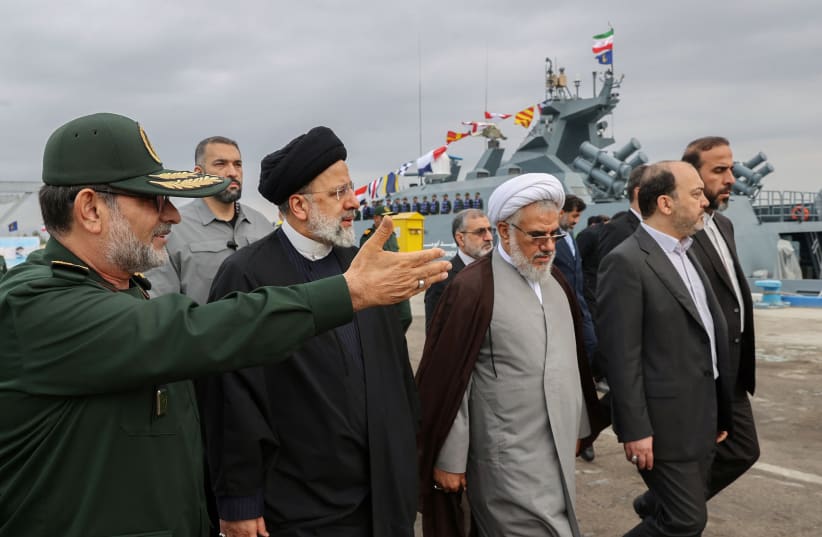
By SETH J. FRANTZMANIranian President Ebrahim Raisi visits the military equipment of IRGC Navy in Bandar Abbas, Iran, February 2, 2024(photo credit: Iran’s Presidency/WANA/Handout via Reuters)
Iran vowed revenge on Israel in the wake of an airstrike in Damascus which killed Mohammed Reza Zahedi, an Iranian Islamic Revolutionary Guard Corps general. The airstrike took place on Monday, April 1. Iran has been messaging about “punishing” Israel for almost a week. This is also the last week of Ramadan and Iran was hosting “Quds Day” events on Friday, an annual event designed to inflame the region about the Palestinian cause.
Now Iran appears to have set a course on its messaging and response. The US had said on Tuesday, April 2, that it was not involved in the airstrike. The airstrike hit a building next to the Iranian consulate in Damascus. Iran views that as an attack on Iranian soil and a major breach of the concept of consulates being off limits from attacks.
The Iranian Revolution took place amid the storming of the US embassy in Tehran and the taking of hostages by the Tehran regime, but Iran doesn’t apparently see that as similar. Be that as it may, Iran’s regime has a message for the US, Israel and the region. The message is this: Iran wants to punish Israel, and it wants the US to be deterred.
On Friday and Saturday the IRGC continued to claim that it would respond. The IRGC claimed that the Quds Day event show that “the issue of Palestine remains the first issue of the Muslim world and that of the awakened non-Muslim societies. It reaffirms the righteousness of the Palestinian people including the oppressed Gazans.”
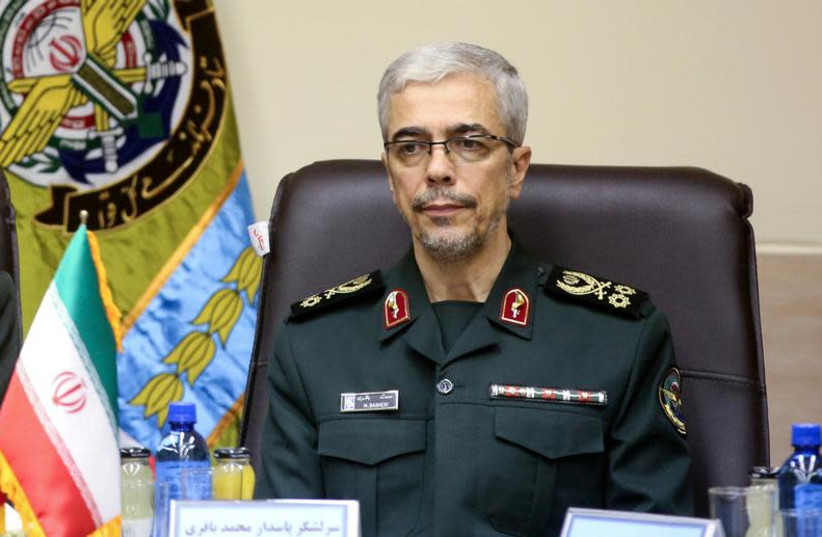
Iran’s Chief of Staff of Iranian Armed Forces Major General Mohammad Baqeri claimed that the US is also responsible for the strike on Iran’s consulate. Iran thus continues to threaten the US and claim that it is an accomplice in the attack. “General Baqeri reiterated the US should be held accountable for the Israeli regime’s carnage in Gaza and other crimes the regime is committing in the region out of desperation,” Fars News reported.
Iranian Military Chief of Staff General Mohammad Baqeri. (credit: TURKISH MILITARY/HANDOUT VIA REUTERS)
Iran’s top commander also claims that Israel has become “bogged down” in Gaza. He compared this to how Israel was portrayed before October 7, when it was seen as projecting power throughout the region. Iran wants Gaza to become a “quagmire” for Israel. Israel has been fighting Hamas for six months. Iran’s Baqeri is openly saying that the October 7 attack was the “tip of the iceberg regarding the prowess of the Palestinians,” Fars News says.
The attempt to drag Israel into a long Gaza war and to isolate Israel in the region is Iran’s plan. October 7 was one part of the plan. Now Iran is also pushing proxies to attack Israel on multiple fronts. For instance it has prodded Iraqi militias to target Eilat with drones.
As Iran tries to isolate Israel, and still hold out the chance it could retaliate against the US for the Damascus incident, it also had a message for Washington. “Iran Advises US not to fall into Israeli trap,” the same Fars News said on Saturday, October 6.
“Tehran has warned Washington to stay away from any potential clash between itself and the Zionist regime, while the United States has cautioned Iran against targeting American facilities and interests.” Iran is trying to distance the US from Israel.
Hezbollah joining the war
In the wake of October 7 the US turned around an aircraft carrier and sent it back into the Eastern Mediterranean to deter Hezbollah or Iran or others from joining a major war on Israel. Hezbollah did join the war, but primarily in firing a small number of rockets a day. This has now become more than 2,500 rockets, but nevertheless the full power of Iran’s proxies has generally been held back, their powder dry.
Iran wants to isolate Israel, distance the US from Israel or make the US feel deterred, and then it will be able to carry out more attacks on Israel. Iran sees this as a “ring of fire” strategy to surround Israel and also to open multiple fronts. It also thinks October 7 exposed Israel’s weaknesses.
Iran’s long-term goal is to weaken the US in the region and get the US to leave, but until that happens it wants the US deterred. Iran challenged the US via 200 attacks by proxies in Iraq and Syria and also killing three US service members in Jordan in January.
Iran is now portraying itself as in dialogue with the US. It says it has warned the US and Iran says the US has “US asked Iran not to target American facilities.” Iran sees this as a major propaganda victory. Iranian propaganda has long been designed to put out messaging in the West that tries to characterize US backing of Israel as potentially leading to a US-Iran war.
For instance in the lead-up to the Iran deal, pro-Iran lobbyists in the West put out hundreds of messages about how the US had to choose between a deal or “war.” Later, during the Trump administration, Iran’s foreign minister used to put out messaging talking about the US and Israeli “B team” and portraying the Trump administration as being led by Israel into more war in the region.
As such, Iran seeks to prey on talking points in the US that prefer isolationism, or talking points that also argue that the “Israel lobby” has influenced US policy to be “anti-Iran.” Tehran is cognizant of how these messages play and it uses them selectively. Now it calls the current conflict in the region an Israel “trap.” It knows US elections are coming and it would like to prey on this issue.
Iran wants a US-Israel rift to grow. It can then also invest in its nuclear project while it tries to distract the region with the Gaza war. Iran is exploiting US messaging after the Damascus attack as well, trying to show that there is daylight between the US and Israel. This is how Iran is angling to exploit the airstrike in Damascus to influence things in the region.