Iran has recently created the “Persian Gulf Strait Authority,” an organization from the Islamic regime that aims to govern the international waterway.
An Iranian flag flutters in the wind as ships remain anchored in the Strait of Hormuz on May 16. Negotiations between the US and Iran over opening this critical waterway have largely stalled.(photo credit: Majid Saeedi/Getty Images) ByTOBIAS HOLCMAN Iran is negotiating with Oman to establish a system that would allow both countries to charge ships transiting the Strait of Hormuz, even after the US warned against establishing payment methods in the waterway, The New York Times reported on Thursday.According to the report, Iranian officials are still looking for ways to generate income from the closure of the international waterway, a key maritime chokepoint for both the energy market and other commodities sold by the Gulf States, such as fertilizers.
Iran has recently created the “Persian Gulf Strait Authority,” an organization from the Islamic regime that aims to govern the international waterway.
On Wednesday, the authority shared a map on X that “defined the boundaries of the Strait of Hormuz management supervision area,” explaining that certain areas required specific permits in order to be transited.
The US has opposed the idea of tolls being established in the Strait, with US President Donald Trump saying on Thursday that “we don’t want tolls. It’s international. It’s an international waterway.”
Ships and boats in the Strait of Hormuz, Musandam, Oman, April 22, 2026. (credit: REUTERS/STRINGER/FILE PHOTO)
“It can’t happen,” said US Secretary of State Marco Rubio, adding that “it would be unacceptable. It would make a diplomatic deal unfeasible if they were to continue to pursue that.”
Iran looks for legal loophole to charge tolls in Strait of Hormuz
The discussions between Oman and Iran are centered on charging fees rather than tolls, a distinction that makes the project legal under international law.
The problem is that tolls for crossing international waterways are illegal under international law, whereas fees for services actually provided in specific ports can be charged without repercussions. The distinction in this case might be only formal, as ships don’t require docking when crossing the Strait under normal conditions.
The idea would still not be legal according to international law precedents, mainly because Iran would be forcing ships into the ports in order to cross, making free navigation of the waterway impossible.
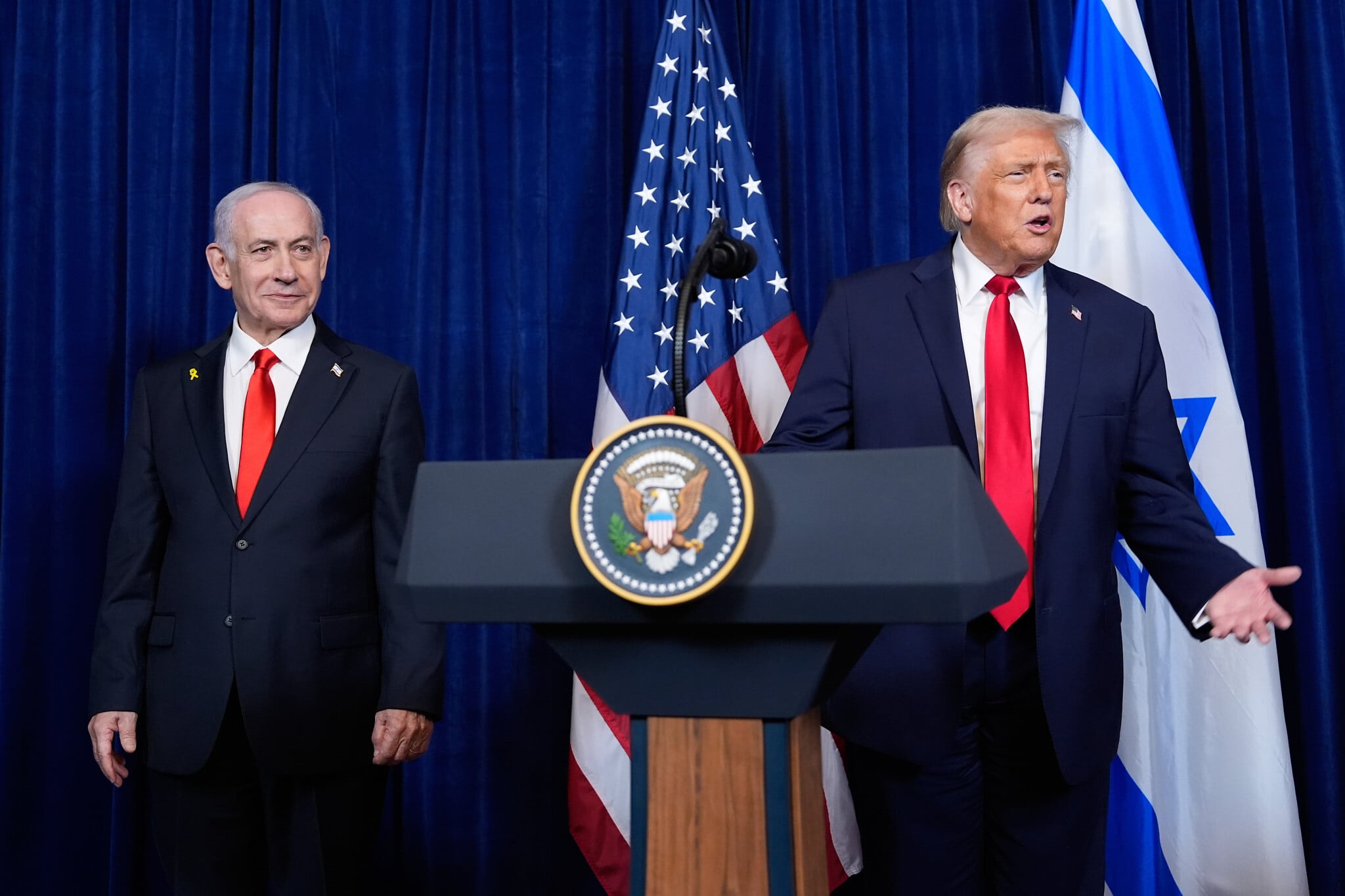
FILE – President Donald Trump answers a question from a reporter at the end of a news conference with Israel’s Prime Minister Benjamin Netanyahu at Mar-a-Lago, in Palm Beach, Florida, December 29, 2025. (AP Photo/Alex Brandon, file)
The United States has almost completely excluded Israel from the negotiations with Iran, two Israeli defense officials tell The New York Times.
Israel was not involved at all in the discussions ahead of the ceasefire and learned of developments in the talks between the US and Tehran from regional diplomatic contacts, as well as through the use of surveillance, the report says.
The Israeli officials spoke to the newspaper on the condition of anonymity due to the sensitive nature of the issue.
The report notes that in the run-up to the start of the war against the Iranian regime earlier this year, Prime Minister Benjamin Netanyahu was in close coordination with Trump and was leading a discussion in the Situation Room in Washington.
“The banishment from the cockpit to economy class has potentially significant consequences for Israel,” the newspaper says.
Two days after presenting the Iranians with the latest US message in the negotiations, Syed Mohsin Naqvi held another round of talks with Iranian Foreign Minister Abbas Araqchi in Tehran.
Iranian Parliament Speaker Mohammad Bagher Ghalibaf meets with Pakistan army chief Asim Munir, in Tehran, Iran, April 16, 2026.(photo credit: Iranian Parliament Speaker Office/WANA (West Asia News Agency)/Handout via REUTERS) ByREUTERS Iran’s foreign minister met Pakistan’s interior minister on Friday to discuss proposals to end the US-Israeli war, Iranian media reported, with Tehran and Washington still at odds over Tehran’s uranium stockpile and controls on the Strait of Hormuz.
Two days after presenting the Iranians with the latest US message in the negotiations, Syed Mohsin Naqvi held another round of talks with Iranian Foreign Minister Abbas Araqchi in Tehran, the semi-official Tasnim and ISNA news agencies reported.
Naqvi was facilitating communication to try and achieve a framework for ending the war and resolving differences, ISNA reported.
US Secretary of State Marco Rubio told reporters on Thursday that there had been “some good signs” in the talks, but there could be no solution if Tehran enforced a tolling system in the Strait of Hormuz, which it effectively closed to most shipping after the war began on February 28.
“There’s some good signs,” Rubio said. “I don’t want to be overly optimistic… So, let’s see what happens over the next few days.”
A woman walks past the mural showing U.S. flag with barbed wire and the Statue Of Liberty with skull face in Tehran, Iran June 25, 2019. (credit: Nazanin Tabatabaee/Nazanin Tabatabaee/West Asia News Agency via REUTERS)A senior Iranian source told Reuters on Thursday that gaps had been narrowed, although uranium enrichment and the Strait of Hormuz remained among the sticking points.
Trump: ‘The US will recover Iran’s stockpile of uranium’
The war has wreaked havoc on the global economy, with the surge in oil prices stoking fears of rampant inflation. About a fifth of the world’s oil and liquefied natural gas shipments traveled through the Strait of Hormuz before the war.
The US dollar was near its highest level in six weeks on Friday amid the uncertainty over the peace talks, while oil prices climbed as investors doubted the prospects of a breakthrough.
“We’re coming to the end of week 12, we’re six weeks in the ceasefire, and I’m just not really that convinced we’re any closer to a resolution between the US and Iran,” Tony Sycamore, a market analyst at IG, said of the Middle East war.
US President Donald Trump said the US would eventually recover Iran’s stockpile of highly enriched uranium, which Washington believes is destined for a nuclear weapon, though Tehran says it is intended purely for peaceful purposes.
“We will get it. We don’t need it, we don’t want it. We’ll probably destroy it after we get it, but we’re not going to let them have it,” Trump told reporters at the White House on Thursday.
Two senior Iranian sources told Reuters before Trump’s comments that Iranian Supreme Leader Ayatollah Mojtaba Khamenei had issued a directive that the uranium should not be sent abroad.
The US president also railed against Tehran’s intentions to charge fees on ships using the strait.
“We want it open, we want it free. We don’t want tolls,” Trump said. “It’s an international waterway.”
Trump faces domestic pressure ahead of November midterm elections, with Americans angry over the surge in fuel prices and his approval rating near its lowest level since he returned to the White House last year.
Tehran submitted its latest offer to the US earlier this week.
Tehran’s descriptions suggest it largely repeats terms Trump previously rejected, including demands for control of the Strait of Hormuz, compensation for war damage, lifting of sanctions, release of frozen assets, and the withdrawal of US troops.
World’s worst energy shock
The International Energy Agency says the conflict has produced the world’s worst energy shock.
It warned on Thursday that the peak of summer fuel demand, coupled with a lack of new supply from the Middle East, meant the market could enter the “red zone” in July and August.
Traffic through the strait has fallen to a trickle compared with 125 to 140 daily passages before the war.
Iran has said it aims to reopen the strait to friendly countries that abide by its terms, which could potentially include fees.
“It would make a diplomatic deal unfeasible if they were to continue to pursue that. So it’s a threat to the world if they were trying to do that, and it’s completely illegal,” Rubio said.
Trump and Israeli Prime Minister Benjamin Netanyahu said their war aims were to curb Iran’s support for regional militias, dismantle its nuclear program, destroy its missile capabilities, and make it easier for Iranians to topple their rulers.
But Iran has so far retained its stockpile of near-weapons-grade enriched uranium, and its ability to threaten neighbors with missiles, drones, and proxy militias.