Macron said France would never initiate an offensive against Russia and that Paris was not at war with Moscow.
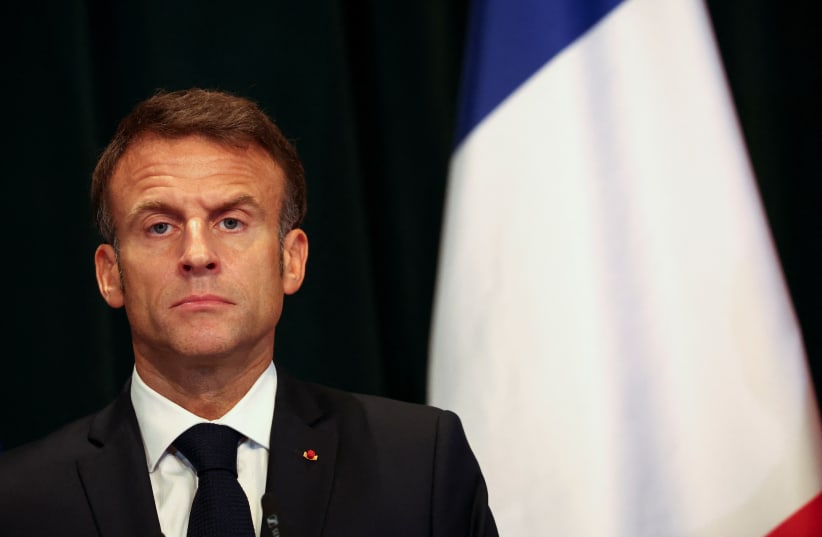
By REUTERSUpdated: MARCH 15, 2024 03:41French President Emmanuel Macron attends a press conference in Tirana, Albania, October 17, 2023.(photo credit: REUTERS/FLORION GOGA)
French President Emmanuel Macron called President Vladimir Putin’s Russia an adversary that would not stop in Ukraine if it defeated Kyiv’s troops in the two-year-old conflict, urging Europeans to not be “weak” and to get ready to respond.
Macron caused controversy last month after he said he could not rule out the deployment of ground troops in Ukraine in the future, with many leaders distancing themselves from that while others, especially in Eastern Europe, expressed support.
“If Russia wins this war, Europe’s credibility will be reduced to zero,” Macron said in a television interview mostly directed at a domestic audience after French opposition leaders criticized his comments as bellicose.
Macron said he “deeply” disagrees with the opposition leaders. “Today, deciding to abstain or vote against support for Ukraine is not choosing peace; it’s choosing defeat. It’s different,” he said.
Macron’s main opposition party, the far-right of Marine Le Pen, abstained in parliament on a vote earlier this week about a security pact France signed with Ukraine, while the hard left France Unbowed party voted against it.
French President Emmanuel Macron attemds a ceremony to pay tribute to the victims of October 7, in the courtyard of the Hotel des Invalides in Paris, France, February 7, 2024 (credit: FLASH90)
“If war spread in Europe, Russia would be to blame,” Macron added. “But if we decided to be weak; if we decided today that we would not respond, it would be choosing defeat already. And I don’t want that.”
He said it was important for Europe not to draw red lines, which would signal weakness to the Kremlin and encourage it to push on with its invasion of Ukraine. He refused to give details on what a deployment to Ukraine might look like.
“I don’t want to do so. I want Russia to stop this war and retreat from its positions and allow peace,” he said. “I’m not going to give visibility to someone who is not giving me any. This is a question for President Putin.”
“I have reasons not to be precise,” he said.
France will not initiate
Macron said France would never initiate an offensive against Russia and that Paris was not at war with Moscow, despite the fact that Russia had launched aggressive attacks against French interests in and outside France.
“The Kremlin regime is an adversary,” he said, declining to call Russia an enemy. He also said Putin making threats about nuclear strikes was “not appropriate.”
Macron said Ukraine was in a “difficult” situation on the ground and that stronger support from allies was necessary.
“Peace does not mean the capitulation of Ukraine,” he said. “Wanting peace does not mean defeat. Wanting peace does not mean dropping Ukraine,” he said.
He also said he hoped that the time would come one day to negotiate peace with a Russian president, “whoever it might be,” for the first time envisaging the possibility of Putin no longer being in charge in Russia.
Macron also said he had not canceled a planned visit to Ukraine for security reasons. “That’s what Russia said. You shouldn’t believe them,” he said.
Nasrallah reassured Qaani he didn’t want Iran to get sucked into a war with Israel or the United States and that Hezbollah would fight on its own, all the sources said.
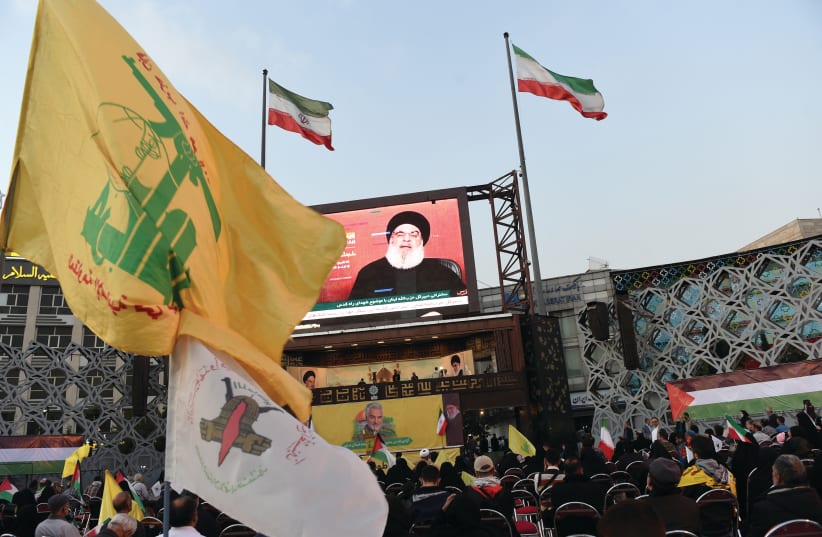
By REUTERSUpdated: MARCH 15, 2024 10:20A CROWD in Tehran watches an address, on the screen by Hezbollah leader Hassan Nasrallah, in November. Hezbollah is virtually a state within a state, sucking the lifeblood out of Lebanon at the instigation of Iran, says the writer.(photo credit: WEST ASIA NEWS AGENCY/REUTERS)
With ally Hamas under attack in Gaza, the head of Iran’s Quds Force visited Beirut in February to discuss the risk posed if Israel next aims at Lebanon’s Hezbollah, an offensive that could severely hurt Tehran’s main regional partner, seven sources said.
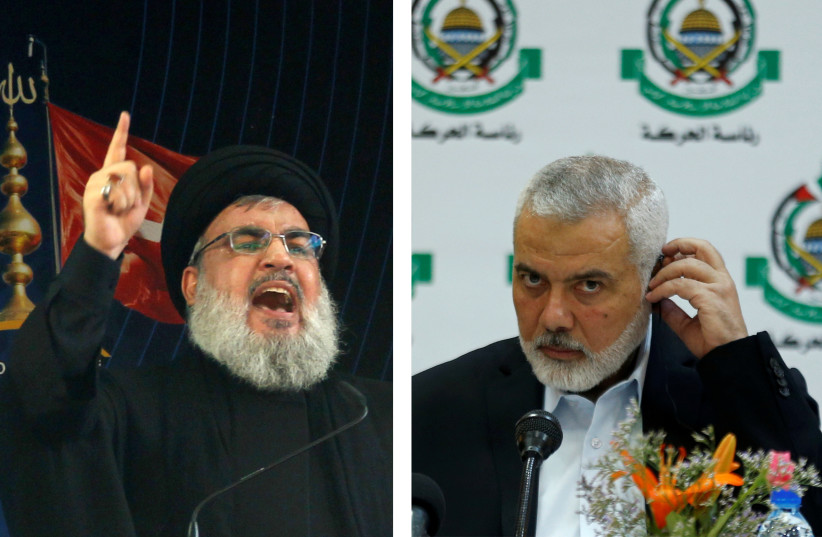
In Beirut, Quds chief Esmail Qaani met Hezbollah leader Sayyed Hassan Nasrallah, the sources said, for at least the third time since Hamas’ deadly October 7 attacks on southern Israel and Israel’s devastating retaliatory assault on Gaza.
The conversation turned to the possibility of a full Israeli offensive to its north, in Lebanon, the sources said. As well as damaging the Shi’ite Islamist group, such an escalation could pressure Iran to react more forcefully than it has so far since October 7, three of the sources, Iranians within the inner circle of power, said.
Over the past five months, Hezbollah, a sworn enemy of Israel, has shown support for Hamas in the form of limited volleys of rockets fired across Israel’s northern border.
At the previously unreported meeting, Nasrallah reassured Qaani he didn’t want Iran to get sucked into a war with Israel or the United States and that Hezbollah would fight on its own, all the sources said.
“This is our fight,” Nasrallah told Qaani, said one Iranian source with knowledge of the discussions.
Calibrated to avoid a major escalation, the skirmishes in Lebanon have nonetheless pushed tens of thousands of people from their homes on either side of the border. Israeli strikes have killed more than 200 Hezbollah fighters and some 50 civilians in Lebanon, while attacks from Lebanon into Israel have killed a dozen Israeli soldiers and six civilians.
IDF strikes escalate
In recent days, Israel’s counter-strikes have increased in intensity and reach, fueling fears the violence could spin out of control.
Israeli Defence Minister Yoav Gallant indicated on Sunday that Israel planned to increase attacks to decisively remove Hezbollah fighters from the border in the event of a Gaza ceasefire, although he left the door open for diplomacy.
In 2006, Israel fought a short but intense air and ground war with Hezbollah that was devastating for Lebanon.
Israeli security sources have said previously that Israel did not seek any spread of hostilities but added that the country was prepared to fight on new fronts if needed. An all-out war on its northern border would stretch Israel’s military resources.
Iran and Hezbollah are mindful of the grave perils of a wider war in Lebanon, two of the sources aligned with the views of the government in Tehran said, including the danger it could spread and lead to strikes on Iran’s nuclear installations.
The US lists Iran as a state sponsor of terrorism and has sought for years to rein in Tehran’s nuclear program. Israel has long considered Iran an existential threat. Iran denies it is seeking a nuclear weapon.
Speaking with Iranian and Lebanese sources
For this story, Reuters spoke to four Iranian and two regional sources, along with a Lebanese source who confirmed the thrust of the meeting. Two US sources and an Israeli source said Iran wanted to avoid blowback from an Israel-Hezbollah war. All requested anonymity to discuss sensitive matters.
The US State Department, Israel’s government, Tehran, and Hezbollah did not respond to requests for comment.
The Beirut meeting highlights strain on Iran’s strategy of avoiding major escalation in the region while projecting strength and support for Gaza across the Middle East through allied armed groups in Iraq, Syria, and Yemen, analysts said.
Qaani and Nasrallah “want to further insulate Iran from the consequences of supporting an array of proxy actors throughout the Middle East.” said Jon Alterman of Washington’s Center for Strategic and International Studies think tank, responding to a question about the meeting.
“Probably because they assess that the possibility of military action in Lebanon is increasing and not decreasing.”
Already, Tehran’s carefully nurtured influence in the region is being curtailed, including by Israel’s offensive against Hamas along with potential US-Saudi defense and Israel-Saudi normalization agreements, as well as US warnings that Iran should not get involved in the Hamas-Israel conflict.
Qaani and Nasrallah control tens of thousands of fighters and a vast arsenal of rockets and missiles. They are the main protagonists in Tehran’s network of allies and proxy militias, with Qaani’s elite Quds Force acting as the foreign legion of Iran’s Revolutionary Guards.
While Hezbollah has publicly indicated it would halt attacks on Israel when the Israeli offensive in Gaza stops, US Special Envoy Amos Hochstein said last week a Gaza truce would not automatically trigger calm in southern Lebanon.
Arab and Western diplomats report that Israel has expressed strong determination to no longer allow the presence of Hezbollah’s main fighters along the border, fearing an attack similar to Hamas’ incursion that killed 1,200 people and took 253 hostages.
“If there is a ceasefire in (Gaza), there are two schools of thought in Israel, and my impression is that the one that would recommend continuing the war on the border with Hezbollah is the stronger one,” said Sima Shine, a former Israeli intelligence official who is currently head of the Iran program at the Institute for National Security Studies:
A senior Israeli official agreed that Iran was not seeking a full-blown war, noting Tehran’s restrained response to Israel’s offensive on Hamas.
“It seems that they feel they face a credible military threat. But that threat may need to become more credible,” the official said.
Washington, via Hochstein, and France have been working on diplomatic proposals that would move Hezbollah fighters from the border area in line with UN resolution 1701 that helped end the 2006 war, but a deal remains elusive.
A war in Lebanon would be a blow for Iran
A war in Lebanon that seriously degrades Hezbollah would be a major blow for Iran, which relies on the group founded with its support in 1982 as a bulwark against Israel and to buttress its interests in the broader region, two regional sources said.
“Hezbollah is in fact the first line of defense for Iran,” said Abdulghani Al-Iryani, a senior researcher at the Sana’a Center for Strategic Studies, a think tank in Yemen.
If Israel were to launch major military action on Hezbollah, the Iranian sources within the inner circle of power said, Tehran may find itself compelled to intensify its proxy war.
An Iranian security official acknowledged, however, that the costs of such an escalation could be prohibitively high for Iran’s allied groups. Direct involvement by Iran, he added, could serve Israel’s interests and provide justification for the continued presence of US troops in the region.
Given Tehran’s extensive, decades-long ties with Hezbollah, it would be difficult, if not impossible, to put distance between them, one US official said.
Since the Hamas attack on Israel, Iran has given its blessing to actions in support of its ally in Gaza, including attacks by Iraqi groups on US interests. It has also supplied intelligence and weapons for Houthi operations against shipping in the Red Sea.
But it has stopped well short of an unfettered multi-front war on Israel that, three Palestinian sources said, Hamas had expected Iran to support after October 7.
Before the Beirut encounter with Nasrallah, Qaani chaired a two-day meeting in Iran in early February along with militia commanders of operations in Yemen, Iraq, and Syria, three Hezbollah representatives, and a Houthi delegation, one Iranian official said.
The official said Revolutionary Guard Commander-in-Chief Major General Hossein Salami was also present. Hamas did not attend.
“At the end, all the participants agreed that Israel wanted to expand the war and falling into that trap should be avoided as it will justify the presence of more US troops in the region,” the official said.
Shortly after, Qaani engineered a pause in attacks by the Iraqi groups. So far, Hezbollah has kept its tit-for-tat responses within what observers have called unwritten rules of engagement with Israel.
Despite decades of proxy conflict since Iran’s 1979 revolution, the Islamic Republic has never directly fought in a war with Israel, and all four Iranian sources said there was no appetite for that to change.
According to the Iranian insider, Supreme Leader Ayatollah Ali Khamenei is not inclined to see a war unfold in Iran, where domestic discontent with the ruling system last year spilled over into mass protests.
“The Iranians are pragmatists, and they are afraid of the expansion of the war,” said Iryani.
“If Israel were alone, they would fight, but they know that if the war expands, the United States will be drawn in.”
“Whether you like Bibi or not, it’s not the question. The question is, is it appropriate for anybody in this body telling another country to take their government down?” Graham said
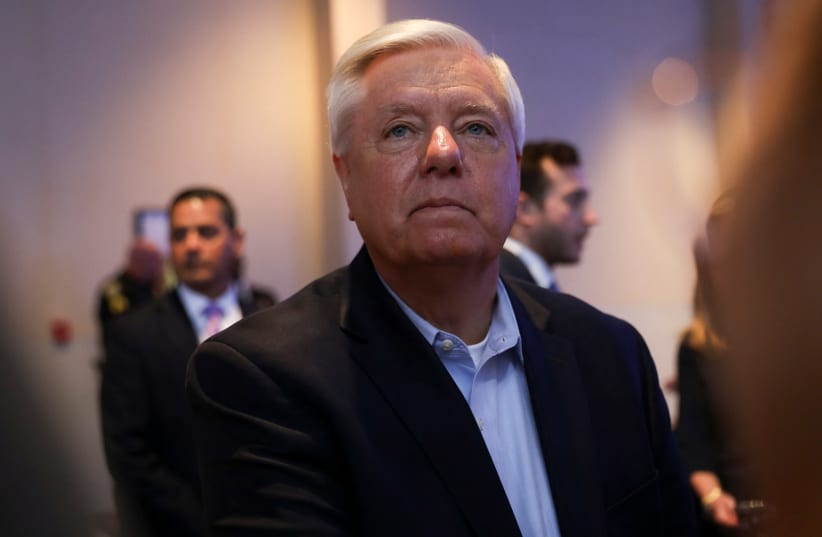
By HANNAH SARISOHNUpdated: MARCH 14, 2024 22:13U.S. Senator Lindsey Graham (R-SC) speaks to members of the press at Republican presidential candidate and former U.S. President Donald Trump’s South Carolina Republican presidential primary election night party in Columbia, South Carolina, U.S. February 24, 2024.(photo credit: REUTERS/ALYSSA POINTER)
Sen. Chuck Schumer’s comments calling for a new election Thursday morning were “earth-shatteringly bad” and “hurtful,” Sen. Lindsey Graham (R-SC) said later in the day.
“The majority leader of the United States Senate is calling on the people of Israel to overthrow their government. Whether you like Bibi or not, it’s not the question. The question is, is it appropriate for anybody in this body to tell another country to take their government down?” Graham said on the Senate floor.
This is a departure about how the US interacts with its allies and it’s done enormous damage to delicate negotiations, Graham said.
The US should remain Israel’s ally
America should be helping Israel without qualification, according to Graham. The best way to find an end to Gazan’s suffering will be to destroy Hamas, he said.
Graham likened pulling support for Israel’s fight against Hamas to “stepping the foot off the gas” when it came to fighting the Nazis and Japanese in WWII.
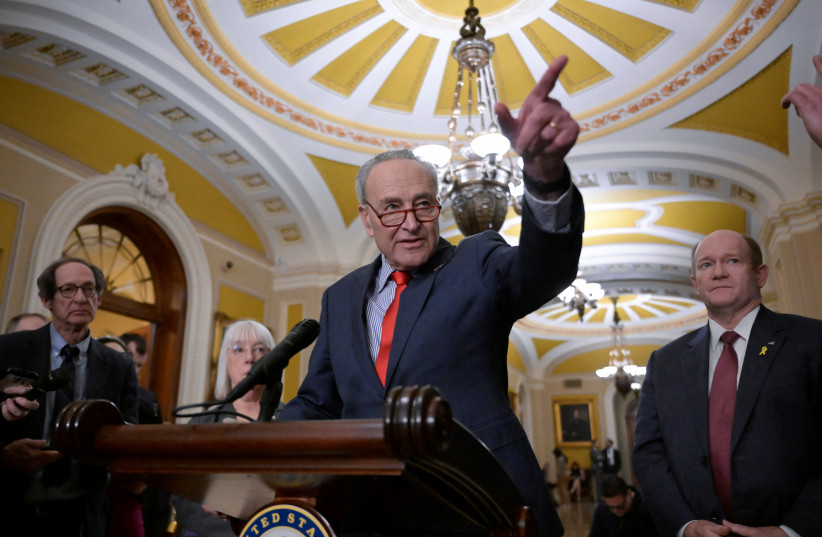
U.S. Senate Majority Leader Chuck Schumer (D-NY) speaks during a press conference following the weekly Senate caucus luncheons on Capitol Hill in Washington, U.S., March 12, 2024. (credit: REUTERS/Craig Hudson)
“We’re having prominent Democratic members, people I respect, calling on the Israeli people to take down their government. I can’t believe it. I thought it was a joke. I thought somebody was pranking me this morning,” Graham said.
Graham said he’s still hoping for a way for relations between Saudi Arabia and Israel to normalize, and part of that deal would be a better life for Palestinians. This will not happen if Hamas is not destroyed, according to Graham.
Graham challenged Schumer’s claim that Prime Minister Benjamin Netanyahu is a hindrance to achieving peace, saying the problem is “radical Islam wanting to kill every Jew they can find.”
“Senator Schumer, I’m disappointed. You’ve done a lot of damage, my friend, and you need to fix this,” Graham said.