Senior IDF official: No change in home front rules • US close to delivering Israeli “Gideon” KC-46 refueling aircraft • IDF strikes Hezbollah in Lebanon
US forces patrol the Arabian Sea near M/V Touska on April 20, 2026, after firing upon the Iranian-flagged vessel that the U.S. accused of attempting to violate the U.S. naval blockade of Iranian ports near the Strait of Hormuz.(photo credit: U.S. Navy via Getty Images)
Britain condemns Iranian strikes on the United Arab Emirates
ByREUTERSBritish Prime Minister Keir Starmer on Monday condemned the Iranian drone and missile strikes targeting the United Arab Emirates.Starmer called on Iran to engage in diplomacy to prevent further escalation in the Middle East, the prime minister’s office said.
“We stand in solidarity with the UAE and will continue to support the defense of our partners in the Gulf. This escalation must cease. Iran needs to engage meaningfully in negotiations to ensure the ceasefire in the Middle East endures, and a long-term diplomatic solution is achieved,” Starmer said.
Iran hit several ships in the Strait of Hormuz on Monday and set a UAE oil port ablaze, as US President Donald Trump’s attempt to use the US Navy to free up shipping provoked the war’s biggest escalation since a ceasefire was declared four weeks ago.
Iran’s Araqchi says no military solution in Hormuz, warns US and UAE against ‘quagmire’
ByREUTERSIran’s Foreign Minister Abbas Araqchi said events in the Strait of Hormuz showed there was no military solution to the crisis, adding that talks were making progress with Pakistan’s mediation while warning the US and the UAE against being drawn into a “quagmire by ill-wishers.”
Iran threatens UAE, warns it not to become ‘Israel’s toy’ – Tasnim
ByJERUSALEM POST STAFFIran warned the United Arab Emirates on Monday not to become “Israel’s toy,” threatening to treat the country as “part of the Zionist regime” if it takes “unwise” action, according to a report by the Islamic Revolutionary Guard Corps (IRGC)-affiliated Tasnim News Agency.
IDF intercepts ‘suspicious aerial target’ in southern Lebanon
ByJERUSALEM POST STAFFThe IDF intercepted a “suspicious aerial target” in southern Lebanon after it approached an area where IDF soldiers were operating, the military said on Monday.No injuries were reported, and no sirens were sounded, the IDF added.
Trump threatens to ‘blow Iran off face of the Earth’ if US vessels attacked
“We have more weapons and ammunition at a much higher grade than we had before,” Trump said. “We have the best equipment.”
US President Donald Trump departs the White House in Washington, DC, US, May 1, 2026.(photo credit: REUTERS/KEVIN LAMARQUE)US President Donald Trump threatened that Iran would be “blown off the face of the Earth” if US vessels were attacked in the Strait of Hormuz during an interview with FOX News on Monday.“We have more weapons and ammunition at a much higher grade than we had before,” Trump said. “We have the best equipment. We have stuff all over the world. We have these bases all over the world. They’re all stocked up with equipment. We can use all of that stuff, and we will, if we need it.”
Senior IDF official: No change in home front rules despite Iran attack on UAE, Oman
“Our air defense systems and attack capabilities are prepared at a high level which is something which has not changed since the ceasefire decision,” the IDF official said.
Fire and smoke rise in the Fujairah Oil Industry Zone, caused by debris after interception of a drone by air defenses, UAE, March 4, 2026; illustrative.(photo credit: REUTERS/Amr Alfiky TPX IMAGES OF THE DAY)Despite an Iranian attack on the UAE and Oman on Monday night, a senior IDF official said that there was still no change to Israel’s home front rules.According to the official, “the IDF is following the situation and is at a high level of readiness.”
Israel prepared for all scenerios, official tells ‘Post’
ByAMICHAI STEINIsrael is prepared for all scenarios following developments in the Gulf, an official told The Jerusalem Post on Monday, adding that Prime Minister Benjamin Netanyahu held several security consultations throughout the day.
US destroys six Iranian small boats, shoots down missiles, drones, US admiral says
ByREUTERSThe US military has destroyed six Iranian small boats and intercepted Iranian cruise missiles and drones fired by Tehran as the US launches an operation to free up shipping through the Strait of Hormuz, US Admiral Brad Cooper, the head of Central Command, said on Monday.Cooper said he “strongly advised” Iranian forces to remain clear of US military assets as it launches the operation. He said a US blockade of Iran, which prevents ships from going to Iran or departing Iranian territory, also remains in effect and was exceeding expectations.
Iran has denied that any boats were sunk.
FlyDubai aircraft from Tel Aviv safely lands in UAE after initial diversion to Oman
ByJERUSALEM POST STAFF, KESHET NEEVA FlyDubai aircraft that took off from Tel Aviv safely landed in the United Arab Emirates after initially diverting to Oman due to UAE airspace closures, the Transportation Ministry told The Jerusalem Post on Monday.Earlier on Monday, three indian citizens were moderately wounded in an Iranian drone attack on Fujairah’s oil industry complex in the UAE, Fujairah’s media office said.
Three Indian citizens wounded in Iranian drone attack on UAE oil facility
Earlier on Monday, the UAE Defense Ministry announced it had intercepted three missiles, with a fourth missile falling into the sea.
Smoke from a reported rocket interception is seen in the sky over Abu Dhabi on February 28, 2026.(photo credit: Fadel SENNA / AFP via Getty Images)Three indian citizens were moderately wounded in an Iranian drone attack on Fujairah’s oil industry complex in the United Arab Emirates, Fujairah’s media office said on Monday.Earlier on Monday, the UAE Defense Ministry announced it had intercepted three missiles, with a fourth missile falling into the sea.
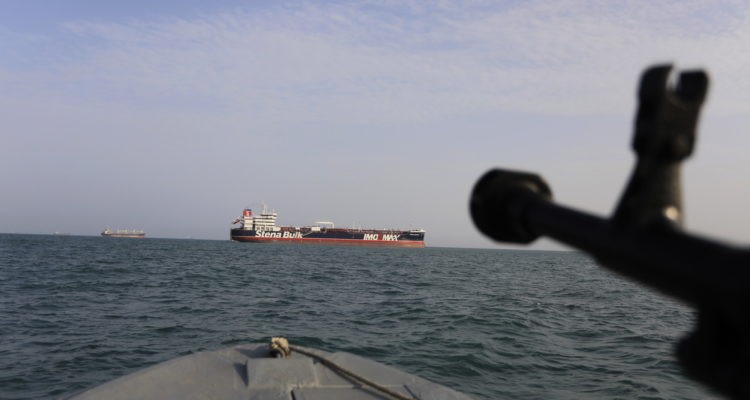
A speedboat belonging to Iran’s Revolutionary Guard approaches British-flagged oil tanker Stena Impero, July 21, 2019. (AP/Tasnim News Agency/Morteza Akhoondi)
Iran issued a sharp warning following the launch of President Donald Trump’s “Project Freedom,” with a senior commander saying any foreign military presence in the Strait of Hormuz would face a “very harsh response.”
Khatam al-Anbiya Central Headquarters commander Ali Abdollahi said Iran “maintains and powerfully manages the security of the Strait of Hormuz,” urging all commercial vessels and oil tankers not to transit the waterway without coordination with Iranian forces “so that their security is not endangered.”
The warning comes as U.S. Central Command rolls out a large-scale escort operation involving naval destroyers, over 100 aircraft, unmanned systems, and roughly 15,000 personnel to guide ships through the strategic strait.
All IDF officers are careful to state that the military never promised regime change, and at most the opportunity to improve conditions for such a change.
A billboard with Iranian centrifuges illustrations and portraits of nuclear scientists killed in Israeli strikes is displayed on a street in Tehran, Iran August 29, 2025(photo credit: MAJID ASGARIPOUR/WANA (WEST ASIA NEWS AGENCY) VIA REUTERS) ByYONAH JEREMY BOBAs a series of complex post-Iran war dilemmas are set into place, the IDF has shifted to focus almost all of its Iran-related attention to the nuclear issue, with the ballistic missiles and regime change questions mostly falling by the wayside.
In briefings, the IDF is spending significant time emphasizing the continued danger of the 60% enriched uranium which the Islamic regime might access under the rubble of its Isfahan and other facilities.
Discussing that issue, the IDF is making it clear that it would be ready to return to a full-fledged war to prevent Iran from using the uranium to move toward a nuclear weapon.
Yet in the same briefings, the ballistic missile threat which Iran wields, has used with lethal effect against the Jewish state four times since 2024, and for which ostensibly Israel went to war with Iran on February 28, is getting much less attention.
It is unclear if the downplaying of the threat relates to the messaging of the US, the greater relative danger posed by a nuclear weapon, the success of the current war in setting the threat back multiple years, or the post war fog surrounding how many missiles remain and how quickly Iran might rebuild the threat.
A large plume of smoke rises over Tehran after explosions were reported in the city during the night on March 28, 2026 in Tehran, Iran. (credit: GETTY IMAGES)
IDF never promised regime change
Of course, the IDF is still carefully following the ballistic missile threat.
However, the impression given in briefings is that the nuclear issue – which many had said was set back by years after the June 2025 operation – is far and above the focus for analyzing post-war moves.
Likewise, regime change has mostly disappeared from IDF briefings.
All IDF officers are careful to state that the military never promised regime change, and at most the opportunity to improve conditions for such a change.
On Friday, the IDF went so far as to admit that some of the attacks on low level Basij militias and checkpoints in Iran, may have been a waste of resources, since they did not change the situation on the ground.
Defending the attacks on the Basij and checkpoints in Iran, the IDF did not so much emphasize positive impact from these attacks as it noted that even during such attacks, it continued to strike other aspects of military threats which Iran presented to Israel.
Putting together the mosaic of targets in Iran the IDF said was like playing a complex symphony.
In terms of achievements in Iran, the IDF said that part of the success came from January 16, 2024 and March 7, 2024 decisions within the IDF to establish the now humongous Iran-focused air force unit.
Mockups of domestically-made Iranian missiles are displayed at an exhibition outside the Defence Museum in Tehran on March 31, 2026. (credit: AFP VIA GETTY IMAGES)
According to the IDF, this sub-unit within the air force has effectively become the military “Iran Command.”
Discussing other moves which the air force may make in the future, the air force said that it may establish a set full-time division devoted to the IDF Central Command for fighting Palestinian terror in the West Bank.
Since summer 2023, the IDF started to use the air force continuously more aggressively against West Bank Palestinian terror – something it had not done for years since the end of the Second Intifada in 2005.
On Thursday, the IDF Central Command announced that it was establishing a larger and more systematic targeting center for aerial and other heavy firepower, similar to what exists for the IDF Northern and Southern Commands.