Israelis block the Nitzana checkpoint to prevent resupply trucks into Gaza. Feb. 14, 2024

(JNS) U.S. State Department spokesman Matthew Miller accused Israeli ministers of being an “obstacle” to Gaza aid on Tuesday, as Washington continues to press Israel to do more to help Palestinian civilians.

Miller was asked at the State Department’s daily press briefing what White House adviser John Kirby meant on Monday when he said that some “inorganic obstacles” to aid delivery had been put in place by the Israeli cabinet.

“You have seen ministers in the Israeli government block the release of flour from the port at Ashdod,” Miller said. “You have seen ministers of the Israeli government supporting protests that blocked aid from going into Kerem Shalom. All of those things are obstacles coming from ministers inside the Israeli government that we have called out, that we have said should end.”

Jonathan Panikoff, director of the Atlantic Council’s Scowcroft Middle East Security Initiative, told JNS that the Biden administration has clearly changed its tone, reflecting White House frustration about the aid situation in Gaza. That’s been particularly the case in the wake of last week’s riot, during which dozens of Palestinians were killed while aid was being delivered.

“I think the convoy last week—even accounting for the facts coming out that there were two different incidents—really encapsulated the frustration by the White House and much of Congress, especially Democrats. Even a small number of Gazans seeking food being killed by the IDF, and even if they rushed the area, should not have happened,” Panikoff said.

“The idea that five months into the conflict, there’s still not sufficient planning for food delivery was rather shocking to U.S. officials,” Panikoff added.

Miller did not name the ministers that Washington held responsible.

US pressures for ceasefire with no hostages freed: Report

Washington appears to now accept Hamas’ claim that a ceasefire is necessary in order to collect information about the hostages’ whereabouts and physical conditions.

By World Israel News

The Biden administration is said to be pressuring Jerusalem to accept a ceasefire proposal that would see a pause in the fighting in Gaza, but with no guarantees regarding the return of Israeli captives kidnapped on October 7th.

Washington’s push comes after a senior Hamas representative claimed that the terror group does not know which hostages are alive or dead, nor their physical location.

It’s unclear whether or not that statement is accurate, as later in the same interview the Hamas official said that such information about the hostages is “valuable” and should not be provided to Israel “for free.”

According to report by the Wall Street Journal, the U.S. is no longer pushing its Qatari interlocuters to frame the release of hostages as a precondition for a temporary stop to military action in the Strip.

Rather, Washington appears to now accept Hamas’ claim that a ceasefire is necessary in order to collect information about the hostages’ whereabouts and physical conditions.

Notably, Arabic-language newspaper Al-Akhbar reported that Hamas is continuing to play hardball, stating that they will only accept a ceasefire that goes beyond a pause in fighting, demanding

There is “no room for negotiations and agreements that do not ultimately lead to a halt to the entire war, and the complete withdrawal of the [IDF] army from the Gaza Strip,” Hamas negotiators reportedly said.

On Tuesday evening, U.S. President Joe Biden expressed optimism regarding a truce.

“The Israelis are cooperating, and it’s now up to Hamas to agree to a ceasefire,” he said.

Under intense pressure from the international community and the left-wing flank of the Democratic party, Biden has increasingly scaled up his public criticism of the Israeli military campaign in Gaza.


Palestinian sources claimed that the decision to attack was made solely by five Hamas leaders, among whom were Sinwar.

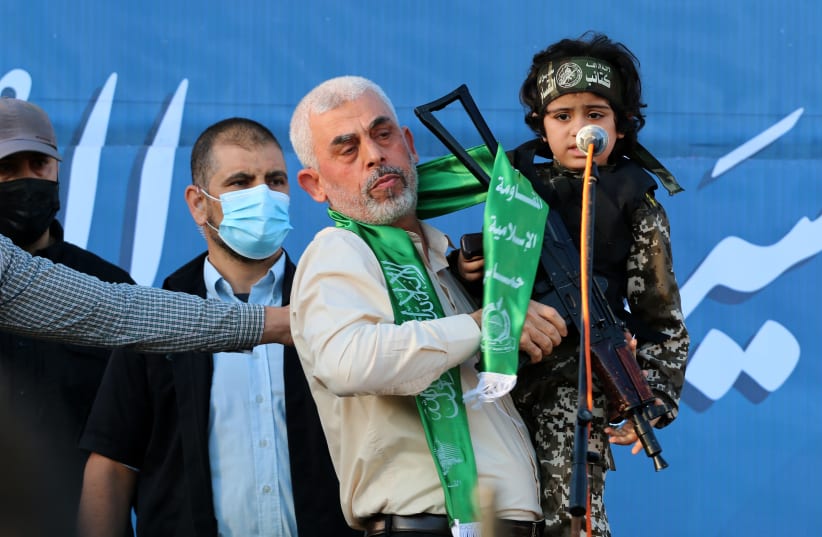
 Yahya Sinwar, leader of the Palestinian Hamas terrorist movement, gestures on stage during a rally in Gaza City. May 24, 2021.  (photo credit: ATIA MOHAMMED/FLASH90)
Yahya Sinwar, leader of the Palestinian Hamas terrorist movement, gestures on stage during a rally in Gaza City. May 24, 2021.
(photo credit: ATIA MOHAMMED/FLASH90)
Yahya Sinwar, Hamas chief in Gaza, has been the object of criticism within the Hamas leadership for launching the October 7 attack without prior consultation with other Hamas leaders, according to a Sky News Arabia report on Tuesday.

According to sources who spoke with the news outlet, those who made the decision to attack were Sinwar, along with his brother Muhammad Sinwar, Muhammad Deif, Hamas military chief, and Marwan Issa, Hamas’s Deputy Military Commander. The four had not consulted the rest of the Hamas leadership and its political bureau, who were ignorant of the decision.

A-Sharq el-Awsat’s January report

A report published by a-Sharq el-Awsat in January, based on Palestinian sources close to the al-Qassam Brigades, claimed that the decision to attack was made solely by five Hamas leaders, among whom were Sinwar, Sinwar’s brother, Deif, Rouhi Mushtaha, a Hamas official close associate of Sinwar and  Ayman Nofal, close to Deif and previous leader of the al-Qassam Brigades’ intelligence.

Interestingly, in the January report, Issa was not included in the close list of confidants.

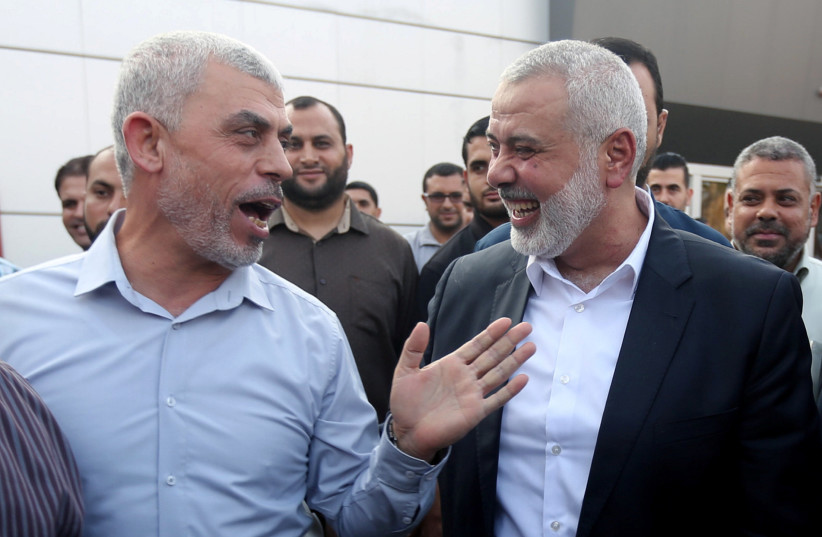
 Hamas Gaza Chief Yahya Sinwar (L) gestures as he speaks with Hamas chief Ismail Haniyeh at the Rafah border crossing in the southern Gaza Strip September 19, 2017 (credit: REUTERS/IBRAHEEM ABU MUSTAFA)Enlrage image
Hamas Gaza Chief Yahya Sinwar (L) gestures as he speaks with Hamas chief Ismail Haniyeh at the Rafah border crossing in the southern Gaza Strip September 19, 2017 (credit: REUTERS/IBRAHEEM ABU MUSTAFA)

In addition, the report stated that the decision to attack and its timing were taken only on October 6, a day prior to October 7.

To ensure secrecy, many of Hamas’s field commanders were not made privy to the specific details of the attack while leaders of the al-Qassam Brigade units received information concerning the attack some three days before.

According to the a-Sharq el-Awsat report, only a few hours prior to the attack did details concerning the attack pervade to a larger circle of Hamas leaders, among whom were Ismail Haniyeh, leader of Hamas’s political bureau and Saleh Arouri, a senior Hamas leader.

Yonah Jeremy Bob contributed to this article.