An Israeli delegation of top security officials returned from talks in Paris on Saturday as reports spread of growing hope in Jerusalem that a new hostage release deal with Hamas could be within reach.
Israel’s war cabinet was to convene Saturday evening to discuss the emerging “outline of an agreement,” described by an Israeli official cited widely in media as a “basis on which to build a plan and the principles for negotiations.”
“There’s significant progress and a solid basis for discussions,” the official said.
At the same time, an Israeli official told The Times of Israel that while there was optimism in Israeli media about the likelihood of a deal, the delegation itself was more cautious.
Talks in Paris were held between Israel, American, Egyptian and Qatari representatives who have been working for weeks to secure a deal to free hostages and pause the fighting. However, a key party not present at the Paris talks was Hamas, and it remained to be seen how the group would respond to the latest proposal.
Another senior Israeli official cautioned in a statement Saturday that negotiators were “still far from a deal” but acknowledged that Hamas had “dropped some of its demands.”
A senior US official echoed the sentiment, telling the Axios news site that there was “some progress made in the hostage talks in Paris on Friday, but more ways to go to get a deal.” The publication noted that moving on to negotiating the details still depended on Qatari and Egyptian negotiators getting Hamas to agree to the framework presented at the talks in Paris.
Keeping up the pressure on Hamas, Prime Minister Benjamin Netanyahu said in a statement Saturday that the cabinet will convene next week to approve the IDF’s plans for an offensive in Hamas’s last stronghold in Gaza — the southern city of Rafah. These, he said, would include the evacuation of civilians from the area. Israel’s global allies have voiced deep concerns over the harm an offensive could cause, with the city full to bursting with civilian refugees from throughout the Strip.
“We are working to reach another framework for the release of our hostages, as well as the completion of the elimination of the Hamas battalions in Rafah,” Netanyahu said. “That is why I sent a delegation to Paris and tonight we will discuss the next steps in the negotiations,” he said.
Sources told Axios that while the outline of the proposal was similar to a previous framework, the current one is far more detailed.
Multiple reports indicated the outline includes the release in the first phase of some 40 hostages held in Gaza, including women, children, female soldiers and elderly and ill abductees, amid a pause in fighting of some six weeks.
It also includes the release by Israel of hundreds of Palestinian terror convicts, and a “redeployment” of Israeli troops within Gaza — but not a complete withdrawal as Hamas had previously demanded. The outline would also reportedly see Israel enable the return of Palestinian women and children to northern Gaza, from where hundreds of thousands evacuated during the fighting, and which Israel has kept cut off from the rest of the enclave.
Channel 12 reported that there are still some points of contention, including Israel’s opposition to significant rehabilitation and reconstruction of Gaza before it is demilitarized, as well as ongoing differences on the number of Palestinian prisoners who would be released in exchange for the hostages.
But, the network noted that there appears to have been “some kind of shift” by Hamas on its demand for an end to war — which the terror group has hitherto insisted must be a condition for further hostage releases. Israel has outrightly refused the demand, vowing to destroy the terror group following the October 7 attack.
A senior government official told Channel 12 that the outline as it appears to stand would likely be approved by the full cabinet.
If the eventual agreement reflects these terms, the TV report said, and if they are also accepted by Hamas, there would be “a high chance that, before March 11, we will see hostages freed for the first time since [the first truce collapsed at the end of] November.”
Axios reported earlier that the US was hoping for an agreement before the start of the Muslim holy month of Ramadan, set to begin on March 10.
National Security Council head Tzachi Hanegbi told Channel 12 Saturday: “From what I’ve heard in the last few hours, it will be possible to make progress.”
Hanegbi said Netanyahu’s key principles for a deal, conveyed to the representatives in Paris, included that “any framework must deal with [the return] of all the hostages” — including those who are dead; that it must provide for “all women and children” to be returned at the start of the process; and that the agreement “can in no way be interpreted” as providing for an end to the war.
If these terms did not lead mediators to “fall off their chairs,” said Hanegbi, “then apparently it will be possible to progress.”
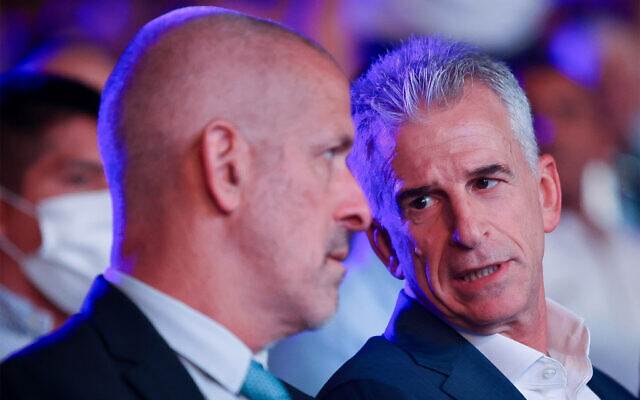
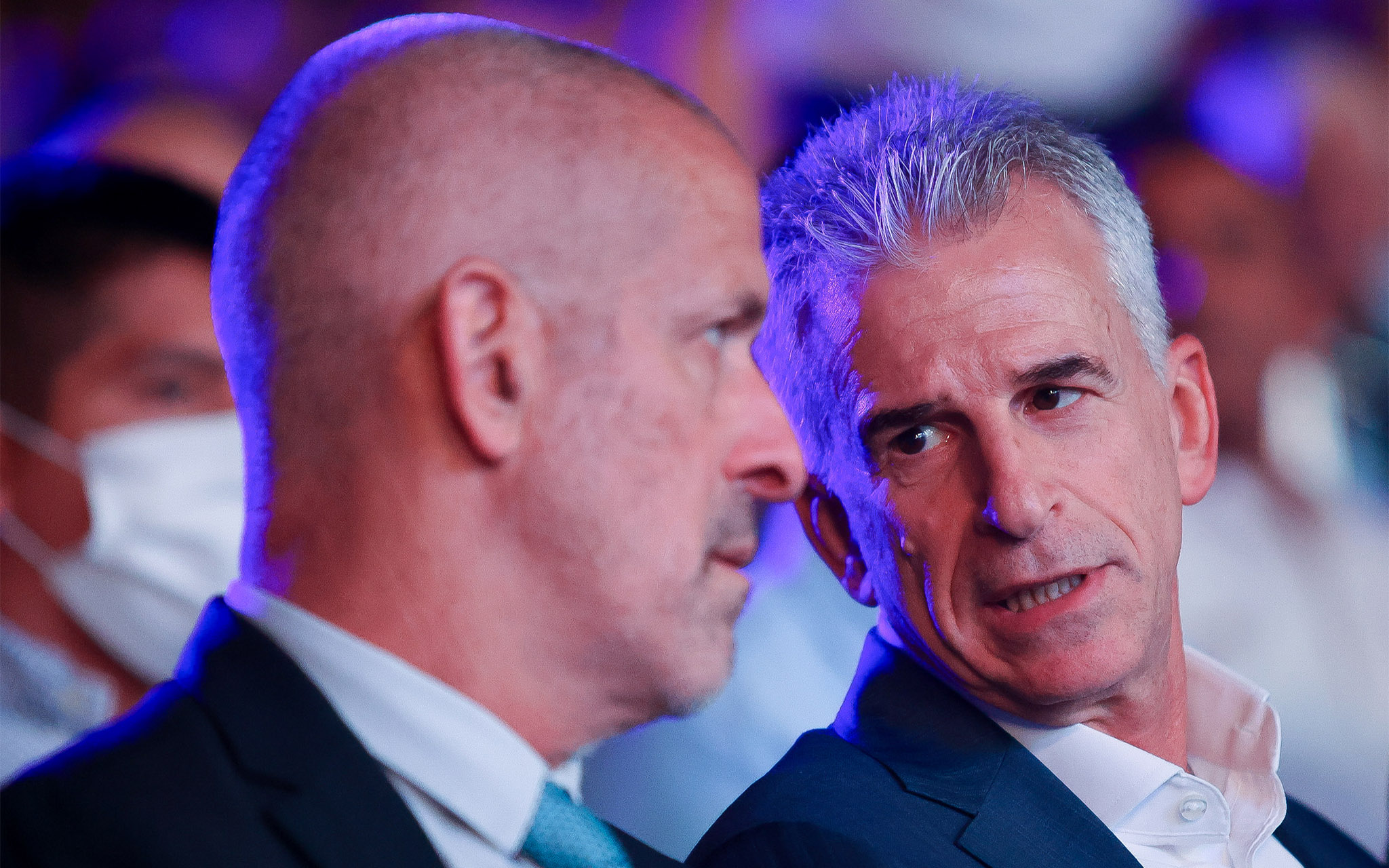
Ronen Bar, head of the Shin Bet security services, left, with Mossad chief David Barnea at the annual IDF memorial ceremony marking the 50th anniversary of the Yom Kippur War at Yad La-Shiryon, September 27, 2023. (Jonathan Shaul/Flash90)
Mossad chief David Barnea, the head of Israel’s delegation to Paris, and Shin Bet director Ronen Bar were set to brief the war cabinet on the developments in Paris Saturday night. War cabinet ministers were to vote by phone on whether to endorse the Paris outline, Channel 12 reported.
Barnea and Bar returned Saturday morning from talks in Paris. Negotiations had been stuck since Netanyahu rejected previous “delusional” demands from Hamas seeking the release of thousands of Palestinian security prisoners, including hundreds serving life sentences, an end to the war, and the withdrawal of all Israeli troops from Gaza.
Over the weekend, Barnea conferred separately with CIA Director William Burns, Qatar’s Prime Minister Sheikh Mohammed bin Abdulrahman Al Thani and Egyptian intelligence chief Abbas Kamel, Reuters reported, citing an unnamed source briefed on the matter.
The Egyptians and Qataris serve as mediators between Israel and Hamas, who do not negotiate directly.
Appearing to confirm some of the details of the outline, a Hamas source told the AFP news agency earlier that the plan being discussed proposed a six-week pause in the fighting and the release of 200-300 Palestinian security prisoners in exchange for 35-40 hostages being held by Hamas.

Protesters attempt to block a street during a demonstration to demand the release of the hostages taken by Hamas terrorists into the Gaza Strip during the Oct. 7th attack, in Tel Aviv, Israel, Jan. 20, 2024 (AP Photo/Leo Correa, File)
The Saudi A-Sharq network reported earlier that Hamas had indeed softened some of its key demands. Citing sources with knowledge of Hamas positions, the report said Hamas had lowered the number of Palestinian security prisoners it is demanding to be released under the next phase of the deal; it is no longer demanding the complete withdrawal of the IDF from Gaza, and appears to have accepted an initial truce of six weeks instead of demanding a permanent ceasefire, a departure from its earlier stance.
Hamas is, however, demanding that Israeli troops withdraw from major population centers and allow displaced Gazans to return home.
Another Saudi channel, Al-Haddad, also reported that Hamas was now asking for some 200-300 Palestinians to be freed in the first phase of the developing deal.

People check the destruction caused by overnight Israeli strikes in Rafah in the southern Gaza Strip on February 23, 2024, as battles between Israel and Hamas continue. (Mohammed Abed/AFP)
An Israeli source cited by Haaretz Saturday said the progress at the Paris summit will enable the sides to present an updated framework for a deal. “Continuing progress is now up to Hamas,” it quoted an unnamed foreign diplomat saying.
The next stage of the talks, according to the Israeli source, will focus on the central issue of which hostages held by terror groups in Gaza and which Palestinian security prisoners will be released in the truce, along with the specifics of the duration of the truce and the IDF’s deployment while it is in force.
It is believed that 130 hostages abducted by Hamas on October 7 remain in Gaza — not all of them alive — after 105 civilians were released from Hamas captivity during a weeklong truce in late November, and four hostages were released prior to that. Three hostages have been rescued by troops alive, and the bodies of 11 hostages have also been recovered, including three mistakenly killed by the military.
Pressure has been mounted on Netanyahu’s government to negotiate a deal and secure the release of the remaining hostages.
A group representing their families held a rally in Tel Aviv Saturday to demand swifter action. The families, together with activists and protesters, have been gathering weekly across Israeli cities to demand an agreement that would free their loved ones.