Palestinian PM: World too focused on Oct. 7 massacre

While there are currently no direct talks between Fatah and Hamas, Russia has invited all of the Palestinian factions to a meeting in Moscow, said P.A. Prime Minister Mohammad Shtayyeh.
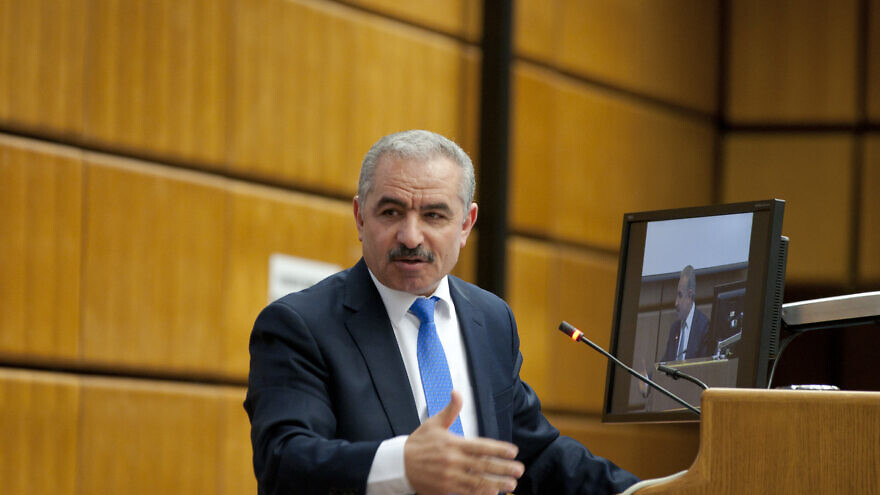
Palestinian Authority Prime Minister Mohammed Shtayyeh. Source: Flickr.

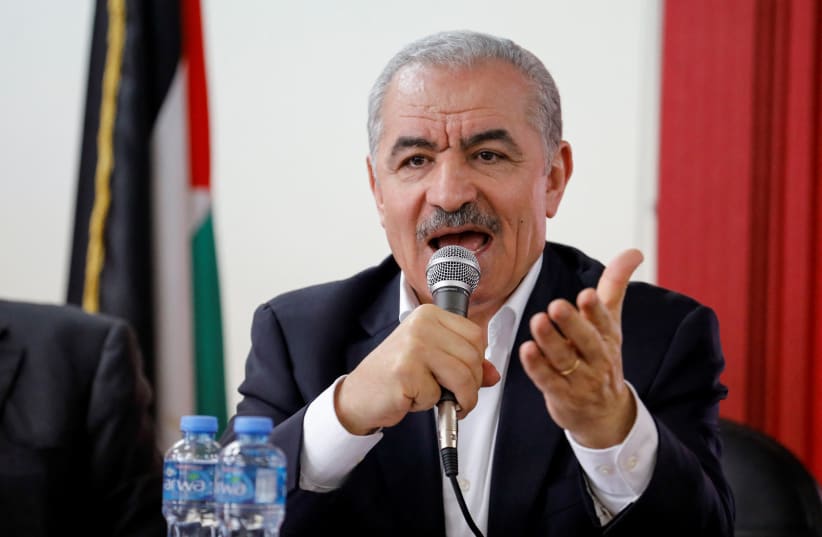
Palestinian Authority Prime Minister Mohammad Shtayyeh said on Sunday that international leaders gathered in Germany for the 60th Munich Security Conference are too focused on the Hamas atrocities of Oct. 7.

“One should not continue focusing on Oct. 7. No way that we accept any killing of innocent people. This is something that we should put behind ourselves,” said Shtayyeh during an interview at the summit in which he mostly avoided questions about the massacre and whether Hamas should be part of a unity government.

Shtayyeh later clarified his remarks in an interview with Qatari state media afterward, telling Al Jazeera that “quite a number of people here [at the Munich conference] only focus on Oct. 7. Yes, Oct. 7 is a major event,” but “Palestinian suffering did not start on Oct. 7. Palestinians have been suffering for the last 75 years…we need an end to the struggle. Don’t deal with the cosmetics, you should deal with the roots of the problem, which is Israeli occupation.”

In the earlier Munich interview, Shtayyeh avoided directly answering whether he thought Israel would stop until the threat was over and security was restored in the wake of Hamas’s slaughter of 1,200 people.

He went into a one-sided history of the Israeli-Palestinian conflict instead, saying that “we don’t accept civilians being killed, but we should not allow the cycle of violence every now and then to repeat itself.”

He also called the Hamas terrorist group “an integral part of the Palestinian political arena.”

For the terrorist group to become a member of the PLO, he continued, “there are certain prerequisites; that Hamas has to accept the political platform of the PLO, that we have an understanding on issues that has to do with resistance, that we are calling for popular resistance and not anything else.”

He said that there were currently no direct talks between Fatah and Hamas but that Russia has invited all of the Palestinian factions for a meeting on Feb. 26 in Moscow.

“We will see. If Hamas is ready…we will engage. If they are not ready, that is a different story. We need a Palestinian unity under any circumstances,” he said.

Arab media outlets reported last week that the P.A. is inching closer to an agreement that would see Hamas become part of the Western-backed leadership in Judea, Samaria and Gaza.

Sources in Ramallah told Sky News Arabia that Hamas had approved a three-phase plan leading to “complete reconciliation [with Fatah]” and joining the Palestine Liberation Organization, which controls the P.A., under a “unified Palestinian-Arab vision.”

The Islamist group reportedly also gave its blessing to P.A. chief Mahmoud Abbas’s proposal to establish a “government of technocrats” whose primary purpose would be the reconstruction of Gaza.

According to Sky News, Hamas has not requested any ministerial posts at this point, but did demand a “clear political horizon” towards establishing a Palestinian state as a condition for the unity deal.

Additionally, during the Munich interview, Shtayyeh also claimed that Jesus was “born in Palestine,” when in fact he was born in Roman-ruled Judea, another instance of the long and documented history of Palestinian officials denying Jewish historical ties to Israel.

Biden administration seeking ways to fund P.A.

The Wall Street Journal reported on Saturday that the Biden administration is looking for ways to financially support the cash-strapped P.A., which the United States hopes will govern a post-Hamas Gaza.

However, in order to do so the United States must circumvent a law that prevents direct contributions to Ramallah.

U.S. officials told the Journal that Palestinian officials are warning that they could run out of money to pay salaries and provide essential government services by the end of this month.

The Biden administration is concerned that what they describe as the “revitalized” P.A. they want to rule Gaza after Hamas is defeated might not even be able to maintain its grip on power in Judea and Samaria without more money and become more vulnerable to extremist groups and a deteriorating security situation.

Israel’s Security Cabinet last month approved a decision to freeze funds from reaching the Palestinian Authority that the latter planned to send to the Gaza Strip. Instead, Jerusalem will channel the money to a third party, Norway, for safekeeping.

The decision, which enjoys U.S. backing, prevents Gaza-earmarked funds from reaching the P.A. “under any circumstances” unless approved by the finance minister, the Prime Minister’s Office said in a statement.

Israel’s Finance Ministry collects taxes and customs duties on behalf of the P.A., which it transfers to the entity monthly.

On Nov. 2, although agreeing to send the revenue to the P.A., the Security Cabinet voted to freeze funds equivalent to those the P.A. sends to the Gaza Strip. The decision came at the insistence of Israeli Finance Minister Bezalel Smotrich.
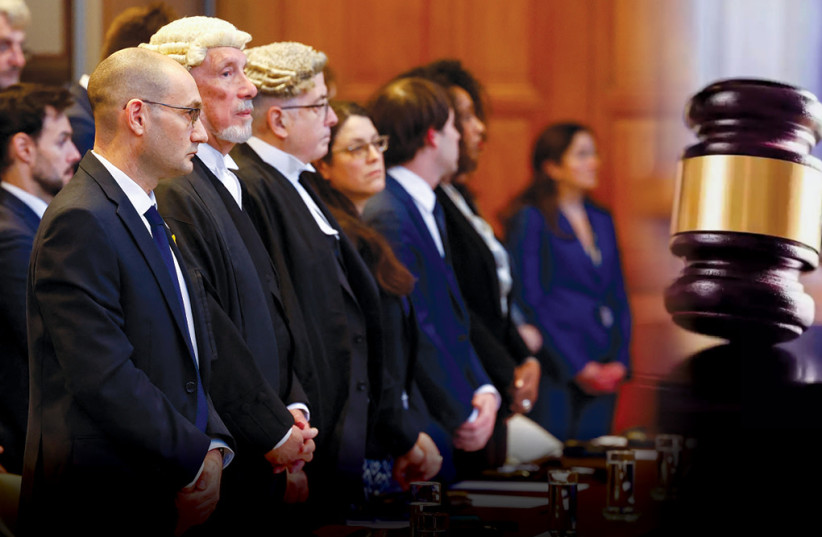
Palestinian Foreign Minister Riyad al-Maliki will speak first in the legal proceedings at the International Court of Justice (ICJ) in The Hague.

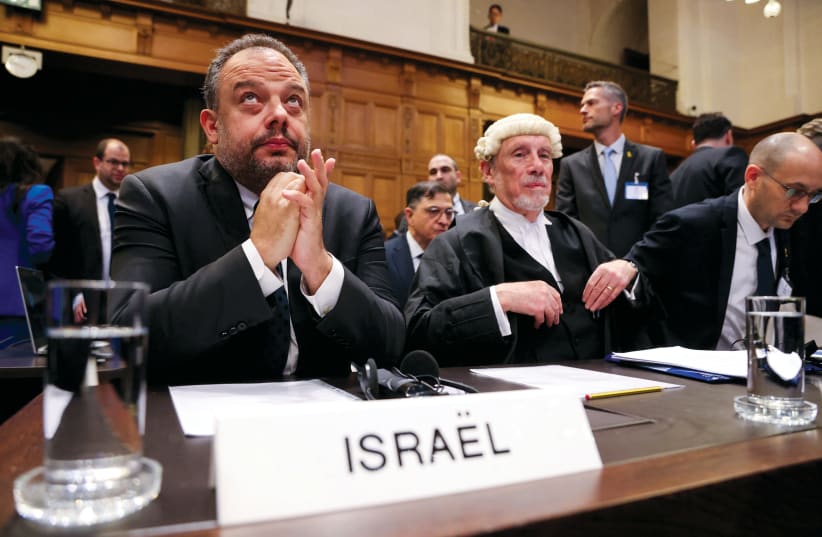
 Israeli Foreign Ministry legal adviser Tal Becker and British jurist Malcom Shaw sit in the International Court of Justice on January 12, 2024. (photo credit: THILO SCHMUELGEN/REUTERS)
Israeli Foreign Ministry legal adviser Tal Becker and British jurist Malcom Shaw sit in the International Court of Justice on January 12, 2024.
(photo credit: THILO SCHMUELGEN/REUTERS)
The United Nations’ top court on Monday opens a week of hearings on the legal consequences of Israel’s occupation of Palestinian territories, with more than 50 states due to address the judges.

Palestinian Foreign Minister Riyad al-Maliki will speak first in the legal proceedings at the International Court of Justice (ICJ) in The Hague.

In 2022, the UN General Assembly asked the court for an advisory, or non-binding, opinion on the occupation.

The hearings will be held until Feb. 26, after that the judges are expected to take several months to deliberate before issuing an advisory opinion.

  The Israeli legal team, including deputy attorney-general for International Law, Gilad Noam and British jurist Malcolm Shaw, listen to the International Court of Justice (ICJ) ruling in The Hague on January 26.  (credit: BASANTA MONDAL/PIXABAY, PIROSCHKA VAN DE WOUW/REUTERS)Enlrage image
 The Israeli legal team, including deputy attorney-general for International Law, Gilad Noam and British jurist Malcolm Shaw, listen to the International Court of Justice (ICJ) ruling in The Hague on January 26. (credit: BASANTA MONDAL/PIXABAY, PIROSCHKA VAN DE WOUW/REUTERS)

While Israel has ignored such opinions in the past, it could increase political pressure over its ongoing war in Gaza, which has killed about 29,000 Palestinians, according to Gaza health officials, since Oct.7.

Among countries scheduled to participate in the hearings are the United States – Israel’s strongest supporter, China, Russia, South Africa and Egypt. Israel will not, although it has sent written observations.

 Palestinian push for Israeli accountability

The hearings are part of a Palestinian push to get international legal institutions to examine Israel’s conduct, which has become more urgent since the Oct. 7 attacks by Hamas in Israel, which killed 1,200 people, and Israel’s military response.

They also come amid mounting concerns about an Israeli ground offensive against the Gaza city of Rafah, a last refuge for more than a million Palestinians after they fled to the south of the enclave to avoid Israeli assaults.

Israel captured the West Bank, Gaza, and east Jerusalem – areas of historic Palestine that the Palestinians wanted for a state – in the 1967 war. It withdrew from Gaza in 2005, but, along with neighboring Egypt, still controls its borders.

It is the second time the UN General Assembly has asked the ICJ, also known as the World Court, for an advisory opinion related to the occupied Palestinian territory.

In July 2004, the court found that Israel’s separation wall in the West Bank violated international law and should be dismantled, though it still stands to this day.

Judges have now been asked to review Israel’s “occupation, settlement and annexation … including measures aimed at altering the demographic composition, character, and status of the Holy City of Jerusalem, and from its adoption of related discriminatory legislation and measures.”

Since 1967, Israel has greatly expanded Jewish settlements in the West Bank – an action Palestinians say compromises the creation of a viable Palestinian state. It has also annexed East Jerusalem in a move not recognized by most countries.

The General Assembly also asked the ICJ’s 15-judge panel to advise on how those policies and practices “affect the legal status of the occupation” and what legal consequences arise for all countries and the United Nations from this status.

The advisory opinion proceedings are separate from the genocide case that South Africa filed at the World Court against Israel for its alleged violations in Gaza of the 1948 Genocide Convention. In late January the ICJ in that case ordered Israel to do everything in its power to prevent acts of genocide in Gaza.

The outcome of the advisory opinion would not be legally binding but would carry “great legal weight and moral authority,” according to the ICJ.


“Russia has invited all Palestinian factions who will be meeting on the 26th of this month in Moscow,” Shtayyeh told the Munich Security Conference during a public interview.

Palestinian Prime Minister Mohammad Shtayyeh speaks as he visits after Israeli settlers' rampage in Hawara in the West Bank, March 1, 2023 (photo credit: REUTERS/RANEEN SAWAFTA)
Palestinian Prime Minister Mohammad Shtayyeh speaks as he visits after Israeli settlers’ rampage in Hawara in the West Bank, March 1, 2023
(photo credit: REUTERS/RANEEN SAWAFTA)
Moscow plans to host unity talks between all Palestinian factions, including Hamas, on February 26, Palestinian Authority Prime Minister Mohammed Shtayyeh said Sunday as he called for unilateral statehood recognition as a prerequisite to peace talks.

“Russia has invited all Palestinian factions who will be meeting on the 26th of this month in Moscow,” Shtayyeh told the Munich Security Conference during a public interview.

He explained that the Palestine Liberation Organization’s invitation for Hamas to join it was a conditional one and would only come into play if the group accepted certain prerequisites.

“One should not continue focusing on October 7,” Shtayyeh said as he denounced Hamas’s actions on that day.“No way [do] we accept any killing of any innocent civilian people,” he said, but added that, “we need a situation in which Palestinians are united, but again on our political agenda.”

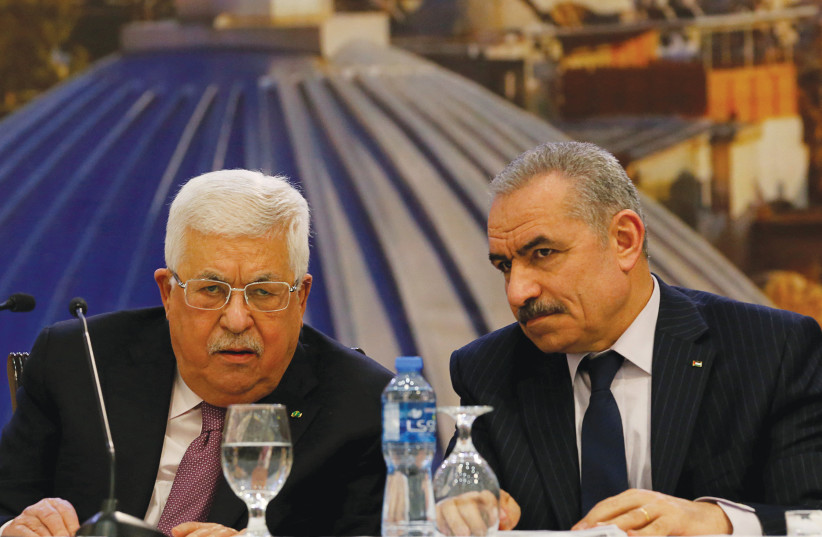
 PALESTINIAN AUTHORITY president Mahmoud Abbas attends a meeting with PA Prime Minister Mohammad Shtayyeh (credit: RANEEN SAWAFTA/REUTERS)Enlrage image
PALESTINIAN AUTHORITY president Mahmoud Abbas attends a meeting with PA Prime Minister Mohammad Shtayyeh (credit: RANEEN SAWAFTA/REUTERS)

He clarified that this would include a Hamas acceptance of “two states on the border of ’67, through peaceful means,” he said.

“In order for Hamas to be a member of the PLO, there are certain prerequisites. Hamas has to accept the political platform of the PLO,” Shtayyeh said.

“We have to have an understanding of issues that have to do with resistance,” Shtayyeh said as he explained that the PLO is “calling for popular resistance and not anything else.”

“If Hamas is ready to come to ground with us, we are ready to engage. If Hamas is not going to come to ground with us, that is a different story,” he stated.

“But we need Palestinian unity,” Shtayyeh stated.

There needs to be a solution that covers both Gaza and the West Bank under the umbrella of a Palestinian state that is recognized by the West and is accepted as a member state of the United Nations.

“There needs to be a serious paradigm shift from talks into a resolution that the United States and Europe do recognize the state of Palestine on the borders of 67 and Palestine will be admitted as an independent sovereign state as a member of the UN,” Shtayyeh said.

“And then we are ready to go for elections,” he added.

One of the problems, he said, is that “there are members of the Israeli government today who do not want to see us, not as a state and not as an Authority.

‘No partner in Israel’

“The problem today is that for the first time, you do not have a partner in Israel to sit down and talk to. When you do not have a partner, there is no process.

“Therefore, you need a third-party intervention,” Shtayyeh said. “Europe, the UN, the US, Arab countries [have to] come up with a solution.”

“The Palestinians need independence. They need an end to the occupation. They need to live free. This is where you end the frustration. You end anger. You end violence. That is how you end the conflict, by giving people their rights,” Shtayyeh said.

The way to end the conflict with Israel is to go to the roots of the issue, and “the root of the problem for Palestinians is the end of occupation. That is the name of the game,” he said.