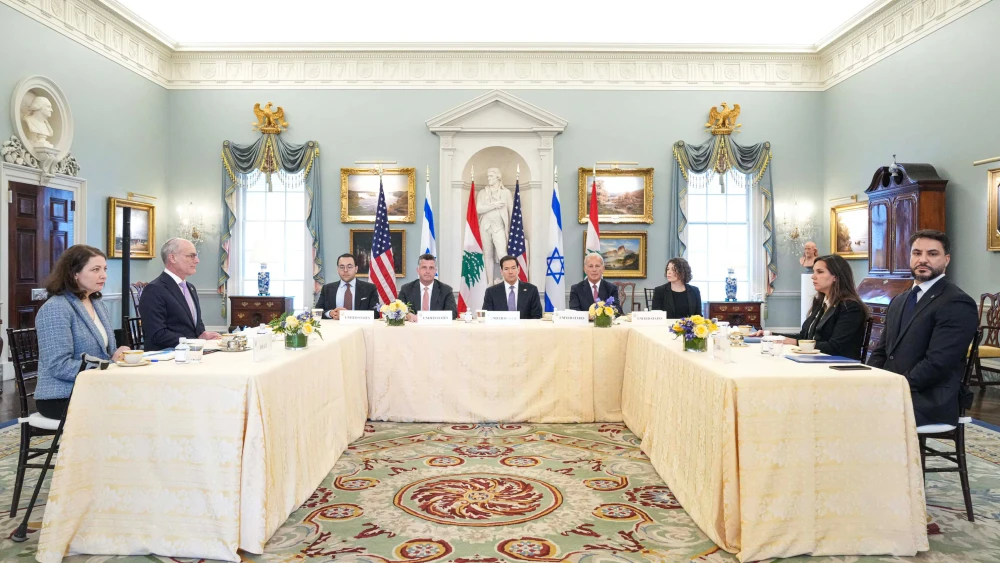
U.S. President Donald Trump participates in the Board of Peace charter announcement and signing ceremony during the World Economic Forum at the Davos Congress Center in Davos, Switzerland, Jan. 22, 2026. Photo by Daniel Torok/White House.
(Feb. 7, 2026 / JNS)
The Trump administration plans to host leaders from the Board of Peace in Washington, D.C., on Feb. 19, Axios reported on Friday night.
“Nothing has been confirmed yet, but the administration is planning it and has started checking which leaders are able to attend,” said one source, who did not identify by name.
Israeli Prime Minister Benjamin Netanyahu, who accepted an invitation to join the board, is scheduled to meet with President Donald Trump in the U.S. capital on Feb. 18, according to the report.
The Israeli premier has not yet signed the charter to join the Board of Peace.
The board’s meeting is meant to advance Phase 2 of Trump’s 20-point peace plan for the Gaza Strip, Axios reported. The second phase involves the disarming of Hamas in the area that it holds west of the so-called Yellow Line that runs through the Strip, and the reconstruction of the devastated territory after two years of war.
“It will be the first Board of Peace meeting and a fundraising conference for Gaza reconstruction,” a U.S. official was quoted as saying.
The Israeli government has remained adamant that the reconstruction phase will begin only after Hamas lays down arms. Although a technocratic Palestinian government—the National Committee for the Administration of Gaza (NCAG)—to run civil matters in Gaza has been established, it has been operating thus far from Egypt. The Rafah Crossing between Gaza and Sinai had reopened on Feb. 1, but only a small number of individuals have been entering or exiting.
On Jan. 22, Trump signed the charter for the Board of Peace at the World Economic Forum in Davos, Switzerland, marking the formal commencement of Phase 2 of the administration’s Gaza peace initiative.
According to the Trump administration, the signing ceremony, attended by regional leaders and global financial executives, transitions the focus of the U.S. strategy from the current ceasefire toward “demilitarization, reconstruction and civil administration” of the Gaza Strip.
Senior official based in Doha says taking away terror group’s weapons is ‘criminalizing the resistance,’ instead backs extended truce where Hamas would commit not to use weapons
By AFP and ToI Staff8 February 2026, 1:00 pmUpdated at 8:06 pm
Senior Hamas leader Khaled Mashaal is interviewed by Al Jazeera on February 8, 2026 (Screenshot/YouTube)
A senior Hamas leader said Sunday that the Palestinian Islamist terror group would neither surrender its weapons nor accept foreign intervention in Gaza, pushing back against US and Israeli demands.
“Criminalizing the resistance, its weapons, and those who carried it out is something we should not accept,” Khaled Mashaal said at a conference in Doha.
“As long as there is occupation, there is resistance. Resistance is a right of peoples under occupation… something nations take pride in,” said Mashaal, who previously headed the terror group.
Offering an alternative to disarmament, Mashaal said Hamas would instead back an extended truce with Israel, during which it would commit to not using its weapons.
“Hamas proposed a truce of five to seven to 10 years. This is a guarantee that these weapons are not used,” Mashaal said, adding that the mediators would serve as guarantors of such a deal and that those countries — Egypt, Qatar and Turkey — are working to sell the idea to the Trump administration.
It was unclear whether he was referring to the idea of decommissioning weapons, which envisions them being gathered and stored in a warehouse guarded by Arab mediating countries.
Hamas, which vows to destroy Israel, launched a deadly cross-border onslaught into Israel from Gaza on October 7, 2023, killing 1,200 people, mostly civilians, amid acts of horrific brutality, and taking 251 people as hostages, triggering the Gaza war that raged for two years.
An October US-brokered ceasefire in Gaza is in its second phase, which foresees the demilitarization of the territory, including the disarmament of Hamas, along with a gradual withdrawal of Israeli forces.
Prime Minister Benjamin Netanyahu and US President Donald Trump have insisted that the terror group must give up its weapons in the near future. Trump has repeatedly asserted that Hamas “promised” to lay down its arms, and has threatened the group over the issue.
At least publicly, however, Hamas has never agreed to lay down its arms.
Hamas fighters are deployed in Rafah ahead of the planned release of two among six Israeli hostages set to be handed over to the Red Cross, Gaza Strip, on February 22, 2025. (AP/Jehad Alshrafi)
Trump’s 20-point plan for Gaza explicitly says that Hamas must give up its weapons, but the Hamas statement endorsing the plan contained significant caveats and did not directly mention disarmament.
Hamas has repeatedly said that disarmament is a red line, although it has indicated it could consider handing over its weapons to a future Palestinian governing authority.
Israel has warned it could renew its military campaign in the enclave if Hamas does not disarm.
In December, Mashaal said the terror group can “store” its weapons, but won’t give them up.
“Disarmament for a Palestinian means stripping away his very soul,” Mashaal said in an interview with Al Jazeera at the time.
Israeli officials say Hamas still has around 20,000 gunmen and large amounts of weaponry, including tens of thousands of rifles.
A Palestinian technocratic committee has been set up with a goal of taking over the day-to-day governance in the battered Strip, but it remains unclear whether, or how, it will address the issue of demilitarization.
World leaders and top diplomats with US President Donald Trump (center) holding a signed founding charter at the ‘Board of Peace’ meeting during the World Economic Forum (WEF) annual meeting in Davos, Switzerland, on January 22, 2026. (Fabrice Coffrini / AFP)
The committee operates under the so-called “Board of Peace,” an initiative launched by Trump.
Originally conceived to oversee the Gaza truce and postwar reconstruction, the board’s mandate has since expanded to global conflicts in general, prompting concerns among critics that it could evolve into a rival to the United Nations.
Trump unveiled the board at the World Economic Forum in the Swiss ski resort of Davos last month, where leaders and officials from nearly two dozen countries joined him in signing its founding charter.
Alongside the Board of Peace, Trump also created a Gaza Executive Board — an advisory panel to the Palestinian technocratic committee — comprising international figures including US envoys Steve Witkoff and Jared Kushner, as well as former British prime minister Tony Blair.
On Sunday, Mashaal urged the Board of Peace to adopt what he called a “balanced approach” that would allow for Gaza’s reconstruction and the flow of aid to its roughly 2.2 million residents, while warning that Hamas would “not accept foreign rule” over Palestinian territory.
“We adhere to our national principles and reject the logic of guardianship, external intervention, or the return of a mandate in any form,” Mashaal said.
“Palestinians are to govern Palestinians. Gaza belongs to the people of Gaza and to Palestine. We will not accept foreign rule,” he stated.
Israel entirely withdraw its forces and civilians, dismantling some 20 settlements, from Gaza in 2005, pulling back to the pre-1967 lines. Hamas violently seized control of the enclave from PA President Mahmoud Abbas Fatah group in 2007, and built up a 24-battalion military force and infrastructure, including vast underground tunnels, ahead of its invasion of Israel 27 months ago.
Netanyahu’s urgent trip to Washington comes amid Israeli concerns over stalled Iran talks and U.S. envoy responses, with Jerusalem worried about gaps on missiles and regional threat
US President Donald Trump and Iranian Supreme Leader Ali KhameneiAP Photo/Ben Curtis – Office of the Iranian Supreme Leader via AP
The US administration has told Iran that it expects Foreign Minister Abbas Araghchi and the Iranian delegation to arrive at the next round of nuclear talks “with significant content,” two sources familiar with the matter told i24NEWS.
The initial meeting between the parties was described as a “good meeting,” but focused primarily on procedural issues rather than substantive negotiations.
Recommended
Washington now anticipates that Tehran will present tangible concessions on its nuclear program and other pressing concerns during the upcoming discussions.
The developments come as Israeli Prime Minister Benjamin Netanyahu prepares for a hastily arranged meeting with US President Donald Trump on Wednesday, sources say. Israeli officials are dissatisfied with the responses provided last week by US envoy Steve Witkoff during his talks with Netanyahu and senior defense officials.
Netanyahu goes to D.C.: PM to meet Trump on Wed., says talks include Iran missiles
Jerusalem is increasingly concerned that the current trajectory of the US-led talks with Iran may not meet Israel’s core security demands, particularly regarding Tehran’s ballistic missile program and support for regional proxy groups. Criticism of Witkoff’s approach has grown in Israel amid fears that any emerging deal could leave these issues insufficiently addressed.