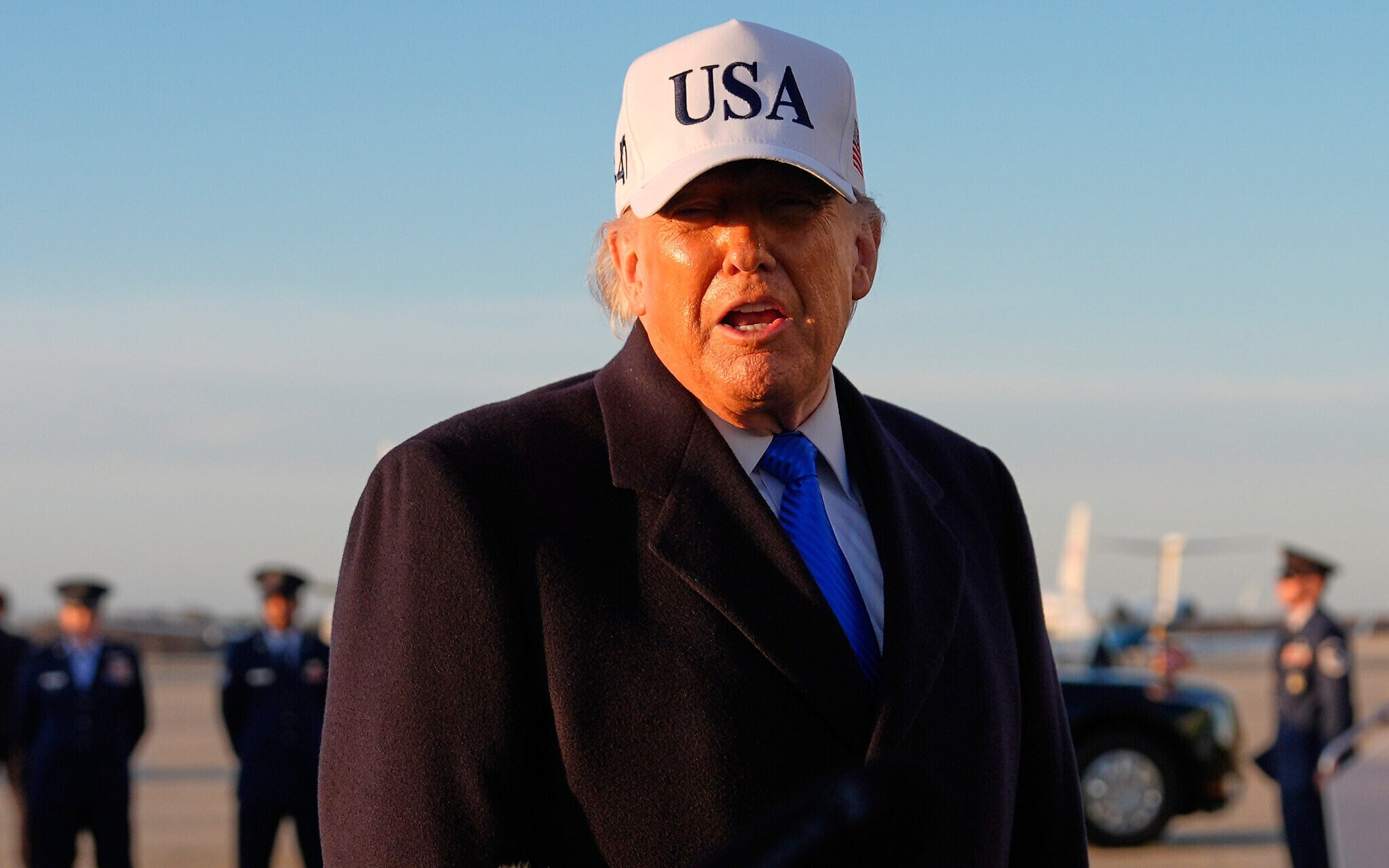
Trump told the Financial Times he could also delay his summit with China’s President Xi Jinping later this month as he presses Beijing to help unblock the crucial waterway.
US President Donald Trump, with Secretary of Defense Pete Hegseth at his side, looks on as he speaks to reporters aboard Air Force One on a flight from Dover, Delaware, to Miami, Florida, US, March 7, 2026.(photo credit: REUTERS/KEVIN LAMARQUE)ByREUTERSUS President Donald Trump has warned that NATO faces a “very bad” future if US allies fail to assist in opening up the Strait of Hormuz, in an interview with the Financial Times published on Sunday.
Trump told the FT he could also delay his summit with China’s President Xi Jinping later this month as he presses Beijing to help unblock the crucial waterway.
“I think China should help too because China gets 90% of its oil from the Straits,” Trump told the newspaper, adding he would prefer to know Beijing’s position before the planned visit.
Tankers sail in the Gulf, near the Strait of Hormuz, as seen from northern Ras al-Khaimah, near the border with Oman’s Musandam governance, amid the US-Israeli conflict with Iran, in United Arab Emirates, March 11, 2026. (credit: REUTERS/STRINGER)
Trump: Countries who benefit from shipping route should help secure it
The US president said countries that benefit from the shipping route should help secure it.
“It’s only appropriate that people who are the beneficiaries of the Strait will help to make sure that nothing bad happens there,” he told the FT.
US Treasury Secretary Scott Bessent and Chinese Vice Premier He Lifeng wrapped up the first of two days of talks in Paris on Sunday to iron out kinks in their trade truce and clear a path for Trump’s trip to Beijing to meet with Xi at the end of March.
The White House did not immediately respond to a Reuters request for comment.
If Israel does not overthrow the ayatollahs while Iran is at its weakest, we guarantee that our grandchildren will fight and die in future wars in Gaza and Lebanon. Opinion.
Robert Besser
Published: Mar 16, 2026, 9:03 AM (GMT+2)
Iranians against the MullahsErfan Fard
Robert Besser is a news editor who has worked in television and newspapers in the United States, Asia and the Middle East.
Israel must pursue regime change in Iran as if our lives depend upon it, because they do.
If fact, if the extremist Iranian Islamic regime remains in power after this current war, Israel will be condemned to forever wars as Iran uses its limitless oil wealth to rebuild its nuclear project, its Iranian armies in Lebanon, Gaza, Iraq, Yemen and wherever, and eventually Iran will again possess many thousands of ballistic missiles to destroy Israel.
Clearly, the continuation of a government of Islamic extremists in Iran is, in itself, an existential threat to Israel.
So what is to be done to put an end to this Iranian government? You and I might not have an answer, but those in Israel who are tasked with finding critical solutions to the Iranian problem need to figure it out – and now.
In overthrowing the Iranian government we seem to be facing a task that appears impossible. But in Israel, we are too often forced to do the impossible.
Remember, Israel is the country that did the impossible when 600,000 Jews defeated five invading Arab armies in 1948. Israel again did the impossible when it liberated Judea, Samaria and Jerusalem in six days in 1967, and yet again did the impossible when it rescued Jewish hostages at Entebbe in 1976.
Israel also did the impossible when it refused to accept defeat in 1973, eventually driving the IDF to within miles of Damascus and crossing the Suez Canal to enter Egypt proper.
Indeed, within every Jew in Israel can be found the spark of David Ben Gurion’s words. “In Israel, in order to be a realist you must believe in miracles.”
Miracles? In today’s Israel we’ve got a bushel basket full of them.
How about miracles with water: Due to desalinization, today the arid country of Israel not only has an excess of water, but even exports water.
Or Israeli miracles in agriculture: Countries from throughout the world now come to Israel to learn how our farmers grow more crops per dunam with less water than anywhere on earth, and foreigners want to learn how Israeli cows produce more milk than anywhere else.
Or miracles in space: With unbelievable audacity, spelled chutzpah, Israel nearly landed a satellite on the moon, and will no doubt be successful in the next attempt.
Or miracles with our military: Israel has reinvented air warfare, turning fighter jets into platforms to destroy our enemies in their apartments, offices, bunkers, automobiles, bedrooms and at their dinner tables.
And every day we learn of new Israeli miracles in science, medicine, research, telecommunications and more.
And let’s not forget the miracle of Israel’s start-up business culture.
So the question must be asked: Is it true that Israel’s best brains can not figure out how to overthrow the Islamic regime?
When terrorists hijacked an Air France aircraft in 1976 with 106 Israelis and other Jews and held them in Entebbe, Uganda, our military planners did not have days or weeks to work out a plan. Instead they had hours. And they did it.
A plan to overthrow the Iranian regime? In the 1950s the US Central Intelligence Agency developed expertise in regime change by simply paying a country’s generals to take over their government. So why not in Iran?
Or in a government like Iran, made up of so many corrupt millionaires, simply pay moderates in the government to take over.
“Simply”, of course, is a silly word. Overthrowing the Iranian government would be an extraordinarily difficult job.
It would take enormous Israeli resources, including military, intelligence and geopolitical minds, knowledge about Iran, Arabs, Moslems, the surrounding countries and so much more.
But what is our choice?
Because if we do not do it now, while the Irananian government is at its weakest point since it overthrew the Shah in 1979, we will guarantee that our grandchildren will have to fight and die in future wars in Gaza and Lebanon.
If we do not overthrow Iran’s regime now, we will ensure that in the future our grandchildren will have to awaken in the middle of the night to run to bomb shelters.
Because if we do not do it now, we will be unable to avoid a nuclear war with Iran, which is the inevitable outcome of allowing Islamic fundamentalists to rearm.
And there is also an unspoken reason why we need to overthrow the Islamic regime right now. And that is because, at this very moment we may well be witnessing the end of the alliance between the United States and Israel.
For Israel has become “treif” among the growing American left in Congress, in the universities, the newsrooms, Hollywood and other woke institutions.
And in the mentally ill view of those of the American leftist religion, Israel has become a rogue state, just as apartheid South Africa was.
Of course, while Israel and the Jews will inhabit planet Earth long, long after American leftists are not even a footnote, in the coming years the hostility Israel felt during the Obama years might prove to be nothing compared to what future leftist American administrations will dish out.
And if, heaven forbid, the Islamists remain in power in Iran following this war, then at the minimum Israel must destroy their oil fields.
For it is their oil money which guarantees that Iran can forever fund their proxy armies, build new missiles and pursue nuclear arms.
And by the way, if 90 percent of Iran’s oil is now being delivered to China, how much of the world oil market will actually be disrupted if Iran loses its oil business?
We have seen with Hamas, we have seen with Hezbollah and we have seen for over 47 years with Iran, that Moslem fundamentalists are genetically incapable of honoring any ceasefire agreements.
Which is why, at this moment while history is being made every day, we Jews must reach into ourselves and find the resolve and the solutions, we must reject western appeasement and find the means to overthrow the Islamic regime.
We Jews have come too far in the past 2,000 years to allow Israel to be destroyed by Iran. We have been conquered, dispersed, and we have built new lives in country after country. We have suffered horribly, and miraculously survived living among the non-Jews. We have restored our language, we have restored our land, we have grown the country from 600,000 Jews in 1948 to nearly 8 million Jews today, we have made the transition from victim to warrior, and we have built Israel into one of the singular wonders of the world.
And above all, we have built a country in which Torah stands tall, as more students study Torah in Israel today than at any time in Jewish history.
So now what? Because some Islamic ayatollahs scream that they want us dead we are supposed to roll over and die?
Unlike the past 2,000 years, we Jews now decide whether we live or die. And, of course, we will decide that we will fight, and we will say no to again being enslaved and dispersed.
For the Jews have returned to Israel, we have fought and we have not only survived, but thrived. The Jews have been reborn.
So the United Nations, the European Union, the Congress and the White House, along with all Arab leaders, must come to understand that
Am Yisrael Chai is not just an American Jewish fundraising slogan, but is our way of life.
And no Islamic madmen are going to be given the opportunity to decide the fate of the Jews of Is
US president says other countries must participate in effort to prevent attacks on shipping; US embassy in Iraq and UAE oil facility targeted by Iran and allies
By Agencies and ToI Staff14 March 2026, 7:47 pm
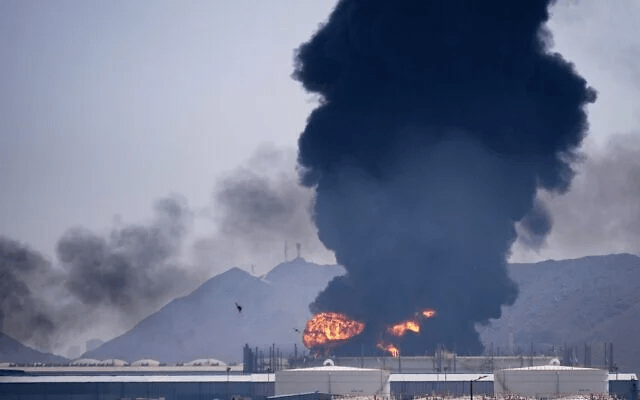
A fire and plume of smoke rise after, according to authorities. debris from an intercepted Iranian drone struck an oil facility in Fujairah, United Arab Emirates, March 14, 2026.(AP Photo/Altaf Qadri)
The US-Israel war with Iran entered its third week on Saturday as a missile struck a helipad inside the US Embassy compound in Baghdad and debris from an intercepted Iranian drone hit an oil facility in the United Arab Emirates, further increasing global anxiety about oil supplies.
Iran has targeted countries across the region and said it would choke off the Strait of Hormuz, a major artery for the world’s oil supply.
In response, US President Donald Trump claimed that “many countries” would send warships to the strait to defend shipping. In a post on Truth Social, Trump then said that “hopefully” China, France, Japan, South Korea, Britain and others would send vessels. It was unclear whether other nations were already confirmed to be sending ships beyond those. He also claimed that “we have already destroyed 100 percent of Iran’s military capability.”
Meanwhile, he warned, the US “will be bombing the hell out of the shoreline” and “one way or the other, we will soon get the Hormuz Strait open, safe and free.”
Later on Saturday Trump said that “countries of the world that receive oil through the Hormuz Strait must take care of that passage, and we will help — a lot! The US will also coordinate with those countries so that everything goes quickly, smoothly, and well.
“This should have always been a team effort, and now it will be — It will bring the World together toward harmony, security, and everlasting peace!” he added.
Iran’s joint military command threatened to attack cities in the UAE, home to Dubai and one of the world’s busiest airports, saying the US used “ports, docks and hideouts” there to launch its overnight strikes on Iran’s Kharg Island, without providing evidence. It called on people to immediately evacuate areas where it said US forces were sheltering, naming Jebel Ali port in Dubai — the Mideast’s busiest — as well as Khalifa port in Abu Dhabi and Fujairah port.
It was the first time Iran has directly threatened non-US assets, in this case commercial ports, in a neighboring country since the war began with US-Israeli strikes on February 28.
Images showed smoke rising over the US Embassy compound in the Iraqi capital and a fire in the UAE’s Fujairah port that broke out after what authorities said was a drone interception.
No one immediately claimed responsibility for the strike on the embassy’s helipad. The embassy complex, one of the largest US diplomatic facilities in the world, has been repeatedly targeted by rockets and drones fired by Iran-aligned militias. There was no immediate comment from the embassy.
Iranian Foreign Minister Abbas Araghchi said on Saturday that Iran would also target the facilities of American companies in the region if its energy facilities are attacked.
“Iran will respond to any attack on its energy facilities,” state television quoted him as saying, after the US attacks on military infrastructure on Iran’s crude oil export hub on Kharg.
“If Iranian facilities are targeted, our forces will target American companies’ facilities in the region, or companies in which the US holds shares,” he warned, while vowing that Tehran would “act cautiously to ensure that densely populated areas are not targeted.”
Trump had said that the US strikes destroyed military sites on Kharg Island vital to Iran’s oil network, and warned that Iran’s oil infrastructure could be next if Tehran continues to interfere with the passage of ships through the Strait of Hormuz, where vessels are backed up and where one-fifth of global oil supplies usually transit.
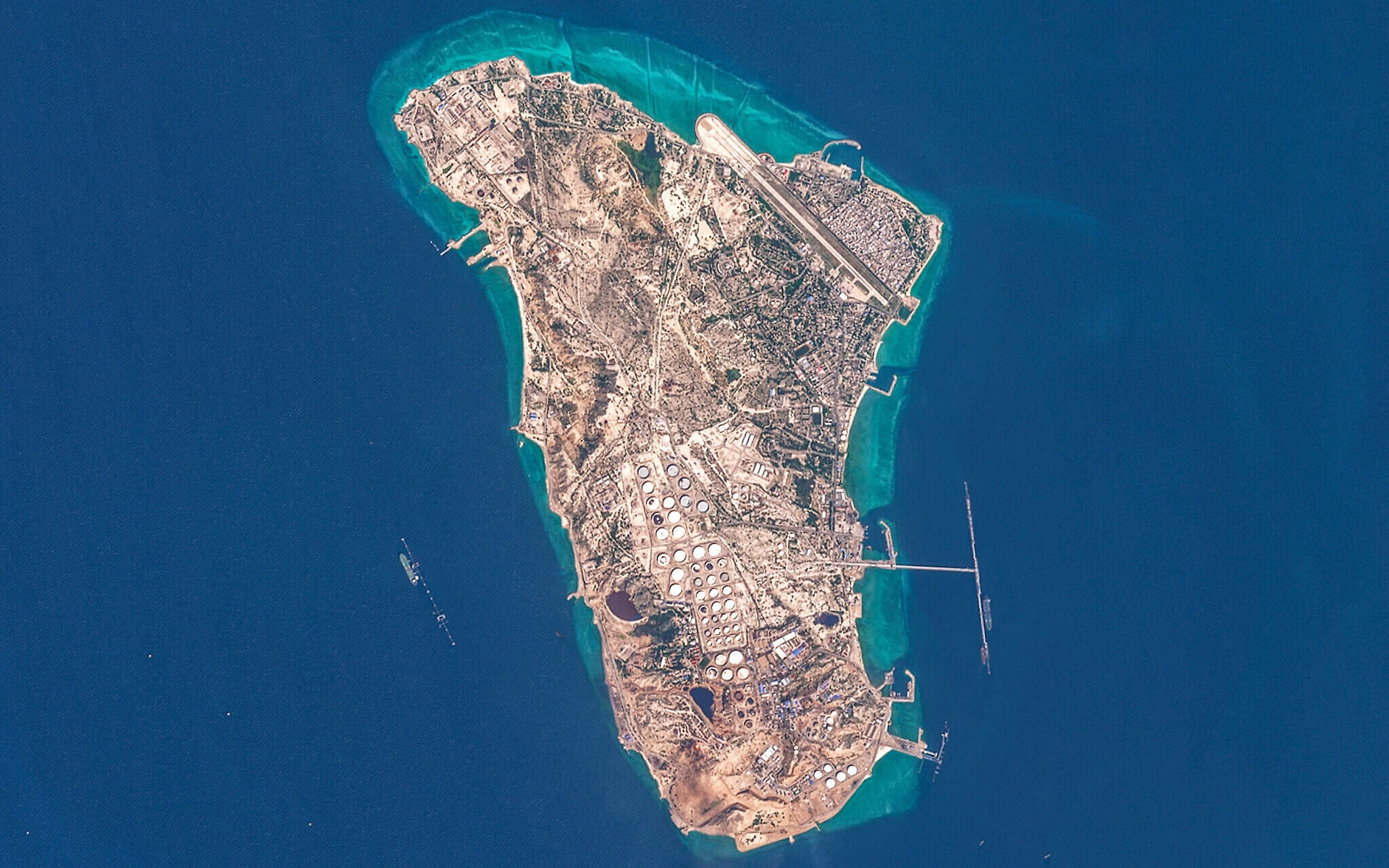
This handout image taken by the European Space Agency, captured by the Copernicus Sentinel-2 satellite, shows a view of Iran’s Kharg Island, which hosts the country’s main crude export terminal and is responsible for the overwhelming majority of its oil shipments to the world, about 30 kilometers south of the mainland in the north of the Gulf, on March 7, 2026. (European Space Agency/AFP)
Trump said US forces on Friday “obliterated” targets on Kharg Island, which is home to the primary terminal that handles the country’s oil exports.
Iran’s parliament speaker had warned that such strikes would provoke a new level of retaliation.
Meanwhile, a US official said 2,500 more Marines and an amphibious assault ship were being sent to the Middle East, adding to the military’s largest buildup of warships and aircraft in the region in decades.
Iran continued to launch missile and drone attacks on Israel and neighboring Gulf Arab states, and US and Israeli warplanes pummeled military and other targets across Iran.
US Defense Secretary Pete Hegseth said Saturday that over 15,000 enemy targets had been struck — more than 1,000 a day since the war began.
Israel announced another wave of strikes in Iran targeting infrastructure, and said its air force had hit more than 200 targets in the last 24 hours, including missile launchers, defense systems and weapons production sites.
Marines and assault ship add to US forces
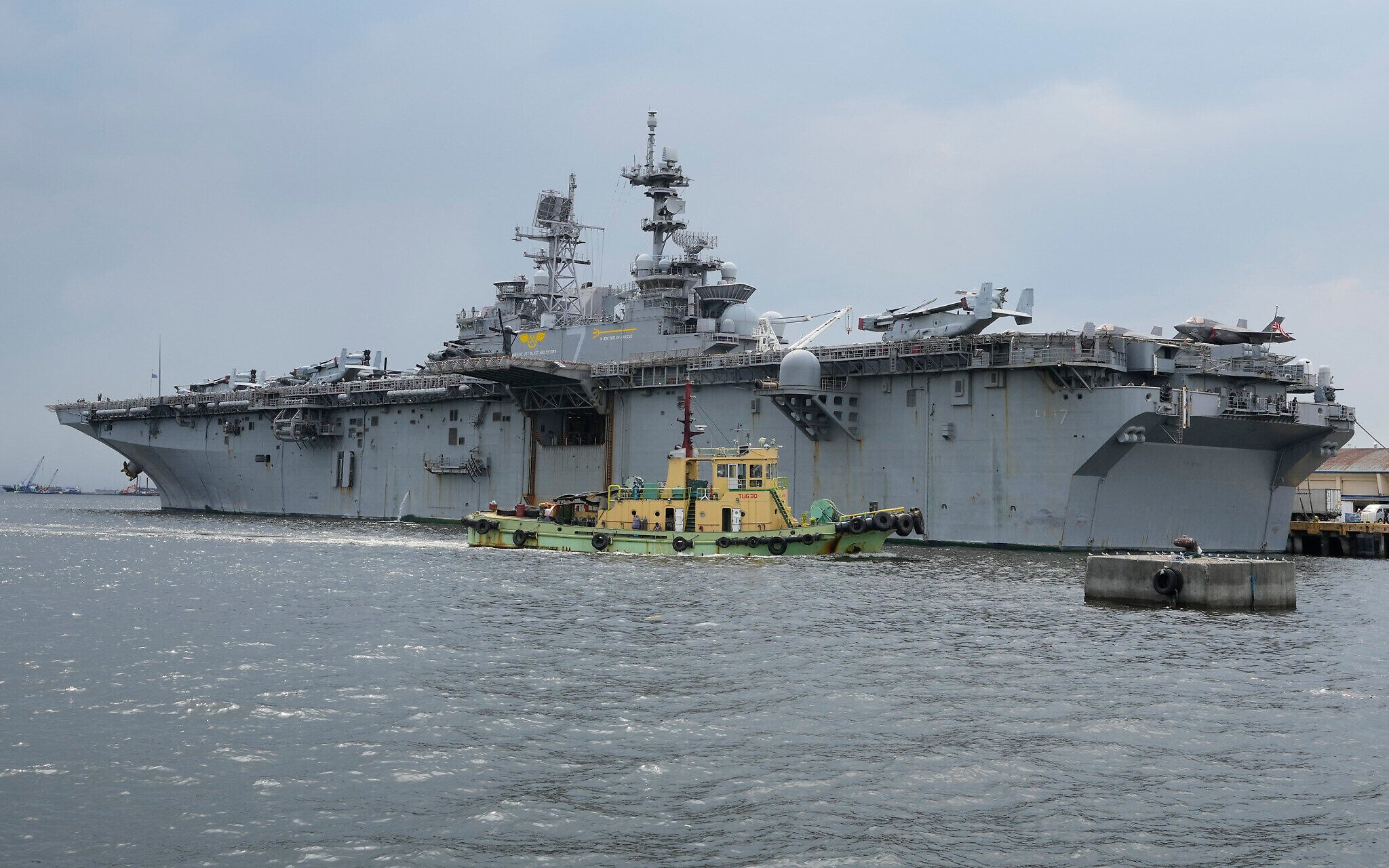
Elements from the 31st Marine Expeditionary Unit and the amphibious assault ship USS Tripoli have been ordered to the Middle East, according to the US official, who spoke on condition of anonymity to discuss sensitive military plans.
Marine Expeditionary Units are able to conduct amphibious landings but also specialize in bolstering security at embassies, evacuating civilians and providing disaster relief. The deployment does not necessarily indicate that a ground operation will take place.
A tugboat passes by a US Navy USS Tripoli (LHA-7) amphibious assault ship during a port call in Manila, Philippines, September 27, 2022. (AP Photo/Aaron Favila)
The Wall Street Journal first reported the Marine deployment.
The 31st Marine Expeditionary Unit, as well as the Tripoli and other amphibious assault ships carrying the Marines, are based in Japan and have been in the Pacific Ocean for several days, according to images released by the military. The Tripoli was spotted by commercial satellites sailing alone near Taiwan, putting it more than a week away from waters off Iran.
Earlier in the week, the Navy had 12 ships, including the aircraft carrier USS Abraham Lincoln and eight destroyers, in the Arabian Sea. Should the Tripoli join, it would be the second-largest ship behind the Lincoln there.
The total number of US service members on the ground in the Middle East is not clear. Al-Udeid Air Base in Qatar, one of the largest in the region, typically houses some 8,000 US troops.
US strikes a key Iranian island after Tehran warning
The US strikes on Kharg Island in the Persian Gulf targeted military sites but left Iran’s oil infrastructure alone for now, Trump said on social media. But he warned that if Iran or anyone else interferes with the passage of ships through the Strait of Hormuz, he will reconsider his decision not to “wipe out the Oil Infrastructure.”
US Central Command released a video showing the strikes and saying it destroyed naval mine storage facilities, missile storage bunkers and other military sites in a large-scale precision strike on the island.
“US Forces successfully struck more than 90 Iranian military targets,” CENTCOM said.
On Saturday, Iran’s joint military command reiterated its threat to attack US-linked oil and energy facilities in the region if the Islamic Republic’s oil infrastructure is hit.
Ebrahim Zolfaghari, spokesperson for Khatam al-Anbiya Central Headquarters, warned they will target “all oil, economic and energy infrastructures belonging to oil companies across the region that have American shares or cooperate with America.”
Iran’s semiofficial Fars news agency said Saturday the US strikes caused no damage to the island’s oil infrastructure. It said at least 15 explosions followed the strikes, which it said targeted an air defense facility, a naval base, the airport control tower and an offshore oil company’s helicopter hangar.
Report: Trump was warned Iran could close Strait of Hormuz
US Chairman of the Joint Chiefs of Staff Gen. Dan Caine warned Trump before the United States launched the war with Iran that Tehran could try to close the Strait of Hormuz in retaliation, The Wall Street Journal reported Saturday, citing sources familiar with the matter.
Caine told the president in several briefings that US officials long believed Iran might attempt to block the critical shipping lane using naval mines, drones and missiles if conflict erupted, according to the report.
Trump reportedly acknowledged the risk but decided to move forward with the military campaign, telling advisers he believed Tehran would likely capitulate before taking such a step, and that the US military would be capable of reopening the waterway if necessary.
US President Donald Trump speaks to reporters before he boards Air Force One, March 13, 2026, at Joint Base Andrews, Maryland, for a trip to Florida. (AP Photo/Mark Schiefelbein)
During the ongoing fighting, Iran’s Revolutionary Guards have all but closed the strait.
Since the start of March, 20 commercial vessels, including nine oil tankers, have been attacked or reported incidents, according to the UK Maritime Trade Operations agency.
The strategy is aimed at harming the global economy in order to exert pressure on the United States.
Hegseth sought to address concerns about the bottling of the strait, telling reporters on Saturday: “We have been dealing with it and don’t need to worry about it.”
Iran has allowed some Indian vessels to sail through the strait, Tehran’s Ambassador to India Mohammad Fathali said Saturday, confirming a rare exception to the blockade.
Fathali did not confirm the number of vessels that have been provided safe passage. He was speaking at broadcaster India Today’s conclave in New Delhi.