Attack causes material damage, sets off air defenses, report says, after two strikes on Aleppo airport in recent weeks

Illustrative: A screenshot from Twitter showing a fire at Aleppo airport following an alleged Israeli airstrike, March 22, 2023. (Screenshot/Twitter; used in accordance with Clause 27a of the Copyright Law)

Illustrative: A screenshot from Twitter showing a fire at Aleppo airport following an alleged Israeli airstrike, March 22, 2023. (Screenshot/Twitter; used in accordance with Clause 27a of the Copyright Law)

The Israeli Air Force allegedly carried out an airstrike near the Syrian capital Damascus early Thursday morning, according to Syria’s state-run media outlet.

The airstrike wounded two soldiers and caused material damage, the state news agency SANA reported.

Loud explosions were heard over Damascus at around 1:30 a.m., and Syrian air defenses were “confronting hostile targets,” SANA said, quoting an unidentified military official.

Israel’s Judiciary: Reform or Ruin?

There was no comment from the Israel Defense Forces, in line with its policy of not generally commenting on air raids in Syria. Israel is believed to have carried out hundreds of strikes on targets inside government-controlled parts of Syria in recent years, including attacks on the Damascus and Aleppo airports, but it rarely acknowledges or discusses the operations.

Israel has acknowledged, however, that it targets bases of Iran-allied groups, such as Lebanon’s Hezbollah, which has sent thousands of fighters to support Syrian President Bashar Assad’s forces. Israel views Iran’s expansion throughout Syria as a continued threat to its national security, and has conducted strikes across a broad range of targets in an effort to curb Iran’s forces in the region.

Thursday’s reported airstrike came after two attacks in recent weeks against the Aleppo International Airport, also attributed to Israel. Those attacks temporarily closed the airport’s runway.

One of the strikes last week also targeted an underground munitions depot at the adjacent Nairab military airport, according to two unnamed “regional intelligence sources” who spoke to the Reuters news agency. The sources said the site was used to store missile-guided systems that had been delivered by Iranian cargo flights.

Also this month, Israel carried out a rare daytime strike against targets in northwestern Syria, injuring three soldiers and causing damage, SANA said.

In January, the Syrian army said Israel’s military fired missiles toward the Damascus international airport, putting it out of service temporarily and killing two soldiers. That attack came amid Israeli fears the Damascus airport was being used to funnel Iranian weaponry into the country.


Azerbaijan, which borders both Russia and Iran, choose to increase its public alliance with Israel as Moscow an Tehran are strengthening ties.

Azerbaijan & Israel Cooperation
(photo credit: PIXABAY)

Azerbaijan became the first Shia Muslim country to open an embassy in Israel on Wednesday, as the Jewish state looks to tighten military ties between the two countries against Iran.

“Israel and Azerbaijan share the same perception of the Iranian threats,” Foreign Minister Eli Cohen told his Azerbaijani counterpart Jeyhun Bayramov when they met in his Jerusalem office, hours before the embassy’s opening reception.

“Israel and Azerbaijan share the same perception of the Iranian threats,” Cohen said, adding that the Islamic Republic “threatens both our regions and destabilizes the entire Middle East.”

Azerbaijan, which borders both Russia and Iran, choose to increase its public alliance with Israel precisely at a time when its two neighbors, Moscow and Tehran, are strengthening their military ties.

Azerbaijan and Israel have a strong history of military cooperation, the country is considered a possible landing site for IDF aircraft in any potential military strike against Iranian nuclear facilities.

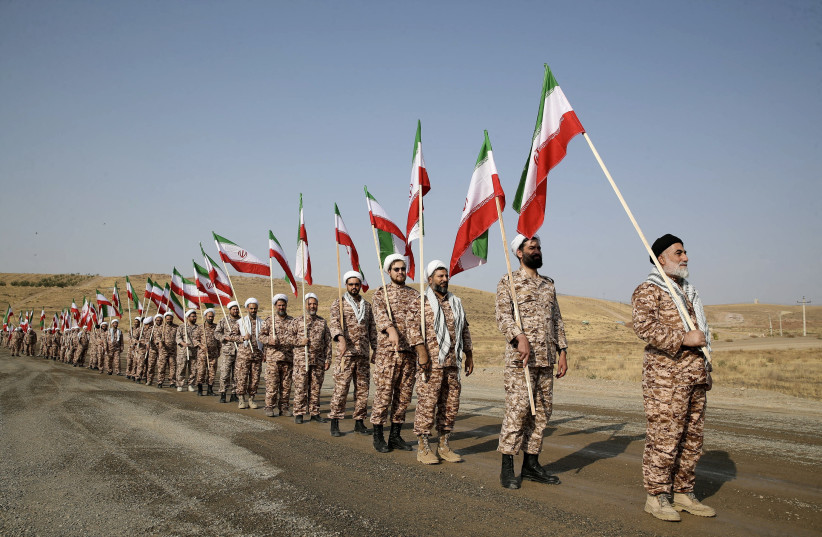
 Members of the Islamic Revolutionary Guard Corps (IRGC) attend an IRGC ground forces military drill in the Aras area, East Azerbaijan province, Iran, October 17, 2022. (credit: IRGC/WANA/HANDOUT VIA REUTERS)Members of the Islamic Revolutionary Guard Corps (IRGC) attend an IRGC ground forces military drill in the Aras area, East Azerbaijan province, Iran, October 17, 2022. (credit: IRGC/WANA/HANDOUT VIA REUTERS)

Azerbaijan’s first-ever ambassador to Israel Mukhtar Mammadov, has already clarified to The Jerusalem Post that the IDF can not use his country to refuel its planes in any military attack against Iran’s nuclear faculties.

ohen underlines importance of military alliance

Cohen, however, underscored the importance of a military alliance between the two countries, when he met with Bayramov.

“We must act together to prevent Iran from achieving nuclear capabilities,” Cohen said. “The way to do it is by using political and economic tools while at the same time formulating a reliable and decisive military threat.”

Israel was one of the first countries to recognize Azerbaijan’s independence in 1991. It formed diplomatic ties with it in 1992 and opened an embassy there a year later.

Cohen spoke about the importance of strengthening the relationship, particularly their financial ties, as he explained that he planned to lead an economic delegation to Baku next month.

“The opening of the Azeri embassy in Israel is further evidence of the strengthening of relations between our countries. Azerbaijan is a Muslim country, and its strategic location makes the relationship between us of great importance and great potential,” Cohen said.

Bayramov did not mention Iran, during his joint press conference with Cohen.

Bayramov said that with the opening of the embassy, the two countries had entered a new improved phase in their relationship, particularly with respect to increased economic ties. He noted that 114 Israeli companies operated in his country, which provides Israel with 30% of its oil.

“There is a huge potential for Israel to bring its advanced technology to Azerbaijan” which is “keen to attract innovation and artificial intelligence-based investments,” Bayramov said. He added that Azerbaijan was particularly interested in Israeli agriculture and water technology.


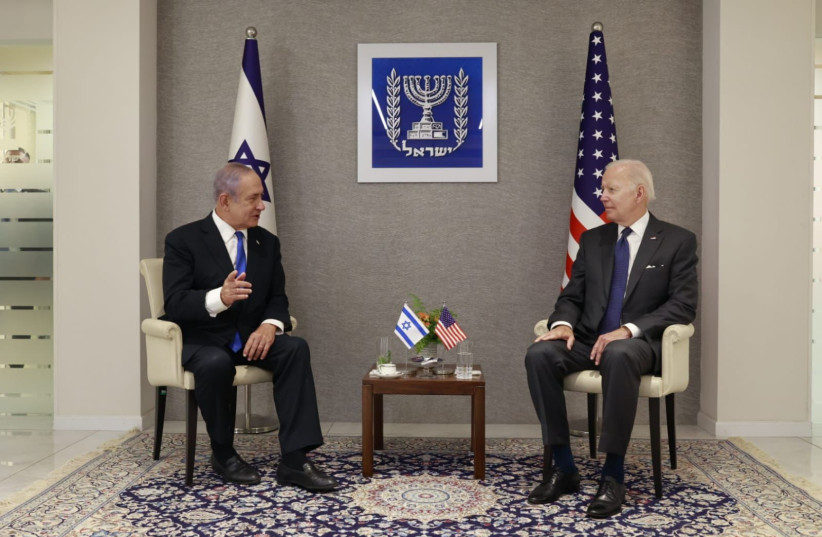
 US President Joe Biden with Israeli opposition head Benjamin Netanyahu on July 14, 2022 (photo credit: RAANAN COHEN/MAARIV)
US President Joe Biden with Israeli opposition head Benjamin Netanyahu on July 14, 2022
(photo credit: RAANAN COHEN/MAARIV)

Prime Minister Benjamin Netanyahu won’t be invited to the White House in the “near term,” US President Joe Biden told reporters in North Caroline on Tuesday, as he continued to express his opposition to Israel’s judicial reform plan.

“They can not continue on this road. I have sort of made that clear,” Biden said.

“I hope he [Netanyhau] walks away from it,” Biden told reporters.

Earlier in the day a US National Security Advisor spokesperson also clarified that “there is no plan for PM Netanyahu to visit Washington.”

“Israeli leaders have a long tradition of visiting Washington, and PM Netanyahu will likely visit at some point,” the spokesperson said.


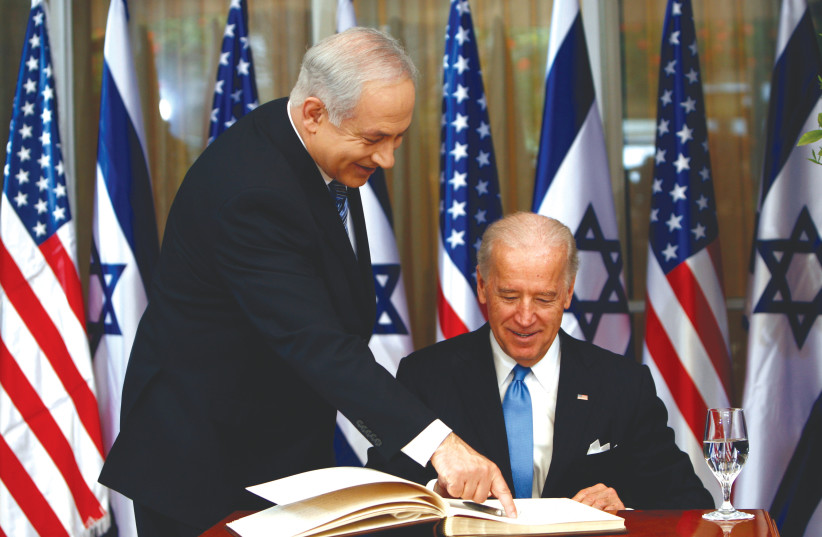
 THEN-US vice president Joe Biden prepares to sign the guest book before his meeting with then-prime minister Benjamin Netanyahu at the Prime Minister’s Residence in Jerusalem in 2010 (credit: RONEN ZVULUN/REUTERS)THEN-US vice president Joe Biden prepares to sign the guest book before his meeting with then-prime minister Benjamin Netanyahu at the Prime Minister’s Residence in Jerusalem in 2010 (credit: RONEN ZVULUN/REUTERS)

Prime Minister Netanyahu said in response, “I have known President Biden for over 40 years and I appreciate his longstanding commitment to Israel.

“The alliance between Israel and the US is strong and it always overcomes the differences of opinion that appear between us from time to time,” Netanyahu said as he defended his judicial reform program which critics warn is weakening Israeli democracy.

“The government led by me is committed to strengthening democracy by restoring the proper balance between the three authorities, which we strive to achieve with broad consensus,” Netanyahu said.

“Israel is an independent country that makes its decisions according to the will of its citizens and not based on external pressures, including our best friends,” he added.

Minister Miki Zohar (Likud) tweed, “It breaks my heart to see how much damage has been done to Israel from all the fake news that has been spread in connection with our justified legal reform.”

When Netanyahu returned to office after an 18-month hiatus, it was expected that one of his first foreign trips would be to meet with Biden.

US Ambassador to Israel Tom Nides often spoke of how a trip was forthcoming in the near future, but never set a date. Similar statements were echoed in Washington.

In 2009, when Netanyahu entered office on March 31, he went to the United States to meet Obama in May, less than two months later.

But when he was re-elected in 2013 and formed a new government, it took almost a year before he visited Obama in the White House.

Still, the absence of an invitation has garnered media attention in Israel as a possible symptom of tensions with Washington over Netanyahu’s judicial reform and his government’s actions and statements with regard to the West Bank and Palestinians.

The United States, including Secretary of State Antony Blinken and Biden, have also urged Netanyahu to take a consensus approach to his judicial reform plan.

Downplaying the absence of invitation

In an interview with Channel 12 on Tuesday Nides downplayed the absence of a Washington invitation.

“I would bet you the Prime Minister has been to Washington more than any single foreign leader combined,” Nides said noting that Netanyahu in the past has had no lack of White House innovations.

“He probably knows the White House better than I do. He has no lack of invitations to the White House. He and Joe Biden go back close to 40 years,” Nides said, adding, “I have no doubt they will spend time together.”

He emphasized that an invitation would eventually be forthcoming, but that no date had been set for such a visit.

He said he welcomed Netanyahu’s decision to suspend the passage of a critical reform bill to allow for a month of consensus talks.

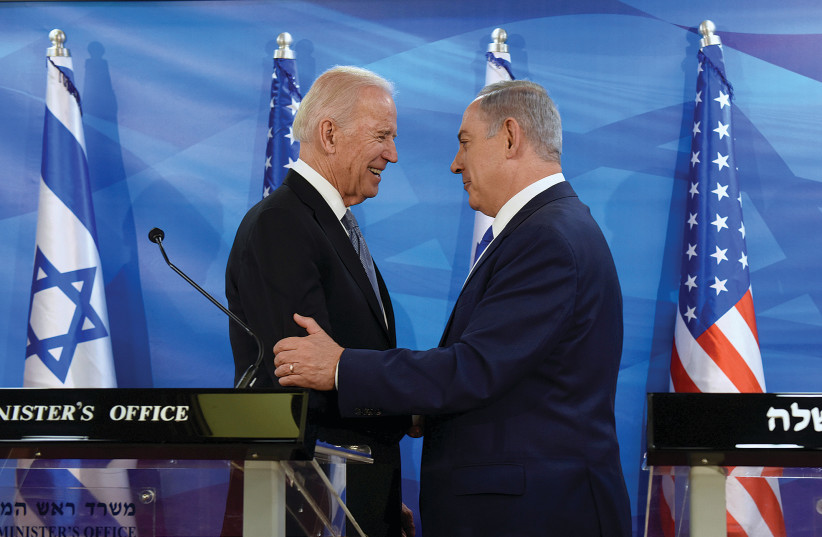
 US VICE-PRESIDENT Joe Biden with then-prime minister Benjamin Netanyahu in Jerusalem, in 2016.  (credit: DEBBIE HILL/POOL/REUTERS)US VICE-PRESIDENT Joe Biden with then-prime minister Benjamin Netanyahu in Jerusalem, in 2016. (credit: DEBBIE HILL/POOL/REUTERS)

“We want to see the country come together with a compromise to slow things down,” Nides said. “That is what I think the Prime Minister is going to do,” he said.

“I take the Prime Minister at his word,” Nides said adding that he believed Netanyahu “wants to create an opportunity to bring the country together and we welcome that.”

The relationship between the United States and Israel is very close, Nides said, explaining that at his embassy “we spend an enormous amount of time every day talking to the PM’s Office and they talk to our office.” It’s akin to a family connection, he added.

Nides rejected an allegation by Netanyahu’s son Yair, that the US State Department was funding the anti-judicial reform protests.

Nides called the claim “absurd” and “ridiculous,” adding that it was not true.

When asked about Defense Minister Yoav Gallant, he said, “I liked the Defense Minister a great deal. He is a smart, shrewd guy. He is a great Defense Minister.”

Nides spoke as Netanyahu is weighing whether to make good on his statement that he planned to fire Gallant for speaking out against the judicial reform process.