Reports claim the Israeli Air Force conducted another airstrike on Aleppo International Airport, marking the third strike this month.

Reports claim the Israeli Air Force conducted another airstrike on Aleppo International Airport, marking the third strike this month.
Top brass reportedly also concerned ant-overhaul protests might spread to full-time soldiers; security official says internal rift has galvanized adversaries
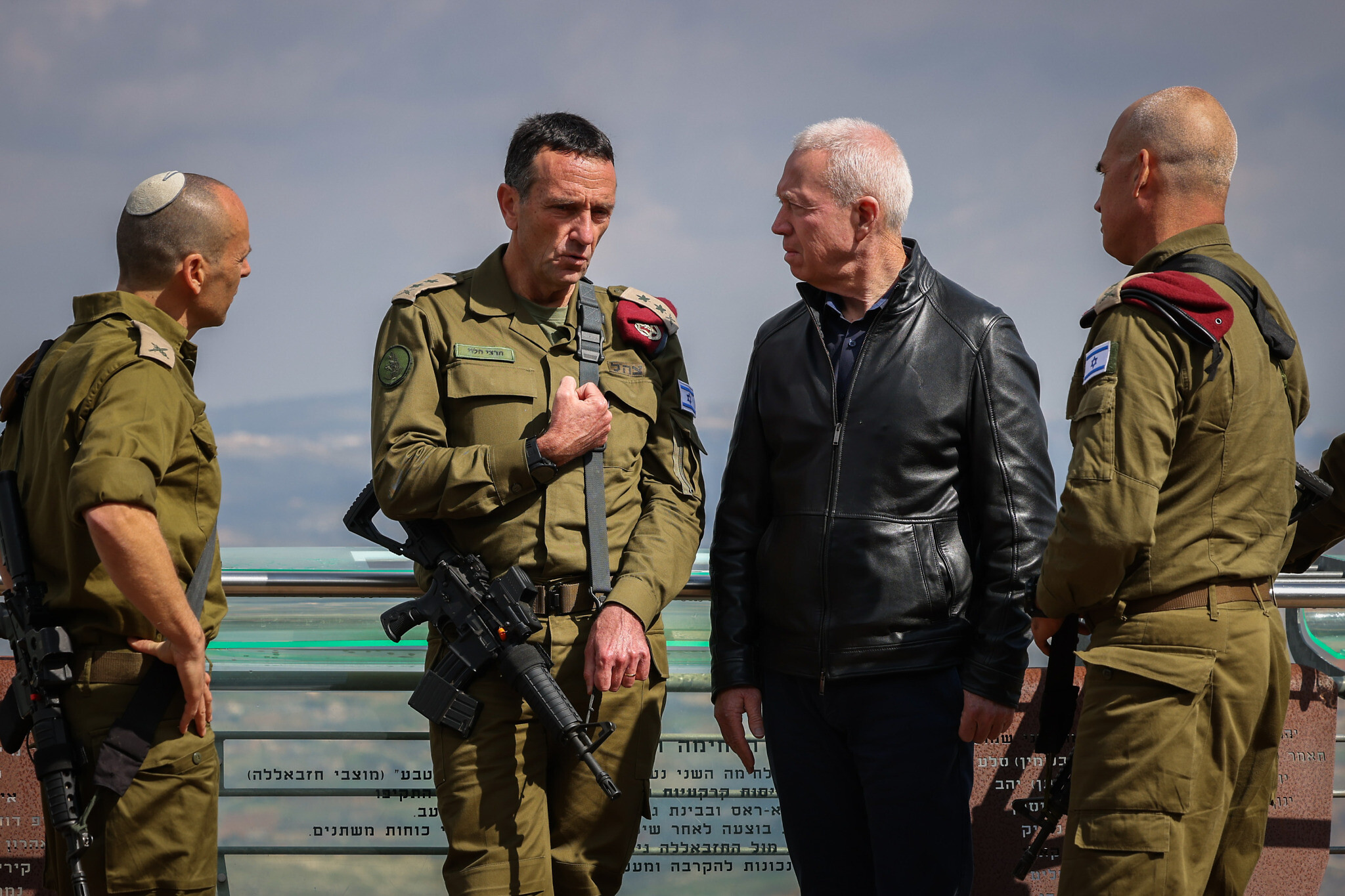
IDF Chief of Staff Herzi Halevi has warned government leaders that the army is on the verge of reducing the scope of certain operations due to the large number of reservists refusing to report for duty in protest over their efforts to weaken Israel’s justice system, The New York Times reported on Friday.
The report cited three Israeli officials who spoke on condition of anonymity and did not elaborate on Halevi’s warning.
The IDF’s top brass is also concerned that the protests against the government’s effort to restrict the Supreme Court’s power might spread from reservists to full-time soldiers, two of the officials told The Times.
A spokesman for Prime Minister Benjamin Netanyahu denied that Halevi or others had notified the premier that the protests were posing such a threat to the IDF’s operational capacity.
Halevi is widely reported to have warned leaders in recent days that the judicial overhaul is leading to deep and dangerous divisions within the military, as growing numbers of reservists warn they will not serve the military of a non-democratic country.
That fear is also believed to be at the top of Defense Minister Yoav Gallant’s mind. Gallant is widely reported to have planned Thursday to call for a halt to the legislation over his intense concerns on the matter, but put the matter off after talking to Netanyahu.
The Times also cited a senior defense official who said the Shin Bet security service has detected an uptick in attempts by Jewish extremists to carry out attacks against Palestinians, adding that they feel empowered by the hardline members of Netanyahu’s government. At the beginning of the month, Finance Minister Bezalel Smotrich called to “wipe out” a Palestinian town before backtracking and apologizing, and National Security Minister Itamar Ben Gvir has a long history of ties to settler extremists.
The defense official told The Times that Israel’s adversaries — Hamas, Islamic Jihad, Hezbollah and Iran — all appear emboldened by the internal crisis in Israel and have even increased cooperation in hopes of bringing about the Jewish state’s collapse against the backdrop of the mass protests against the government.
Prime Minister Benjamin Netanyahu said Friday that calls for refusal to serve in the IDF are a grave danger to the future of the State of Israel, and could spread beyond those who oppose the overhaul.
“Surrendering to [IDF] refusal is a terrible danger to the State of Israel,” Netanyahu said in a briefing to reporters following his meeting with British Prime Minister Rishi Sunak in London. “It won’t stop with just one side, it will move from side to side.”
The prime minister said he has heard from those who support the government’s plans who say they could also refuse to serve in the military if the legislation is not passed.
“You need to understand what is happening on the other side. People say that if it’s like this because of the threat of IDF refusal, then why just on one side?” Netanyahu said. “They say: ‘We will not send our children either.”
Netanyahu said he expects the security establishment to adopt a “firm position against” the phenomenon.
“The country cannot exist without the IDF. There will not be a nation, it’s very simple,” Netanyahu said Friday. “All red lines have been crossed. People who were responsible for the security of the country have suddenly adopted this cynicism.”
On Friday, 200 reservist pilots and 100 doctors who serve in the military reserves said they will halt service due to the legislative push, as opposition to the government’s efforts in the army’s ranks continued to spread.
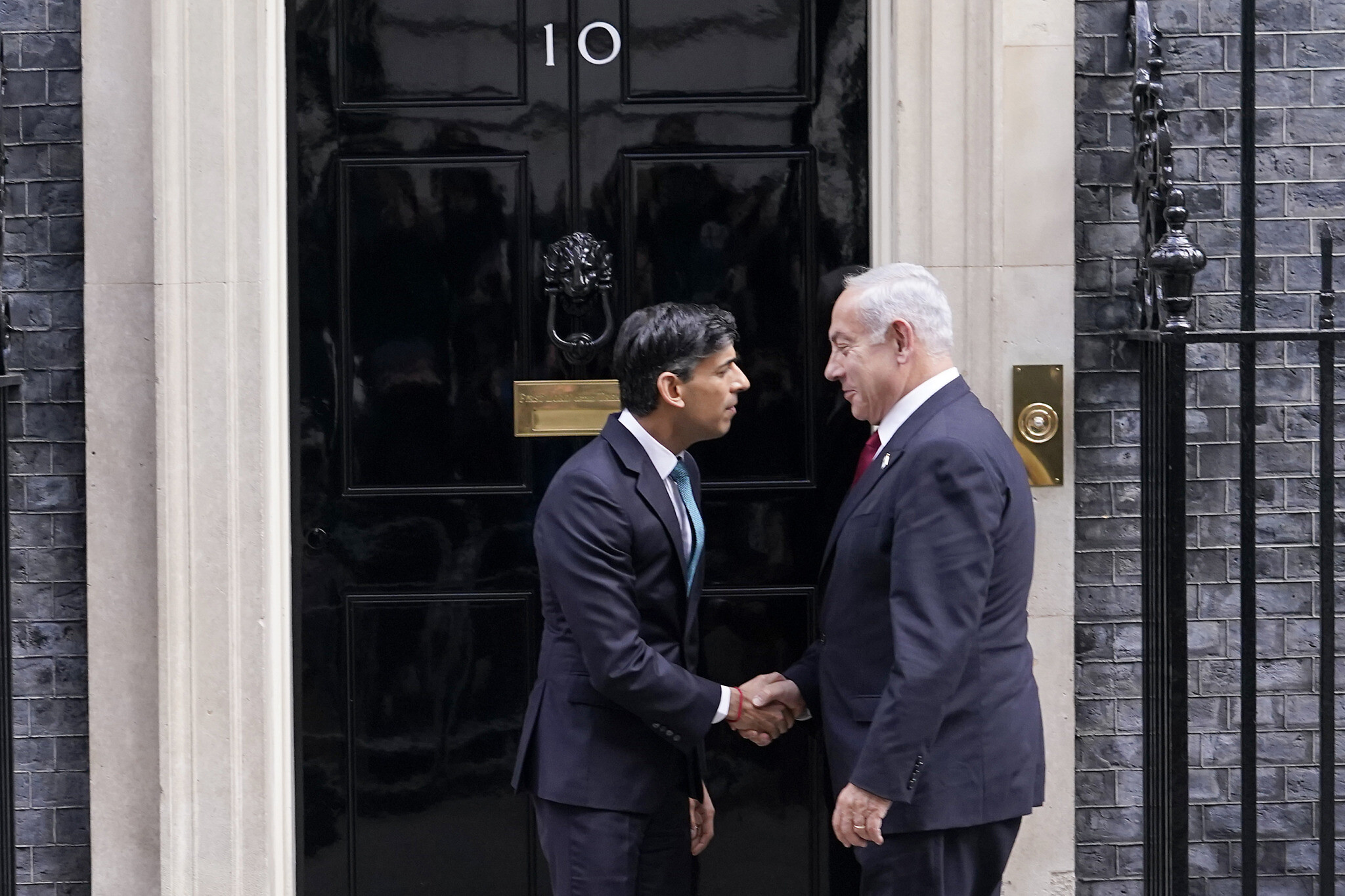
After the meeting between Netanyahu and Sunak Friday morning, Israel and the UK both issued statements about the sit-down, although only the British readout mentioned the judicial overhaul. Sunak’s statement said he had stressed to Netanyahu “the importance of upholding the democratic values that underpin our relationship, including in the proposed judicial reforms in Israel.”
A senior Israeli official who was present during the meeting said that the issue of the judicial overhaul was discussed for less than a minute toward the end of the Sunak-Netanyahu meeting.
Netanyahu also spoke out Friday against concerns that the intense protests and divides could color Israel’s national Memorial Day next month.
The prime minister said that “even if I were to halt the legislation, it wouldn’t help” keep Memorial Day apolitical, “because whoever wants to make a provocation on Memorial Day will do it.”
Netanyahu said that he spoke out strongly against any attempts to use Memorial Day to political ends while he led a strong opposition campaign against the Oslo Accords in the 1990s.
“People would tell me that I was disrespecting Yoni,” said Netanyahu, referring to his late brother, Yoni Netanyahu, who was killed during the IDF raid on Entebbe in 1976. “It is forbidden to say that!”
Netanyahu’s convoy was greeted Friday morning in London by several hundred Israeli and Jewish protesters chanting against the prime minister and his government’s controversial legislation. In an unusual move, he and Sunak did not make any public comments or hold a press conference, rather only released readouts of their meeting, which lasted about an hour.

Sunak has faced pressure in recent days to publicly comment on Israel’s highly contentious judicial shakeup, leading to speculation that he chose to forgo any public comments with Netanyahu in order to avoid taking a stance.
During Netanyahu’s visit to Berlin last week, he and German Chancellor Olaf Scholz publicly sparred during a press conference over the government’s continued push for legislation that will greatly expand political control over Israel’s High Court.
Netanyahu said Friday he’d invited Sunak to visit Israel in the near future. According to the British readout, Sunak said he “looked forward to visiting Israel at the earliest opportunity.”
Netanyahu met later Friday with UK Home Secretary Suella Braverman, without any public statements or press conference. His only other scheduled meeting during his trip — which is slated to last until early Sunday morning — is with the group Conservative Friends of Israel.
As it stands, the legislative package will — among other things — allow the Knesset to override court decisions with the barest majority, preemptively shield laws from judicial oversight, and put the selection of most judges in the hands of coalition politicians. Netanyahu said Thursday night that the law on selecting judges would be enacted next week.
While supporters say the judicial overhaul will rebalance power away from an overly activist court, critics argue the moves will remove essential checks on executive and legislative power, putting democracy in peril and leaving many basic rights unprotected.
Times of Israel staff contributed to this report.
But how much substance lies behind the rhetoric?
Jerusalem Post, 25/3
Ali Ramzi al-Aswad, a senior member of the Al-Quds Brigades, the armed wing of the Palestinian Islamic Jihad movement, was shot dead on Sunday, March 19, in the Qudsaya area of Damascus. According to a report in the pro-Hizballah, pro-Assad Lebanese newspaper al-Akhbar, unidentified assailants fired more than 30 rounds from automatic weapons at al-Aswad, as the Islamic Jihad operative walked from his home to his car. Al-Akhbar and other regional media outlets immediately assumed that Israel was responsible for the killing.
An editorial in the same al-Akhbar, published on March 20th, sought to locate the killing of al-Aswad within the broader context of the current escalation in tensions between Israel and Hizballah.
This escalation derives from the significant uptick this year of violence in the northern West Bank, and from growing indications that Lebanese Hizballah, with its Iranian patrons behind it, is seeking to assist, capitalize on and extend the scope of this violence. In this regard, the recent incident in Megiddo, in which an operative entered Israel from Lebanon equipped with weaponry including a sophisticated claymore mine, represents until now the clearest practical evidence of this attempt at linkage. So how seriously should these efforts be taken?
The al-Akhbar editorial was written by the paper’s chief editor, Ibrahim Amin. Amin is a close associate of the Hizballah leadership and of the movement’s general secretary, Hassan Nasrallah. As such, his writings often reflect the thinking of senior currents of the pro-Iran axis in Lebanon and elsewhere, and are hence worthy of particular attention.
Amin locates current events within the framework of the approaching month of Ramadan. He asserts that ‘events, consultations and contacts seen and unseen’ suggest that ‘the coming month of Ramadan will be an occasion to announce a new, more effective level of coordination between the resistance forces in the entire region.’ Amin goes on to note the position ‘recently launched by the leaders of the resistance regarding the unity of the arenas…the aim of which is to raise resistance activity inside Palestine to a level that opens the door to a comprehensive uprising.’
The ‘resistance,’ according to Ibrahim Amin, ‘realizes that direct, qualitative action on the entire area of historical Palestine represents the starting point for the complete liberation project.’
From this point of view, Amin contends that the killing of al-Aswad reflected an Israeli desire to respond to the Megiddo ‘operation’ and the evidence it indicated of the aforementioned ‘unity of the arenas.’
Israel’s aim, Amin suggests, was to strengthen deterrence, while avoiding ‘uncontrolled escalation’ and a deterioration to a general conflict. The choice of the target – a Palestinian from an Iran and Hizballah backed organization, and the location – Syria rather than Lebanon – was calibrated in order to achieve this precise effect, the al-Akhbar editor proposes.
The approach to Ramadan this year, Amin continues, is distinguished by the presence of what he refers to as an ‘insane government’ in Israel, and a resulting ‘internal crisis in the occupying entity in an unprecedented manner, amid the escalation of regional dangers to Israel, especially from Iran and the northern front.’
‘Everyone’, Amin concludes, ‘is waiting for different days in the coming Ramadan, and first and foremost the enemy, who does not desist even for an hour from the crimes of killing and assassination.’
Ibrahim al-Amin’s editorial, it is worth noting, is primarily a response to a somewhat dispiriting event for his readers and patrons – namely the successful penetration as he perceives it of his side’s territory by its enemies, and the targeted assassination of a senior operative. Nevertheless, the opinions expressed in it reflect a widespread stance reflected in other statements by leaders and mouthpieces of the pro-Iran regional alliance. The specific and common elements are the conviction that their cause is served by the internal disunity and strife in Israel, and the desire to link the evident renewed desire for confrontation in the West Bank with the capabilities and capacities of Iran and its clients.
Recent statements by Nasrallah himself, and by senior Hamas military officials including Marwan Issa and Saleh al Arouri have followed along similar lines.
A series of meetings of senior officials of Hizballah, Hamas and Islamic Jihad over the past week, meanwhile, further suggest at least a desire to project an image of coordination.
According to a statement issued by Hizballah’s press office on Sunday, Nasrallah met recently with a delegation led by Saleh al Arouri of Hamas. The discussion, according to the statement, centered on “the latest developments in occupied Palestine, especially the resistance in the West Bank and Jerusalem.”
Arouri is the most senior military operative of Hamas currently active on the external front. Formerly based in Turkey, he has claimed responsibility for organizing the kidnapping and murder of three Israeli Jewish teenagers which led to Operation Protective Edge in 2014.
Nasrallah also met last Saturday with Palestinian Islamic Jihad leader Ziad al-Nakhala, and an accompanying delegation. Nasrallah and al-Nakhala agreed to ‘continue consultation and coordination with a view to enhancing the resistance against Israel,” according to a statement subsequently released by Islamic Jihad.
How should all this be interpreted? Firstly, it should be noted that expressions of bellicose self-confidence on the part of this camp, sometimes with only glancing resemblances to reality, are not a new development.
A narrative according to which the violence of May 2021 represented the birth of a new paradigm in the struggle between Israelis and Palestinians is prevalent here. What Israelis refer to as Operation ‘Guardian of the Walls’ is termed by Hizballah and its allies the ‘Saif al-Quds’ (Sword of Jerusalem) battle.
Robert Inlakesh, writing at the pro-Hizballah al-Mayadeen media website in May 2022, characterized the supposed new developments of this period in the following terms: ‘the tactics used by the armed groups, such as; slowly revealing new weapons technology, striking everywhere inside the 1948 territories, putting Israeli airports on temporary lockdown and controlling the course of the battle, all showed the entire region the weaknesses of “Tel Aviv”.
The latest statements by Nasrallah and Issa, and al-Amin’s editorial, should be seen as coming from within this perception. A cooler glance at the situation, however, would require an acknowledgement that even in 2021, the hoped for mass mobilization of Palestinians in support of a new intifada did not take place. Nor did it happen in the Ramadan of 2022, despite the uptick in violence. Nor has it happened so far this year, despite the very significant increase in violence in the West Bank since the start of 2023.
The key question, however, is not the accuracy of the perceptions revealed in al-Amin’s editorial and Inlakesh’s somewhat overheated prose. Rather, the key matter is the extent to which those who publicly profess these views, especially among the decisionmakers in that camp, are themselves genuinely convinced by them. Rhetoric, after all, can play a compensatory and comforting role,. It can divert attention from a more cautious and pragmatic praxis. In the Arab world, famously, it very often fulfils this function. Is that the case here? Or is something more substantive being revealed?
This takes us back to the incident in Megiddo. All the relevant information is not publicly available. But here is what is known: the forces that control the Lebanese side of the Israel-Lebanon border, ie Hizballah and its Iranian masters, chose to initiate or permit the launching of an operation involving the use of sophisticated military technology which if successfully employed would have resulted in an act of terror involving mass casualties. Such an action would undoubtedly have brought forth a major Israeli response. That they carried out or sanctioned such an operation would seem to indicate that the assessment outlined in Ibrahim al-Amin’s editorial following the assassination of Ali Ramzi al-Aswad does indeed reflect the view adhered to by key individuals in the highest echelons of Hizballah and among the Iranian forces which stand behind it. This ought to be a matter of note for all those concerned with Israel’s security, and with the maintenance of its deterrence.
Scofield Biblical Institute and Theological Seminary Copyright 2010 – 2020
