The chairman of the Joint Chiefs of Staff told a House panel that “from a time of Iranian decision,” the Islamic Republic could produce fissile material for a nuclear weapon in less than two weeks.

US Chairman of the Joint Chiefs of Staff General Mark A. Milley looks on as he attends a news conference with US Secretary of Defense Lloyd Austin (not pictured), on the day of the NATO defence ministers' meeting at the Alliance's headquarters in Brussels, Belgium, February 14, 2023. (photo credit:  REUTERS/JOHANNA GERON)
US Chairman of the Joint Chiefs of Staff General Mark A. Milley looks on as he attends a news conference with US Secretary of Defense Lloyd Austin (not pictured), on the day of the NATO defence ministers’ meeting at the Alliance’s headquarters in Brussels, Belgium, February 14, 2023.
(photo credit: REUTERS/JOHANNA GERON)

WASHINGTON – The Islamic Republic of Iran could produce fissile material for a nuclear weapon in less than two weeks from the “time of an Iranian decision,” and after that, it would only take “several more months” to produce an actual nuclear weapon, General Mark Milley, Chairman of the Joint Chiefs of Staff, warned on Thursday.

Testifying at the House Appropriations Committee to discuss the Pentagon budget request for 2024 alongside Secretary Lloyd Austin, General Milley said that Iran threatens to push the Middle East into regional instability by continuing its support to terrorists and proxy forces.

“The United States remains committed as a matter of policy that Iran will not have a fielded nuclear weapon.”

Mark Milley

“But the United States remains committed as a matter of policy that Iran will not have a fielded nuclear weapon,” he told the House panel. He went on to say that the US military has developed “multiple options for our national leadership to consider if or when Iran ever decides to develop an actual nuclear weapon.”

Israel: Ongoing cooperation needed to stop Iran from going nuclear

Israel hosted the top US General earlier this month for discussions that it said included the need for cooperation on denying Iran nuclear weaponry.

“Ongoing cooperation is required in order to prevent Iran from gaining a nuclear weapon.”

Yoav Gallant

“Ongoing cooperation is required in order to prevent Iran from gaining a nuclear weapon,” Israeli Defense Minister Yoav Gallant‘s office quoted him as telling Milley.

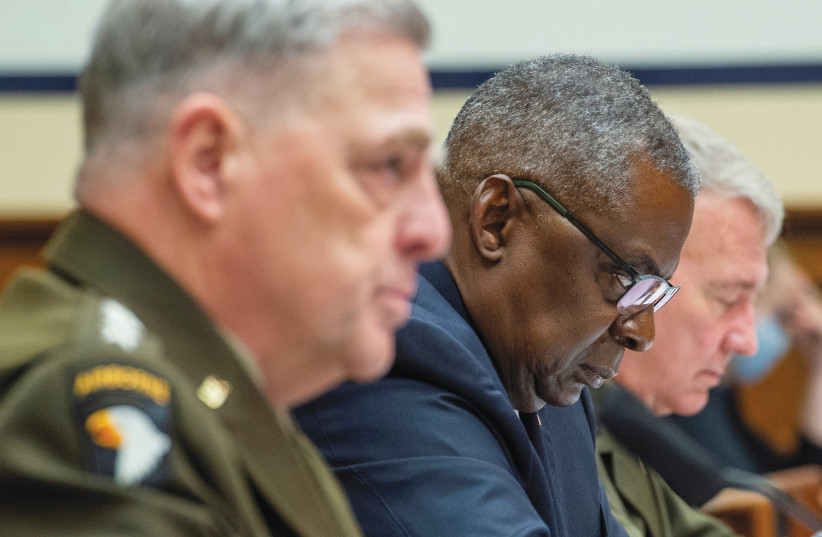
 US DEFENSE SECRETARY Lloyd Austin (center) and military brass, including Chairman of the Joint Chiefs of Staff Gen. Mark A. Milley (left) are questioned in Congress last week on the withdrawal from Afghanistan. (credit: REUTERS)US DEFENSE SECRETARY Lloyd Austin (center) and military brass, including Chairman of the Joint Chiefs of Staff Gen. Mark A. Milley (left) are questioned in Congress last week on the withdrawal from Afghanistan. (credit: REUTERS)

Milley’s remarks comes a month after Under Secretary of Defense for Policy Colin Kahl said at a House hearing that Iran could make enough fissile for one nuclear bomb in “about 12 days,” down from the estimated one year it would have taken while the 2015 Iran nuclear deal was in effect.

“Because Iran’s nuclear progress since we left the JCPOA has been remarkable,” he said. “Back in 2018, when the previous administration decided to leave the JCPOA it would have taken Iran about 12 months to produce one bomb’s worth of fissile material. Now it would take about 12 days,” Kahl, the third-ranking Defense Department official, told lawmakers.

Reuters contributed to this report.


Evangelical Christian groups have supported the Zionist cause in various capacities for decades, and have close relationships with Israeli institutions.

 Head of the Finance committee MK Moshe Gafni leads a Finance committee meeting at the Knesset, the Israeli parliament in Jerusalem, on January 17, 2023. (photo credit: OLIVIER FITOUSSI/FLASH90)
Head of the Finance committee MK Moshe Gafni leads a Finance committee meeting at the Knesset, the Israeli parliament in Jerusalem, on January 17, 2023.
(photo credit: OLIVIER FITOUSSI/FLASH90)

After a bill punishing Christian missionaries with prison time for any type of proselytization caused furor among pro-Israel evangelicals on Sunday, Prime Minister Benjamin Netanyahu publicly assured that the State of Israel would not pass legislation targeting Christians.

“We will not advance any law against the Christian community,” Netanyahu wrote on Twitter in both English and Hebrew on Wednesday.


United Torah Judaism leader Moshe Gafni also released a statement on Wednesday, noting that the bill would not be advanced at this stage. The bill, which is identical to other bills on this matter promoted by Gafni, was placed procedurally on the Knesset table four months ago.


Response to Netanyahu’s assurances

US Christian leaders and political actors welcomed Netanyahu’s response to their concerns.

“Prime Minister Netanyahu is an amazing leader of courage,” said Sam Brownback, ex-Kansas governor and former US ambassador for International Religious Freedom. “I applaud his quick and decisive addressing of what could have been a major issue.”

Evangelist pastor Greg Laurie said on Wednesday that Gafni and Netanyahu’s comments were “great news.”

Penny Nance, head of Christian evangelical non-profit Concerned Women for America, also thanked Netanyahu on Thursday for “standing up for Christians,” after she had warned of the repercussions of the bill if it passed.

“If this became law Evangelicals on tour from the US if led by the Holy Spirit to share the Gospel with their tour guide would risk imprisonment,” Nance said on Wednesday.

Pastor Jack Graham joined the chorus of those expressing disconcertion about the bill, saying “I love Israel and we need to be praying for Israel and its leaders.”

The outrage over the bill began after a Sunday report by Christian evangelical outlet All Israel News. Editor-in-Chief Joel C. Rosenberg credited the outlet for raising awareness of the issue.

“I am deeply grateful to Israeli Prime Minister Netanyahu for his strong, unequivocal statement,” said Rosenberg on Wednesday. “The Evangelical community worldwide greatly appreciates your friendship. Bless you.”

The bill would amend preexisting proselytization provisions in the 1977 Penal Code, which hold that forbids missionary action through material enticement, persuading minors to convert, or holding conversion ceremonies without consent of parents. Visitors to Israel may also be denied entry into the country if they were traveling for missionary purposes.

The amendment would change the crime to apply to all conversion attempts “directly, digitally, by direct mail, or online. The maximum prison sentence would be a year for conversion attempts of an adult, whereas the previous six month sentence for those proselytizing against minors would be increased to two years.

The explanatory notes of the bill contend that there have recently been increased attempts by mostly Christian missionary groups. These proselytization attempts didn’t violate the law because they didn’t involve material enticement.

Negative consequences such as “mental damage” and concern that missionaries targeted vulnerable segments of society required legislators to act, the bill said.

Indeed, there have been notable cases of late of Israeli Jewish orthodox community members being revealed as Christian missionaries.

In April 2021, a French Hill family from New Jersey was revealed to be Christian missionaries. The father posed as a rabbi, mohel and sofer. The mother claimed to be the daughter of an Auschwitz survivor. A Seattle man who made Aliya and lived in Jerusalem was accussed of posing as a Jew and being a missionary in May 2021.

In December, The Collegiate Association for the Research of Principles, which is connected to a messianic South Korean cult, was accussed of distributing flyers to youth in Jerusalem inviting them to an event.

In 2022, the Central Bureau of Statistics said that 182,000 Christians lived in Israel, making up about 1.9% of its population.

Peggy Cidor, Sam Halpern and Jeremy Sharon contributed to this report.


Iran-Saudi deal doesn’t necessarily signal a whole new ball game in the Middle East, as some folks might claim; however, there has been a shift in the balance of power.

SAUDI CROWN Prince Mohammed bin Salman (right) receives UAE President Sheikh Mohammed Bin Zayed Al Nahyan, in Jeddah, last summer. Categorizing the UAE as a loser may not be entirely accurate, says the writer.
(photo credit: SAUDI PRESS AGENCY/REUTERS)

The recent agreement between Saudi Arabia and Iran has sent shockwaves through the media and government officials. The involvement of China as a mediator has added fuel to the fire, making it imperative to read between the lines to understand the deal’s implications and strategic fallout for all parties involved.

While some observers view the agreement as a sign that Saudi Arabia prioritizes stability and peace with Iran over its alignment with a counter-camp led by the United States and Israel, which views Iran as a strategic threat, others have taken a broader perspective. They have conducted an inventory that evaluates the agreement’s impact on regional and international parties, categorizing them as either winners or losers.

While the recent agreement between Saudi Arabia and Iran on the resumption of bilateral relations may appear promising, it is important to wait for the results of their efforts in settling outstanding regional issues between the two powers. It should be noted that while the Chinese mediator and timing of the agreement may be surprising, the two countries have been exchanging declarations of desire for calm and dialogue for nearly two years, following Iraqi officials announcing their mediation between the parties.

Did the UAE emerge as a loser?

The agreement carries potential profit and loss calculations for several regional parties. However, categorizing the UAE as a loser in the agreement may not be entirely accurate. The UAE has consistently called for dialogue and stability in the region, it has resumed official relations with Iran and it does not support wars in the Gulf, whether between regional countries or between Iran and Israel.

It is widely recognized that the UAE’s ambitious development goals, much like Saudi Arabia and other GCC countries, are reliant on a stable and secure atmosphere. As such, any looming military conflicts could have a negative impact on the UAE’s economy, present significant security challenges and create unnecessary tensions.

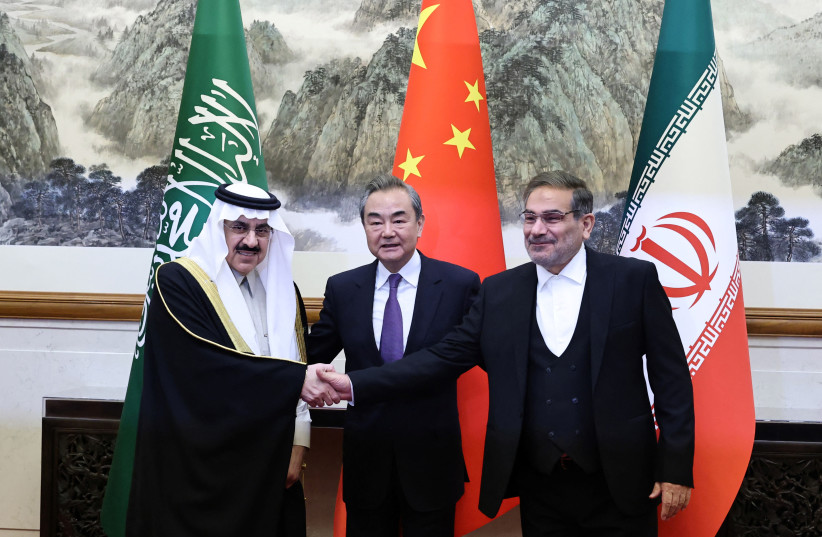
Wang Yi, a member of the Political Bureau of the Communist Party of China (CPC) Central Committee and director of the Office of the Central Foreign Affairs Commission, Ali Shamkhani, the secretary of Iran’s Supreme National Security Council, and Minister of State and national security adviser of Sau (credit: CHINA DAILY VIA REUTERS)Wang Yi, a member of the Political Bureau of the Communist Party of China (CPC) Central Committee and director of the Office of the Central Foreign Affairs Commission, Ali Shamkhani, the secretary of Iran’s Supreme National Security Council, and Minister of State and national security adviser of Sau (credit: CHINA DAILY VIA REUTERS)

Did Israel emerge as a loser?

Meanwhile, some observers have classified Israel as a potential loser in the agreement, having lost a potential regional ally in the face of what it considers an existential strategic threat. However, it is important to note that the Iranian-Saudi agreement does not signify the disappearance of the Iranian nuclear threat to any country in the region, including Israel.

It is critical to differentiate between cooling tensions and transforming Iran into a friendly country for Saudi Arabia, as the events and accumulated history between the two countries over the past seven years will not disappear overnight with a stroke of a pen or an agreement whose ink has not yet dried.

Despite the recent agreement between Saudi Arabia and Iran, doubt may still linger in the space of relations for a period that could vary depending on the development of relations between the two sides. Furthermore, formal relations between Israel and Saudi Arabia have not yet been established and the kingdom’s stance toward normalizing relations with Israel remains, at least officially, in the testing phase.

AS SUCH, the agreement with Iran is not seen as an adversary to any trend in this regard, nor does it hinder any Saudi effort to establish official relations with Israel if Riyadh decides to do so. In fact, the agreement could provide a more favorable environment for such a step to proceed, with direct channels of communication to reassure Tehran.

So, the word on the street is that Saudi Arabia wants the US to jump through some hoops before they agree to play nice with Israel, like giving the green light to nuclear energy for peaceful purposes. But I don’t think this goes against the recent agreement and it might even make Riyadh look better and put pressure on Washington to reconsider its stance.

In any case, Saudi Arabia has expressed its reluctance to join any military alliance against Iran, whether in partnership with Israel or other countries. This decision is attributed to the Kingdom’s focus on achieving its development goals and avoiding conflicts that could hinder its progress or drain its resources. With the recent visits of US officials to Israel, Iraq and other Arab nations, it is also speculated that Riyadh is seeking to distance itself from potential military escalations against Iran.

Furthermore, a recent agreement between Iran and the International Atomic Energy Agency could restrict any attempts by Israel to launch a military strike on Iran’s nuclear facilities. The current regional and international environment does not support such a move, particularly since China has taken on a mediator role in resolving the crisis between the Gulf poles. Iran, too, stands to benefit greatly from the agreement, given its need to butter up the global community and narrow down the reasons for any further military escalation against it.

The deal also presents an opportunity for Iran to reduce tensions and limit spending on pro-Iranian militias and sectarian arms, which has become a priority due to internal protests and the country’s economic struggles. Other regional players, such as Iraq, Lebanon, Syria and Yemen, stand to benefit, as well.

The US emerges as a loser

On the other hand, the US emerges as a strategic loser in this scenario. The trilateral statement coming out of Beijing at a time when Sino-American relations are strained places the US at a disadvantage, regardless of the extent of the loss.

To put it in a nutshell: the Iran-Saudi deal doesn’t necessarily signal a whole new ball game in the Middle East, as some folks might claim; however, there has been a shift in the balance of power among regional and global players, following the post-Ukraine era.

These developments reflect the strategic preparations underway for the interactions of the coming years and decades, taking place in a world with some potential for other players to compete for leadership of the global order.

The writer is a UAE political analyst and a former Federal National Council candidate.