Netanyahu Cutting Germany Visit Short

The Prime Minister’s Office has announced that Prime Minister Benjamin Netanyahu plans to cut short his visit to Germany by several hours, returning to Israel on Thursday night.

Netanyahu departed Wednesday for a diplomatic visit to Berlin, where he was scheduled to meet with German Chancellor Olaf Scholz on the situation with Iran and its race towards nuclear breakout.

Although no reason was given for the change in Netanyahu’s schedule, it is believed one reason has to do with a developing security situation in northern Israel or the expected compromise proposal by President Isaac Herzog on judicial reform.

The prime minister held a security consultation on Wednesday afternoon with Defense Minister Yoav Gallant.

“In recent days, the prime minister has been updated and is following security developments together with the senior security leadership,” the prime minister’s office said in a statement.

Gallant has also held several other “urgent” security assessments in the past 24 hours in the wake of a serious “security incident” that took place in the northern sector.

On Tuesday, roads were closed near Israel’s border with Lebanon. A gag order was placed on the release of any further details.

Netanyahu Cutting Germany Visit Short


We are a “crossroads” between “a historical crisis or a defining constitutional moment.”

By World Israel News Staff

President Isaac Herzog on Wednesday night presented his compromise proposal, the so-called “people’s plan,” to counter the government’s plans to reform the judiciary, calling for a “constitutional moment” amid what he said was a “nightmare” with “civil war looming.”

“Those who think that a civil war is a border we won’t reach, have no clue,” he said in a live television address, noting that he had spoken to thousands of Israelis in recent weeks.

“I’ve heard deep-rooted hatred. I’ve heard people from all sides say that if, God forbid, there’ll be blood in the streets, it will no longer shock them,” he said.

“Civil war is a red line. I will not let it happen,” he added.

According to the president, Israel sits at a “crossroads” between “a historical crisis or a defining constitutional moment.”

He called his proposal a “golden path” which ties together the broadest range of views.

“It’s not the president’s plan. It’s the people’s plan,” Herzog said.

Israeli Prime Minister Benjamin Netanyahu delayed a scheduled flight to Berlin by five hours in order to attend a discussion on the president’s proposal alongside chairman of the Constitution, Law and Justice Committee Simcha Rothman and several other senior ministers.

  NETANYAHU VISITS BEREAVED MOTHER OF TERROR VICTIMS, REQUESTS PHOTO OF CHILDREN TO SHOW WORLD LEADERS

Before leaving for Berlin, Netanyahu said that some of the compromise’s “key clauses…only perpetuate the existing situation and do not bring the required balance between the authorities in Israel.”

The draft proposes that Basic Laws would be approved after four readings, and not in three as is currently the case. In the first three votes, a slim majority of 61 MKs will be required, but in the fourth reading, a majority of 80 MKs will be required in most cases.

The proposal also states that the Supreme Court will not be able to review Basic Laws, and will only have the power to strike down ordinary laws. In order to do so, the Supreme Court will be required to do so with an expanded panel of no less than 11 judges, and by a majority of at least 7. Without that, the law returns to review by the Knesset.

The Judicial Appointments Committee would comprise 11 members and not include a majority for the coalition, which would have only five prominent representatives there. The committee will include the Justice Minister, two other ministers chosen by the government, the Supreme Court president, two judges, three members of the Knesset – one from the coalition and two from the opposition from different factions. At least four members will be women and one from Israel’s Arab sectors.

  FORMER PM OLMERT CALLS FOR ‘REAL WAR’ TO STOP JUDICIAL REFORM, SAYS PROTESTS NOT ENOUGH

Herzog opened his speech by referencing an event from earlier in the evening when a terrorist from Lebanon infiltrated Israel and planted an explosive device that caused the serious injury of an Israeli citizen at the Megiddo Junction.

“Our enemies recognize very well the primacy of Israeli unity – and act accordingly,” he said.


Ramin Yektaparast, a biker gang leader wanted on suspicion of murder in Germany who now lives in Iran, is accused of directing antisemitic attacks from Iran.

 ISLAMIC REVOLUTIONARY Guard Corps Commander-in-Chief, Maj.-Gen. Hossein Salami, reviews military equipment during an IRGC ground forces drill in Iran last year. (photo credit: IRGC/WANA/via Reuters)
ISLAMIC REVOLUTIONARY Guard Corps Commander-in-Chief, Maj.-Gen. Hossein Salami, reviews military equipment during an IRGC ground forces drill in Iran last year.
(photo credit: IRGC/WANA/via Reuters)

After a century-old synagogue in Essen, Germany, was struck by two bullets last November, news reports connected it to the shooting at a synagogue in Halle three years earlier that had been perpetrated by a far-right German extremist.

But authorities quickly connected the Essen shooting to a different kind of perpetrator: Ramin Yektaparast, a biker gang leader wanted on suspicion of murder in Germany who now lives in Iran and is accused of directing antisemitic attacks from there.

German intelligence officials revealed in December that they believed the Essen shooting and two other synagogue attacks at the same time had ties to Iran. Last week, The Washington Post quoted anonymous German and US intelligence sources who named Yektarapast as a suspect, and as an alleged asset of Iran’s Revolutionary Guard Corps. The United States considers the Revolutionary Guard a terrorist organization, though Germany does not.

Yektarapast fled from Germany to Iran in 2021 after being suspected of the grisly murder of a fellow member of the Hells Angels gang. Involving criminals in terrorism plots is part of Iran’s playbook, a former US counterterrorism official told the Washington Post.

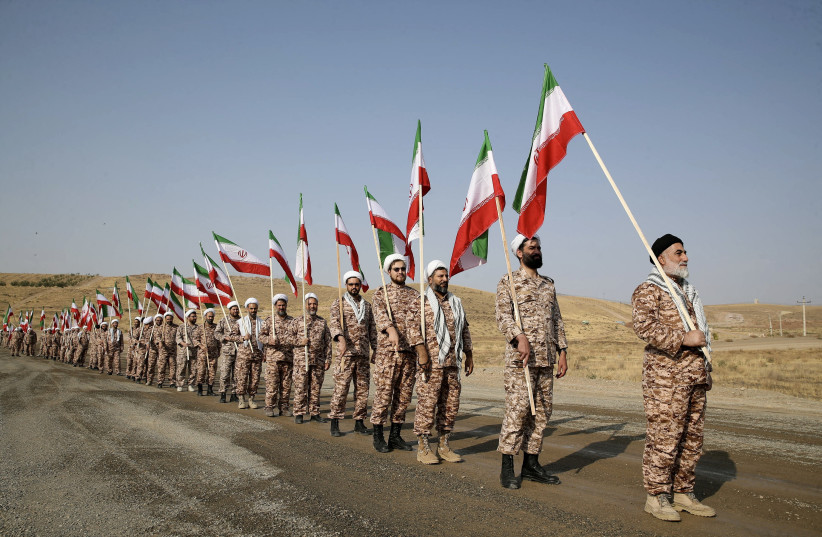
 Members of the Islamic Revolutionary Guard Corps (IRGC) attend an IRGC ground forces military drill in the Aras area, East Azerbaijan province, Iran, October 17, 2022. (credit: IRGC/WANA/HANDOUT VIA REUTERS)Members of the Islamic Revolutionary Guard Corps (IRGC) attend an IRGC ground forces military drill in the Aras area, East Azerbaijan province, Iran, October 17, 2022. (credit: IRGC/WANA/HANDOUT VIA REUTERS)

IRGC overseas strategy

Matthew Levitt, a fellow at the Washington Institute for Near East Policy, said Iranian agents have seen high-level assassination plans foiled and now are turning to “softer” targets in their efforts to sow terror and harm their country’s enemies.

“That’s when the plots targeting Jews come into play,” Levitt said.

Reports of Iran-linked terror cells targeting Jews or Israelis in Europe have been widespread in recent years. Last summer, as a record number of Israelis visited Turkey, Israel’s intelligence service, the Mossad, and its Turkish counterpart hunted through Istanbul for an Iranian cell. The cell had reportedly been tasked with targeting Israeli tourists in retaliation for the killing of an Iranian colonel in Tehran, allegedly by Israeli operatives.

Later last year, the Washington Post reported that Iran had targeted prominent Jews and Israelis around the world, including the French Jewish philosopher Bernard-Henri Levy. Josef Schuster, the head of the Central Council of Jews in Germany, has also been targeted, according to German authorities.

Iran’s attacks on Jewish and Israeli targets abroad are not new. Multiple investigations have implicated Iranian agents in the bombing of the AMIA Jewish community center in Buenos Aires in 1994, which killed 85 people. Officially, the case remains unsolved. (Two of the agents suspected in the bombing are among Iran’s senior officials today.)

The reports of Iranian involvement in attacks against Jews in Germany come as the country has reported a rise in antisemitic hate crimes. National data showed a 29% rise in reported hate crimes against Jews in 2021 compared to the previous year. This week, new data from Berlin showed that reports of antisemitic crimes rose sharply in 2022, with nearly 700 incidents reported compared to 386 in 2019, according to Judische Allgemeine, a German-Jewish newspaper. The incidents included both violent and nonviolent incidents, including vandalism.

That period coincided with an anti-vaccination movement that included comparisons between pandemic restrictions and the Holocaust, a possible crime under Germany’s restrictive laws against Holocaust denial and minimization. In Munich, for example, a Jewish leader filed antisemitic harassment charges against two leaders of a protest rally on Kristallnacht, the anniversary of the acceleration of the Nazis’ campaign against the Jews.

That period also saw a crackdown on activity by far-right extremists in Germany. Authorities arrested dozens of people in December who they said were planning to try to overthrow the government. Last May, German police found explosives and antisemitic, far-right literature at the home of a teenager they suspected of planning to attack at a school, also in Essen.

Germany announced a comprehensive plan to combat antisemitism in December, the country’s first.