
New renovation of the Davidson Center in Jerusalem utilizes interactive tech and augmented reality to highlight history and archaeology of Temple-era Jerusalem

An ancient coin from around 40 BCE with the oldest known depiction of a Temple Menorah will be displayed at the newly renovated Davidson Center in Jerusalem, which will open to the public on March 13, 2023. (courtesy Emil Algam/Israel Antiquities Authority)

An ancient coin from around 40 BCE with the oldest known depiction of a Temple Menorah will be displayed at the newly renovated Davidson Center in Jerusalem, which will open to the public on March 13, 2023. (courtesy Emil Algam/Israel Antiquities Authority)

An ancient coin bearing the oldest-known depiction of the Temple menorah will go on display to the public for the first time on Monday with the opening of the recently renovated Davidson Center in Jerusalem’s Old City.

The coin dates to around 40 BCE, during the Roman times and the reign of the last Hasmonean king. “This is the oldest known artistic depiction of the menorah, created 107 years before the destruction of the Second Temple,” says Dr. Yuval Baruch, head of archaeology and administration at the Israel Antiquities Authority, who was one of the excavators of the site and led the archaeological curation of the Davidson Center. The coin was donated to Israel sometime during the 1940s, during the British Mandate period, and it’s unclear where or when it was found.

It’s part of an exhibit of rare artifacts that contain some of the earliest known references and research about the origin of the Temple menorah, a seven-branched candelabra that is also used as the symbol of the modern State of Israel. Next to the coin is the Magdela Stone , which was discovered in the town of Migdal in 2009 and was likely a Torah reading table from a first-century synagogue. The intricately carved stone shows multiple menorahs as well as a possible depiction of the Jerusalem Temple.

Also being displayed to the public for the first time is a piece of plaster from Jason’s Tomb, a carved-rock tomb from the Second Temple period nestled into the leafy Rehavia neighborhood in Jerusalem. There are five menorahs carved into the plaster, which was discovered in the 1950s during the excavation of the tomb prior to building an apartment building.

The three pieces were chosen as the centerpiece of the newly opened Davidson Center, which will open to the public on Monday after a three-year closure due to renovations. The multi-million dollar overhaul doubled the size of the museum and visitor’s center, which is located in the Jerusalem Archaeological Park in the Old City.

The new visitor’s center will combine archaeological finds with interactive technology to help visitors experience what life was like during the First and Second Temple Periods.

“Over the ages, people have found different ways to tell stories, which is a wonderful thing for human condition,” said Darin McKeever, the president and CEO of the Davidson Foundation, which funds the Davidson Center. “This story comes back to the original artifacts and original stones, so we can tell the history using archaeological finds, and use the technology to add to people’s understanding of the story behind them.”
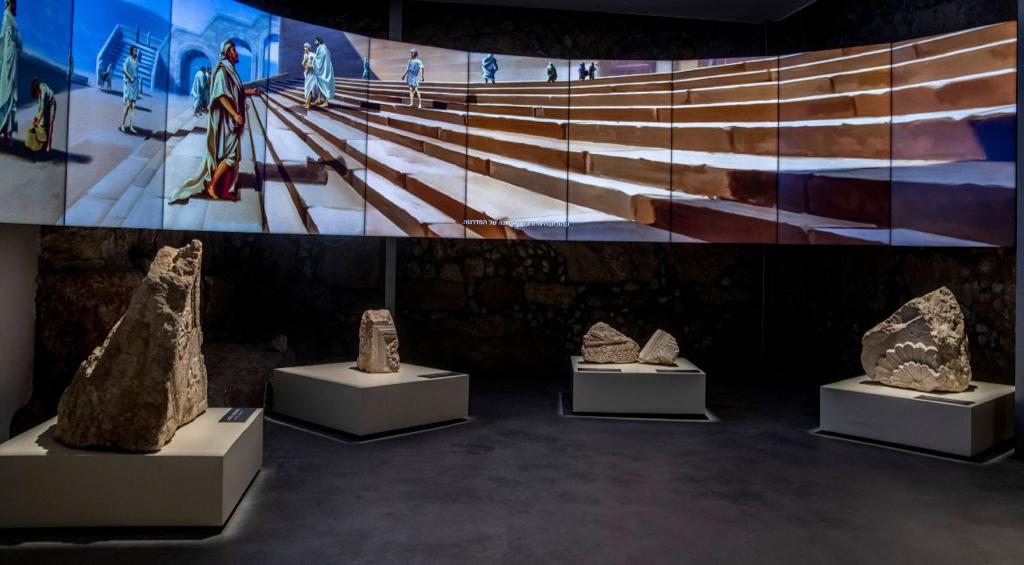
Artifacts from the Temple in Jerusalem displayed in the newly-renovated Davidson Center in Jerusalem, which will open to the public on March 13, 2023. (courtesy Emil Algam/IAA)

The Davidson Center first opened in 2001. The new wings of the building will have interactive galleries and augmented reality displays to help make life in ancient Jerusalem come alive. The Davidson Center is located in an Umayyad-period palace, built around the late 600s CE and used for administration, housing, and storage by the Umayyad dynasty.

In order to keep a low profile within the park, most of the Davidson Center is located underground in some of the ancient storerooms from the Umayyad period. The building is across from the southwestern corner of the Temple Mount, along what archaeologists believe was a main street for pilgrims who were ascending to the Temple courtyards via the Hulda Gates during festivals or other occasions.
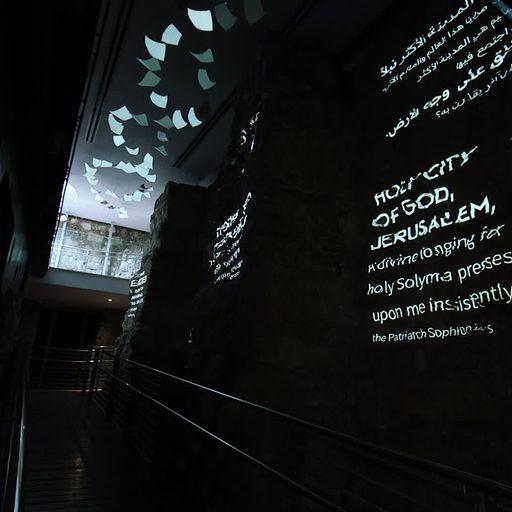
The newly-renovated Davidson Center in Jerusalem, which will open to the public on March 13, 2023, uses a combination of archaeological discoveries and technology. (courtesy Emil Algam/IAA)

The center was closed for three years for extensive renovations. McKeever said the crews worked throughout the pandemic closures, and that the lack of traffic in the Old City actually allowed them to speed up some of their work. The renovation also added new outdoor lighting in the Archaeological Park so the center will be able to stay open in the evenings. Prior to the closure, the Davidson Center hosted around 250,000 visitors per year.
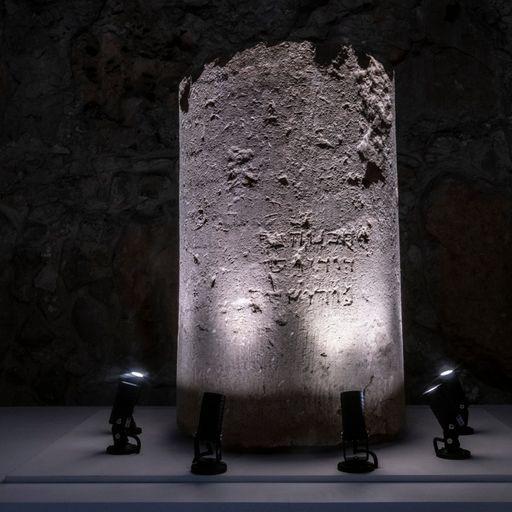
One of the oldest depictions of the word “Jerusalem” on display at the Davidson Center in Jerusalem, which will open to the public on March 13, 2023. (courtesy Emil Algam/IAA)

Philanthropist William Davidson and his William Davidson Foundation, a Detroit-based family foundation that focuses on issues in southeast Michigan and Israel, established the Jerusalem Archaeological Park in 1995 and the Davidson Visitor’s Center in 2001. Experts from the Israel Antiquities Authority and the Company for the Reconstruction and Development of the right-wing Jewish Quarter in the Old City of Jerusalem Ltd (CRJQ) oversaw the curation of the new exhibits.
The exhibits at the entrance to Davidson Center will focus on the name “Jerusalem,” and include some of the earliest known inscriptions bearing Jerusalem’s ancient Hebrew name, “yršlm.”

“We want to make sure [the Davidson Center] contributes to Jerusalem and the understanding of Jerusalem and First and Second Temple periods,” said McKeever. “Technology sits along wonderfully with the archaeology, it’s a mix of old and new. Since the center first opened, technology has really changed and given us new opportunities to tell stories.”
Netanyahu denies report of Israeli crisis with UAE

The UAE reportedly said that it would not buy Israeli defense systems until it felt that Netanyahu can control his government.

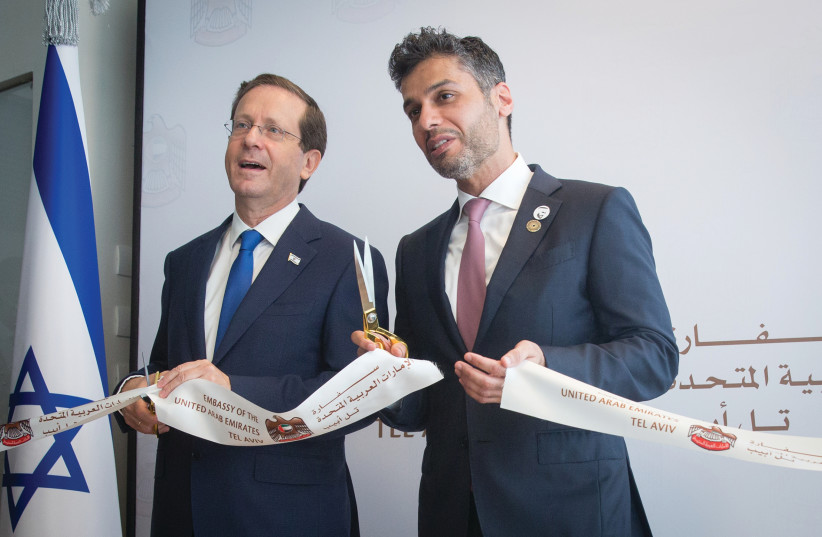
PRESIDENT ISAAC HERZOG and UAE Ambassador to Israel Mohamed Al Khaja attend the opening ceremony of the UAE Embassy in Tel Aviv on July 14. (photo credit: MIRIAM ALSTER/FLASH90)
PRESIDENT ISAAC HERZOG and UAE Ambassador to Israel Mohamed Al Khaja attend the opening ceremony of the UAE Embassy in Tel Aviv on July 14.
(photo credit: MIRIAM ALSTER/FLASH90)

Prime Minister Benjamin Netanyahu’s Office denied a report by Channel 12 of a crisis in its relations with the United Arab Emirates due to the actions of Finance Minister Bezalel Smotrich and National Security Minister Itamar Ben-Gvir.

“The news is without any basis, Israel and the UAE maintain fruitful political relations in all fields, including today,” the PMO stated.

Channel 12 reported on Sunday night that the UAE plans to halt its purchase of Israeli defense systems to protest the action of Netanyahu’s new government.

Emirati President, Sheikh Mohamed bin Zayed told Israeli officials that “until we can be sure that Prime Minister Netanyahu has a government he can control, we will not be able to jointly operate.”

The report came just two days after Iran and Saudi Arabia reestablished diplomatic ties after seven years, a move that appeared to make it more difficult for Netanyahu to achieve its goal of normalizing ties with Saudi Arabia.

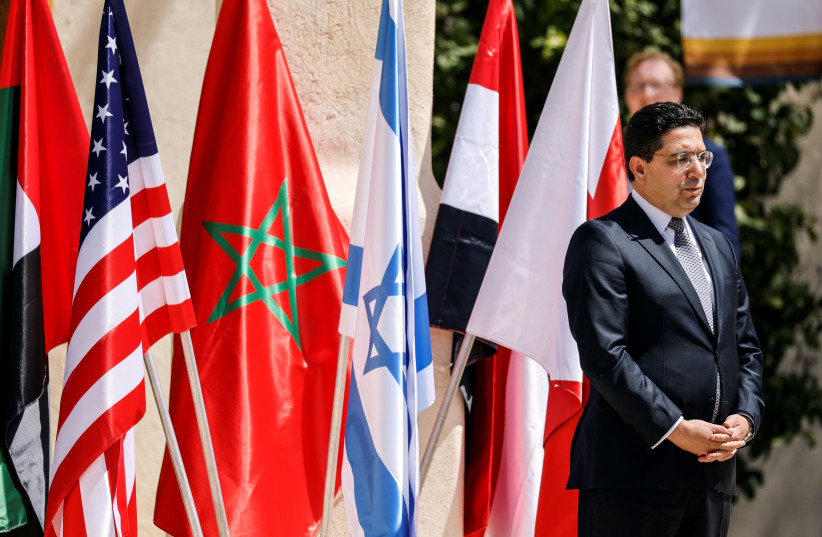
 Morocco's Foreign Minister Nasser Bourita, waits outside the Kedma Hotel, the location of ''The Negev Summit,'' attended by US Secretary of State Antony Blinken, and the Foreign Ministers of Israel, the UAE, Bahrain, Morocco and Egypt in Sde Boker, Israel, March 28, 2022 (credit: REUTERS/AMIR COHEN)Morocco’s Foreign Minister Nasser Bourita, waits outside the Kedma Hotel, the location of ”The Negev Summit,” attended by US Secretary of State Antony Blinken, and the Foreign Ministers of Israel, the UAE, Bahrain, Morocco and Egypt in Sde Boker, Israel, March 28, 2022 (credit: REUTERS/AMIR COHEN)

Netanyahu has yet to publicly comment on the Iranian-Saudi agreement even though parliamentarians from the opposition — including former prime ministers Yair Lapid and Naftali Bennett as well as former Defense Minister Benny Gantz  — have warned that it moves one of the main defensive shields Israel has against Iran. They claimed that the deal would make it difficult for Israel to build a regional defense architecture with the Gulf states against Iran.

How has Netanyahu’s diplomacy progressed?

Netanyahu returned to office at the end of December with a policy objective of strengthening the 2020 Abraham Accords, which he himself had put in place during his last tenure in office. Under the auspices of the US-brokered Accords, Israel had normalized ties with four Arab countries: the United Arab Emirates, Bahrain, Morocco and Sudan.

Netanyahu wants to fold other countries into those Accords. Israeli relations with the UAE have blossomed in the last three years and have been an example for Israel of what is possible with the Arab world.

The Foreign Ministry also denied the Channel 12 report, noting that ties between the two countries are “strong and solid.” Israeli reached an agreement with the UAE this month on the text of a customs agreement that will govern the free trade agreement between the two countries, it said. Once the free trade agreement comes into force it will “expand the economic, commercial and political relations between Israel and the UAE,” the Foreign Ministry said.


Israel Denies Report of UAE Freezing Business with Israel

Israel’s Foreign Ministry issued a strong denial Sunday night over a report that the United Arab Emirates had announced its intention to stop the purchase of defense systems from Israel. The UAE was the first Gulf state to sign the historic Abraham Accords with Israel in 2020.


According to the unconfirmed report by Israel’s Channel 12 News, the UAE decided to suspend “certain military purchases” from Israel due to “recent Netanyahu government actions and statements,” the news outlet said.

“Until we make sure that Prime Minister [Benjamin] Netanyahu has a government that he controls, we will not be able to carry out joint projects,” UAE President and Abu Dhabi ruler Sheikh Mohammed bin Zayed al Nahyan allegedly said in his statement.

Within minutes of the report, however, the Prime Minister’s Office in Israel had already issued a firm denial.

“The report is baseless. Israel and the United Arab Emirates are holding productive diplomatic contacts in all areas, including today,” the PMO said.

“Contrary to this evening’s report, relations between Israel and the United Arab Emirates are strong and stable,” Israel’s foreign ministry insisted in a follow up statement.

“Evidence of this is, among other things, the agreement reached in recent days on the text of an agreement on customs, which will lead to the start of a free trade agreement between the two countries, and expand the economic, commercial and political relations between Israel and the United Arab Emirates,” the foreign ministry added.

The move allegedly came in response to a recent visit by National Security Minister Itamar Ben Gvir to the Temple Mount, and a controversial statement about the Palestinian Authority town of Huwara by Finance Minister Bezalel Smotrich, who later walked back the remark.


Ben Gvir, who has been a regular visitor to the Temple Mount for years, simply continued his regular routine after taking office earlier this year. But as a government minister, Ben Gvir’s visits to the Temple Mount have attracted far more attention – and opposition.

Following a deadly terror attack in which two Israeli brothers were murdered in cold blood as they stood in traffic in Huwara – and a subsequent riot in the town by Israeli protesters who torched multiple homes and businesses in retaliation – Smotrich retweeted a remark by a local official saying the town should be wiped out.

He later qualified the remark, emphasizing that his statement, issued while in an emotional state, was not intended to be taken literally. Nevertheless, his remark was roundly condemned by the United States, Egypt, Jordan and the United Arab Emirates.
