
President tells Iranians: ‘The hour of your freedom is at hand,’ vows to destroy regime’s missiles, navy, ensure ‘they will never have a nuclear weapon’ * Explosions across Iran as US, Israel attack * Reports claim Iranian ministries, officials targeted * Israeli and Iranian air space closed

The Times of Israel is liveblogging Saturday’s events as they unfold.
Sirens sound in Tel Aviv and across central Israel amid an Iranian ballistic missile attack; Israelis in area told to enter safe rooms
Sirens sound in Tel Aviv and across central Israel amid an Iranian ballistic missile attack — the second of the day.
The Israeli military says air defense systems are working to intercept the missiles.
Israelis who hear the sirens are told to go into safe rooms.
No injuries after Iran fires two missiles; second launch detected
There are no reports of injuries following Iran’s ballistic missile attack on northern Israel, the Magen David Adom ambulance service says.
At least two missiles were fired, with one reportedly striking an open area.
The IDF says it has detected another launch of ballistic missiles from Iran.
Sirens are expected to sound in the coming minutes.
Israelis who get an alert are instructed to enter bomb shelters.
Lebanon PM says Beirut won’t let anyone drag country into war
Lebanese Prime Minister Nawaf Salam says Beirut won’t let anyone drag the country into war, amid concerns that Iran’s Lebanese proxy Hezbollah will strike Israel following the US-Israeli attacks in Iran this morning.
“I urge all Lebanese to act wisely and patriotically, placing the interests of Lebanon over any other consideration,” Salam writes on X. “I repeat that we won’t let anyone drag the country to adventures that threaten its security and unity.”
Sirens sound across northern Israel amid an Iranian ballistic missile attack
Sirens sound across northern Israel amid an Iranian ballistic missile attack. Israelis in the area are told to go to safe rooms.
The Israeli military says air defense systems are working to intercept the missiles.
“At this time, the Israeli Air Force is operating to intercept and strike threats where necessary to remove the threat,” the military says.
Missile fire detected from Iran; Israelis who receive alert should go into safe rooms
The IDF says it has detected the launch of missiles toward Israel from Iran.
Sirens are expected to sound in the coming minutes.
Israelis who get an alert are told to enter safe rooms and protected areas.
Pezeshkian in ‘full health,’ Iranian media says, amid reports president targeted in strikes
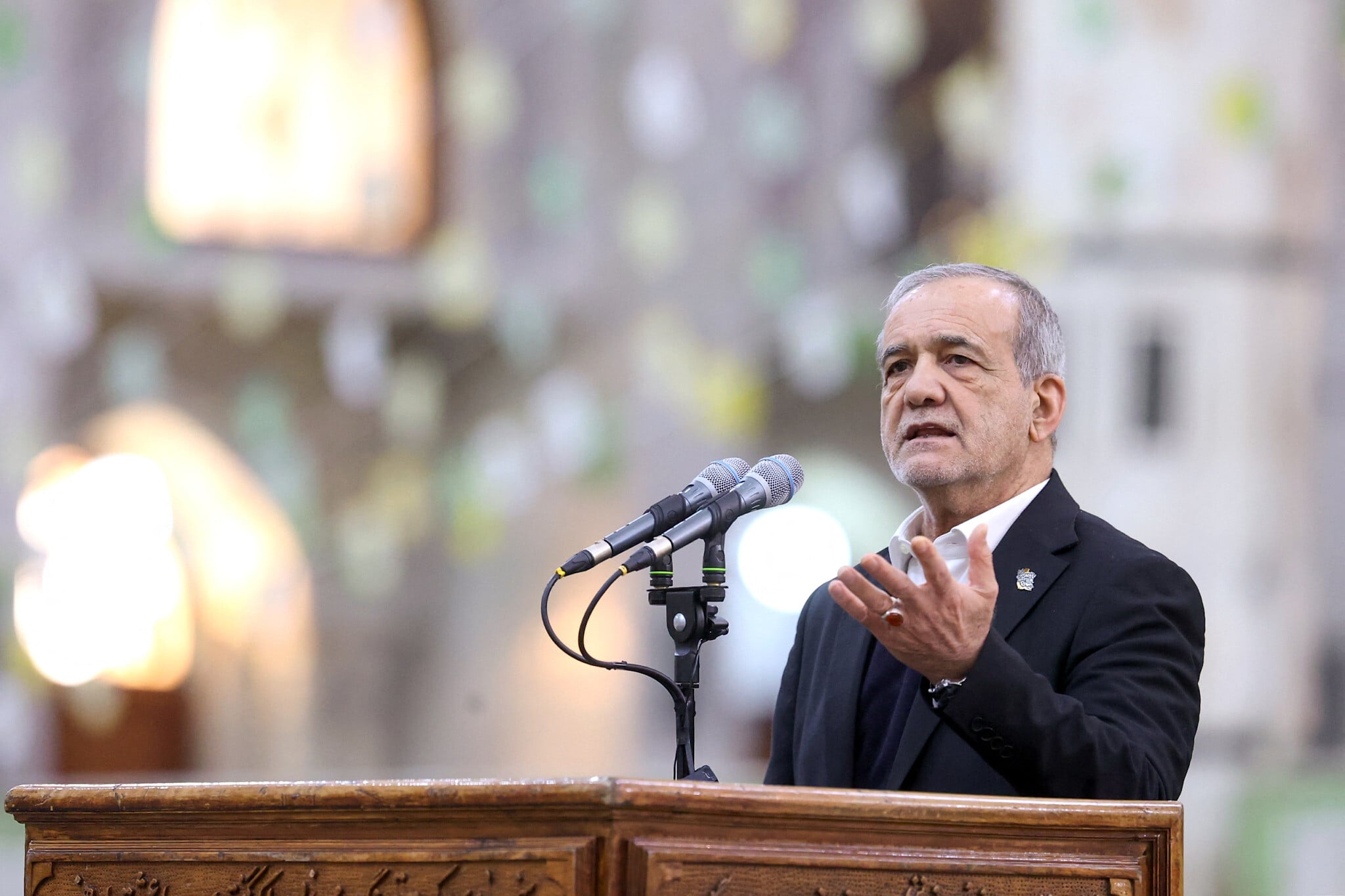
Iranian President Masoud Pezeshkian is “in full health,” Iran’s Tasnim news agency reports, citing a source close to the presidency.
This follows unconfirmed reports that Pezeshkian was among those targeted in the Israeli and US strikes in Iran this morning.
US embassy in Bahrain issues shelter-in-place orders for personnel
The US embassy in Bahrain tells its staff to seek shelter and advises US citizens to do the same after the United States and Israel launched strikes on Iran.
The embassy says in a statement it is “implementing a shelter-in-place for all personnel. We recommend all Americans do the same until further notice,” and urges US citizens to “find a secure location within your residence or another safe building.”
The announcement follows a similar statement from the US embassy in Qatar.
Trump indicates goal of Iran strikes is to topple regime; tells Iranian people: ‘When we’re finished, take over your government’
US President Donald Trump indicates that the goal of the ongoing strikes in Iran is to topple the regime, and he calls on the Iranian people to seize the opportunity and take over their government.
“To the members of the Islamic Revolutionary Guard, the armed forces and all of the police. I say tonight that you must lay down your weapons and have complete immunity, or in the alternative, face certain death,” Trump says in an eight-minute video statement confirming the US strikes.
“Lay down your arms. You will be treated fairly with total immunity, or you will face certain death,” Trump says.
“To the great, proud people of Iran, I say tonight that the hour of your freedom is at hand. Stay sheltered. Don’t leave your home. It’s very dangerous outside. Bombs will be dropping everywhere,” he continues.
“When we are finished, take over your government. It will be yours to take. This will be probably your only chance for generations.”
“For many years, you have asked for America’s help, but you never got it… So let’s see how you respond. America is backing you with overwhelming strength and devastating force,” Trump says.
“Now is the time to seize control of your destiny and to unleash the prosperous and glorious future that is close within your reach. This is the moment for action. Do not let it pass,” he adds.
Strikes on Iran said to target homes of senior officials, military figures, ministries
The strikes on Iran so far today have targeted the homes of ministers and military chiefs, Defense and Intelligence Ministry installations, and a presidential facility, among other targets, Channel 12 reports.
Iran targeted with cyberattacks as Israel and US carry out strikes
Amid the Israeli and US strikes on Iran, a wave of cyberattacks has also targeted the country, the semi-official Fars news agency reports.
Fars says that several major Iranian news agencies were targeted and “experienced severe disruptions in their operations,” and that some widely used mobile applications were also experiencing disruptions.