Hassan Nasrallah, the leader of the Lebanese terrorist organization, claimed that the controversy in Israel over the government’s planned judicial reforms showed that the Jewish State is approaching the end of its existence.
“Everything that is happening in Israel is among the signs of the end of this entity,” Nasrallah said in a video address Monday.
He warned that the efforts of the Otzma Yehudit party to pass a law imposing the death penalty for terrorists would only lead to an increase in terrorist attacks against Israelis.
“Any time your enemy decides to pass a law to execute prisoners, it means he is a fool,” the terrorist leader said. “You foolish Zionists, this law will increase the courage of the Palestinian mujahideen (Islamic warriors) to carry out operations.”
This is not the first time Nasrallah has used the current internal tensions within Israel to claim that the country’s end is approaching. In a televised address last month, he claimed that Israel would not survive another five years to celebrate its 80th birthday.
“The situation in the enemy’s entity is unprecedented on the internal level, the strategic environment and the current foolish government are pushing matters into two major clashes, the first internally in Israel and the second with the Palestinians, and it may extend throughout the region,” he said.
He added: “For the first time in the Zionist entity, we hear talk from the president of the entity, former prime ministers, and former defense ministers, all of whom talk about civil war, bloodshed, the imminence of an explosion and emigration. The head of the occupation entity himself acknowledged his fears of an imminent internal explosion and the collapse of the entity.”
The terrorist leader added that Israeli leaders have expressed concern that the country, which will soon celebrate its 75th Independence Day, will not survive until its 80th birthday. “The biggest threat to us in the region, Allah willing, will not last 80 years.”
Prime Minister Benjamin Netanyahu today warned that the IDF reservists who are threatening not to report for duty to protest the planned judicial reforms “threaten the foundation of our existence.”
Attending a reading of the Book of Esther at the Border Police base in Beit Horon Monday evening, the prime minister said that “in society there is room for protest, room for opposing viewpoints, but no room for refusals, because as soon as it is legitimized, it will spread and become a [common] method.”
Haaretz investigation reveals dozens of cargo flights from Baku to Israeli airstrip used for export of explosives ■ Israel sells Azerbaijan weaponry worth billions – and, per sources, receives oil and access to Iran ■ Tensions between Azerbaijan and both Iran and Armenia have ratcheted up recently
An Azeri Silkway IL-76, over Israel. Frequently lands at OvdaCredit: Yarden Antebi, @ace_pio
An Azerbaijani cargo plane landed last Thursday at the Ovda Israeli air force base north of Eilat. After two hours on the ground, as usual, the old Ilyushin-76 airlifter took off, flew over central Israel, continued north over Turkey and then to the east – returning to its home field in Baku, the capital of Azerbaijan.
An investigation by Haaretz, based on publicly available aviation data, reveals that over the past seven years, 92 cargo flights flown by Azerbaijani Silk Way Airlines have landed at the Ovda airbase, the only airfield in Israel through which explosives may be flown into and out of the country.
Israel has had a strategic alliance with Azerbaijan for the past two decades, and Israel sells the large Shi’ite-majority country weapons worth billions of dollars – and in return, Azerbaijan, per sources, supplies Israel with oil and access to Iran.
According to foreign media reports, Azerbaijan has allowed the Mossad to set up a forward branch to monitor what is happening in Iran, Azerbaijan’s neighbor to the south, and has even prepared an airfield intended to aid Israel in case it decides to attack Iranian nuclear sites. Reports from two years ago stated that the Mossad agents who stole the Iranian nuclear archive smuggled it to Israel via Azerbaijan. According to official reports from Azerbaijan, over the years Israel has sold it the most advanced weapons systems, including ballistic missiles, air defense and electronic warfare systems, kamikaze drones and more.
Silk Way is one of the largest cargo airlines in Asia, and according to official documents it serves as a subcontractor for various defense ministries around the world. The company operates three weekly flights between Baku and Ben-Gurion International Airport with Boeing 747 cargo freighters, and last year it was the third-largest foreign cargo carrier in terms of volume at Ben-Gurion.
But the figures revealed here for the first time show that since 2016, the company’s IL-76 planes have landed at least 92 times at the Ovda airport, an unusual destination for civilian cargo planes. Silk Way is one of the very few airlines that lands at Ovda; over the years only a handful of Eastern European airlines that have carried explosives have landed and taken off from there. Silk Way was even at the center of an investigative report in the Czech media in 2018, which stated that weapons banned for sale to Azerbaijan were flown there in spite of the arms embargo – in a circular deal through Israel.
Photo by Yarden Antebi @ace_pio
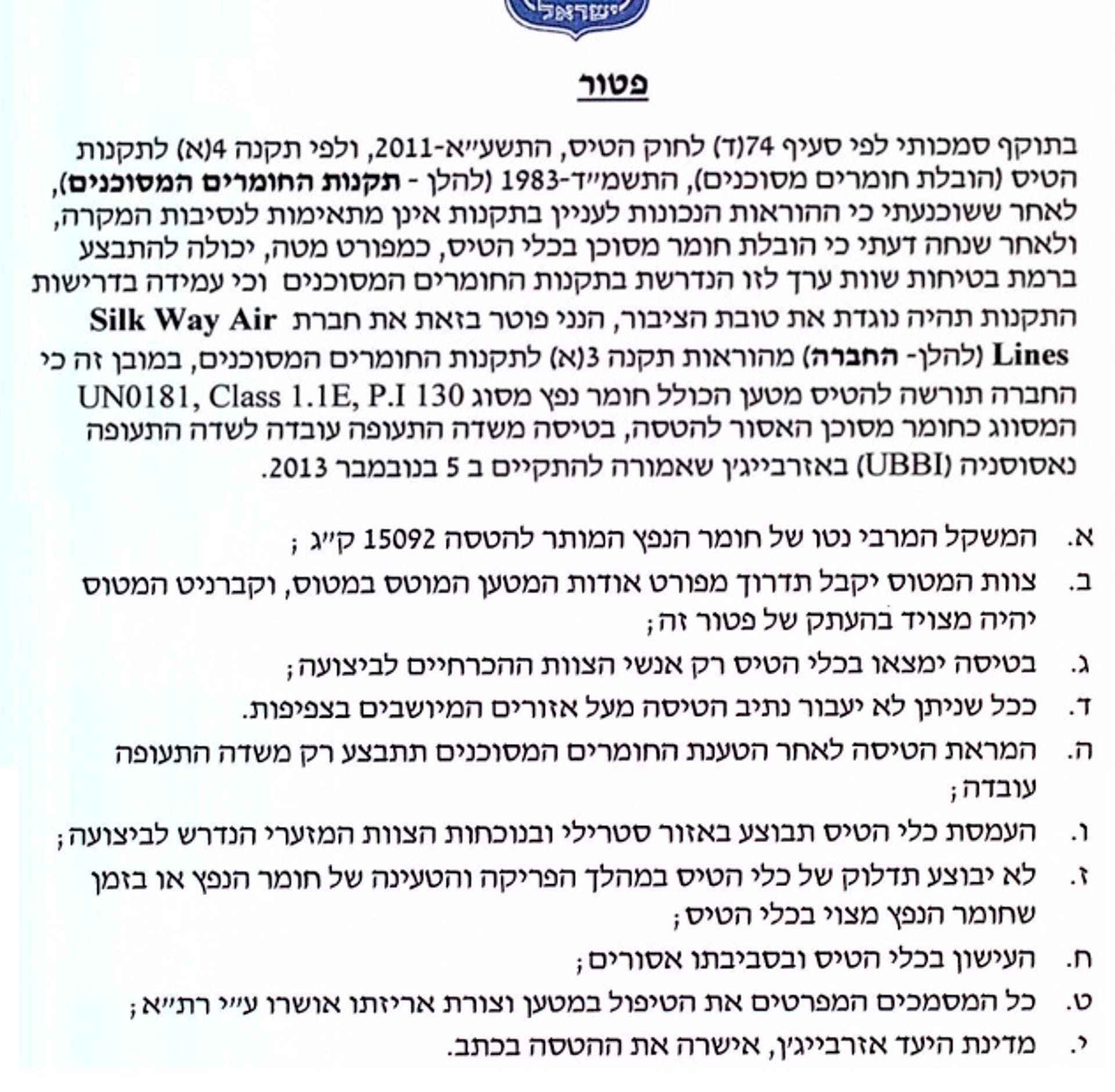
Israeli aviation law forbids the routine transport of explosives from Ben-Gurion Airport, because it is located in the heart of a densely populated area, said sources in the aviation industry. The only airport from which it is permitted to import and export explosives is the Israel Air Force base in Ovda, the sources said. In October 2013, the head of the Israel Civil Aviation Authority, Giora Romm, signed an exemption permitting Silk Way planes to fly shipments of explosives – “classified as dangerous materials banned to fly” – from Ovda to a military airfield on the outskirts of Baku. This exemption, which was posted at the time on the Civil Aviation Authority’s website, requires strict safety conditions, and includes a list of the Azerbaijani aircraft allowed to transport explosives from Ovda to Azerbaijan.
These Silk Way aircraft (and others) have landed at Ovda almost 100 times since the permit was issued. The data expose an increasing pace of flights to Baku especially in the middle of 2016, in late 2020 and at the end of 2021 – which coincide with periods of fighting in Nagorno-Karabakh. Azerbaijan and Armenia have waged war over this disputed region between them many times since the beginning of the 20th century – and all the more so since both countries gained independence after the Soviet Union collapsed.
Israeli permit for Silkway airline to deliver explosives from Ovda to Azeri air base
Some of these flights landed at Ovda with the official call sign of Azerbaijan’s Defense Ministry. In 2016, Silk Way was granted another exemption and allowed to continue to land here – even though its planes did not meet the Israeli aviation noise standards – just so they could continue flying to Ovda.
A shared enemy, a strategic alliance
Nagorno-Karabakh is the most famous of a number of enclaves that has led to the troubled relations between Azerbaijan and Armenia throughout their history. The Soviet regime was relatively successful in reducing the tensions between the Christian Armenian population and the Shi’ite Azeris, but in 1988 the parliament of the Nagorno-Karabakh region called a referendum on leaving Azerbaijan and uniting with Armenia. This step led to violence and what became, in practice, massacres of Armenians in Baku and other Azerbaijani cities – and similar acts against the Azeri population.
When the Soviet Union collapsed, the conflict turned into an open and bloody war, which ended in 1994 in a clear victory for Armenia, which took control of large areas surrounding the enclave. Hundreds of thousands of refugees from both sides were expelled or forced to flee for their lives.
The harsh conflict left both sides under sanctions and severe export restrictions in Europe and the United States. President Ilham Aliyev, after inheriting the position from his father Heydar Aliyev, has ruled Azerbaijan with a firm hand – and his regime has a long history of repressing civil rights and arrests of opposition activists. In 2017, the U.S. State Department released a report condemning the state of the LGBT community in the country, which suffers from persecution, discrimination, disappearances and arrests, torture and murder.
The sanctions provided a business and strategic opportunity for an unexpected partner: Israel. The fact that the two countries both see Iran as a direct threat only strengthened the ties. Azerbaijan declared its independence in October 1991, and Israel – which was one of the first countries to recognize the new nation – opened an embassy in Baku in 1993.
“Azerbaijan’s relations with Israel are discreet but close,” wrote Rob Garverick, the head of the political and economic department in the U.S. Embassy in Baku, in a 2009 telegram that was published as part of the Wikileaks documents. “Each country finds it easy to identify with the other’s geopolitical difficulties and both rank Iran as an existential security threat. Israel’s world-class defense industry with its relaxed attitude about its customer base is a perfect match for Azerbaijan’s substantial defense needs that are largely left unmet by the United States, Europe and Russia for various reasons tied to Armenia and Nagorno-Karabakh. Aptly described by Azerbaijani President Aliyev as being like an iceberg, nine-tenths of it is below the surface, this relationship is also marked by a pragmatic recognition by Israel of Azerbaijan’s political need to hew publicly and in international forums to the [Organization of Islamic Cooperation’s] general line.”
Azerbaijan’s economy is based primarily on oil and gas, and as part of its strategic alliance it has become Israel’s largest supplier of oil. According to estimates, about half of the oil imported by Israel comes from Azerbaijan.
During their first years of independence, both Armenia and Azerbaijan relied on the Soviet arsenal of weapons, but according to the Stockholm International Peace Institute, since 2016 the situation has changed and Israel is now responsible for almost 70 percent of Azerbaijan’s weapons.
Numerous official reports, statements and videos from Azerbaijan show Israel has exported a very wide range of weapons to the country – starting with Tavor assault rifles all the way to the most sophisticated systems such as radar, air defense, antitank missiles, ballistic missiles, ships and a wide range of drones, both for intelligence and attack purposes. Israeli companies have also supplied advanced spy tech, such as communications monitoring systems from Verint and the Pegasus spyware from the NSO Group – tools that were used against journalists, the LGBT community and human rights activists in Azerbaijan, too.
Israeli weapons played an important role when the fighting against Armenia restarted in the Four-Day War between the two countries in April 2016, and especially during the Second Nagorno-Karabakh War in 2020, as well as in the battles during 2022. “The skillful use by the Armed Forces of Azerbaijan of high technology and high-precision weapons, including those produced in Israel, in particular drones, played an important role in achieving military victory. I am confident that our bilateral ties will be further strengthened and deepened in various fields after the Patriotic War”, Azerbaijan’s Foreign Minister Jeyhun Bayramov told the Israel Hayom newspaper in an interview in April 2021.
The Stockholm International Peace Institute says Israel’s defense exports to Azerbaijan began in 2005 with the sale of the Lynx multiple launch rocket systems by Israel Military Industries (IMI Systems), which has a range of 150 kilometers (92 miles). IMI, which was acquired by Elbit Systems in 2018, also supplied LAR-160 light artillery rockets with a range of 45 kilometers, which, according to a report from Human Rights Watch, were used by Azerbaijan to fire banned cluster munitions at residential areas in Nagorno-Karabakh.
Armenia also fired cluster munitions manufactured by Russia, and a great deal of unexploded ordnance remained in civilian areas. Israel, the United States, Russia and China are among the opponents of the 2008 international Convention on Cluster Munitions banning the development and use of cluster munitions, which has been signed by 123 countries.
In 2007, Azerbaijan signed a contract to buy four intelligence-gathering drones from Aeronautics Defense Systems. It was the first deal of many. In 2008 it purchased 10 Hermes 450 drones from Elbit Systems and 100 Spike antitank missiles produced by Rafael Advanced Defense Systems and in 2010 it bought another 10 intelligence-gathering drones.
Soltam Systems, owned by Elbit, sold it ATMOS self-propelled guns and 120-millimeter Cardom mortars, and in 2017 Azerbaijan’s arsenal was supplemented with the more advanced Hanit mortars. According to the telegram leaked in Wikileaks, a sale of advanced communications equipment from Tadiran was also signed in 2008.
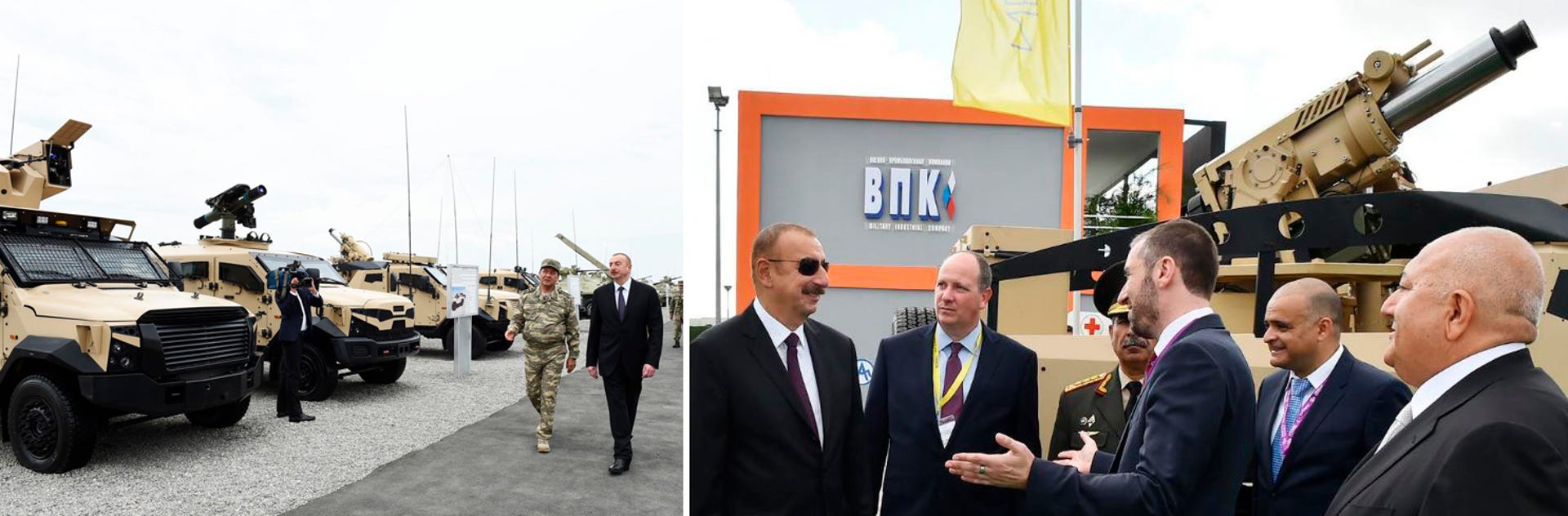
Azeri President Aliyev with Israeli Spike missiles and Hanit artilleryCredit: president.az
Israel and Azerbaijan took their relationship up a level in 2011 with a huge $1.6 billion deal that included a battery of Barak missiles for intercepting aircraft and missiles, as well as Searcher and Heron drones from Israel Aerospace Industries (IAI). It was reported that near the end of the Second Nagorno-Karabakh War in 2020, a Barak battery shot down an Iskander ballistic missile launched by Armenia.
Aeronautics Defense Systems also began cooperating with the local arms industry in Azerbaijan, where some of the 100 Orbiter kamikaze (loitering munitions) drones were produced – drones that Azerbaijan’s defense minister called “a nightmare for the Armenian army.” In 2021, an indictment was filed against Aeronautics Defense Systems for violating the law regulating defense exports in its dealing with one of its most prominent clients. A court-imposed gag order prevents the publication of further details.
A project to modernize the Azerbaijani army’s tanks began in the early 2010s. Elbit Systems upgraded and equipped the old Soviet T-72 models with new protective gear to enhance the tanks’ and their crews’ survivability, as well as fast and precise target acquisition and fire control systems. The upgraded tanks, known as Aslan (Lion), starred in the 2013 military parade.
Azerbaijan’s navy was reinforced in 2013 with six patrol ships based on the Israel Navy’s Sa’ar 4.5-class missile boats, produced by Israel Shipyards and carrying the naval version of the Spike missiles, along with six Shaldag MK V patrol boats with Rafael’s Typhoon gun mounts and Spike missile systems. Azerbaijan’s navy also bought 100 Lahat antitank guided missiles.
In 2014, Azerbaijan ordered the first 100 Harop kamikaze drones from IAI, which were a critical tool in later rounds of fighting. Azerbaijan also purchased two advanced radar systems for aerial warning and defense from IAI subsidiary Elta that same year
Azeri President Aliyev with an Israeli Harop kamikaze droneCredit: president.az
“We have purchased the most modern air defense installations. Our army has the most powerful artillery … The weaponry and ammunition we have acquired in recent years suggest we can accomplish any task … Just as we have beaten the Armenians on the political and economic fronts, we are able to defeat them on the battlefield,” declared Aliyev during a visit to the battlefield – and also on his Twitter account.
Two years later, Azerbaijan bought another 250 SkyStriker kamikaze drones from Elbit Systems. Many videos from the areas of fighting showed Israeli drones attacking Armenian forces.
Azerbaijani strike with Israeli Harop on an Armenian S-300
In 2016, during Prime Minister Benjamin Netanyahu’s visit to Baku, Aliyev revealed that contracts had already been signed between the two countries for the purchase of some $5 billion in “defensive equipment.”
In 2017, Azerbaijan purchased advanced Hermes 900 drones from Elbit Systems and LORA ballistic missiles from IAI, with a range 430 kilometers. In 2018, Aliyev inaugurated the base where the LORA missiles are deployed, at a distance of about 430 kilometers from Yerevan, Armenia’s capital. During the war in 2020, at least one LORA missile was launched, and according to reports it hit a bridge that Armenia used to supply arms and equipment to its forces in Nagorno-Karabakh.
More advanced Spike missiles were sent in 2019 and 2020. Along with the Israeli weapons systems, Turkey – Azerbaijan’s ally and Armenia’s enemy – supplied its Bayraktar TB2 drones, which played a major role in destroying Armenian targets.
An official visit – and an embassy
In October 2022, Israeli Defense Minister Benny Gantz visited Azerbaijan and met with Aliyev. In an official statement, Gantz said his visit concerned security and policy issues and deepening the cooperation between the two countries. What was not made public at the time was that a month before Gantz’s visit, Yair Kulas, the head of Israel’s defense exports directorate (SIBAT), made his own visit to Azerbaijan and met with the minister in charge of Azerbaijan’s defense industries.
The Azeri ministry said the two discussed expanding business with Israeli defense industries. A short time later Azerbaijan officially announced that it would soon open an embassy in Israel for the first time, calling it a “historic step” and adding that the “sky is the limit for the relations between the two countries and peoples.”
Since the visit, tensions have flared between Azerbaijan and its neighbor Iran. And based on testimony from Nagorno-Karabakh, Azerbaijan’s relations with Armenia have reached the boiling point again, and another violent conflict may be looming.
In the meantime, seven more Azeri flights have landed at the Ovda airbase. After two hours on the ground, with their cargo loaded, they departed – back to Baku.
Ynet’s Ron Ben-Yishai: Reason for US top defense officials’ visit to Israel is concern that Israel might attack Iran without notifying Washington ahead of time.
The Biden administration is concerned that Israel might attack Iran’s nuclear sites without notifying Washington ahead of time, according to Ynet’s military analyst, Ron Ben-Yishai.
In a column he published on Sunday, Ben-Yishai wrote that the concerns brought the US to send to Israel, at short notice, the two most senior figures in the Pentagon – the Chairman of the Joint Chiefs of Staff and the Secretary of Defense – for clarification and coordination talks with senior officials of the Israeli defense establishment and with the senior political figures in Jerusalem.
US Chairman of the Joint Chiefs of Staff, General Mark Milley, landed in Israel on Friday and met with IDF Chief of Staff Herzi Halevi and with Defense Minister Yoav Gallant. Secretary of Defense Lloyd Austin is scheduled to arrive in Israel on Thursday of this week.
The reason for the visits, according to a senior member of Israel’s defense establishment who was quoted in Ben-Yishai’s column, is that the White House and the Pentagon fear that the current Israeli government will surprise the United States by striking Iran and dragging Washington into a military conflict in the Middle East, while the United States and its allies are investing most of their resources in the Ukraine war and in the escalation of the “cold” conflict with China.
From an American point of view, noted Ben-Yishai, the situation now is similar to the one that prevailed between 2010 and 2012, when Barack Obama was President of the United States, and Prime Minister Benjamin Netanyahu and then-Defense Minister Ehud Barak planned to attack Iran.
Ben-Yishai noted that the element of time is the critical element that has gone wrong in the Israeli-American “security work plan”, which was designed to prevent Iran from obtaining nuclear weapons, as a result of the IAEA revelation.
If, until now, Jerusalem and Washington estimated that Israel has more than a year to complete preparations for a major attack in Iran and a war in other arenas that will develop in its wake, the assessment in Israel now is that the timetable will be significantly reduced.
Ben-Yishai outlines four issues which will be at the center of the meetings between the visiting top US officials and their Israeli counterparts:
The first – how the two countries can jointly deter Iran from enriching uranium to the 90% level which would be sufficient for one or more nuclear bombs. Israel believes that a credible Israeli-American military threat and additional severe sanctions will make the Iranians think twice before moving ahead.
The second – how Israel and the United States react if Iran becomes a fully-fledged nuclear threshold state. US officials are not hiding from their Israeli compatriots their concerns about a scenario in which Prime Minister Netanyahu gives the order to attack Iran, not only because it will thwart the Iranian nuclear program, but because it will silence and push the public protest over the judicial reform to the margins of the Israeli public’s agenda.
That is why, according to Ben-Yishai, the Americans are demanding that Israel not act without coordinating and confirming with them. “You are a sovereign country,” they will say in the meetings, “but it is better that we decide together how to react because in the end we too will have to be involved in the war that will develop”.
The third issue – Israel will demand that the United States and the Europeans, through the United Nations, impose additional tough sanctions on Iran within the framework of the Security Council or outside of it, in order to force Iran to reduce military aid to Russia.
The fourth issue – Israeli officials believe that Austin and Milley will demand that Israel refrain from civil and military actions that would agitate the situation with the Palestinian Authority, and also result in the fact the two-state solution will no longer be feasible. The Americans will also demand that the government refrain from actions that would lead to conflicts on the Temple Mount and in Jerusalem during the month of Ramadan. The bottom line is that the Americans are telling Israel: “We will help you as much as possible in the Iranian context but, in return, was ask that you do not ignite a conflict with the PA that will oblige us to be involved in another conflict besides Ukraine and the South China Sea.”