
Israeli nuclear expert: Iran can create nuclear bomb with 84% uranium

Israeli nuclear physicist and UN inspector said it’s hard to know the truth about rogue nation’s weapon enrichment.
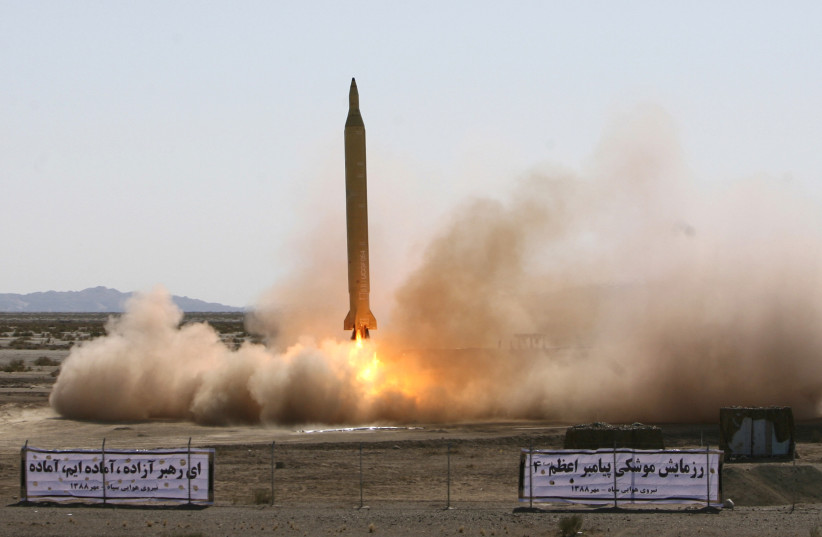
A Ghadr 1 class Shahab 3 long range missile is prepared for launch during a test from an unknown location in central Iran (photo credit: REUTERS)
A Ghadr 1 class Shahab 3 long range missile is prepared for launch during a test from an unknown location in central Iran
(photo credit: REUTERS)

Israeli nuclear physicist Dr. Naama Charit Yaari doesn’t know for sure if Iran has really enriched uranium to 84% purity or left its supplies at “only” 60% as it has claimed. But she told The Jerusalem Post in an interview on Monday that the bomb dropped by the US on Hiroshima, Japan that ended World War II had uranium with 80% purity, and if the Americans had had time to reach 93% or 94%, the damage would have doubled.

The International Atomic Energy Commission (IAEC) revealed this week that Iran has enriched uranium to the highest level ever – to 84%, which is close to the weapons’ grade of 90% – but the Iranian government quickly denied it for an unknown reason.

“So far, we have not made any attempt to enrich above 60%,” Behrouz Kamalvandi, the spokesman for Iran’s Atomic Energy Organization, said on Monday, according to the official IRNA News agency. “The presence of particles above 60% enrichment does not mean production with an enrichment above 60%,” Kamalvandi added.

Not surprisingly, the Iranian regime has not produced the necessary documents to announce its plans to raise uranium-enrichment levels at two of its nuclear facilities in Fordo and Natanz.

Charit Yaari is Israel’s representative in the UN Preparatory Commission for the Comprehensive Nuclear-Test-Ban Treaty that works to prevent experiments on nuclear weapons and not where they work on uranium. She is also a UN nuclear inspector who has made dozens of visits to Jordan, Russia, South Korea and other countries and is head of physics innovation initiatives at the Davidson Institute of Science Education, the educational arm of the Weizmann Institute of Science in Rehovot.
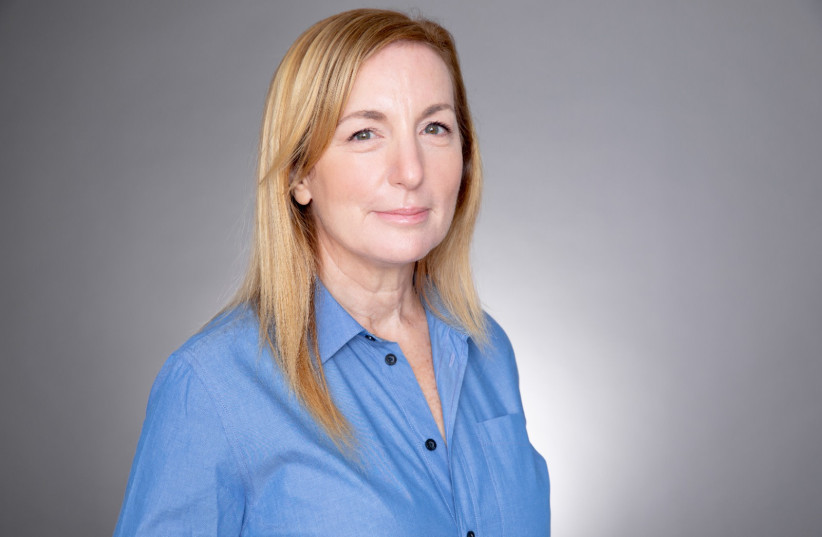
 Photo of Dr. Naama Charit Yaari. (credit: INBAR MARMARI FOR THE DAVIDSON INSTITUTE.)Photo of Dr. Naama Charit Yaari. (credit: INBAR MARMARI FOR THE DAVIDSON INSTITUTE.)

Dr. Charit Yaari’s thoughts

“Iran has been purifying uranium fuel for 10 years. It is worrisome. We can’t know yet if they are doing it or not. There will be more checks by inspectors. My organization prevents nuclear experiments but is not involved in where they purify it,” she said. “If the report by the IAEC about finding in Iran uranium enriched to the level of 84% is indeed accurate, then in theory, the Ayatollah regime already has nuclear fuel suitable for making a bomb. It will be less effective than a quality bomb, but certainly possible,” said Charit Yaari.

“To use the enormous energy stored in the nucleus of the atom, uranium 235 – an atom with 92 protons and 143 neutrons in its nucleus must be split. Most of the uranium in nature is uranium 238 (with 146 neutrons) which does not fission, so you need to separate the two types, which are very similar to each other in most respects. The most common method is through an array of thousands of centrifuges, which makes it possible to take advantage of the tiny physical differences between them to enrich the uranium – that is, to increase the concentration of the uranium that has broken down in the ore. In this process, many tons of natural uranium come to single grams of enriched uranium. Effective nuclear bombs require a very high enrichment of uranium, much more than nuclear fuel for power reactors of 93% to 94%,” she explained.

“The new finding teaches two important things. First, it seems that Iran is getting closer to the optimal level of enrichment for a nuclear fission bomb and is less than ten percent short of reaching the goal. Second, a nuclear reactor to generate electricity does not require 84% enrichment, but much less than that. However, apparently it is possible that, as the Iranians claim, they produced a very small amount of over-enriched uranium, at the level of residues only, and such a situation should not be of concern. What will indicate if this is the case is the quantity.”

The Israeli nuclear physicist added that “Iran’s economy is in a terrible state, and its citizens are angry, but it’s a shady regime. Even North Korea looks enlightened in comparison. I don’t know how the IEAC will go about inspecting, because the Iranians hide their nuclear centrifuges underground. I myself know better today than 20 years ago what to look for. They have tens of thousands of centrifuges. If the employees there work according to Western standards, it is not dangerous to their health. It’s hard to assess if they are using leftovers or they have deliberately enriched their uranium. It’s hard to believe that they reached 84% by mistake since the process is so complicated,” added Charit Yaari. “For all that work, they get just a few grams of nuclear fuel.”

Other countries where uranium is purified include the US, Russia, Holland, Belgium and Germany – but these are used mostly to produce electricity, she said.

She traveled to Jordan three times – the last in 2014 for two or three weeks at a time. “It may have not been very smart for me to go, but I was well protected. Yet, when this is so, as an Israeli physicist it is more noticed and exposed. However, in an 80-person UN delegation there, we did good work.”

Charit Yaari visited nuclear sites including the infamous Chernobyl, in Russia many times, the last in 2017. “The facility is buried underground like a sarcophagus. People still live in the area, some of which is toxic.” She has never been to North Korea, which is a “terror nation.”

The US typically blocks such moves, but it allowed the issue to move forward given its frustration with Israel over its authorization of 9 new settlements.

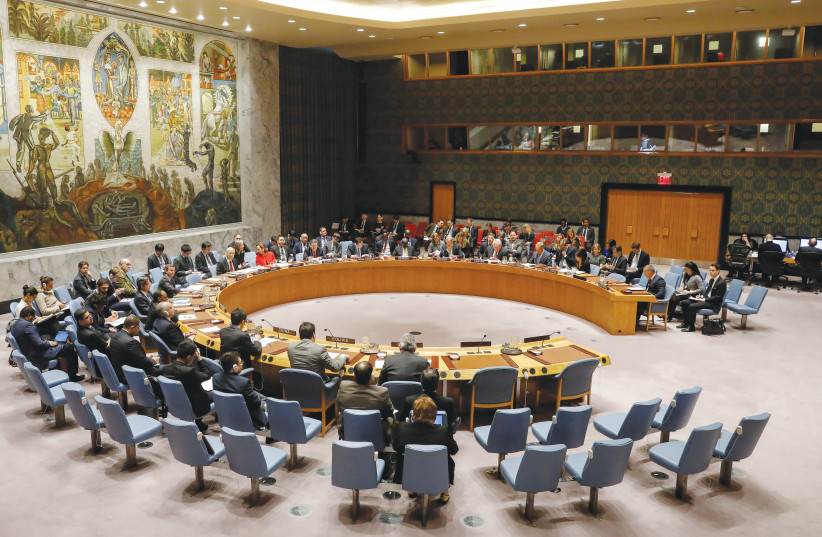
 US Ambassador to the United Nations Linda Thomas-Greenfield addresses the UN Security Council as it meets to discuss the issue of Israeli settlement activities in the occupied Palestinian territory at UN headquarters in New York City, New York, US, February 20, 2023.  (photo credit: Mike Segar/Reuters)
US Ambassador to the United Nations Linda Thomas-Greenfield addresses the UN Security Council as it meets to discuss the issue of Israeli settlement activities in the occupied Palestinian territory at UN headquarters in New York City, New York, US, February 20, 2023.
(photo credit: Mike Segar/Reuters)

Tensions between Jerusalem and Washington rose on Monday as the United Nations Security Council issued a rare consensus statement of “dismay” and “concern” over Israeli settlement activity.

It was a move that could only have happened with the support of the Biden administration.

“The statement should never have been made, and the United States should never have joined it,” the Prime Minister’s Office said in a statement.

“The UN Security Council has issued a one-sided statement which denies the rights of Jews to live in our historic homeland, [and] fails to mention the Palestinian terror attacks in Jerusalem in which 10 Israeli civilians were murdered,” it said.

The statement also “ignores the Palestinian Authority’s grotesque pay-for-slay policy, which subsidizes the murder of Jews, and belittles the evil of antisemitism, which has resulted in the slaughter of millions,” it added.

 THE UNITED NATIONS Security Council holds a regular meeting on the situation in the Middle East, focusing on Israel in relation to the Palestinians.  (credit: BRENDAN MCDERMID/REUTERS)THE UNITED NATIONS Security Council holds a regular meeting on the situation in the Middle East, focusing on Israel in relation to the Palestinians. (credit: BRENDAN MCDERMID/REUTERS)

The last three US administrations have strongly backed Israel’s contention that the UN is biased against it and that statements and resolutions stem from prejudice rather than any specific issue. Washington has used its veto power at the UNSC to protect Israel.

The last time the UNSC issued a consensus statement against Israel like the one published on Monday was during Operation Protective Edge in the Gaza Strip in 2014. The UNSC in 2016 also approved resolution 2334 against settlement activity, with the US abstaining rather than vetoing.

US supports UNSC condemnation

The Biden administration’s approval of Monday’s UNSC consensus presidential statement reflected its growing frustration with Israel over settlement activity, particularly the security cabinet’s authorization this month of 10 West Bank outposts to become nine new settlements.

It was also upset that the Higher Planning Council for Judea and Samaria plans to meet on Wednesday to advance plans for thousands of new homes.

The Security Council in its consensus statement said it “strongly underscored” the need for Israel to halt its “construction and expansion of settlements, confiscation of Palestinians’ land, and the ‘legalization’ of settlement outposts.”

The two-page document issued in New York also called on Israel to stop the “demolition of Palestinians’ homes and displacement of Palestinian civilians.”

The United Arab Emirates, which normalized ties with Israel under the Abraham Accords, submitted the statement on behalf of the PA.

The PA had sought a more consequential UNSC resolution but backed away when it understood that the US would veto the text. A compromise was reached in which the US would support a UNSC statement that dealt with issues beyond settlement activity.

The UNSC recalled “the obligation of the PA to renounce and confront terror,” condemned “all acts of terrorism” and called for the “strengthening of ongoing efforts to counter terrorism in a manner consistent with international law.”

It also spoke of its concern regarding “discrimination, intolerance and hate speech motivated by racism or directed against persons belonging to religious communities, in particular cases motivated by Islamophobia, antisemitism or Christianophobia.”

UNSC members in the statement affirmed their commitment to a two-state resolution to the conflict and to the status quo on Jerusalem’s Temple Mount, including Jordan’s special connection to the site known to Muslims as al-Haram al-Sharif.

Absent from the document was any direct reference to Palestinian terrorism, the PA’s monthly stipends to terrorists and their families and any reference to the Palestinian terrorist attacks in Jerusalem at a synagogue and a bus stop.

US Ambassador to the United Nations Linda Thomas-Greenfield condemned those attacks when she addressed the UNSC’s monthly meeting Monday on the Israeli-Palestinian conflict before she launched into her statements of “strong” opposition to Israeli settlement activity.

“These unilateral measures exacerbate tensions,” she said. “They harm trust between the parties. They undermine the prospects for a negotiated two-state solution. The United States does not support these actions. Full stop.”

“The clear and longstanding position of the United States is that settlement activity is unhelpful and puts us further away from a negotiated, two-state solution.

“That’s why we strongly support the Presidential Statement, put forward by the United Arab Emirates, which demonstrates the Security Council’s unanimous, collective voice on these issues.”

The UNSC statement “is real diplomacy at work, and we believe it signifies to all parties how seriously this Council takes these threats to peace,” Thomas-Greenfield said.

Israeli Ambassador to the UN Gilad Erdan read out the names of the Israeli victims of the Jerusalem terrorist attacks this year and stood for a moment of silence in their memory as he took the UNSC to task for condemning Israeli settlement activity without also speaking out against those responsible for their deaths.

PA Ambassador to the UN Riyad Mansour welcomed the UNSC statement and thanked the UAE, adding that Israeli settlement activity was moving in the direction of annexation.

The resolution had the support of 14 of the 15 UNSC members for a resolution. It was more than enough to ensure its passage, but the Biden administration did not want to exercise its veto, Mansour said.

The PA backed away from a resolution in exchange for a US-backed statement because it was certain that continued Israeli settlement activity would soon force a UNSC resolution with US support, he said.

“We believe that this Israeli government most likely will continue to violate international law and would force the Security Council to act again.”

Riyad Mansour

“We believe that this Israeli government most likely will continue to violate international law and would force the Security Council to act again,” Mansour said. “If we are united, even those who protect Israel and who are very close to Israel, when they oppose its policy and actions, it means that they moved one step in the right direction. If bigger things happen, it will be difficult for them not to take further steps.”

“The intention was always to create space for diplomacy and dialogue… It was important that the UNSC spoke with one voice and that the draft resolution still remains in circulation.”

Lana Zaki Nusseibeh

UAE Ambassador to the UN Lana Zaki Nusseibeh said: “The intention was always to create space for diplomacy and dialogue… It was important that the UNSC spoke with one voice and that the draft resolution still remains in circulation.”

Mansour said this meant it would take only 24 hours to bring the resolution back to the UNSC.

“The question of Palestine cannot be marginalized at the UN,” he said.


After members bow to American pressure, withdraw resolution urging halt to settlement activity, they issue softer joint statement saying actions imperil prospects for 2 states

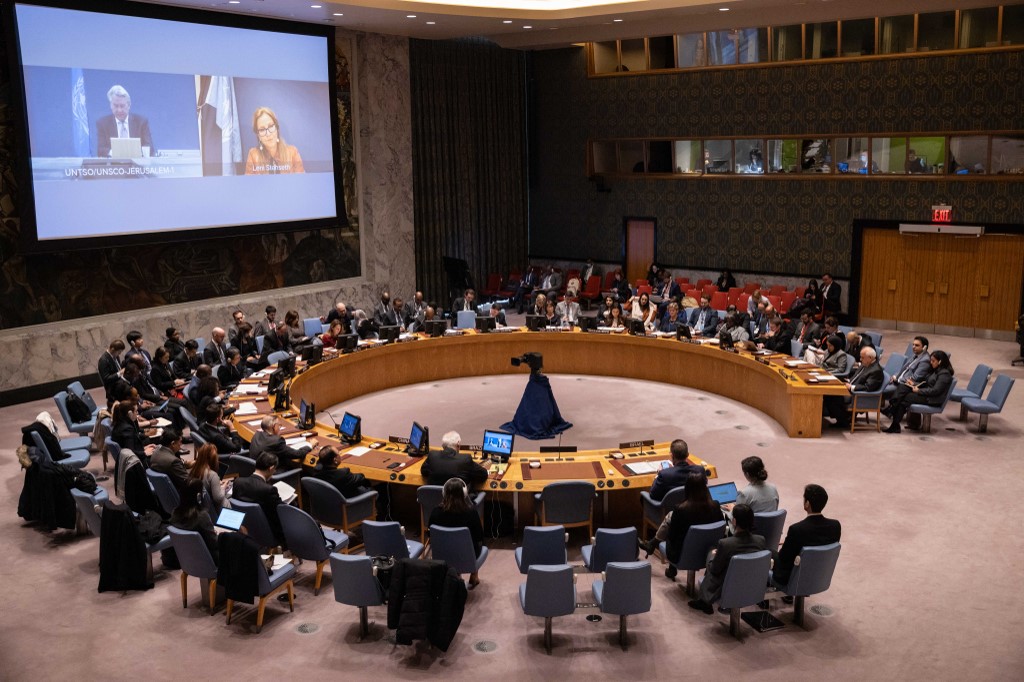
A United Nations Security Council meeting on the situation in the Middle East, at the United Nations headquarters in New York City on February 20, 2023. (Yuki IWAMURA / AFP)

A United Nations Security Council meeting on the situation in the Middle East, at the United Nations headquarters in New York City on February 20, 2023. (Yuki IWAMURA / AFP)

Members of the UN Security Council issued a rare joint statement on Monday condemning a series of recent Israeli settlement expansion announcements, after the US managed to convince members to withdraw a more forceful resolution on the matter.

“The Security Council expresses deep concern and dismay with Israel’s announcement on February 12, 2023, announcing further construction and expansion of settlements and the ‘legalization’ of settlement outposts,” the presidential statement reads, referring to the cabinet decision to legalize nine outposts — many of which are on private Palestinian land — and to green-light plans for some 10,000 settlement homes for advancement this week, the largest-ever package of projects to be approved in one sitting.

While a presidential statement is largely symbolic and likened by Israeli media to a “glorified press release,” Monday was the first time one had been issued regarding the Israeli-Palestinian conflict in nine years. Still, it lacked the binding nature of a resolution akin to the one adopted in 2016, which more forcefully condemned Israeli settlements.

“The Security Council reiterates that continuing Israeli settlement activities are dangerously imperiling the viability of the two-state solution based on the 1967 lines,” read Monday’s communique.

The statement also condemned “all acts of violence against civilians, including acts of terrorism” and called on all parties to condemn acts of terrorism, refrain from inciting violence and hold those targeting civilians accountable. Members also recalled “the obligation of the Palestinian Authority to renounce and confront terror.”

Despite those latter points, Prime Minister Benjamin Netanyahu’s office issued a statement of its own blasting the Security Council announcement as “one-sided,” claiming that it “denies the rights of Jews to live in our historic homeland and ignores the Palestinian terror attacks in Jerusalem over the past month.”

Then-head of opposition Benjamin Netanyahu seen during an inauguration ceremony of a new neighborhood in Beit El, in the West Bank, July 12, 2022. (Sraya Diamant/Flash90)

Netanyahu’s office said the Security Council statement “turns a blind eye to the fact that the PA subsidizes terrorism and pays the families of terrorists.”

In a rare public criticism of the Biden administration, Netanyahu’s office concluded that the Security Council statement “should not have been made and the US should not have signed on to it.”

The US found itself in an uncomfortable situation over the past week at the UN as it lobbied members not to bring a resolution against the recent Israeli settlement announcement — which it has itself strongly opposed. However, the Biden administration has long maintained that the UN is not the proper forum to adjudicate the Israeli-Palestinian conflict.

In order to coax the PA to withdraw its support for the resolution drafted by the United Arab Emirates on Ramallah’s behalf, US Secretary of State Antony Blinken told PA President Mahmoud Abbas that Washington would instead support the lower-level presidential statement, two US and Palestinian officials told The Times of Israel. In addition, Blinken told Abbas that he would receive a White House meeting with US President Joe Biden later this year — an invitation that Netanyahu himself has yet to receive.

Israel had also passed along warnings to the PA that it would not advance a series of measures aimed at easing Palestinian lives ahead of Ramadan if a Security Council resolution was adopted, according to an official familiar with the matter.

A display shows US Ambassador to the United Nations Linda Thomas-Greenfield as she speaks during a United Nations Security Council meeting on the situation in the Middle East, at the United Nations headquarters in New York City on February 20, 2023. (Yuki IWAMURA / AFP)

The PA acquiesced on Sunday and the UAE agreed to withdraw the resolution. The presidential statement did not call for an immediate end to settlement activity but did express the council’s opposition to “unilateral measures that impede peace,” including confiscation of Palestinian land, demolition of Palestinian homes and displacement of Palestinian civilians.

It also called for upholding the status quo at Jerusalem holy sites, a matter that has come into question under the new government, which includes religious officials who have long campaigned in favor of allowing Jewish prayer at the compound.

Later on Monday, the Security Council held its monthly session where members are briefed on developments in the Israeli-Palestinian conflict.

During the session, the UN’s Mideast envoy Tor Wennesland expressed his support for the presidential statement while urging Israeli and Palestinian leaders “to match security efforts with political steps that can halt the negative slide and restore hope in an end to the conflict and prospects for a viable two-state solution.”

He lamented the loss of life on both sides since the council’s last meeting. The new calendar year has seen 11 Israelis killed in attacks in East Jerusalem and 49 Palestinians killed in the West Bank — most in clashes with IDF troops but some under more questionable circumstances being investigated.

Israel’s Ambassador to the United Nations Gilad Erdan holds a picture of Yaakov and Asher Paley while speaking to members of the media, following the United Nations Security Council meeting on the situation in the Middle East, at the United Nations headquarters in New York City on February 20, 2023. (Yuki IWAMURA / AFP)

In her own remarks to the council, US Ambassador to the UN Linda Thomas-Greenfield condemned “terrorist attacks on religious sites, attacks by settlers, attacks on security services, rockets launched against civilian areas, and other forms of violence create a cycle of increasingly dangerous escalations.”

She also characterized the presidential statement as “real diplomacy at work, and we believe it signifies to all parties how seriously this Council takes these threats to peace.”

For his part, Israeli Ambassador to the UN Gilad Erdan blasted the Security Council for taking issue with “building permits [issued] in already existing communities… while dead Jewish children elicit nothing. This is a disgrace.”

Midway through his remarks to the Council, Erdan held up a photo of brothers Yaakov Yisrael and Asher Menahem Paley who were killed in a ramming attack by a Palestinian earlier this month.

“Today’s meeting should have been wholly dedicated to the innocent Israelis recently murdered, but seeing as this council prefers to focus elsewhere, I ask the minimum respect be paid to the victims and their memories,” he said before proceeding to read out the names of the 11 victims killed in attacks in the past month and standing for a minute silence.
