
Journalists in this new media era have gone from being information suppliers to information recyclers. The opportunity for manipulation is now much greater than it used to be.

 Artificial intelligence chatbots like ChatGPT are changing the world (Illustrative). (photo credit: PIXABAY)
Artificial intelligence chatbots like ChatGPT are changing the world (Illustrative).
(photo credit: PIXABAY)

Traditional news outlets, such as print media and broadcast journalism, has been transformed in the past few decades, following the trend of 1960s New Journalism.  New Journalism is a media style that involves subjective reporting, with a conscious intention of relaying specific messages, as opposed to neutral and objective journalism. In other words, the New Journalist is not just reporting news and transmitting information, but is also expressing his own personal opinion. This trend is especially prevalent in political reporting.

ChatGPT, based on artificial intelligence and brought into the world by genius billionaire Elon Musk, has already made us long for New Journalism. The chatbot is a digital computer program that enables reporters to receive immediate information and answers, by tapping a key on a keyboard, without having to be on the scene at all.

AI collects information in any realm and on any topic and prepares it for reading (and reporting). With the press of a button, reporters can receive stories without any investigation required before publishing it. This process has made journalism obsolete — and it might even cause it to disappear. Chatbot use might even lead to articles and broadcasts without any connection to reality, their source being the internet and not reality itself.

This process might make us look back nostalgically at the good old times, when reporters actually went out into the field to collect information and bring back real first-person reports. Today, few journalists do this – instead, using online media information without verifying whether it is true or false or agenda-driven – thus confirming that the era of mass communication is over and is being replaced by a new form of media: that of AI.

Furthermore, chatbots that retrieve online material in Israel will be mostly anti-right wing, as traditionally, the Right hasn’t known how to make use of the media and deliver it according to its views. Instead, the Right prefers to simply ignore it. The Left, however, understands that the media is an important and worthy weapon in the political world, and so the internet is now filled with pro-Left and anti-Right articles, which will be dully used by the bots against the Right.

Will AI be capable of overpowering humanity? (credit: Wikimedia Commons)Will AI be capable of overpowering humanity? (credit: Wikimedia Commons)

IN OTHER words, since the chatbot can use only online articles, media coverage of the Right in Israel might appear worse than it is. This situation compels the Right, and the government elected by a right-wing majority, to attempt to flood the Internet with its own media, which reflects reality from its point of view.

This effort in the era of chatbots must be worldwide, not just in Israel, in these days of rising antisemitism. It must take place in the US, Europe, and Latin America, in order to cope with the new reality and the latest technology-media challenge.

The human factor in the media is changing: AI chatbots are here

At the same time, today we are witnessing a change in the human factor in the media. The age of reporters and anchors is decreasing, since young people can be paid less and they remain in the profession for only short periods, eventually moving on to more lucrative professions. Media organizations will thus turn to chatbots to minimize costs and receive accessible material quickly.

The era of searching for real and accurate information sources is over; digital bots are much easier to process. Fifty years ago, reporters would go into the field to verify stories and information. Then they’d go downstairs to the newspaper archives and read the clippings that had been collected on the topic in the past, building their articles upon them.

Nowadays, in the Google era, this process is unnecessary. The new New Journalist uses Wikipedia and other online sources, without searching on the scene for what is or isn’t there.

If, in the past, a reporter could stand behind his article and say, “I spoke the truth,” today’s reporter can only say, “I (data) mined the truth.” Journalists in this new media era have gone from being information suppliers to information recyclers. The opportunity for manipulation is now much greater than it used to be.

Dr. Ron Schleifer is a senior lecturer at Ariel University’s School of Communication. Dr. Yehudit Yehezkely is a journalist and analyst of political communication.


Iran willing to risk worse US sanctions over Russian drone factory

Iran’s arming of Russia crossed a red line and Tehran appears to believe it cannot go back – instead it’s increasing its cooperation with Moscow.

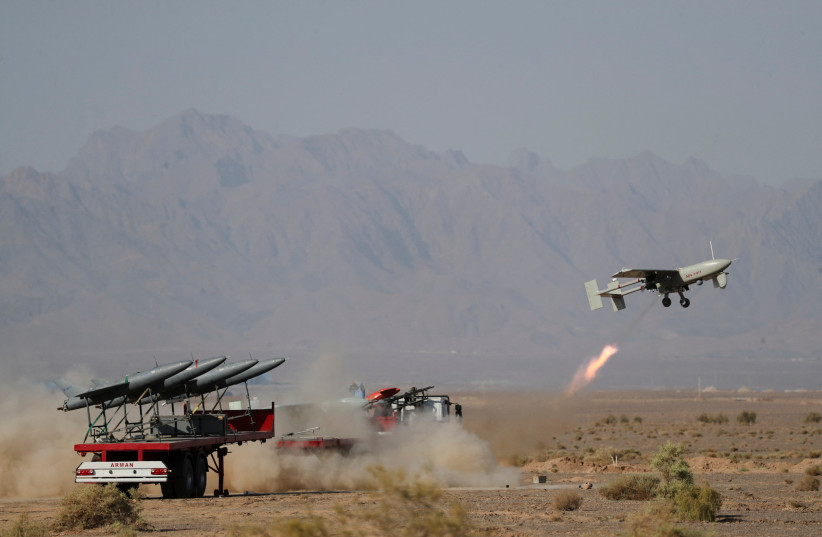
 A drone is launched during a military exercise in an undisclosed location in Iran, in this handout image obtained on August 25, 2022. (photo credit:  Iranian Army/WANA (West Asia News Agency)/Handout via REUTERS)
A drone is launched during a military exercise in an undisclosed location in Iran, in this handout image obtained on August 25, 2022.
(photo credit: Iranian Army/WANA (West Asia News Agency)/Handout via REUTERS)

A day after the US announced sanctions on eight Iranian individuals involved in Iran’s drone manufacturing, US media has reported that Russia is moving forward with a plan to establish a factory to manufacture some 6,000 Iranian drones every year. The report was in the Wall Street Journal and came after the US State Department reported the sanctions.

Russia and Iran are seeking to establish a factory in Iran that could make 6,000 of the Iranian drones that Russia has already been using with deadly effect against Ukraine. These are assumed to be the Shahed style kamikaze drones that Russia has used over the past year.

Iran has angered the West

The use of these drones has angered the West. Drone components have been discovered in Ukraine that can be traced back to the West, showing how Iran’s IRGC and other nefarious Iranian entities acquire Western technology for use in weapons. They acquire this under dual use trade, where they pretend it is not for weapons, but in fact it ends up in drones.

Iran’s decision to export drones to Russia has become a major issue in the West. Now Iran appears play a key role in the war against Ukraine. This has shifted perceptions of Iran from a regional threat in the Middle East, where its drones targeted Israel and Saudi Arabia and other countries, to a an Iran that is actively targeting Europe. The recent reports are according to the Wall Street Journal and it has cited officials in the West in its reports. The recent report links to warnings in the US that Moscow could move ahead with these plans.

At the same time the United States said it “is designating eight Iranian individuals in leadership roles at Paravar Pars, an Iranian firm that produces unmanned aerial vehicles (UAVs) for the Islamic Revolutionary Guard Corps Aerospace Force. Iranian UAVs are being transferred to Russia for use in its brutal and unprovoked war against Ukraine,” the US State Department said.

The Iranian Shahed 129 drone (credit: MILITARYEDGE.ORG)The Iranian Shahed 129 drone (credit: MILITARYEDGE.ORG)

The report further says “Russia is using Iran-produced UAVs in attacks against civilians and civilian infrastructure in Ukraine. The Iranian regime’s military support for Russia helps fuel Russia’s brutal war against Ukraine and has also resulted in violations of UN Security Council resolution 2231, which prohibits Iran’s provision of military UAVs to Russia without advance, case-by-case approval of the UN Security Council.”

Iran lost any favour it had

Iran is increasingly under scrutiny for its role in arming Russia. This has been a big gamechanger in western perceptions of Iran. Iran is now unable to sell itself as a country that is “moderate” or that can be counted on to do some kind of “deal” with the West. Today the regime in Iran, having aided Russia in its war in Ukraine, is rapidly losing any friends in the West, or even commentators who might excuse its activity.

This is a big shift from a decade ago when Iran was able to pose as a country that had “moderates” and that was working toward an Iran deal with the West. In those days it used to claim that Israel was the problem, and if only the West came to an agreement, then Iran would be a rational normal player in international relations.

These days the Iranian regime, now apparently seeking to work with Russia on a drone manufacturing facility, is quickly losing out on any positive feelings it had in the West, or even any ability to threaten the West, because it is now seen as entirely part of the Russian camp and one of the few countries actively engaging in Russia’s campaign against innocent Ukrainians. For years Iran used its drones to terrorize the Middle East, launching them against Israel, arming Hezbollah, Hamas and the Houthis in Yemen.

Today its arming of Russia has crossed a red line and Tehran appears to believe it cannot go back. Instead the reports indicate it is going forward and increasing its work with Moscow. The new US sanctions and the WSJ reports indicate how Iran is moving forward, a year after Moscow began its war against Ukraine.

Whether the Iranian drones will have an impact is unclear. Western countries are increasing their air defense for Ukraine and Iran’s drones are not particularly sophisticated. They are built more to terrorize than to win wars. It’s unclear if Moscow’s support for Iran or any factories in Russia could increase the range and capabilities of Iran’s drones. If Moscow can increase the range and capabilities then it’s plausible Iran could learn from this experience and use them against countries in the Middle East, a potential blowback from the war against Ukraine.