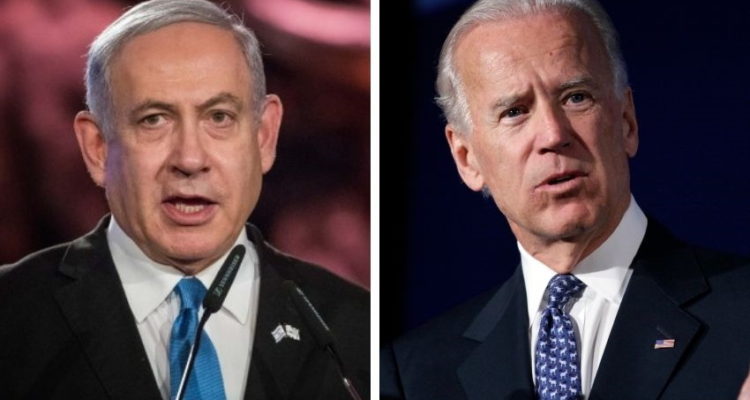
Is a Biden-Netanyahu brawl inevitable?

Both men want to keep disputes between them private. But sympathy for the anti-Bibi resistance and differences over Iran could change that.
By Jonathan S. Tobin, JNS

If you listen to the statements from both the Israeli and American governments, all’s well between Jerusalem and Washington these days. But despite the bromides being uttered by high-ranking officials, the pretense that there are no disputes between them that can’t be dealt with privately is wearing thin.

The pressure from the Israeli left and its many American supporters for the United States to signal its opposition to the new Benjamin Netanyahu-led government is growing. The question is: Will prudence and the desire on the part of President Joe Biden and his foreign-policy team to avoid a messy confrontation with Israel survive the coming weeks and months, as the anti-Bibi resistance intensifies?

Israel was not at the top of Biden’s agenda during his first two years in office. He was distracted by the coronavirus pandemic, a tottering economy and the disastrous withdrawal from Afghanistan.

He was eager to resume a policy of appeasement toward Iran, via an even more dangerous nuclear deal, though that effort stalled. And since last February, Washington has treated aiding Ukraine fend off a Russian invasion as its top priority, a position that didn’t always dovetail with its push with Iran.

To his credit, Biden wasn’t under the delusion that the Palestinians wanted peace or that a resumption of negotiations with them would bring forth the dream of a two-state solution to the conflict with Israel. So, although he is an ardent believer in that failed concept, he was the first president in a generation to come into office who did not treat the quest for a Palestinian state as a priority.

Moreover, relations with the multi-party coalition led first by Naftali Bennett and then Yair Lapid were also generally good, as the two sought to avoid open disagreements with Washington, even when the Americans’ desire to appease Iran presented a genuine threat to Israeli security. But with Netanyahu back in power, the pressure on Biden to start acting like his old boss Barack Obama and go to war with Netanyahu is getting harder to ignore. New York Times columnist Thomas Friedman spoke for many liberals when he wrote this week begging Biden to “save Israel.”

Friedman’s incoherent description of the new coalition’s plans for judicial reform was predictably ignorant and distorted. For example, his horror at the idea of scrapping the committee system for choosing new Supreme Court justices that gives the existing judges the right to choose and/or veto potential successors in favor of one that gives the representatives of the voters more say, was laughable.

  ‘I HAVE SUCCEEDED’: NETANYAHU ANNOUNCES HE HAS FORMED A GOVERNMENT

Would any American stand for a system that allowed the U.S. Supreme Court to do the same? Would anyone, on the American left or right, put up with a court that considered itself to have the right to intervene in any dispute or governmental action, or to rule the Constitution as Israel’s supremes have given themselves the right to do, on the basis of nothing more than what they think is or isn’t “reasonable?”

But Friedman’s critique went further than the attack on a necessary attempt to rein in an out-of-control court. He hyperbolically faulted the voters who gave Netanyahu’s coalition a clear majority in the Knesset for being “hostile to American values” and, even worse, have more in common with Republicans than Democrats like Rep. Alexandria Ocasio-Cortez (D-N.Y.)

Citing some of the partisan incitement against the government in the Times of Israel and Haaretz, he falsely accused Netanyahu of trying to emulate Turkish President Recep Tayyip Erdoğan. Quoting Netanyahu’s defeated political foes, he labeled the new government as “fascist.”

This is familiar stuff to many Americans who, like Biden, claim to love Israel but only on their own terms. They only think Israel deserves support as long as it obeys orders from Washington and acts as if it is a deep blue colony of liberal Jews living abroad, rather than a Jewish state filled with people with their own ideas, and who understand that they live in the Middle East and not the Upper West Side of Manhattan.

  BIDEN: NUCLEAR DEAL ‘DEAD, BUT WE’RE NOT GONNA ANNOUNCE IT’

Much like the president, Friedman’s been wrong about every major issue of the last four decades, but has never been held accountable for it. As easy as it would be to dismiss him as a caricature of foreign-policy-establishment cluelessness and dogmatic adherence to failed ideas, however, his call for the United States to intervene in Israeli politics to aid the opposition’s attempt to topple a democratically elected government resonates among many Democrats.

Still, that isn’t the public message Biden has been trying to convey. U.S. Ambassador to Israel Tom Nides has sought to interfere in his host’s domestic affairs when it comes to issues like settlements and preserving the mythical possibility of a two-state solution. But he’s also been careful to state that he won’t be conducting any boycotts of controversial members of Netanyahu’s new government, such as Finance Minister Bezalel Smotrich and National Security Minister Itamar Ben-Gvir.

Other figures, like Secretary of State Antony Blinken and National Security Advisor Jake Sullivan, have similarly avoided making overt statements opposing Netanyahu, even though they are uncomfortable with the new government’s desire to step up efforts to hold the Palestinian Authority accountable for its incitement to and support for the current uptick in terrorism.

In return, Netanyahu has similarly tried to send signals that he wants to avoid trouble with Biden. He reportedly told a private gathering sponsored by AIPAC that he thinks the U.S. and Israel are closer than before with respect to the Iranian nuclear threat. And if Biden truly believes, as he said last month, that his foolish efforts to revive the nuclear deal with the regime in Tehran is “dead,” due to its brutal suppression of mass demonstrations against its despotic rule and support for Russia in Ukraine, perhaps that’s true.

But if there’s anything that we’ve learned about Biden’s presidency, it’s that he has steadily drifted to the left for fear of offending the activist and intersectional base of his party. That’s been evident on a host of issues, ranging from illegal immigration to his bending of the knee to the Black Lives Matter movement and the imposition of the hard-left’s DEI—diversity, equity and inclusion—-catechism throughout the government.

  WHAT ARE THE NEXT STEPS BEFORE NETANYAHU’S GOVERNMENT IS SWORN IN?

For now, Biden is too committed to doubling down on an endless and unwinnable war in Ukraine to want to get drawn into a battle over who should govern Israel. But as the Israeli left turns up the volume on its anti-Bibi resistance effort, the idea that America has a “duty” to save Israel from itself will be gaining more and more support in the liberal corporate media. The fact that distorted coverage of Israeli judicial reform is already getting more attention in the American press than Iranian executions of dissidents is a sign of what is to come.

And as the 2024 presidential race begins in earnest later this year, Biden’s need to curry favor with his party’s left wing will make him less, not more, likely to avoid fights with the Jewish state. Whether the excuse concerns the Palestinians or Israeli efforts to stop Iran, it won’t be easy for Netanyahu to avoid such battles.

Yet those who are eager for Biden to start ratcheting up the pressure on Netanyahu have short memories. Obama spent his eight years in the White House constantly plotting to undermine and defeat Netanyahu. But each time he did so, he only strengthened the prime minister.

Netanyahu has many political enemies at home, but those who want to save Israel from itself always forget that its citizens have little interest in accepting diktats from American presidents or liberal Jews who want a fantasy Israel rather than the real one. The more Biden leans on Netanyahu or tries to influence the debate in the Jewish state, the less likely it is that the prime minister will be beaten.

Jonathan S. Tobin is editor-in-chief of JNS (Jewish News Syndicate).



Hamas released a video that depicted Mengistu, an Israeli civilian, speaking a few short sentences on Monday.

 Prime Minister Benjamin Netanyahu seen during a visit to the West Bank on January 17, 2023 (photo credit: CHAIM TZACH/GPO)
Prime Minister Benjamin Netanyahu seen during a visit to the West Bank on January 17, 2023
(photo credit: CHAIM TZACH/GPO)

Israel knew that Avera Mengistu, held captive in Gaza by Hamas since 2014, was alive, Prime Minister Benjamin Netanyahu said on Tuesday.

Netanyahu uttered the first public confirmation of the matter one day after Hamas released a video that depicted Mengistu, an Israeli civilian, speaking a few short sentences. There were no visuals in the video by which to date the clip.

“Yesterday, we received another confirmation of what we knew all along: Avera is alive,” Netanyahu said. “This is a young man who is not in good health. Responsibility for his fate rests entirely on Hamas.”

He did not reference Hisham al-Sayed, the other Israeli held captive by Hamas, since 2015. Hamas released a video of Sayed in April of last year that could be dated. Both men are believed to be suffering from psychological illness. Hamas is also presumed to be holding the bodies of two Israeli soldiers killed in the 2014 Gaza war, Hadar Goldin and Oron Shaul.

 Family and supporters of Avera Mengistu protest as they call for his release from Hamas captivity Five years after he was kidnapped, in Tel Aviv on September 8, 2019 (credit: TOMER NEUBERG/FLASH90)Family and supporters of Avera Mengistu protest as they call for his release from Hamas captivity Five years after he was kidnapped, in Tel Aviv on September 8, 2019 (credit: TOMER NEUBERG/FLASH90)

Netanyahu: Israeli efforts to return prisoners of war ongoing

“Israel has not stopped its efforts to return Avera Mengistu and the rest of our captives and missing persons,” Netanyahu added.

The prime minister spoke after a visit to the Shin Bet’s Samaria Division in the West Bank with Shin Bet (Israel Security Agency) head Ronen Bar to get a security assessment from officers stationed there.

The Foreign Ministry stepped up its campaign for the release of the two men and the return of the two bodies after the video’s publication sending letters to the Pope, the UN Secretary-General Antonio Guterres, the World Health Organization and the Red Cross asking for their increased involvement in returning the captives. In December the Pope met with representatives of the four families in the Vatican.

Foreign Minister Eli Cohen said that “bringing the bodies of the soldiers to their graves in Israel and returning Israeli citizens to the bosom of their families is a moral obligation … We will continue to work with the international community to expose the cruel face of the terrorist organization Hamas until they are returned home.”Netanyahu returned to office late last month, after a year and a half as opposition leader. The release of the two Israeli citizens and the bodies of two Israeli soldiers has been on his agenda for most of the time they have been held captive.

“Israel has not stopped its efforts to return Avera Mengistu and the rest of our captives and missing persons,”

Prime Minister Benjamin Netanyahu

Negotiations have been held through Egyptian-brokered indirect talks, but no agreement was ever reached. One of the obstacles has been the Hamas demand for the release of prisoners who have killed Israelis in terrorist attacks.

Such prisoner releases are often highly controversial, given that historically, some of those released in past swaps have carried out other attacks.

Netanyahu’s predecessor, Yair Lapid, who was in office only for the second half of last year, addressed the issue in an interview with KAN News.

In the interview, he said the first meeting he held as prime minister was about the release of these men, and that was not an accident.

“We made efforts, just as past governments did,” Lapid said. “But everyone gets stuck in the same loop where you are not willing to endanger Israel’s security by releasing dangerous people with blood on their hands.”

To explain how complex the matter is, Lapid referenced the 2011 deal to release Gilad Schalit in which Israel released 1,027 Palestinian prisoners. Schalit was kidnapped by Hamas in 2006, while serving as an Israeli soldier along the Gaza border. He was held for five years.

The deal had been “very popular” at the time but “everyone understands today that too high a security risk was taken,” Lapid explained.

It’s not that “it’s impossible to do a deal,” but the issues here are complex, he explained, indicating that the political price of the agreement was too high.


More than 90 countries on Monday night expressed their deep concern regarding the Israeli government’s decision to deny entry to Israel to several Palestinian Authority leaders following their appeal to the UN General Assembly to request the opinion of the International Criminal Court in The Hague regarding the “occupation” of Judea and Samaria.

Here is a screenshot of the statement:

Statement calling on Israel not to punish the PA. / Screenshot

The statement was signed by countries that voted for the UN resolution, but also by some that abstained and voted against the resolution. Altogether, the statement was signed by representatives of Arab nations, the 57-member Organization of Islamic Cooperation, and 37 other countries, including Germany, France, Italy, Japan, South Korea, Brazil, Mexico, and South Africa.

Global Affairs Canada, the department of the Government of Canada that manages its diplomatic and consular relations, on Monday issued a statement saying:

“Canada is a steadfast supporter of the International Court of Justice as the principal judicial organ of the United Nations, and it recognizes the important role the court plays in the peaceful settlement of disputes.
“We are deeply concerned by the punitive measures taken against the Palestinian Authority, which were recently announced by the Government of Israel, as well as the impact of those measures on the region’s stability and the prospect for a two-state solution.
“Canada continues to oppose unilateral actions undertaken by either Israel or the Palestinian Authority which contribute to the hardening of positions and are unhelpful to the cause of peace.
“We remain committed to the goal of comprehensive, just and lasting peace in the Middle East, including a two-state solution resulting from direct negotiations between the parties.”

On January 8, Israel retaliated for Ramallah’s move by confiscating PA Foreign Minister Riyad al-Maliki’s VIP travel pass when he crossed from Jordan into Judea and Samaria.

Prime Minister Benjamin Netanyahu told his cabinet that Israel was imposing “sanctions against senior Palestinian figures,” because “the Palestinian Authority has promoted an extremist anti-Israeli resolution at the United Nations.”

Israel’s Defense Ministry also revoked the VIP cards of three other senior PA officials for visiting a released terrorist who spent 40 years in prison for multiple murders of Israelis.

Another painful sanction: Finance Minister Bezalel Smotrich announced the distribution of roughly 139 million shekels ($40 million) of PA taxes and customs collected by Israel to victims of Arab terror attacks. The amount matches the salaries the PA pays out to terrorists behind bars in Israel and their families.

The PA’s envoy to the UN Riyad Mansour said, “we exercised our democratic rights to go to the General Assembly in a peaceful way, a legal way, and put a question to the ICJ to seek an advisory opinion.” He hailed the fact that the statement was signed by countries that abstained or voted against the resolution but objected to punishing the PA “for going to the General Assembly in an adoption of a resolution is something else. That’s why they stood with us and opposed this policy of the Israeli government, and they are demanding a reversal of this decision.”