
JANUARY 2, 2023 3:55 PM

by Andrew Bernard

US Secretary of State Antony Blinken speaks at a news conference following meetings at the Danish Foreign Ministry, Eigtved’s Warehouse, in Copenhagen, Denmark, May 17, 2021. Photo: Saul Loeb/Pool via REUTERS

US Secretary of State Antony Blinken called new Israeli Foreign Minister Eli Cohen on Monday to congratulate him on his appointment and discuss US-Israel relations as Israel’s hardline right-wing coalition comes into clearer focus.

The two discussed the US-Israel security partnership, the threat posed by Iran, and a gathering of the US, Israel, Bahrain, Egypt, Morocco and the United Arab Emirates dubbed The Negev Forum, which Israeli officials announced will reconvene in Morocco in March, according to the US readout of the call.

Cohen, who was Minister of Intelligence in the previous Netanyahu government, is expected to participate in that summit and play a key role in expanding the normalization agreements with Arab countries. Speaking to his Foreign Ministry colleagues for the first time on Monday before the call with Blinken, Cohen said that “the expansion of the agreements to include additional countries is not a question of if, but rather when.”

Netanyahu’s office said on Dec. 31 that UAE President Mohammed bin Zayed had congratulated the prime minister on the formation of a new government and that the two had agreed that Netanyahu would visit the UAE “soon.”

The US readout of Monday’s call between Blinken and Cohen also said that the two discussed “the continued U.S. commitment to a two-state solution and opposition to policies that endanger its viability.”

Similar language about shared US-Israeli values, support for the two-state solution, and Israeli policies that might undermine those positions has been repeated by US officials since Israel’s November elections returned the most right-wing government in Israeli history.

The inclusion of Itamar Ben-Gvir, Israel’s far-right Minister of National Security, in the coalition government has been of particular concern to US diplomats.

In November, the State Department condemned Ben-Gvir’s appearance at a memorial for Meir Kahane, the far-right, US-born Israeli parliamentarian assassinated in 1990. “Celebrating the legacy of a terrorist organization is abhorrent; there is no other word for it,” State Department spokesman Ned Price said at the time. Kahane was convicted of terrorism-related offenses in both Israel and the US, and his political party and its successor organizations were designated by the US as terrorist organizations from 1997 until May 2022.

Ben-Gvir on Sunday announced that he intends to visit the Temple Mount, which a spokesman for Hamas, the Gaza-based Palestinian terrorist group, said would be explosively escalatory. Former Prime Minister Yair Lapid said Monday that if Ben-Gvir visits the Temple Mount, “people will die.”

In his speech at the Foreign Ministry Monday, Cohen called the US the “closest ally” of Israel and said that the relationship between the two countries was a priority.

“There is no substitute for Israel-US relations. It is a long-term strategic partnership based first and foremost on common values as well as on common interests,” Cohen said.

Cohen also said the new government intends to speak less in public about the Russia-Ukraine conflict, but that humanitarian aid to Ukraine would continue.

Follow Algemeiner Washington Correspondent Andrew Bernard on Twitter @AndrewJBernie
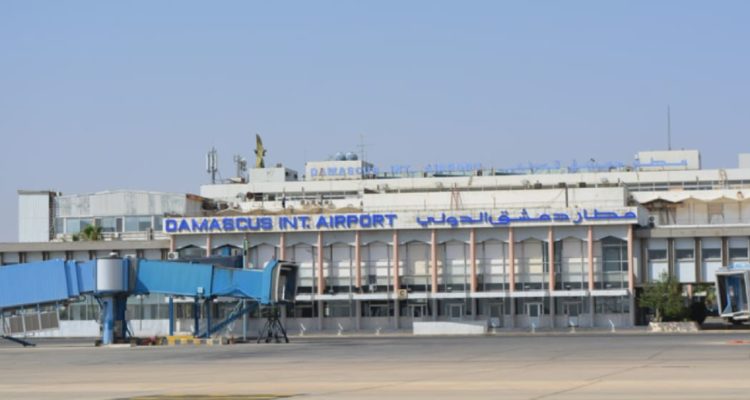

Two Syrian soldiers were among the four killed in a strike against Hezbollah in and around the airport, putting it out of business for several hours.

By Batya Jerenberg, World Israel News

Israeli forces struck the international airport in Damascus very early Monday morning, putting it out of business for several hours, Syrian media reported Monday.

Military sources told state media SANA that two Syrian soldiers were killed and two others injured when Israeli jets “coming from the direction of the Sea of Galilee” fired “barrages of missiles, targeting Damascus International Airport and its surroundings” at around 2 a.m.

Both runways were struck, forcing the aviation authorities to close the airport for repairs. Syrian media reported that the damage to the airport was repaired in the following hours and by 9 o’clock the site was functioning normally again.

According to the London-based Syrian Observatory for Human Rights (SOHR), at least four people were killed in the attack, which targeted “positions for Hezbollah and pro-Iranian groups inside the airport and its surroundings, including a weapons warehouse.”

Israel has not commented on the attack, which comes just days after Benjamin Netanyahu as sworn in as prime minister.

The IDF has hit Iranian targets and military sites of its Hezbollah proxy hundreds of times annually over recent years, no matter who was prime minister. Called the “war between the wars” in Hebrew, the ongoing attacks are meant to prevent the Islamic Republic from gaining a threatening foothold on Israel’s northern border.

  ‘MERCHANT OF DEATH’: WHO’S THE ISLAMIC TERROR SUPPORTER BIDEN FREED IN DEAL WITH RUSSIA?

While parts of the airport have been hit numerous times in an apparent effort to stymie weapons shipments from Tehran to its forces in Syria, this was the second time the airport had to shut down due to Israeli operations. On June 10, the IAF cratered the main runways and destroyed terminal arrival halls, communication towers, three weapons depots belonging to Hezbollah and other airport infrastructure.

At the time, the SOHR reported that missile components smuggled into the country on civilian flights from Iran had been stored in the terminals. They were to be used to convert ordinary rockets into precision-guided missiles.

It took two weeks for the airport to be repaired from the damage and resume regular flights.

In September, Syrian media reported that Israeli forces hit Aleppo’s international airport in northern Syria, forcing it to shut down for several days as well. No injuries or deaths on the ground were reported in that raid.


Iran bombs mock Israeli navy base in military exercise

Iran watchers conclude it was Eilat’s naval facility, while official Iranian media did not label it nor issue any threats against Israel, unlike its joint drill last year.

By Batya Jerenberg, World Israel News

Iranian forces holding military drills in the Straits of Hormuz successfully targeted a mock-up of an Israeli base Saturday, according to Iranian media accounts.

The official Islamic Republic News Agency (IRNA) publicized a video clip in which a UAV can be seen being launched from an Iranian Hengam-class landing ship called IRIS Lavan and dropping an object.

The footage then changes to show what looks like a computer-generated image of a small, coastal base with a ship in dock, before changing back into a real-life view of a bomb hitting one building, followed immediately by a drone smashing into an adjacent structure and exploding in a ball of fire.

The model of the ship remained unscathed in the practice attack, which is part of a joint naval, air and ground exercise called Zolfaghar-1401 that began Thursday in the Gulf of Oman.

Throwing into possible doubt what viewers saw, an Iranian-American with the Twitter handle Mehdi H. who uses open-source intelligence to publicize Iranian military affairs, tweeted Saturday that the IRNA video is a “mixture of two different Iranian drone operations. The one launched from IRIS Lavan is an Ababil, but the one hitting the target is an Arash loitering munition.”


In a military exercise in December 2021, Iranian forces carried out a ballistic missile attack on a model of Israel’s nuclear complex in Dimona. Tehran made it clear that it was a warning to the Jewish state, in contrast to this weekend’s drill, where the naval base was not officially identified.

Islamic Revolutionary Guard Corps chief Maj. Gen. Hossein Salami told state television at the time that “The military exercise… is a serious warning to Zionist regime officials… Make the slightest mistake, we will cut off their hand.”

According to Iranian daily Ettela’at, the Zolfaghar exercise also included bombing runs on land and sea of the air force’s old American Phantom F-4E planes from the time of the Shah and Russian Su-24 jets, which were mostly manufactured in the 1980s.

The air defense system was also tested, with a “hostile” drone force identified and destroyed in the drill, said the paper. The Iranian military had held a joint exercise with 150 unmanned aircraft, include missile drones and ‘suicide’ drones this past August as well.

Western intelligence reports that Tehran is on the verge of a massive upgrade to its air force, striking a deal with Moscow for 24 of its modern Su-35 Sukhoi jets, cruise missile-carrying fighters that according to the Russians can reach a speed of Mach 2.5 and have a range of over 3,500 km, making Israel quickly and easily within striking distance of Iran. Iranian pilots are already training on the jets in Russia, said the report.