
“This gets us closer to deploy nuclear power when and where it is needed to give our nation’s warfighters the tools to win in battle,” said Under Secretary of Defense for Acquisition and Sustainment.

Cooling towers at the former Three Mile Island Nuclear power plant during a tour by Constellation Energy in Londonderry Township, Pennsylvania, US, June 25, 2025
(photo credit: REUTERS/EDUARDO MUNOZ)
The US Departments of Energy and Defense on Sunday for the first time transported a small nuclear reactor on a cargo plane from California to Utah to demonstrate the potential to quickly deploy nuclear power for military and civilian use.

The agencies partnered with California-based Valar Atomics to fly one of the company’s Ward microreactors on a C-17 aircraft, without nuclear fuel, to Hill Air Force Base in Utah.

Energy Secretary Chris Wright and Under Secretary of Defense for Acquisition and Sustainment Michael Duffey were on the C-17 flight with the reactor and its components, and hailed the event as a breakthrough for US nuclear energy and military logistics.

“This gets us closer to deploy nuclear power when and where it is needed to give our nation’s warfighters the tools to win in battle,” Duffey said.

President Donald Trump‘s administration sees small nuclear reactors as one of several ways to expand US energy production. Last May, Trump issued four executive orders aimed at boosting domestic nuclear deployment to meet growing energy demand, support national security, and advance competitive AI.

US President Donald Trump speaks during a reception with business leaders, at the 56th annual World Economic Forum (WEF), in Davos, Switzerland, January 21, 2026.
US President Donald Trump speaks during a reception with business leaders, at the 56th annual World Economic Forum (WEF), in Davos, Switzerland, January 21, 2026. (credit: REUTERS/JONATHAN ERNST)

Energy Department issues grants to help accelerate developing modular reactors

The Energy Department in December issued two grants to help accelerate the development of small modular reactors.

Proponents of microreactors have also touted them as energy sources that can be sent to remote locations, offering an alternative to diesel generators, which require frequent fuel deliveries. But skeptics have argued that the industry has not demonstrated that small nuclear reactors can generate power at a reasonable cost.

“There is no business case for microreactors, which, even if they work as designed, will produce electricity at a far higher cost than large nuclear reactors, not to mention renewables like wind or solar,” said Edwin Lyman, director of nuclear power safety at the Union of Concerned Scientists.

The Energy Department plans to have three microreactors reach “criticality,”  when a nuclear reaction can sustain itself, by July 4, Wright said.

The microreactor in Sunday’s event, a little larger than a minivan, can generate up to 5 megawatts of electricity, enough to power 5,000 homes, according to Valar CEO Isaiah Taylor. It will start operating in July at 100 kilowatts and peak at 250 kilowatts this year before ramping up to full capacity, he said.

Valar hopes to start selling power on a test basis in 2027 and become fully commercial in 2028. Although private industry funds its own development of nuclear technology, it also needs the federal government “doing some enabling actions to allow fuel fabrication here and uranium enrichment here,” he said.

Fuel for Valar’s reactor will be transported from the Nevada National Security site to the San Rafael facility, Wright told reporters.

However, even small generators result in a significant amount of radioactive waste, Lyman said. Other experts have said designers are not compelled to consider waste at inception, beyond a plan for its management.
Although disposal of nuclear waste remains unresolved, the Energy Department is in talks with a few states, including Utah, to host sites that could reprocess fuel or handle permanent disposal, Wright said.


Netanyahu: Israel ready to phase out US military aid

At Jerusalem gala, Prime Minister outlines strict Iran terms, vows to disarm Hamas, phase out US aid and confront rising antisemitism.

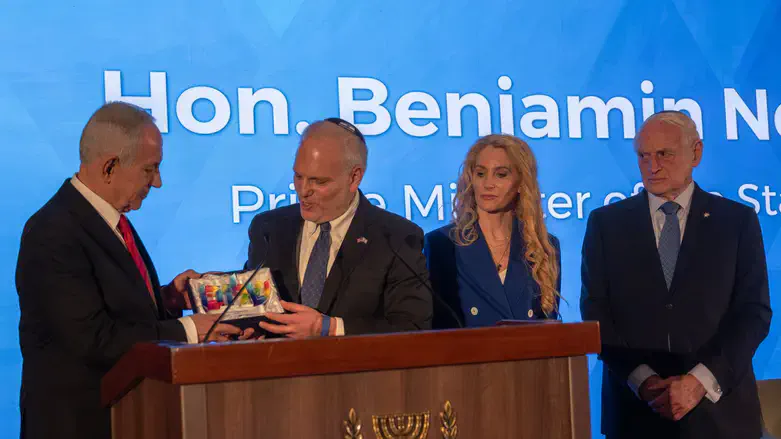
Netanyahu, William Daroff,  Betsy Berns Korn, Malcolm Hoenlein

Netanyahu, William Daroff, Betsy Berns Korn, Malcolm HoenleinCourtesy, Conference of Presidents

Prime Minister Benjamin Netanyahu addressed the opening gala of the Conference of Presidents of Major American Jewish Organizations’ 51st Leadership Mission to Israel on Sunday night in Jerusalem.

The Prime Minister spoke about his recent trip to the United States and his meeting with President Trump. “I just had very important meeting with President Trump. The focus was on Iran. The President is determined to exhaust the possibilities of achieving an agreement,” Netanyahu said.

Addressing the Iranian issue, Netanyahu stated, “I expressed my skepticism of any deal with Iran because Iran is reliable on one thing – they lie and cheat.”

He outlined conditions that he said must be included in any agreement. “First, all enriched material has to leave Iran. Second, there should be no enrichment capability. Not just stop the process but dismantle the infrastructure that allows you to enrich. Third, need to deal also with the question of ballistic missiles. And the fourth is to dismantle is the axis of terror of Iran. And finally, distrust and verify. Must have effective inspections for all of the above.”

Turning to Gaza, Netanyahu said Israel had three goals in the war: “return the hostages, disarm and dismantle Hamas military capabilities, and third dismantle Hamas governing capabilities. The first has been achieved.”

“Hamas must give up its weapons. The weapon that does the most damage is the AK-47. Assault weapons. There are 60,000 such weapons, they must go,” he said.

“First disarm Hamas. Second, demilitarize Gaza. We dismantled about 150 km of 500 km of tunnels. We’re giving the President’s plan a chance. It can be done the easy or hard way. We hope the easy way. Because we know the human cost of war. But that goal must be achieved. And one way or another it will be.

“Gaza will not pose a threat ever again to the State of Israel,” Netanyahu declared.

On the economy, the Prime Minister said, “After 2 years of war, our economy is growing rapidly, our stock market is at an all-time high. The shekel vs the dollar is almost at a 30-year high. Inflation is going down.”

He added, “Israel is the number 2 cyber power in the world. Israel receives more foreign investment in cybertech than any country aside from the United States. Will do the same in AI and quantum. Israel is a juggernaut of innovation.”

“Israel is a very strong country coming out of the war. Strong militarily, strong economically, strong technologically. The United States just issued a memorandum, describing its vision of alliances, and it called Israel ‘the model ally.’ We are willing to fight for ourselves.”

Netanyahu expressed appreciation for American support and addressed the issue of military aid. “With deep appreciation for American support over the years from both parties, we can afford to phase out the military aid. Israel will support itself and does. Over the next ten years, Israel will move from aid to partnership, with the United States. Our goal is to build an independent arms industry in Israel.”

Addressing antisemitism, Netanyahu said, “People are shocked by the rise of antisemitism. But it’s not shocking if you look at the cycle of history.”

“But the great change of Jewish history, is the independent state with the power to roll back those attacks. Fight back. Do not cower, fight back. People respect those who respect themselves. We have to fight back. Silence will not help. To defeat antisemitism, we have to fight it.”


Syrian Arab Army takes over Al-Shadadi in northeast of country, close to Jordan-Iraq border; site formerly housed prison where Kurdish forces held Islamic State members

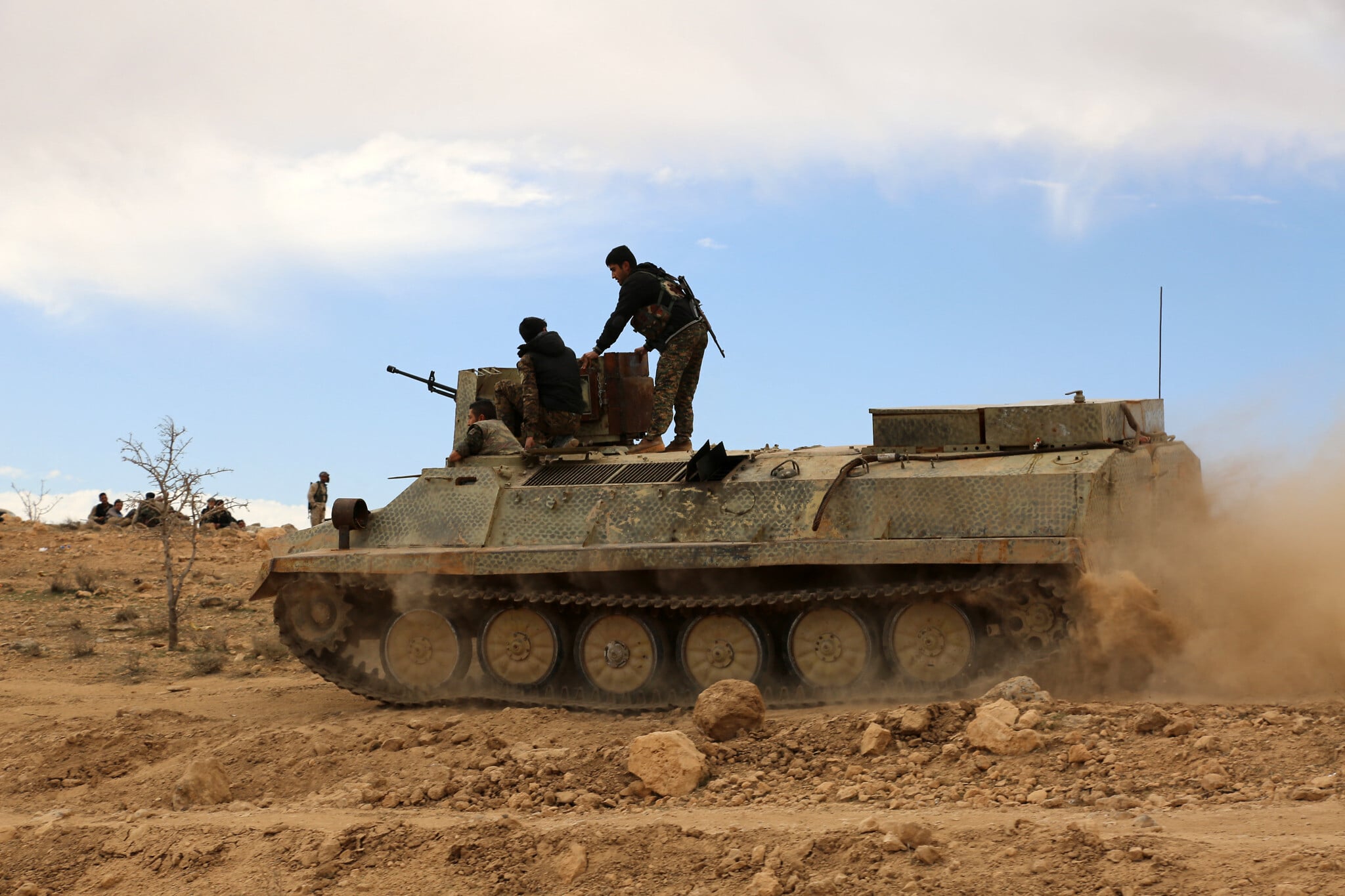
Fighters from the Syrian Democratic Forces (SDF) sit atop an armoured personnel carrier on the outskirts of the town of al-Shadadi in the northeastern Syrian province of Hasakeh, on February 19, 2016. (Delil souleiman / AFP)

Fighters from the Syrian Democratic Forces (SDF) sit atop an armoured personnel carrier on the outskirts of the town of al-Shadadi in the northeastern Syrian province of Hasakeh, on February 19, 2016. (Delil souleiman / AFP)

DAMASCUS, Syria — Syria’s defense ministry said on Sunday it had taken over the Al-Shadadi base in the northeast from US forces, days after assuming control of a facility near the Jordan-Iraq borders.

“The forces of the Syrian Arab Army have taken over the Al-Shadadi military base in the Hasakeh countryside following coordination with the American side,” a ministry statement said.

US forces operating as part of the international coalition against the Islamic State group had been stationed at the base outside the town of the same name.

The town housed a prison where Kurdish forces detained members of the extremist jihadist organization, before government forces advanced into the area last month.

Sunday’s announcement follows US confirmation on Thursday that its forces had vacated Al-Tanf base near Syria’s borders with Jordan and Iraq.

The Kurdish-led Syrian Democratic Forces (SDF) were a major partner of the US-led international coalition against ISIS, and were instrumental in the group’s territorial defeat in Syria in 2019.

But following the fall in December 2024 of longtime ruler Bashar al-Assad, the United States has drawn closer to the new government in Damascus, recently declaring that the need for its alliance with the Kurds had largely passed.

Despite ISIS’s territorial defeat, the group remains active, however.

On Saturday, the US Central Command said its forces had struck more than 30 ISIS targets in Syria this month.

A CENTCOM statement said the air strikes between February 3 and 12 hit ISIS “infrastructure and weapons storage targets.