Israeli security forces believe the shooting was not directed at Ben-Gvir’s home, but rather at a military checkpoint near the settlement.

 Israeli security forces gather near the entrance of the Jewish settlement of Kiryat Arba'a near the West Bank town of Hebron, on May 19, 2021 (photo credit: WISAM HASHLAMOUN/FLASH90)
Israeli security forces gather near the entrance of the Jewish settlement of Kiryat Arba’a near the West Bank town of Hebron, on May 19, 2021
(photo credit: WISAM HASHLAMOUN/FLASH90)

A terrorist opened fire at Israeli civilians and security forces at a checkpoint in the West Bank settlement of Kiryat Arba, near the home of Otzma Yehudit MK Itamar Ben-Gvir on Saturday night, according to the IDF Spokesperson’s Unit.

One Israeli was killed following efforts to save his life at Hadassah-University Medical Center in Jerusalem after being evacuated by helicopter to receive treatment. Another was moderately injured and four others were lightly injured.

One of those injured was a 37-year-old Palestinian who was evacuated by Israeli forces to be treated in Palestinian Authority-controlled land.

Two of the wounded Israelis are father and son, according to reports. Two males, 48 and 19 years old, were also hospitalized in Hadassah in light condition.

A large force from the Israel Police and Shin Bet (Israel Security Agency) arrived at the scene, Maariv reported. The assailant was killed by a civil security officer, the IDF said, with scans ongoing to determine whether more terrorists were involved in the attack.

Ben-Gvir wasn’t targeted in terror shooting, security forces say

Following initial investigations, Israeli security forces believe the shooting was not directed at Ben-Gvir’s home like he claimed but rather at a military checkpoint near the settlement, in the Hebron area.

Ben-Gvir’s family and the other residents of Kiryat Arba were told to stay inside as Israeli security forces investigated.

“My family is currently being secured under a shooting attack on our home in Givat Avot,” Ben-Gvir wrote on Twitter. “We’re listening to the instructions from security forces.”


This is a developing story.


The IDF’s shadow war on Iranian weapons smuggling in Syria

The IDF is in the midst of an ongoing war against smuggling of weaponry from Iran to Syria, where they end in the hands of Lebanese terrorist organization Hezbollah.

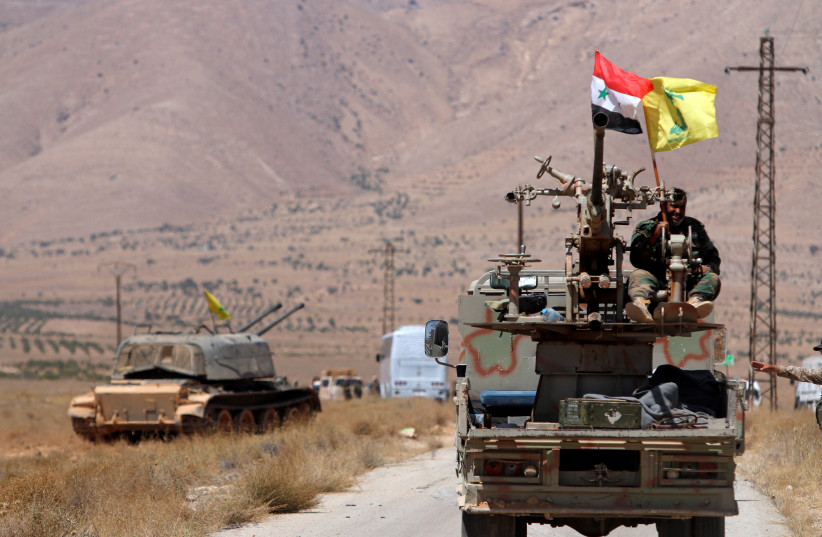
 Hezbollah and Syrian flags flutter on a military vehicle in Western Qalamoun, Syria August 28, 2017.  (photo credit: REUTERS/OMAR SANADIKI)
Hezbollah and Syrian flags flutter on a military vehicle in Western Qalamoun, Syria August 28, 2017.
(photo credit: REUTERS/OMAR SANADIKI)

A violent blast tore through a street of Masyaf, in a region of Syria known as a hub for the Assad regime-controlled Syrian defense industry, in August 2018. The attack, attributed by Syrian officials to Israel’s Mossad, killed rocket scientist Dr. Aziz Asbar.

“It was a hit on the soft underbelly of the Syrian regime, which has made great efforts since then to rehabilitate that field,” a senior former defense official said earlier this week.

The assassination of Asbar raised the issue of Iran, Hezbollah, North Korea and Russia’s involvement in the development of weapons on Syrian soil, especially among Western intelligence agencies and moderate Sunni states in the Middle East.

The Israeli war on weapon manufacturing, smuggling in Syria

But the Israeli battle began all the way back in 2005, following intel showing the development of chemical weapons in Syria.

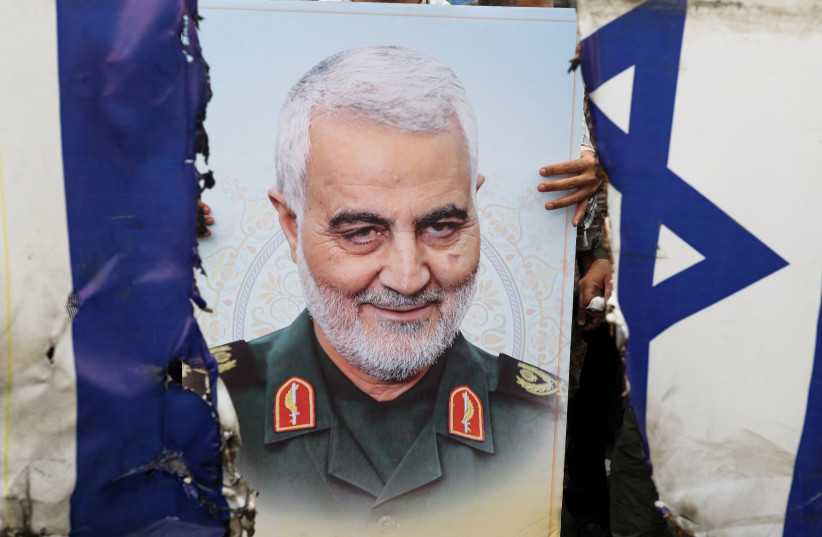
A poster of senior Iranian military commander General Qassem Soleimani is seen during a rally marking the annual Quds Day, or Jerusalem Day, on the last Friday of the holy month of Ramadan in Tehran, Iran April 29, 2022 (credit: WANA NEWS AGENCY/REUTERS)A poster of senior Iranian military commander General Qassem Soleimani is seen during a rally marking the annual Quds Day, or Jerusalem Day, on the last Friday of the holy month of Ramadan in Tehran, Iran April 29, 2022 (credit: WANA NEWS AGENCY/REUTERS)

Following Israeli intel and US sanctions on The Scientific Studies and Research Center (SSRC), which included sanctions carried out by the Trump administration on 271 individuals in the SSRC  in 2017, the center was attacked.

The message to Assad was clear but Damascus was not moved, continuing the development and smuggling of weaponry to Hezbollah and Iranian-backed militias across Syria.

A year later, Dr. Asbar was assassinated and as time went on, his influence on multiple projects, especially precision-guided missiles, became apparent. It remains to be discovered how close the rocket scientist was to Assad, Iran’s slain Quds Force commander Qassem Soleimani and North Korean colleagues.

“It was clear Soleimani and Hezbollah Secretary-General Hassan Nasrallah led a plot to gain control of the research center and its production lines,” the former defense official said. “In other words, a significant route for smuggling high-quality weaponry opened in Syria for Iranian miltias and Hezbollah.

“Israel cannot tolerate this,” he added.

Over the past year, Tal Barry, head of research at Alma, has been working on wide-ranging research on the different production facilities in the SSRC. Those include Institute 1000, Institute 2000, Institute 3000, and Institute 4000.

According to Barry, some of Institute 4000’s infrastructure, which mainly produces precision-guided missiles, was moved sometime during the Syrian Civil War to Masyaf, where Asbar headed the project until his mysterious death.

Institute 4000 also holds other, small-scale projects, Barry said, such as ‘Project 99’ for developing Scud missiles along with North Korea and Iran. Another branch, Project 794, is particularly interesting due to its proximity to a Russian base along the Syrian coast.

Alleged Israeli efforts to damage Insitute 4000 projects

In August, Syrian air defense systems were activated following an airstrike on Insitute 4000 facilities in Masyaf. Several buildings were completely destroyed, including one which reportedly contained a missiles cache that burned for two days.

Earlier this month, efforts to rebuild the damaged structures began. “Those leading the efforts are Iranian construction companies associated with the IRGC,” Barry explained.

“What is the end goal? serve Iranian interests in Syria and Hezbollah’s in Lebanon…Hezbollah will have autonomous capabilities in Beirut. If Tehran could, it would move it all to Lebanon but they are facing difficulties, there is no infrastructure in Lebanon.

The scope of attacks attributed to the IDF, headed by Chief of Staff Lt.-Gen. Aviv Kohavi, suggest that Iran and Hezbollah are far from meeting deadlines on projects set years prior by Soleimani, who was assassinated in 2020. His replacement has since visited Syria and Lebanon but spends most of his time in Iran and Iraq, monitoring the Quds Force’s takeover of the SSRC facilities under Assad’s nose.

“We think the Iranians, under the auspices of the Assad regime, operate at border crossings and airports through various means,” a senior defense official told Walla. “As long as the Syrians refuse to address it, even if it is happening without their knowledge…someone needs to take care of it.”


One Palestinian killed and 2 injured as soldiers shoot at two ‘suspect’ vehicles following attack, hour after army says it is ending 2-week-old blockade amid Lion’s Den crackdown

Israeli soldiers stand guard by concrete blocks in the Palestinian village of Huwara, south of Nablus in the West Bank on October 26, 2022. (MENAHEM KAHANA / AFP)

Israeli soldiers stand guard by concrete blocks in the Palestinian village of Huwara, south of Nablus in the West Bank on October 26, 2022. (MENAHEM KAHANA / AFP)

Palestinian gunmen in a passing car opened fire on Israeli troops near Nablus early Friday morning, Israel’s army said, moments after the military announced it was easing a blockade on the Palestinian city following gains against a local terror group.

A Palestinian man was killed and two others were injured by Israeli fire, the Palestinian Health Ministry said.

The Israel Defense Forces said in a statement that soldiers in the town of Huwara, just south of Nablus, opened fire on two “suspect” vehicles after a passing car opened fire on troops at an IDF post in the town.

No soldiers were injured and hits were identified, the army said.

Palestinian health authorities said Imad Abu Rashid, 47, was killed after being shot by Israeli forces in the head, chest and stomach. Two other wounded Palestinians were brought to Nablus’s Rafidia Hospital.

The military said soldiers who shot at the cars had been in the area as part of an offensive operation. Troops were searching the area for additional suspects, and a number of backpacks were found at the scene of the incident, according to the IDF.

Video published on social media appeared to show one of the cars that had taken Israeli fire, with several broken windows and what appeared to be bullet holes.

A balaclava is also seen on a seat, alongside pomegranates.


The attack occurred about an hour after the Israeli military announced it was opening a number of entrances into Nablus, which has been under a tight military cordon since October 12.

“Following a situational assessment… it was decided to change the method of restricting movement in the Nablus area and some entrances into the city will be opened tonight,” an IDF spokesperson said in a statement sent shortly after midnight.

It was not immediately clear if the Huwara checkpoint was among those that were reopened.

The decision to ease the blockade on the city came after Israel appeared to make major gains against the Lions Den terror group in recent days. The ad hoc group, which had formed less than two months earlier, had claimed responsibility for near-nightly attacks on soldiers and settlements, including a shooting on October 11 that left one soldier dead.

Gunmen at the funeral of those killed in clashes sparked by an overnight Israeli raid against the Lion’s Den terror group, in the West Bank city of Nablus on October 25, 2022. (Ronaldo Schemidt/AFP)

On Tuesday, Israeli troops raided a house used by Lion’s Den in Nablus’s old city, killing the apparent leader of the group and four other gunmen, and destroyed a bomb factory.  That came a day after another senior member was killed in a strike attributed to Israel.

Four members of Lion’s Den turned themselves in to the Palestinian Authority security services late Wednesday, reportedly as part of a deal granting them protection from the Israeli crackdown, which has also netted a number of arrests in recent days.

Lion’s Den members have vowed to continue carrying out attacks.