OCTOBER 12, 2022 2:47 PM

by Andrew Bernard

People walk as Israeli navy boats are seen in the Mediterranean Sea as seen from Rosh Hanikra, close to the Lebanese border, northern Israel May 4, 2021. REUTERS/Ammar Awad

Israel’s security cabinet on Wednesday voted to approve the newly negotiated permanent maritime border between Israel and Lebanon. The landmark deal aims to resolve a decades long dispute between Israel and Lebanon over territorial and gas rights in a 330 square mile area of the Mediterranean Sea.

Israel’s wider coalition government, made up of eight political parties, also approved the terms on Wednesday by a “large majority,” according to the Prime Minister’s office.

The deal, which was brokered by the United States and agreed to by the Lebanese and Israeli leaders on Tuesday, will be brought to the Knesset for a non-voting review before returning to the Israeli cabinet for final approval in 14 days.

“Following years of mediation by the United States, the Governments of Israel and Lebanon today announced consensus on an historic agreement to establish a permanent maritime boundary between the two countries,” said US Secretary of State Antony Blinken. “This breakthrough promises to usher in a new era of prosperity and stability in the Middle East and will provide vital energy to the people of the region and to the world.”


While settling the maritime boundary between the two countries, the deal also clarifies control of the Karish and Qana gas fields. Flow testing began at the Karish field on Sunday. On Tuesday, Lebanese President Michel Aoun announced that the French energy major Total would begin the exploration phase of the Qana field “immediately.” Under the agreement, Israel will receive approximately 17% of the revenues from the Qana field when it comes online.

For now, the deal allays concerns about a military escalation along the Israeli-Lebanese border. Last week Israeli Minister of Defense Benny Gantz had placed the IDF on alert when the outcome of the negotiations still remained uncertain.

“The deal decreases the likelihood of conflict in the short-term, but things could derail rapidly,” said Will Todman, Middle East Program Fellow at the Center for Strategic and International Studies in Washington. “If Israel elects a more hardline government and seeks to amend or cancel the deal, Hezbollah will likely adopt a much more aggressive stance. In the longer-term, if no hydrocarbon reserves materialize in Lebanon’s territory, the mutual deterrence will fade and the risk of conflict will increase.”

Security analysts have cautioned that the long-term effects of the deal on Lebanon’s fragile economy remain to be seen.

“The deal will not solve Lebanon’s crisis,” said CSIS’s Todman.  “There are no confirmed reserves and even if there are, it will likely be years until revenues begin to flow.”

Nevertheless, Todman said, the deal has been welcomed in Beirut as pushing the country toward the right direction.

“The Lebanese political elite are delighted at the prospect of major hydrocarbon revenues and are depicting this deal as a potential solution to its economic crisis.”

In an address Tuesday, Hezbollah’s leader Hassan Nasrallah said that he would welcome any deal backed by the Lebanese government. “It is strange that some in Israel and in the Arab media are claiming that Hezbollah wants to sabotage the deal. We have no problem when the Lebanese officials say that the agreement meets the Lebanese demands,” Nasrallah said. “Tonight we will not issue threats. Tonight there will only be joy and clapping.”

In Israel, the deal was met with mixed reactions.

Israeli opposition leader Benjamin Netanyahu took to twitter to criticize the deal saying,  “Behind the backs of the citizens of Israel and the Knesset, Lapid and Gantz surrendered to Hezbollah’s blackmail. They transfer strategic assets of the State of Israel to Hezbollah in a liquidation sale. Hezbollah will use billions from the gas to arm itself with missiles and rockets against Israeli citizens.”

At a press conference Wednesday Israeli Prime Minister Yair Lapid said that criticism of the deal was “poisonous propaganda,” and that Netanyahu had not seen the final text of the agreement. “When the deal is brought before the public, everyone will be able to see for themselves that the claims about it were false,” Lapid said. “This evening, I sent an invitation for a briefing to Opposition Leader Netanyahu, so he can know about the agreement and its details. We will invite all the opposition party heads for a briefing and show them the details of the deal for the first time.”


Jerusalem negotiator says new proposal meets ‘all our demands,’ protects ‘Israel’s security interests’; Beirut’s lead representative to talks also says concerns addressed

Energean's floating production system (FPSO) at the Karish gas field in the Mediterranean Sea. (Energean)

Energean’s floating production system (FPSO) at the Karish gas field in the Mediterranean Sea. (Energean)

Israel said Tuesday morning that a “historic” deal with Lebanon to resolve a long-running maritime border dispute over gas-rich Mediterranean waters was close, after a US-drafted proposal met Israeli “demands.”

“All our demands were met, the changes that we asked for were corrected. We protected Israel’s security interests and are on our way to an historic agreement,” Eyal Hulata, the national security adviser and the lead negotiator at the talks, said in a statement.

His comments came after Lebanon received the updated draft of the US-brokered maritime agreement with Israel, which Beirut’s top negotiator said satisfied its previous concerns and could imminently lead to a “historic deal.”

“If everything goes well, Amos Hochstein’s efforts could imminently lead to a historic deal,” Bou Saab told Reuters, referring to the Biden administration’s energy envoy, who has led the negotiations between Jerusalem and Beirut for the past 15 months.

Hochstein was engaged in intensive talks for the past week after he submitted what at the time was described as a final proposal aimed at settling a dispute over control of a series of gas fields off the coast of Israel and Lebanon — two countries officially at war and with no recognized maritime boundary between them.

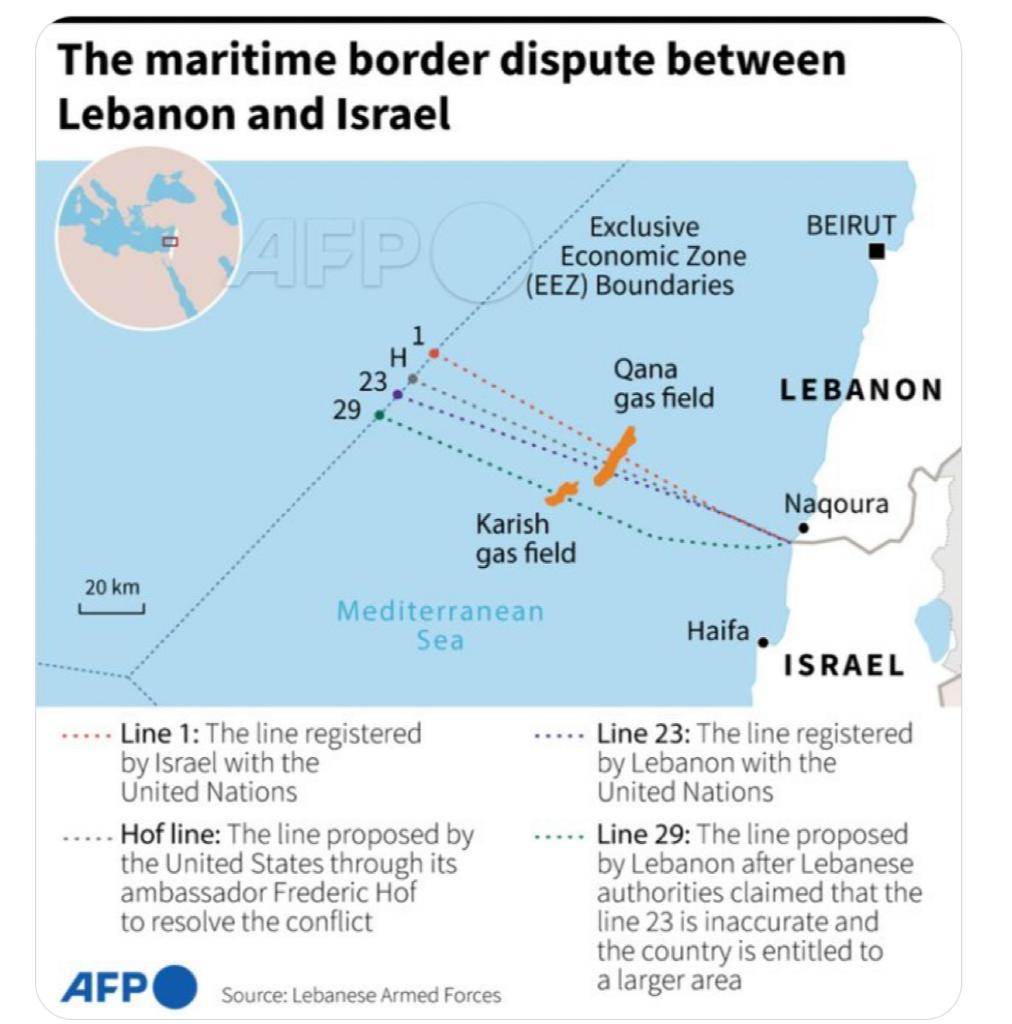
A deal would put to bed a long-running dispute over some 860 square kilometers (330 square miles) of the Mediterranean Sea, covering the Karish and the Qana gas fields.

National Security Adviser Eyal Hulata speaks during the IISS Manama Dialogue in the Bahraini capital Manama on November 21, 2021. (Mazen Mahdi/AFP)

While details of the agreement have not been formally publicized, officials said that last week’s proposal granted Jerusalem international recognition of its buoy-marked boundary five kilometers (3.1 miles) off the coast of the northern town of Rosh Hanikra, which Israel established in 2000. After that, Israel’s border will follow the southern edge of the disputed area known as Line 23.

Lebanon will enjoy the economic benefits of the area north of Line 23, including the Qana gas field, though a senior Israeli official briefing reporters on the deal said that Jerusalem will receive compensation for giving up rights to Qana, a portion of which will lie in what the agreement recognizes as Israeli waters.

While Jerusalem indicated openness to last week’s proposal, it was swiftly rejected by Lebanon, which reportedly has reservations over officially recognizing the buoy-marked boundary established by Israel. Prime Minister Yair Lapid’s office has subsequently made clear that it will not back off from this demand though.

Map showing Israel-Lebanon maritime border claims (AFP News Agency)

Lebanon also is said to have opposed the previous draft’s requirement for Israel to receive a share of the revenues from potential gas produced at Qana.

Saab — the Lebanese negotiator — did not reveal the details of Hochstein’s latest amendments to the proposed maritime border, but it is believed to be related to both the buoy-boundary and the Qana gas field.

Last Thursday, Hebrew media reported that the director of the Israel Energy Ministry told ministers at a cabinet meeting that estimates on how much natural gas could be extracted from Qana — the reservoir at the center of a maritime dispute — were far less than initially thought.

Lebanese protesters on a motorboat carry their national flag as they sail in front of an Israeli Navy vessel during a demonstration backing Lebanon’s claims to disputed maritime oil and gas fields, near the southern border town of Naqoura, Lebanon, September 4, 2022. (AP/Mohammed Zaatari)

The revelation appeared to be an attempt by the ministry director to convince wary ministers to get on board with the US-brokered maritime agreement by emphasizing that Israel will only be compromising on a reservoir that may offer a very limited profit while receiving international recognition control over other reservoirs in the Mediterranean that are far more profitable.

The White House declined to confirm its submission of an updated proposal to Israel and Lebanon on Monday night, but a National Security Council spokesperson said Hochstein “continues his robust engagement to bring the maritime boundary discussions to a close. We remain in close communication with the Israelis and Lebanese.”

A senior State Department official told Al Arabiya English that the US is “so close” to reaching a deal, adding that “the alternative is war.”

After a phone call with Hochstein on Sunday, Lebanese President Michel Aoun expressed optimism on Monday about finalizing a deal “within days.”

“The negotiations went a long way and the gaps were closed over the last week,” he said.

Prime Minister Yair Lapid flies over the Karish gas field on July 19, 2022. (Amos Ben Gershom/GPO)

On Saturday, Israel’s security establishment gave Energean a green light to start testing the Karish pipeline, with full operations slated to begin within weeks. Israel has insisted it will not wait for a deal, but has only allowed Energean to take preliminary steps thus far.

Hezbollah chief Hassan Nasrallah has repeatedly threatened that his Lebanese terror group will strike Israel if it begins gas exploration at Karish before a maritime agreement is reached. In more recent rounds of talks, Lebanon began claiming ownership of Karish in addition to Qana. The demand has been largely dismissed, with Israel insisting that its control over Karish is non-negotiable.

Israel and Lebanon never agreed to demarcate their border on land either, keeping to a UN-enforced ceasefire “Blue Line” instead, and thus leaving their offshore exclusive economic zone disputed. The lack of a maritime border had not been a major issue until a decade ago, when a gas discovery bonanza began in the eastern Mediterranean, potentially reshaping the region’s economic future.

Successive US administrations have sought to broker a maritime agreement, with Hochstein leading the talks during the Obama administration as well. The effort was picked up several years later when Donald Trump was president but made little progress.


IAEA update finds installation of advanced centrifuges now complete at Natanz underground plant; Tehran says plans to add even more of devices banned under 2015 deal

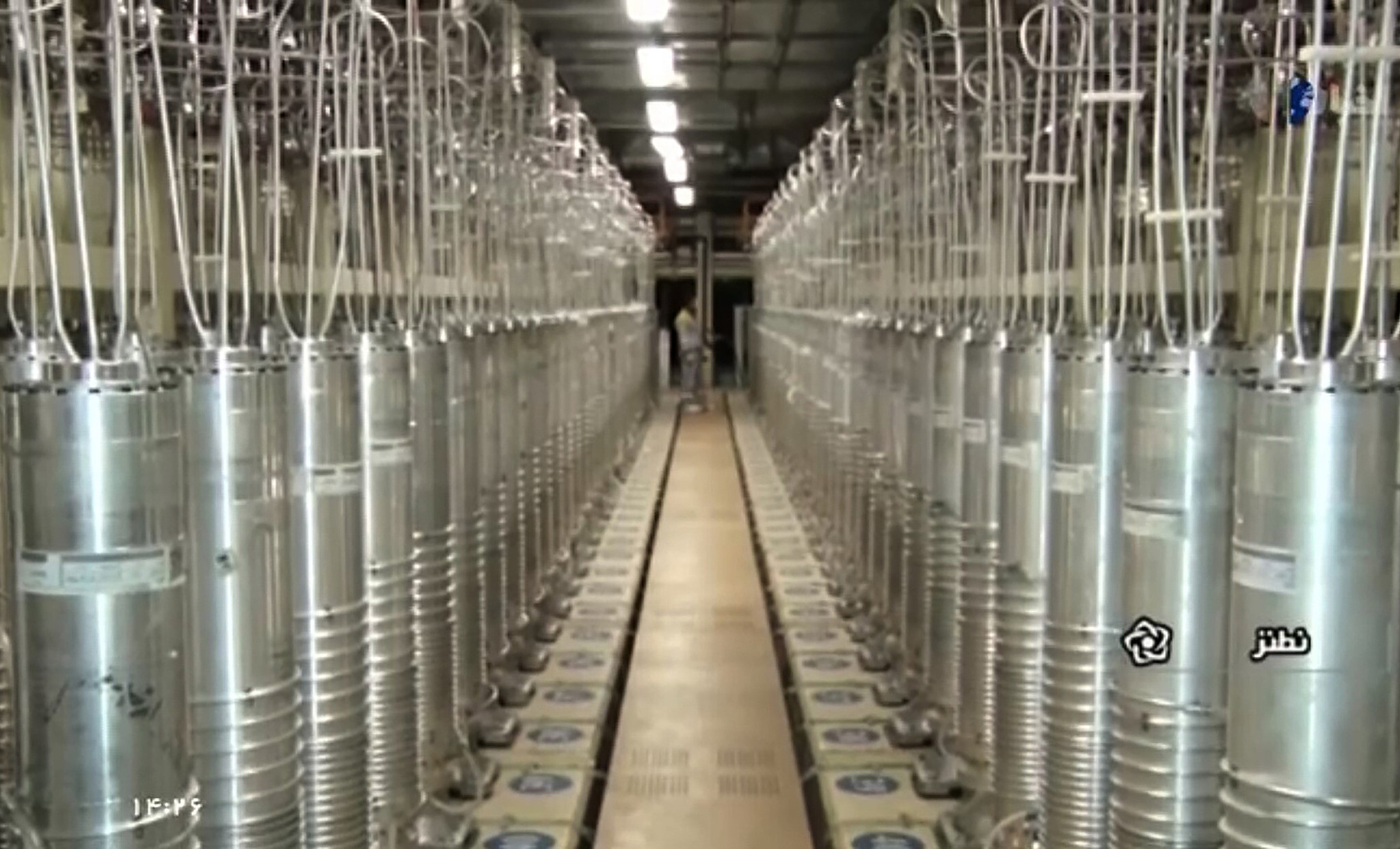
Various centrifuge machines line a hall at the Natanz Uranium Enrichment Facility, on April 17, 2021. (Screenshot/Islamic Republic Iran Broadcasting-IRIB, via AP)

Various centrifuge machines line a hall at the Natanz Uranium Enrichment Facility, on April 17, 2021. (Screenshot/Islamic Republic Iran Broadcasting-IRIB, via AP)

Iran has increased the number of advanced uranium enrichment centrifuges it fields and intends to add more of the devices, quickly growing its enrichment capabilities, according to a confidential International Atomic Energy Agency report seen by Reuters on Monday.

The newly installed devices, located at the underground Natanz enrichment plant, are banned under Iran’s 2015 nuclear deal with world powers.

Efforts to salvage the tattered agreement — which eased international sanctions in exchange for a drastic limitation of Iran’s nuclear activities — have been ongoing since then-US president Donald Trump withdrew America from it in 2018.

The US reimposed biting sanctions, provoking Tehran into stepping back from its nuclear commitments, greatly increasing its stock of enriched uranium and turning off monitoring cameras operated by the IAEA, the United Nations nuclear watchdog.

The new report was an update following a September review of a visit by IAEA inspectors to the site at the end of August. Since then, Iran has completed the installation of seven cascades of centrifuges, the bulletin said.

The six IR-2m machines and one IR-4 device are not yet enriching uranium, the IAEA found.

In addition, Iran has told the IAEA it intends to add three more cascades of IR-2m centrifuges at Natanz. There are already 12 such cascades at the plant, each consisting of several combined centrifuges enriching uranium. Work has already started on two of the cascades.

In another development, the report said that while all the centrifuges at Natanz are producing uranium hexafluoride (UF6) gas enriched to five percent, they are now being fed with natural UF6. In September the IAEA said the devices were being loaded with UF6 enriched to up to 2%. The recent report did not explain why the change was made, Reuters said.

Director General Rafael Mariano Grossi speaks at the 66th General Conference of the International Atomic Energy Agency (IAEA) in Vienna, Austria, September 26, 2022. (Theresa Wey/AP)

IAEA chief Rafael Grossi said last week he had met with the head of Iran’s atomic energy agency, amid stalled attempts to revive the nuclear deal, known formally as the Joint Comprehensive Plan of Action.

After months of friction, the two sides met face-to-face in Vienna.

“Dialogue has restarted with Iran on clarification of outstanding safeguards issues,” Grossi tweeted on September 26.

He said he had met with Mohammad Eslami — Iran’s nuclear chief — on the sidelines of the IAEA’s annual conference, and posted a picture of the two men shaking hands.

The UN watchdog has been pressing Iran to give answers on the presence of nuclear material at three undeclared sites, a key sticking point that led to a resolution criticizing Iran being passed at a June meeting of the IAEA’s board of governors.

Ahead of the meeting, Grossi told Iran that his agency would not halt the probe into the undeclared sites, signaling that the issue would continue to block efforts between world powers and Iran to reenter the nuclear deal.

Eslami also signaled Iran was unwilling to compromise on the issue, saying the investigation relied on “false, baseless information.”