
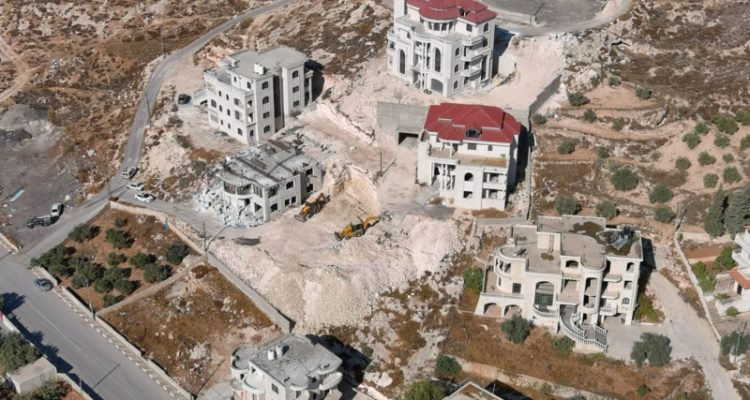
Watchdog group says illegal Palestinian Arab construction across areas under full Israeli control in Judea and Samaria has surged by 80% in 2022. There are now more than 80,000 illegal Arab buildings in Area C.

By World Israel News Staff

Land grabs and illegal construction by Palestinian Arabs in parts of Judea and Samaria under full Israeli constrol surged in 2022, according to a newly-released report.

The report, drafted by the Regavim Movement – a watchdog group which monitors illegal construction in the Arab sector – found that in 2022, illegal Palestinian Arab construction in Area C, the portion of Judea and Samaria under full Israeli jurisdiction, increased by 80%.

The report documents 5,535 new illegal structures built in 2022, compared to 3,076 structures in the same period in 2021.

The data was collected through fieldwork, aerial photography and GIS mapping, and compared the situation on the ground in 2021 to that of 2022.

The study covered the period of April 2021 through April 2022, analyzing the number of structures, the legal status of the land on which they were built and the jurisdictional lines dictated by international law.

Regavim claimed that in comparison to previous years, the data for the most recent period are “unprecedented, both in quality and quantity.”

Most of the new structures are not temporary shacks or makeshift shelters that characterized much of the illegal activity in earlier years; in 2022, new Palestinian construction has been characterized by “palatial residences, sprawling holiday resorts, amusement and entertainment compounds and event halls, swimming pools and vacation villages, and high-rise residential and commercial towers.”

In addition to the mass-scale construction, in many areas development and infrastructure work was carried out to lay the groundwork for future full-scale neighborhoods, such as at Khirbet Khattha near Tarkumiyeh and Lakef near Karnei Shomron.

An analysis of construction patterns in Area C found that there are 81,317 illegal Arab-built structures in this area, covering an area of approximately 150,000 dunams – twice the total area of Jewish settlement in Judea and Samaria.

Unauthorized Jewish construction stands at 4,382 structures, of which 406 new structures were built in the time period of the new study.

Although the disparity in number is striking, it is far overshadowed by the disparity in quality: Whereas illegal Arab-built structures are located in desolate, remote areas far from existing villages or settlement clusters, all of the illegal construction in the Jewish sector is located within the municipal “blue line” boundaries of existing Jewish towns.

Regavim claimed that the massive surge in illegal Arab construction in areas under Israeli control is not driven by a lack of open territory in Areas A and B, which are under Palestinian Authority administration.

“Analysis of the hard data reveals several additional important facts: Aerial photos show that in Areas A and B – the sections of Judea and Samaria placed under full Palestinian Authority civil jurisdiction under the Oslo framework, there are abundant empty spaces that remain undeveloped and completely un-utilized,” Regavim said in a statement Sunday.

“Rather than developing these areas, Arab construction has continued to seep into the open spaces of Area C. Additionally, these same aerial photos leave no room for doubt: Arab construction is neither random nor haphazard.”

“Construction is strategically placed, in accordance with the Fayyad Plan, according to pre-established criteria and objectives: Creating contiguous Arab settlement – a pattern that is particularly pronounced in northern Samaria; isolation and strangulation of Jewish communities; construction on the route of planned traffic arteries such as the Funduk Bypass Road and the Tekoa – Ibei HaNachal Access Road in eastern Gush Etzion; construction alongside existing highways, including Route 55 and Route 60, the main roads of Samaria and Judea respectively.”


“The Israeli government is creating a de facto Palestinian state,” warned Meir Deutsch, Director General of Regavim. “Over the years we have documented the illegal construction on a daily basis and sounded the alarm about the Palestinian annexation of Judea and Samaria, but the most recent construction data are clear and unequivocal: Under the present government there has been a meteoric rise in the extent of illegal construction and the Palestinian takeover of land.”

“This is not a warning light – it’s a wailing, deafening siren. Before our eyes, a Palestinian state is taking shape – and it is already posing an existential threat to the future of the State of Israel. The data indicate that the present government did not merely turn a blind eye to this phenomenon; this a clear and conscious policy, reflected in recent statements by Interim Prime Minister Yair Lapid regarding the creation of a Palestinian state.”


Recently, Minister of Defense Benny Gantz announced: “We are enforcing the law against illegal construction in area C – on both sides, both Jewish and Arab, and I am proud of it.”

“The data revealed by Regavim indicate that Gantz’s statement should be cause for concern “primarily because it exposes the Minster of Defense’s complete failure to grasp the impact and inevitable outcome of failure to protect the territory under Israel’s jurisdiction,” said Deutsch. “No less cause for concern is the failure of so many of our elected officials and political hopefuls, as well as a very large segment of the Israeli public, to grasp the danger posed by Benny Gantz to the security of the State of Israel.”
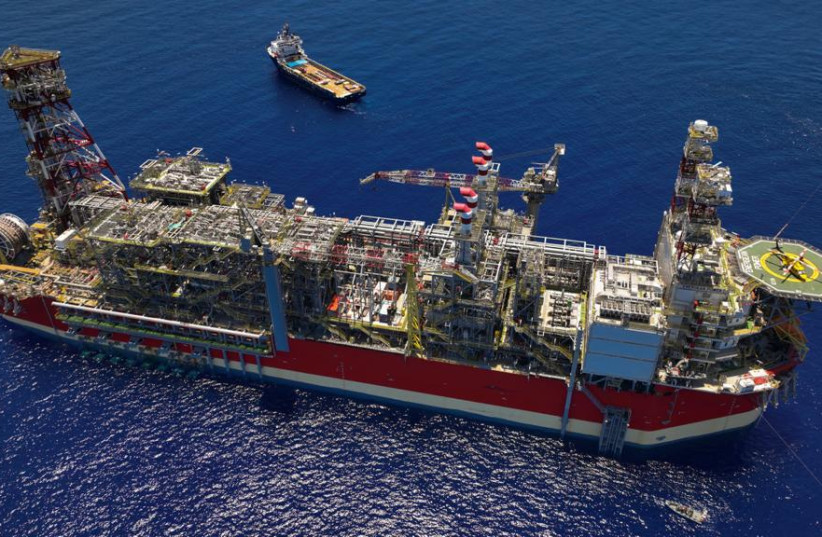
Energean, the Greek company that has the license to pump the gas from Karish, was given the green light from Israel to start testing the pipeline, as early as Sunday.

 Karish gas field, located in Israel territory and disputed by Lebanon. (photo credit: ENERGEAN)
Karish gas field, located in Israel territory and disputed by Lebanon.
(photo credit: ENERGEAN)

Israel began testing the gas rig at the Karish field near the disputed waters with Lebanon on Sunday in a move that could escalate tensions between the countries.

Over the weekend, Defense Minister Benny Gantz threatened to destroy Lebanon if Hezbollah attacked Israel, but struck an optimistic note about the pending maritime gas deal between Israel and Lebanon, saying it was still on the table and could be concluded “within days.”

“Negotiations are continuing,” Gantz said in interviews he gave on Friday.

Energean, the Greek company that has the license to pump the gas from Karish, was given the green light from Israel to start testing the pipeline and initiated the tests on Sunday morning. The gas will be pumped from the land station to the sea-based rig to see that that the pipe is operational.

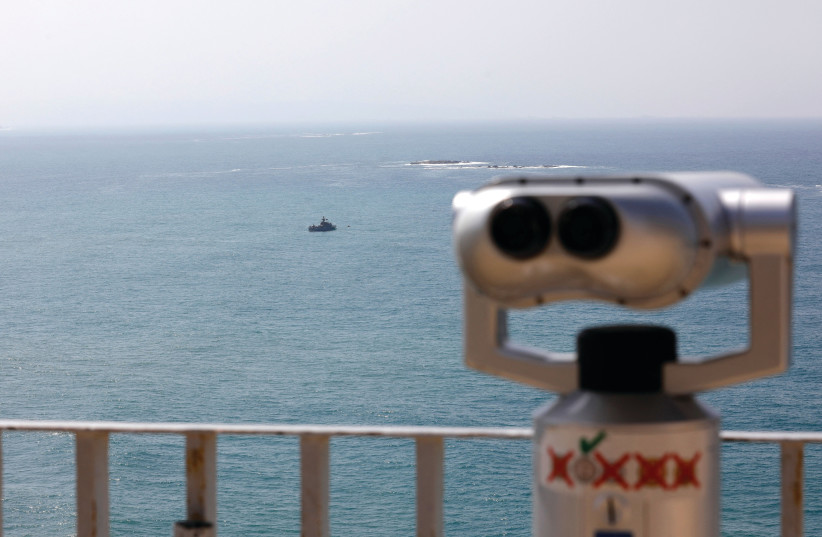
 Israeli Navy vessels patrol Mediterranean waters off Israel’s crossing at Rosh Hanikra, known in Lebanon as Ras al-Naqura, a border area between the two countries, this week (credit: JALAA MAREY/AFP VIA GETTY IMAGES)Israeli Navy vessels patrol Mediterranean waters off Israel’s crossing at Rosh Hanikra, known in Lebanon as Ras al-Naqura, a border area between the two countries, this week (credit: JALAA MAREY/AFP VIA GETTY IMAGES)

Those tests are expected to last a month and if everything works right, the rig could begin pumping gas from beneath the seabed within a few weeks.

Hezbollah, the Iranian-backed terrorist group which operates in Lebanon, has warned Israel against putting the Karish gas field in service, and the IDF is prepared to respond harshly in such an instance.

“Israel is prepared to reach a deal, but it is also determined to preserve its security and economic interests. In light of this, I have instructed the IDF to be prepared for an escalation that does not necessarily need to occur,” Gantz said in the interviews which were published on Saturday night.

Gantz said that he had placed the IDF on high readiness in terms of intelligence, offensive, and defensive operations in the north.

“If Hezbollah will make this mistake and attack Israel, in any way – by land, sea,or air – Israel will protect itself, attack them and if it turns into something wider, we will destroy Lebanon,” he warned.


Lebanese official tells Hezbollah-linked newspaper that the Biden administration must ‘fulfill its promises and manage the issue with Israel’

Lebanese president Michel Aoun, right, meets with US Envoy for Energy Affairs Amos Hochstein, at the presidential palace, in Beirut, Lebanon, September 9, 2022. (Dalati Nohra, Lebanon's official government photographer, via AP)

Lebanese president Michel Aoun, right, meets with US Envoy for Energy Affairs Amos Hochstein, at the presidential palace, in Beirut, Lebanon, September 9, 2022. (Dalati Nohra, Lebanon’s official government photographer, via AP)

Lebanon seemed to be sticking firm to its stance on the proposed maritime deal with Israel despite reported pressure from the Biden administration to drop some of its demands.

The Hezbollah-linked Al-Akhbar newspaper on Friday quoted a Lebanese official telling US mediator Amos Hochstein that “Lebanon does not intend to retract its comments” on the maritime deal.

The unnamed Lebanese official added that “it’s on the US to fulfill its promises and manage the issue with Israel.”

Despite indications earlier this week that the deal was close to being sealed, it has since appeared to falter as Lebanese negotiators insist on certain changes that have been rejected by Prime Minister Yair Lapid.

According to the Kan public broadcaster, the Biden administration was pressing Lebanon to drop some of its demands as Hochstein remained in direct contact with both sides.

In comments to the broadcaster, an Israeli official described the efforts as an attempt to resuscitate the talks themselves.

Energean’s floating production system (FPSO) at the Karish gas field in the Mediterranean Sea. (Energean)

Although the deal’s exact points of contention remain unconfirmed, Al-Akhbar reported Tuesday that Beirut did not agree to recognize Israel’s buoy-marked boundary — which Jerusalem unilaterally placed five kilometers off the coast of the northern town of Rosh Hanikra in 2000 — as an international border.

The report also claimed Beirut was against the idea of demarcating a land border as part of the agreement and maintained that the issue must instead be reserved for discussions with the United Nations.

Health Minister Nitzan Horowitz, a member of the high-level security cabinet, insisted Friday that Israeli activities in the gas fields would continue despite the uncertainty over a deal.

“Israel is working on the construction of the gas field located in its territory… production will begin according to the schedule of the extraction companies and that will be very soon. Those who make threats and all sorts of intimidation — from our perspective it makes no difference,” Horowitz told Kan.

He also held out hope that a deal could soon be reached, saying there is a “chance” of signing the agreement before Israel’s elections on November 1. Horowitz added that “there are large political interests in both countries that increase the chances [of a deal] in the very near future.”

Health Minister Nitzan Horowitz speaks during a press conference in Tel Aviv, February 14, 2022. (Avshalom Sassoni/Flash90)

On Thursday, as the maritime deal stalled, Defense Minister Benny Gantz placed IDF forces on alert after holding a situation assessment with military chief Aviv Kohavi.

“The defense minister directed the IDF to prepare for a scenario of escalation in the north, both offensively and defensively, given the developments in the negotiations on the maritime border,” a statement from Gantz’s office said.

Times of Israel staff contributed to this report
