
Riots on the Temple Mount – a direct result of concessions

Last Wednesday, the Arabs heard that Israel is ready to establish a state for them. If they just keep rioting, their dream will come true.


TEMPLE Mount riots (archive)

TEMPLE Mount riots (archive)Flash 90

On Wednesday a week ago, the Arabs of the Land of Israel heard again that Israel is ready to go back and establish a state for them. If they just keep going, if they just press, if they just keep rioting, their state dream still exists.

Israel falls into the same trap again and again. With our own hands, for years and years we have fostered their hope to receive territories from our small country. What didn’t we do for it? We established an armed regime for them, we left the entire Gaza Strip, we expelled thousands of Jews from their homes, we removed the dead from their graves, we developed the economy in Judea and Samaria and especially in Jenin, we made sweeping proposals for the establishment of a new Arab state between the Jordan and the sea. In return for all these measures, we received terror, international pressure, support for a boycott of Israel and recently Holocaust denial.

Prime Minister Lapid’s current announcement of his willingness to tear up swathes of land in favor of a terrorist state came in the midst of a wave of terrorism. That is, the message of the victory of terrorism was immediate.

As a result, we received, as always, more terrorism, in the most symbolic place, in a place that symbolizes for them the possibility of victory – the Temple Mount, or in their words, “Al-Aqsa”. This terrorism may still prevail in the coming weeks, as much as we try to “contain” it and leave the Arab street hope for an uprising that will shock Israel. It is precisely on the Temple Mount were we must strike with an iron fist.

All this is happening when the Palestinian Authority is weaker than ever. When the Americans do care about them, Arab countries bypass them on the way to cooperation with Israel, and Europe is busy with the war in Ukraine. This is the moment to increase the pressure, not to create hopes among the enemy.

We have to change the equation. The Arabs of Judea and Samaria and Gaza and their supporters must first stop the violence and terrorism, acknowledge the defeat of their violent struggle against Israel, recognize Israel as a Jewish and democratic state, and only then negotiate the final arrangement from a position of strength and victory. Otherwise, the violence will not stop. They, even among the Arab citizens of Israel, will always see statements or actions of unilateral concessions as a weakness and an opportunity to exert more pressure. This is not a hypothesis, it happened in the past and there is no reason for it to change.

A week ago, the ‘Israeli Victory Project’ launched a campaign in which Ahmed Tibi is seen wrapped in the Israeli flag and on it is written “This is what the image of victory will look like”. Precisely when it comes to the leaders of the Arab public in Israel who support the violent struggle against us – precisely they should be seen wrapped in the Israeli flag. Precisely now, it is right to talk about their principles. They must stop supporting the terrorist and violent struggle against Israel and recognize its defeat and the victory of the State of Israel as a Jewish and democratic state. There is no other way, and any other attempt will fail in the future, as it has failed in the past.

All of the above is especially true on the Temple Mount, due to its being a symbol. When we lose even a little on the Temple Mount, in terms of Arab terrorism – it is a shot of encouragement and faith that Israel can be defeated and destroyed. No less than that. This hope should be cut off, not fostered.

We must remember that although we have become addicted to the desire for peace, those who need peace and order more than the Israelis are the Arabs, in order to finally start living and not just dream of an imagined victory in their war against Israel.


The author is the CEO of the organization “Beyadenu – Returning to the Temple Mount” and a member of the Israel Victory Project.


PA concerned over possible British embassy relocation

PA cabinet leader warns against change in status quo in Jerusalem as Truss contemplates relocating embassy.


Mohammad Shtayyeh

Mohammad ShtayyehNasser Ishtayeh/Flash90

Palestinian Authority (PA) cabinet leader Mohammad Shtayyeh voiced concern on Monday over Britain’s decision to review the location of its embassy in Israel, Reuters reported.

“Any change in the status quo in Jerusalem would undermine the two-state solution and will be considered a tacit recognition of the city’s annexation to Israel, which will encourage the occupying state,” Shtayyeh was quoted as having said at a weekly cabinet meeting in Ramallah.

His comments follow reports that British Prime Minister Liz Truss told Prime Minister Yair Lapid during a recent meeting that she is reviewing moving the British embassy in Tel Aviv to Jerusalem.

Truss initially pledged to review moving the embassy to Jerusalem last month, when she was running for the leadership of the Conservative Party. She made the pledge in a letter to the Conservative Friends of Israel.

A spokesperson for the British government’s Foreign, Commonwealth & Development Office told Reuters in a statement that on Monday Truss “understands the importance and sensitivity of the location of the British embassy in Israel”.

“We are undertaking a review of the current location to ensure that we are in the best possible position to continue promoting British interests in Israel, peace and stability in the region, and in support of a two-state solution,” the spokesperson said. “We will not speculate on the outcome of any review before it concludes.”

Former US President Donald Trump recognized Jerusalem as Israel’s capital and relocated the US Embassy from Tel Aviv to Jerusalem in May of 2018.

Following Trump’s announcement, Guatemala also relocated its embassy to Jerusalem. Paraguay moved its embassy to Jerusalem as well, but Paraguayan President Mario Abdo later reversed the previous administration’s decision and said his country’s embassy would move back to Tel Aviv.


Romania, Moldova, and Honduras both announced plans to relocate their countries’ embassies in Israel from Tel Aviv to Jerusalem, though Honduras has since said it is considering moving the embassy back to Tel Aviv.

Hungary, meanwhile, opened a trade office in western Jerusalem in 2019.


Netanyahu pledges massive West Bank settlement building if elected

Netanyahu signed his name on the pledge along with members from Likud, Shas, United Torah Judaism, the Religious Zionist Party and HaBayit HaYehudi.

 Benjamin Netanyahu, the former prime minister has diminished in influence, but it isn't extinguished. (photo credit: AMIR LEVY)
Benjamin Netanyahu, the former prime minister has diminished in influence, but it isn’t extinguished.
(photo credit: AMIR LEVY)

In an appeal to right-wing voters, former prime minister Benjamin Netanyahu pledged to support massive housing construction in West Bank settlements if he regains his former leadership position.

Netanyahu signed his name, along with 30 members of his Likud Party, and another 26 politicians from Shas, United Torah Judaism, Religious Zionist Party and Bayit Yehudi to a declaration on intended settlement building by the Sovereignty Movement.

In a campaign titled “Moving Eastward,” the Sovereignty Movement is claiming that the best resolution to the housing crisis is to build in Judea and Samaria.

Those that signed the statement put their name to a text that said, “the distress in housing prices in the country’s center requires massive construction in the adjacent areas in Judea and Samaria.”

The declaration targeted in particular the route between Tel Aviv and the settlement of Ariel, located deep within the Samaria region.

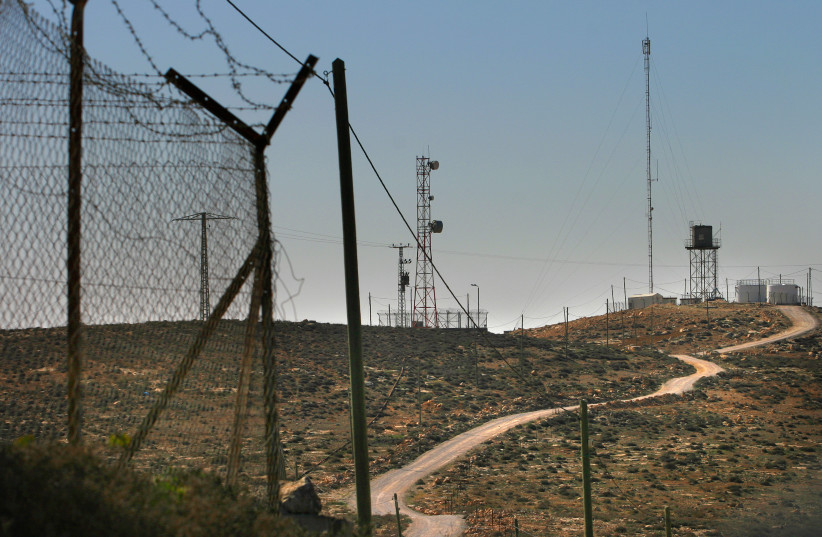
 General view of electricity water and cellular phone plans from the fence of the illegal settlement of Lucifer Farm on November Wednesday 29, 2006 (credit: OLIVIER FITOUSSI/FLASH90)General view of electricity water and cellular phone plans from the fence of the illegal settlement of Lucifer Farm on November Wednesday 29, 2006 (credit: OLIVIER FITOUSSI/FLASH90)

“Construction of thousands of housing units on the Tel Aviv-Ariel thoroughfare will lead to a dramatic rise in the supply of land for construction and to a significant drop in housing prices,” the declaration stated.

Those who signed it pledged to use all parliamentary tools at their disposal to ensure that such construction takes place, particularly by changing regulations to ease the granting of settler building permits.

Netanyahu put his name on the document at a time when the Biden administration has sharpened its rhetoric against settlement building, with US Ambassador Tom Nides clarifying that Israel had been asked to constrain settlement activity.

Holding fast to that pledge would put him on a collision course with the US administration.

It would also sharpen the conflict on the issue with the European Union, which just resumed its annual EU-Israel Association Council meetings.

Netanyahu had a strong record on advancing settlement planning during the supportive Trump administration but struggled to hold his own on the matter against US president Barack Obama.

He agreed to a 10-month moratorium on breaking ground for new settler homes and periodic de-facto planning freezes. There were also periods during the Obama era when he surged forward with settler housing plans.

The US, the EU and the Palestinians have opposed settlement building, arguing that it prevents a two-state resolution to the conflict. Israel has argued that settlements have no connection to the peace process.

The Sovereignty Movement intends to publish a more detailed study in the near future claiming that 75,000 homes could be constructed there in the next five years.

The movement, led by Yehudit Katsover and Nadia Matar, has focused in particular in the areas over the pre-1967 lines between Hadera and Gedera, explaining that this is where many citizens want to live.

How will this plan affect housing prices?

Building there will also drop housing prices within the Green Line by 20% once the 75,000 homes are on the market, Matar said.

The Yesha Council in the past has also argued that settlement construction is the best answer to the lack of affordable housing.

Katsover and Matar said that, “today, the population density in Israel is one of the highest among countries in the developed world.

“By 2040, Israel’s population is projected to grow to almost 13 million people. In Tel Aviv alone, the density is 7,841 residents per sq. km., a density significantly greater than the density in the Gaza Strip, which is 6,859 residents per sq. km.”

Meretz head Zehava Galon said in response, “Solving the housing problem in Israel by building outside of Israel is like robbing a bank in order to close your deficit in that same bank.

“But Bibi will do anything to win votes to get him out of prison,” she added.
