State news agency says Lebanese president spoke with senior officials ‘to provide a Lebanese response as soon as possible’ on draft of deal to demarcate sea border

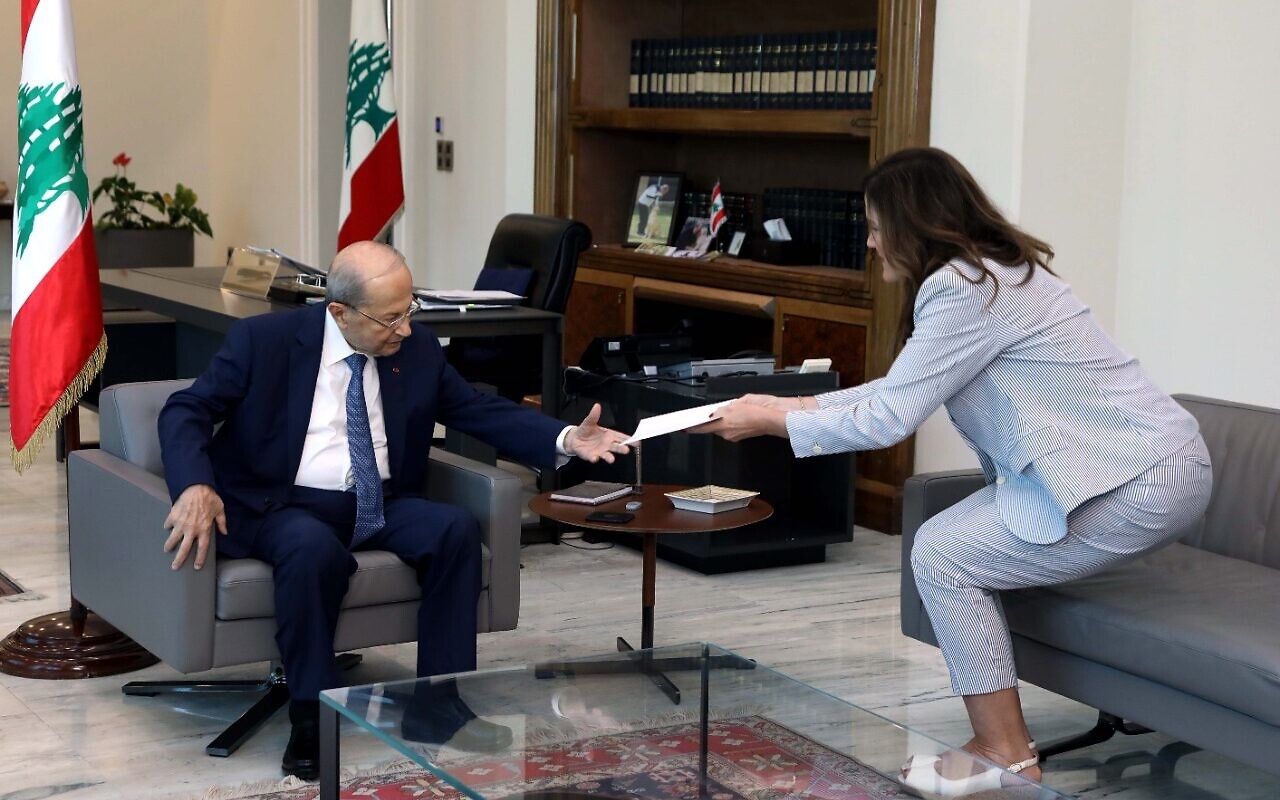
Lebanese President Michel Aoun (L) receives a proposal from US ambassador to Lebanon Dorothy Shea to resolve a maritime border dispute with Israel, October 1, 2022 (Lebanese Presidency)

Lebanese President Michel Aoun (L) receives a proposal from US ambassador to Lebanon Dorothy Shea to resolve a maritime border dispute with Israel, October 1, 2022 (Lebanese Presidency)

The United States handed over a long-negotiated written proposal to Lebanese President Michel Aoun on Saturday to potentially resolve a maritime border dispute between Israel and Lebanon.

According to a tweet from the Lebanese presidency’s account, Aoun met with US ambassador to Lebanon Dorothy Shea and received the written proposal from US mediator Amos Hochstein for the demarcation of the maritime border with Israel.

The Lebanese state news agency said Aoun then contacted Speaker of Lebanon’s Parliament Nabih Berri and Prime Minister-designate Najib Mikati for a consultation on the US proposal.

The report said Aoun discussed with the two “how to move forward to provide a Lebanese response as soon as possible.”

No details were provided about the proposal.

The maritime dispute relates to some 860 square kilometers (330 square miles) of the Mediterranean Sea that include lucrative offshore gas fields.

US Senior Advisor for Energy Security Amos Hochstein arrives at at meeting in Beirut on July 31, 2022. (Anwar AMRO / AFP)

The US-brokered talks on rights to the area, the subject of long-running negotiations between Jerusalem and Beirut and repeated threats from the Hezbollah terror group, have appeared to make progress in recent weeks.

On Sunday, Israel’s Channel 13 news said security officials believe a deal will be reached in the next two weeks.

The television report followed talks Prime Minister Yair Lapid held on preparations to produce gas from the Karish field, amid Hezbollah threats to attack Israel if it begins drilling there before a maritime border deal is reached.

Hezbollah chief Hassan Nasrallah said last week that his Iran-backed terror organization’s missiles were “locked on” Karish.

Lebanon claims that the Karish gas field is in disputed territory, while Israel says it lies within its internationally recognized economic waters.

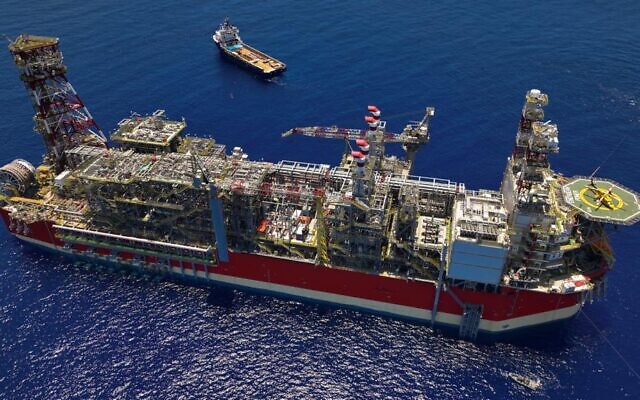
Energean’s floating production system (FPSO) at the Karish gas field in the Mediterranean Sea. (Energean)

Earlier this month, Lapid’s office vowed Israel would go ahead and extract gas from Karish with or without a deal on the maritime border with Lebanon. Those comments came hours after Aoun said that indirect talks with Israel to end a maritime border dispute are in their “final stages.”

A spokesperson for Lapid issued a statement later that day saying: “Israel believes that it is both possible and necessary to reach an agreement on a maritime line between Lebanon and Israel, in a manner that will serve the interests of the citizens of both countries.”


The islands of Abu Musa, Greater Tunb and Lesser Tunb are highly valued for their key strategic location in the Strait of Hormuz.

THE STRAIT of Hormuz between Iran and Oman is a major artery for oil circulation, targeted by Iran in the event of war. (photo credit: Wikimedia Commons)
THE STRAIT of Hormuz between Iran and Oman is a major artery for oil circulation, targeted by Iran in the event of war.
(photo credit: Wikimedia Commons)

Iran and the United Arab Emirates both reaffirmed their respective claims to the three contested Persian Gulf islands in the Strait of Hormuz during their speeches at the 77th annual United Nations General Assembly meeting last month.

UAE speaker, Minister of State for International Cooperation Reem bint Ibrahim Al Hashemy, discussed the dispute over the three islands, Abu Musa, Greater Tunb and Lesser Tunb.

“We renew our demand to end Iran’s occupation of the UAE’s three islands: Greater Tunb, Lesser Tunb, and Abu Musa,” the Emirati speaker explained. “History and international law bear testimony to the UAE’s sovereignty over the three islands. We will never stop our legitimate claim to these islands, either through direct negotiation or through the International Court of Justice.”

“We renew our demand to end Iran’s occupation of the UAE’s three islands: Greater Tunb, Lesser Tunb, and Abu Musa. History and international law bear testimony to the UAE’s sovereignty over the three islands. We will never stop our legitimate claim to these islands, either through direct negotiation or through the International Court of Justice.”

UAE Minister of State for International Cooperation Reem bint Ibrahim Al Hashemy

Iran, however, was quick to fire back.

Strait of Hormuz map 370 (credit: Wikimedia Commons)Strait of Hormuz map 370 (credit: Wikimedia Commons)

“The Emirati official’s allegations and repetition of baseless claims concerning the Iranian islands in the Persian Gulf is tantamount to an attack on Iran’s territorial integrity,” the Iranian mission to the UN said in a statement, as reported by Iranian media.

Both statements underscore how important these three islands are to both countries.

But why are these islands so important to the UAE and Iran? What is the basis for both of their claims?

Here is what you should know.

What are the three islands Iran and the UAE both claim?

The three islands of Abu Musa, Greater Tunb and Lesser Tunb are all relatively small and reside in the Persian Gulf.

Abu Musa, a 12.8 square-kilometer island, has a small population of just over 2,000 people living on it. The Greater Tunb, with an area of 10.3 square kilometers, and the Lesser Tunb, just two square kilometers, both have little to no inhabitants, aside from Iran military personnel.

Though the UAE claims sovereignty over them, with Abu Musa belonging to the Emirate of Sharjah and the Tunbs belonging to the Emirate of Ras Al Khaimah, all three islands are de facto controlled by Iran and are administered as part of the Hormozgan Province.

Despite the islands being small and having little in the way of natural resources or population, they are highly valued for their key strategic location in the Strait of Hormuz, arguably the most vital waterway in the world.

The reason for their importance is that in order to get through the Strait of Hormuz, connecting the Persian Gulf to the rest of the world, oil tankers and other big ships need to pass between these three islands.

This, in turn, makes them essential for controlling the waterway.

But what are the claims behind them?

Why does the UAE claim the islands?

The islands have maintained a long presence throughout regional history as both controlled by Arab tribes and the Persian Empire at different times. However, control over them was largely held by the Al Qasimi family, an Arabian royal dynasty that has been in power in some form or another for 300 years.

The Qasimi were a maritime power in the Persian Gulf and were heavily involved in regional affairs.

Eventually, their holdings were incorporated into the Trucial States, which largely became part of the confederation that were largely British protectorates, all of which would soon go on to become the UAE in 1971.

To this day, the Qasimis still rule two of the seven emirates that make up the UAE, Sharjah and Ras Al Khaimah. As such, the UAE claims that their holdings are rightful Emirati territory.

Why does Iran claim the islands?

Iran’s claims are rooted in the islands having been part of the Persian Empire for thousands of years. How true this is isn’t clear, since pre-colonial sovereignty records don’t exist. The earliest records put the islands under Arab control in the 1500s.

Further, Iran also claims that the Qasimis who ruled the area were actually based in the Iranian side of the Persian Gulf, and as such, they were Persian subjects and the islands would therefore come to Iran.

Iran also cites a Memorandum of Understanding signed with Qasimi leaders in 1971 to share the island, though Iran quickly launched a military invasion to seize control of them.

Currently, that is where this stands, and Iran has remained in control of the islands for over 50 years.

Who recognizes the UAE’s claims?

While all attempts at international relief through the International Court of Justice or United Nations have failed thus far, the UAE can boast the support of a number of countries for their claims, especially from the broader Arab world.

However, due to the long history of the islands and their strategic value, as well as the UAE being aligned against Iran in the broader scope of Middle Eastern geopolitics, Iran is unlikely to willingly give the islands up any time soon.


The US Embassy in Moscow issued a stark warning on Wednesday urging American citizens to leave Russia immediately.

“On September 21, the Russian government began a mobilization of its citizens to the armed forces in support of its invasion of Ukraine. Russia may refuse to acknowledge dual nationals’ US citizenship, deny their access to US consular assistance, prevent their departure from Russia, and conscript dual nationals for military service,” the State Department warned in the notice.

“Commercial flight options are extremely limited at present and are often unavailable on short notice. Overland routes by car and bus are still open.

“If you wish to depart Russia, you should make independent arrangements as soon as possible. The US Embassy has severe limitations on its ability to assist US citizens, and conditions, including transportation options, may suddenly become even more limited,” the notice said.

“US citizens should not travel to Russia and those residing or travelling in Russia should depart Russia immediately while limited commercial travel options remain. . . We remind US citizens that the right to peaceful assembly and freedom of expression are not guaranteed in Russia. Avoid all political or social protests and do not photograph security personnel at these events. Russian authorities have arrested US citizens who have participated in demonstrations.”

The September 21 decree by President Vladimir Putin ordering the mobilization of 300,000 more soldiers to fight in Ukraine has prompted thousands of Russians to leave the country – among them many Jews.

The Israeli government is preparing for a jump in immigration from Russia in the wake of the conscription order.

“We see more requests to immigrate from Russia,” Immigration and Absorption Minister Pnina Tamano-Shata said. “I follow the [Russian Jewish] community and the ministry is doing its best to make sure all those wishing to can arrive safely, despite challenges. My ministry is preparing for a large-scale immigration wave. We’ve had talks with El Al and other airlines to find solutions to allow the Jewish community in Russia to immigrate.”

Following a September 22 inter-ministerial meeting on the issue, Tamano-Shata told Ynet, “We are doing everything in our power to help them reach us here in Israel safely, despite all the challenges that stand in their way at this time. My ministry is preparing for a massive absorption. We’ve had talks with El Al and other airlines in order to find solutions to allow the Jewish community in Russia to immigrate.”

Israel’s national carrier, El Al Airlines, is among the few that have maintained service from the Russian capital.

But Russian authorities have reportedly refused requests from Israel to increase the number of El Al departures from Moscow.

Flights from Moscow are sold out at more than double the usual price, and tickets are also being resold on the black market, with prices as high as NIS 23,000 for a one-way flight to Tel Aviv, according to Ynet.

Hebrew-language reports are noting that many Russian Jews are fleeing the country over land and hoping to catch a flight to the Jewish State from neighboring countries.

Russia’s former Chief Rabbi Pinchas Goldschmidt, who left Russia at the start of Moscow’s invasion of Ukraine, told Israel’s KAN News public broadcaster on Sunday, “The situation will only get worse.” He urged everyone who “can get out, to get out.”