Premier gets shoutout in Emirati minister’s speech to UN General Assembly, which also includes line noting importance of Abraham Accords

UAE International Cooperation Minister Reem Al Hashimy addresses the UN General Assembly on September 24, 2022. (Screen capture/UN)

UAE International Cooperation Minister Reem Al Hashimy addresses the UN General Assembly on September 24, 2022. (Screen capture/UN)

UAE International Cooperation Minister Reem Al Hashimy welcomed Israeli Prime Minister Yair Lapid’s backing for a two-state solution in her speech before the UN General Assembly on Saturday.

The Emirati minister joined US President Joe Biden and Palestinian Authority President Mahmoud Abbas in lauding Lapid’s decision to express support for the two-state initiative on the UN stage two days earlier, though the Palestinian leader spent much of his speech castigating Israel and accusing it of destroying prospects for peace.

Much of Hashimy’s speech focused on the broader theme of international cooperation, and Lapid was just about the only leader to receive a shout-out, albeit not in name.

“We stress here our firm position calling for the establishment of an independent Palestinian state based on the borders of June 4, 1967, with East Jerusalem as its capital, in accordance with agreed international references,” Hashimy said, backing the PA’s specific stance on a two-state solution, one which has little support among the Israeli public since it would ostensibly require Israel to relinquish some of its sovereignty over Jerusalem and evacuate every one of its settlements.

“We welcome the point made by the Prime Minister of the State of Israel in his statement from this podium regarding support for the vision of the two-State solution,” she said.

The Emirati minister later highlighted the two-year anniversary of the Abraham Accords normalization agreements Israel signed with the UAE and Bahrain, noting that “several initiatives took place to promote developmental and economic integration and cooperation across our region.”

Prime Minister Yair Lapid addresses the 77th session of the United Nations General Assembly, Thursday, September 22, 2022, at UN headquarters. (AP Photo/Julia Nikhinson)

“We have witnessed a rise of the community for progress in the Middle East which will reinforce joint cooperation around the most pressing global priorities,” she said.

Lapid also hailed the Abraham Accords in his speech, though his decision to become the first Israeli prime minister to back the two-state solution at the UN General Assembly since former prime minister Benjamin Netanyahu did so in 2016 was what received more attention.

“An agreement with the Palestinians, based on two states for two peoples, is the right thing for Israel’s security, for Israel’s economy and for the future of our children,” Lapid declared.

Lapid said Israel had only a single condition for Palestinian statehood: “That a future Palestinian state will be a peaceful one. That it will not become another terror base from which to threaten the well-being and the very existence of Israel. That we will have the ability to protect the security of all the citizens of Israel, at all times.”

“You can ask us to live according to the values in the UN Charter,” he said, “but you cannot ask us to die for them.”

Lapid’s call for a two-state solution in his speech has drawn condemnation from the right flank of his governing coalition, as well as Netanyahu, who is currently the opposition leader and his chief rival in upcoming elections.

Palestinian Authority President Mahmoud Abbas holds up a graphic as he addresses the 77th session of the United Nations General Assembly at UN headquarters in New York on September 23, 2022. (Bryan R. Smith/AFP)

Biden in a tweet called Lapid’s remarks “courageous,” adding that “an agreement with the Palestinians, based on two states for two peoples, is the right thing for Israel’s security, for Israel’s economy and for the future of our children,” he declared.

Abbas also gave a nod to Lapid in his UNGA speech the next day, saying that “when we hear something positive, we acknowledge it.”

“I heard them supporting the two-state solution and we’re thankful for that.”

“But the real test to the seriousness and credibility to this stance… is for the Israeli government to go back to the negotiation table immediately,” the PA president said, adding that Israel must cease all unilateral actions such as settlement building, demolition of homes, evictions and “killings.”


32% of Jewish Israelis surveyed support a two-state solution to the Israeli-Palestinian conflcit while 57.5% oppose one, according to a poll by the Israel Democracy Institute.

 Palestinian demonstrators protesting the arrest of tPalestinian militants clash with Palestinian security forces, in Nablus in the Israeli-occupied West Bank, September 20, 2022. (photo credit: REUTERS/MOHAMAD TOROKMAN/FILE PHOTO)
Palestinian demonstrators protesting the arrest of tPalestinian militants clash with Palestinian security forces, in Nablus in the Israeli-occupied West Bank, September 20, 2022.
(photo credit: REUTERS/MOHAMAD TOROKMAN/FILE PHOTO)

Just 36% of Israelis either “strongly” or “somewhat” agree that the government formed after the election should try to advance a two-state solution to the Israeli-Palestinian conflict, according to the Israel Democracy Institute’s Voice of Israel Index for the month of September.

Among Jewish Israelis that number is just 31%, while among Arab Israelis it is 60%, the survey found.

The numbers among both Jews and Arabs were down from a similar survey in February 2021, when 50% of Israelis believed that the government should try to advance the two-state solution – 44% Jewish and 79% Arab.

The data was published a day after Prime Minister Yair Lapid claimed in his speech at the United Nations General Assembly on Thursday that most Israelis supported the two-state solution. The current survey shows that a strong majority believes that this is not relevant for the next government.

Palestinian protester gestures as IDF soldiers stand guard during a demonstration against Israeli settlements, in Masafer Yatta near Hebron in the West Bank, September 17, 2022. (credit: REUTERS/MUSSA QAWASMA)Palestinian protester gestures as IDF soldiers stand guard during a demonstration against Israeli settlements, in Masafer Yatta near Hebron in the West Bank, September 17, 2022. (credit: REUTERS/MUSSA QAWASMA)

Do Israelis think Israel can thwart a nuclear Iran without US help?

The survey also asked Israelis whether the country should carry out a military attack against Iran’s nuclear facilities even without American agreement, with almost half (49%) answering that they “strongly” or “somewhat” agreed that Israel should do so. This includes 55% of Jewish Israelis and 17% of Arab Israelis, the survey found.

Are Israelis optimistic about the New Year?

Ahead of Rosh Hashanah, respondents were also asked what they thought the new Hebrew year will be like for the nation.

Among Jewish Israelis, 31% said that the year will be “much better” or “a little better” than the previous one. The exact same percentage said that the coming year would be similar to last year, 18% said it would be “a little” or “a lot” worse than last year, and 20% said they didn’t know.

Among Arab Israelis, however, just 20% believed the coming year would be much or a little better than last year, 23% said it would be the same – and 36% said it would be worse, nearly double the percentage in response to a similar question asked last year.

Finally, asked about their attitudes regarding the future of democratic rule in Israel, 46% of the respondents said that they were optimistic, versus just 20% who said they were pessimistic.


Blinken: U

Israel plans to begin drawing gas from the Karish field in the coming weeks amid growing Hezbollah threats.

AN ISRAELI Air Force F-35 takes off on a training mission in southern Israel.  (photo credit: IDF)
AN ISRAELI Air Force F-35 takes off on a training mission in southern Israel.
(photo credit: IDF)

The United States will not be able to stop Israel from retaliating against Lebanon if Hezbollah decides to attack it over the Karish gas field, US Secretary of State Antony Blinken reportedly told the Lebanese prime minister in a recent meeting.

According to Saudi media reports, Blinken told Prime Minister Najib Mikati that even if Hezbollah only demonstrates a small show of force, Washington will not be able to stop Israel.

Earlier this month, the Lebanese Al-Akhbar newspaper claimed that Washington had increased its pressure on Israel to finalize a maritime deal following intelligence according to which Hezbollah has changed the deployment of forces and is preparing for military action.

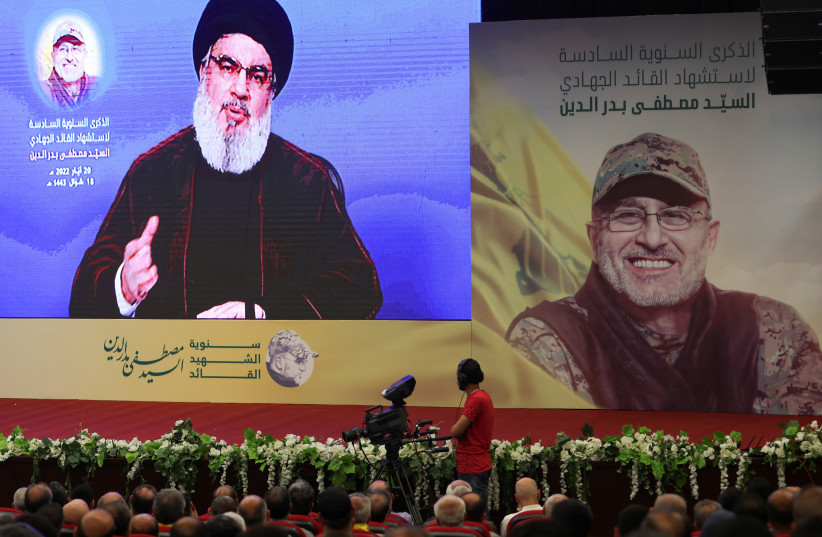
 Lebanon's Hezbollah leader Sayyed Hassan Nasrallah addresses his supporters via a screen during a rally commemorating late Hezbollah commander Mustafa Badreddine who was killed in an attack in Syria, in Beirut suburbs, Lebanon May 20, 2022 (credit: REUTERS/AZIZ TAHER/FILE PHOTO)Lebanon’s Hezbollah leader Sayyed Hassan Nasrallah addresses his supporters via a screen during a rally commemorating late Hezbollah commander Mustafa Badreddine who was killed in an attack in Syria, in Beirut suburbs, Lebanon May 20, 2022 (credit: REUTERS/AZIZ TAHER/FILE PHOTO)

President Joe Biden spoke recently with Prime Minister Yair Lapid and urged Israel to speed up negotiations to reach a deal that would demarcate economic waters and solve the standoff over the Karish gas field which Israel plans to begin drawing gas from in the coming weeks.

According to an official readout of the meeting by the State Department, Blinken told Mikati that it is time to hold a timely presidential election in Lebanon and to implement key reforms needed to effect meaningful change, promote good governance, and revive Lebanon’s economy while restoring the trust of its people.

“The Secretary stressed the urgent need and continued support to conclude a maritime agreement to ensure stability and Lebanon’s economy. The Secretary reiterated that the United States would continue to work with Lebanon for peace and prosperity in the region,” the statement said.

Defense Minister Benny Gantz warned earlier this month that Lebanon would pay the price for any Hezbollah attack on its offshore Karish gas field, even as it said it hoped a US-brokered deal to set a maritime boundary in the north was close to completion.

“If [Hezbollah leader Hassan] Nasrallah wants to try and harm and to complicate this process, he is welcome to do so, the price is Lebanon,”  Gantz told Reichman University’s 21st World Summit on Counter-Terrorism on Thursday morning. “I hope for his sake that he won’t do this, we are prepared to defend our interests.”

Last week, Nasrallah warned that Israel “faces a problem” if it begins to pump gas from the Karish gas rig.

Lebanon is waiting to receive its demands, he added, referring to a US-brokered deal on a maritime boundary between Israel and Lebanon that is in the works. “Lebanon is facing a golden opportunity that may not be repeated to address its crisis,” Nasrallah declared.

He further stated that the extraction of gas from the Karish field was a “red line,” adding, “We gave the negotiations a real opportunity with the aim of extracting Lebanon’s gas, and we did not look for any problem.”

S will not be able to stop Israel if Hezbollah attacks over gas

Blinken: US will not be able to stop Israel if Hezbollah attacks over gas