
During his speech at the United Nations General Assembly, Ebrahim Raisi demands more guarantees and assurances from the US that it would not leave the nuclear deal.

 Iran's President Ebrahim Raisi addresses the 77th Session of the United Nations General Assembly at UN Headquarters in New York City, US, September 21, 2022. (photo credit: REUTERS/SHANNON STAPLETON)
Iran’s President Ebrahim Raisi addresses the 77th Session of the United Nations General Assembly at UN Headquarters in New York City, US, September 21, 2022.
(photo credit: REUTERS/SHANNON STAPLETON)

Anyone who was looking for confirmation that Iran nuclear talks were going to remain on hold for a while – perhaps indefinitely – need look no any further than Iranian President Ebrahim Raisi’s remarks at the UN General Assembly on Wednesday.

Raisi demanded more guarantees and assurances from the US that it would not leave the nuclear deal.

“The issue of guarantees is not just about something that may happen,” he said. “We are basing it on lived experience… Can we really trust [the US] without guarantees and assurances that it will live up to the agreement this time?”

Raisi said more or less that US sanctions don’t bother Iran – “We have managed to neutralize the [American] sanctions in many cases” – even though earlier in the speech, he called them a “weapon of mass destruction” against the Iranian people.

Raisi said Iran “found our path, independent of any agreement, and will continue steadfastly.”
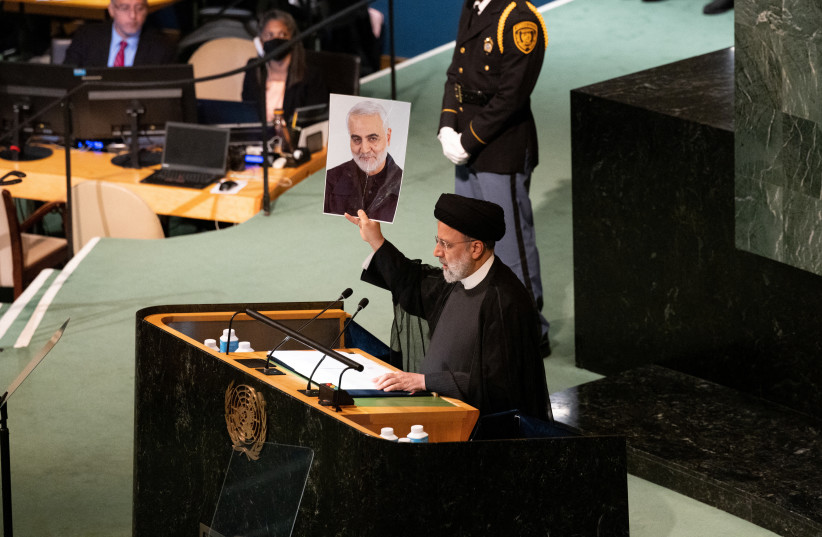
 Iranian President Ebrahim Raisi holds ups photograph of General Qassem Soleimani during his speech at the 77th United Nations General Assembly at UN headquarters in New York City, New York, US, September 21, 2022. (credit: REUTERS/CAITLIN OCHS)Iranian President Ebrahim Raisi holds ups photograph of General Qassem Soleimani during his speech at the 77th United Nations General Assembly at UN headquarters in New York City, New York, US, September 21, 2022. (credit: REUTERS/CAITLIN OCHS)

In other words, give Iran what it wants, or they’ll be just fine without a nuclear deal – sanctions and all.

A day earlier, with French President Emmanuel Macron, Raisi demanded that the International Atomic Energy Agency close its investigation into undeclared nuclear sites in Iran. Macron responded that “Iran and the IAEA can resolve the cases through cooperation. We won’t pressure the IAEA.”

Speaking to the French media soon after, Macron said that “the ball is now with Iran, which must say whether it accepts the conditions that have been proposed by the Americans and the Europeans,” such as that the IAEA must remain independent.

If Iran can’t accept that, “in effect that would mean we won’t close” a deal, the French president said.

The mention of guarantees and assurances and the IAEA probe are not-so-subtle clues that Iran is not in the mood for compromise, since those are the major issues holding up negotiations with world powers to return to the 2015 Joint Comprehensive Plan of Action.

The Iran talks’ coordinator, the EU, gave a “final” text of the renewed deal to the sides in early August. Iran responded to the draft with a “yes, but,” bringing up some issues, but the other parties to the talk still thought the gaps could be bridged quickly and the US sent a response.

Iran gave more demands at the UNGA
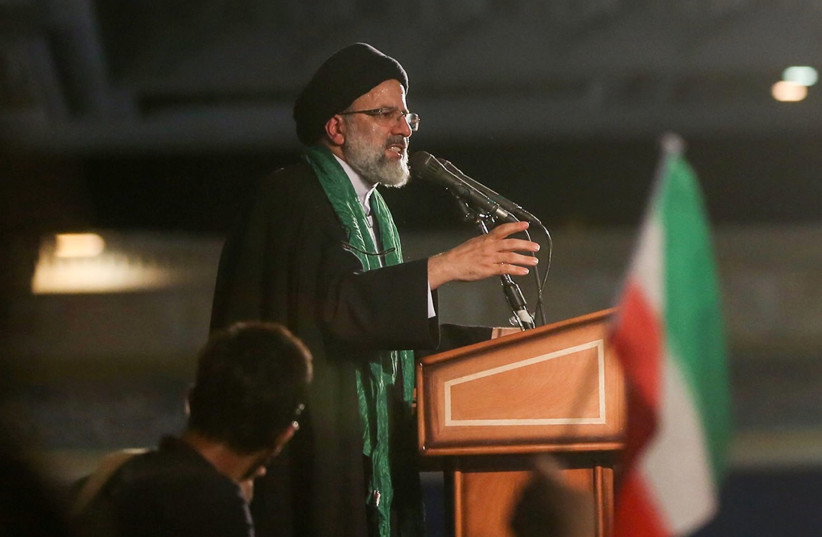
Iranian Presidential candidate Ebrahim Raisi speaks during a campaign meeting at the Mosalla mosque in Tehran, Iran (credit: REUTERS)Iranian Presidential candidate Ebrahim Raisi speaks during a campaign meeting at the Mosalla mosque in Tehran, Iran (credit: REUTERS)

Soon after Iran made even more demands, including the guarantees Raisi mentioned in his address.

Iran wanted to be sure that unlike in 2018 – when then US president Donald Trump left the deal over Iran lying about seeking nuclear weapons and continuing to fund terrorism and proxy warfare – this time no president would leave the deal before it expired in 2030.

However, US President Joe Biden cannot legally make that promise, because he cannot bind a future president to his foreign policy unless it comes in the form of a treaty ratified by Congress – and the Iran deal was designed to avoid that process.

In addition, Iran wants guarantees that Western companies will do business in the Islamic Republic, since many were hesitant in 2015. While Washington agreed to provide information to businesses that they can work with Iran without risking sanctions, the US and E3 – Britain, France and Germany – cannot force companies to work in Iran.

Those businesses may have reasonable concerns about working in a pariah state that has faced heavy sanctions, which could come back in 2030 or even before if the US withdraws again or Iran violates the deal.

Iran also insisted on closing the IAEA probe, something that the Western parties to the talks have said will not happen without Iran first cooperating with the investigation.

After Iran submitted those demands, the US said they were not productive.

What were the responses to the demands?

EU High Commissioner for Foreign Affairs Josep Borrell said the demands could derail the process entirely.

“We were converging to a closer position and the initial requests that we received were reasonable… and they were taken aboard without countering the text fundamentally,” Borrell said of Iran’s earlier response. But Tehran’s new demands for additional guarantees from Washington last week are “not converging, [they are] diverging… That’s very much worrisome.”

Negotiations have been on hold ever since. Israeli officials have said they heard from their American counterparts that they will not return to the talks until after the midterm election on November 8.

US law requires a 30-day congressional review period before any deal lifting sanctions on Iran can be implemented, which would put a potentially unpopular agreement on the agenda right before Election Day.

There is also the matter of the Iran deal’s nonproliferation benefits, which officials in Washington, Brussels, Paris and others have been warning for the better part of a year will become irrelevant if an agreement is not reached soon.

With his remarks at the UNGA, Raisi used the world’s stage to double down on the very demands that led to the talks being shelved, calling into doubt whether they can be picked up again at all.


Defense minister says over 1,000 terror operatives arrested or shot in recent months, amid uptick in violence in Palestinian cities

File: Israeli soldiers block the entrance to the Jalamah checkpoint near the West Bank city of Jenin, September 14, 2022.(David Cohen/Flash90)

File: Israeli soldiers block the entrance to the Jalamah checkpoint near the West Bank city of Jenin, September 14, 2022.(David Cohen/Flash90)

The Israel Defense Forces on Tuesday announced the closure of crossings with the West Bank and Gaza Strip during the upcoming Jewish holidays.

Closures for Rosh Hashanah will begin Sunday, September 25 at 4 p.m. and last until 11:59 p.m. on Tuesday, September 27.

On Yom Kippur, closures will begin October 4 at 12:01 a.m. and last until 11:59 p.m. on October 5.

During Sukkot, closures will begin October 9 at 4 p.m. and last until 11:59 p.m. on October 10, as well as between October 16 at 4 p.m. and October 17 at 11:59 p.m.

Security officials are to convene to decide whether to extend the closure for the entirety of Sukkot, October 9-17.

In all cases, the Israel Defense Forces said the planned reopening of border crossings would be “subject to a situational assessment.”

Exceptions to the closures will be made for humanitarian and other outstanding cases, but will require the approval of the Defense Ministry’s liaison to the Palestinians, known as the Coordinator of Government Activities in the Territories.

Such closures are standard practice during festivals and holidays. The military says they are a preventative measure against attacks in periods of increased tension. But during the holiday of Purim in March, the military skipped the usual closure for the first time in five years.

Since then, however, tensions have spiked as Israeli forces have ratcheted up arrest raids and other counterterror efforts that Palestinians say inflame anger.

Israeli troops operate in the West Bank, September 20, 2022. (Israel Defense Forces)

Israeli troops have also repeatedly come under gunfire during nightly raids in the West Bank. The military launched the operation after a series of deadly attacks that killed 19 people between mid-March and the beginning of May.

More than 2,000 suspects have been detained since the beginning of this year, according to the Shin Bet security service.

Defense Minister Benny Gantz said Tuesday that Israeli troops have arrested and shot more than 1,000 Palestinians engaged in terror activity in recent months, as the military pressed on with the ongoing operation.

“In the last few months we have arrested and hit more than a thousand terrorists,” Gantz said after touring the military’s West Bank division base.

“We are acting decisively and correctly against terror, to allow those who are not involved to have a life of economic and civil well-being,” he said. “The perpetrators of terror are the ones who harm the Palestinian population, their livelihood, and the ability to advance their interests.”

Defense Minister Benny Gantz issues a statement at the Israel Defense Forces Judea and Samaria Division base in the West Bank, September 20, 2022. (Nicole Laskavi/Defense Ministry)

Many of the IDF’s arrests in recent months have concentrated on Nablus and Jenin in the northern West Bank, where a number of the terrorists who committed the attacks earlier this year hailed from.

Israeli security officials have warned in recent months that the Palestinian Authority is losing control of the northern West Bank.


US blocks Israeli air defense system sale to Germany

The Israeli air defense system that Germany intends to buy is of questionable efficiency
ByNews Desk– September 18 2022
https://media.thecradle.co/wp-content/uploads/2022/09/ezgif.com-gif-maker.jpg

Arrow 3 air defense system during trials (Photo credit: US Missile Defense Agency)

Israel Today reported on 18 September that US President Joe Biden’s administration has blocked the sale of an advanced Israeli air defense system to Germany.

According to the details, Israel has failed to sell its exo-atmospheric hypersonic anti-ballistic missile system, Arrow 3, to Germany, despite its numerous attempts to get US approval.

The air defense system is a US-Israeli defense project funded by the annual foreign aid to Israel. It is jointly developed and produced by Israel Aerospace Industries (IAI) and Boeing.

Earlier in March, German Chancellor Olaf Scholz officially expressed an interest in purchasing the system during his meeting with former Israeli prime minister Naftali Bennett.

Following the meeting, Israeli Defense Minister Benny Gantz contacted the US administration to ask for its approval of the sale. However, the request was rejected, even after several attempts.

US approval is mandatory, considering US taxpayers have covered 80 percent of the project’s budget, investing up to $2.2 billion in research and development efforts towards IAI.

Scholz renewed his interest in the system during his meeting with Israeli Prime Minister Yair Lapid in Berlin on 12 September.

“We are very keen to work with Israel, including in the area of air defense where Israel has a very effective product with the Arrow 3 system,” Scholz said in a joint press conference with Lapid.

The public remarks came as a shock to Lapid, as Israel often goes out of its way to keep the details of possible arms exports secret.

Ariel Kahane reported in Israel Today that Lapid did not take Scholz’s explicit reference to “Israeli missiles” well, and refused to provide him with any technical information.

Soon after, Bloomberg reported that Germany has chosen the Israeli defense system over its rival, the US-manufactured Terminal High Altitude Area Defense (THAAD) by Lockheed Martin Corp.

Scholz aims to integrate the Israeli defense system “within the framework of NATO,” despite the Arrow 3 system being relatively new, with no proven efficiency beyond control tests.

Unlike the THAAD, the worth of the Arrow series of air defense systems is still questionable, considering its previous failures over the years.

In April of 2021, Israel acknowledged its failure to shoot down errant Syrian missiles that crossed into Israel on several occasions, detonating in the air or falling in open areas.
