
The coins, dated to around the Second Temple and Bar Kochba revolt periods, document the Jewish revolt against the Romans.
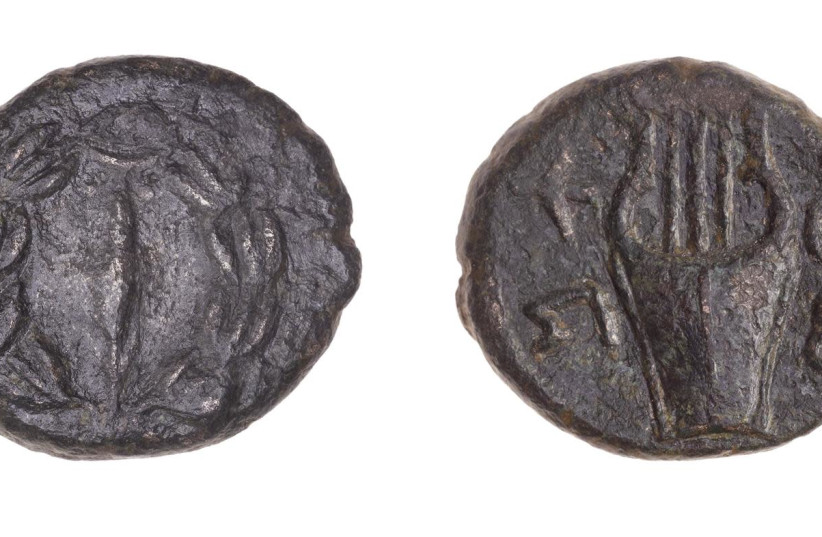
The 2,000-year-old coins that date back to the period of the Jewish revolts against the Romans, July 13, 2021.
(photo credit: TAL ROGOVSKY)
Two coins dating back some 2,000 years were found in the Binyamin region of the West Bank during an archaeological survey conducted by Bar-Ilan University, the university and the Binyamin Regional Council announced Tuesday.
The coins date back to the period of the Jewish revolts against the Romans.

One of them was minted around 67 CE. It features a vine leaf and the Hebrew inscription Herut Zion (Freedom for Zion) on one side, and the inscription “Year Two” on the other. Just three years later, in 70 CE, the Romans would destroyed the Temple in Jerusalem.
The second coin dates back to the time of the Bar Kochba Revolt some 70 years later. It bears a palm branch surrounded by a wreath and the inscription LeHerut Yerushalayim (Freedom to Jerusalem) on one side and a musical instrument and the name “Shimon” on the other – the first name of the rebellion’s leader Bar Kochba.
Other findings, such as pottery sherds, were also uncovered in the survey.

The survey included the area of Wadi Rashash, which has dozens of caves that offered refuge to Jewish refugees fleeing the Romans.
“The coin from Wadi Rashash indicates the presence of a Jewish population in the area until the end of the Bar-Kochba revolt, in contrast to what was previously believed by researchers: that the Jewish settlement north of Jerusalem was destroyed during the Great Revolt and not afterward,” said Dr. Dvir Raviv from Bar-Ilan, who led the survey.
The coin is also the first evidence that “the northernmost of the provinces of Judea in Roman times was controlled by the Bar Kochba administration.”
