
The fight against terrorism is a global one, a shared mission of the entire world,” they said. IRGC’s proxies are behind attacks across the region.
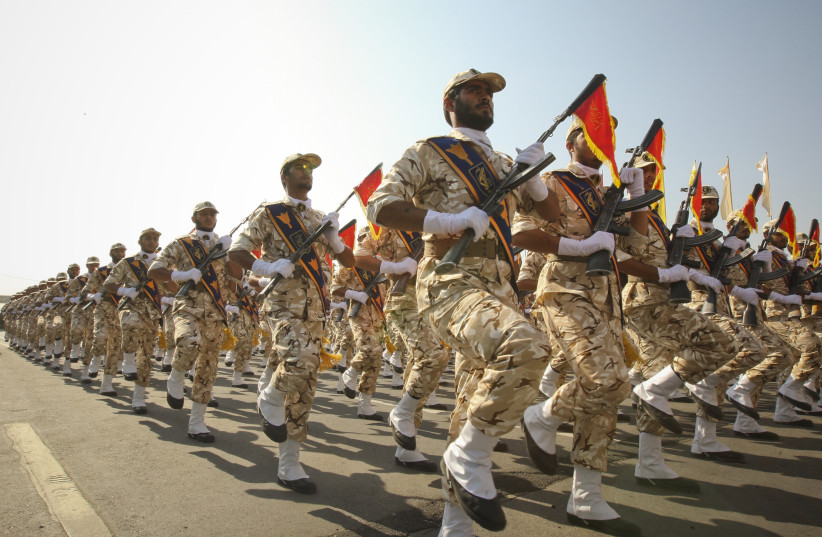
The US must not remove the Islamic Revolutionary Guards Corps’ designation as a foreign terrorist organization, Prime Minister Naftali Bennett and Foreign Minister Yair Lapid warned in a joint statement on Friday.
“We believe that the United States will not abandon its closest allies in exchange for empty promises from terrorists,” the ministers said.
The remarks came as Israeli diplomatic sources said the US was considering acceding to Iran’s demand to lift the IRGC’s designation in exchange for a commitment by Tehran to regional de-escalation and not to attack Americans, as a side deal to the revival of the 2015 Iran nuclear deal.
“We find it hard to believe that the IRGC’s designation as a terrorist organization will be removed in exchange for a promise not to harm Americans,” they said. “The fight against terrorism is a global one, a shared mission of the entire world.”
Bennett and Lapid listed the IRGC’s proxies, such as Hezbollah in Lebanon, Islamic Jihad in Gaza, the Houthis in Yemen, and militias in Iraq, and pointed out that the branch of the Iranian military is behind attacks throughout the Middle East, including in the past year, plans to assassinate American officials, the killing of hundreds of thousands of Syrian civilians, and more.
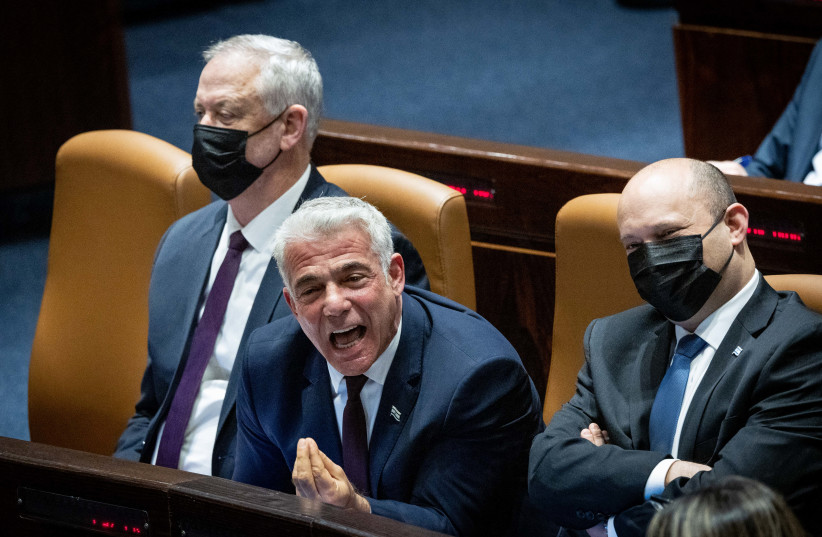
“They kill Jews because they are Jews, Christians because they are Christians, and Muslims because they refuse to surrender to them,” the ministers stated. “They are an integral part of the brutal machine of oppression in Iran. Their hands have on them the blood of thousands of Iranians and the crushed soul of the Iranian society.”
“The attempt to delist the IRGC as a terrorist organization is an insult to the victims and would ignore documented reality supported by unequivocal evidence,” they said.
MK Yuli Edelstein (Likud) said he doubts the Americans will really remove the IRGC’s terrorist designation, “but the fact that we are talking about it is further proof of the great loss of control and international status of Israel.”
“The Bennett-Lapid government manages to fail again and again and harm Israeli interests,” Edelstein stated. “They are not up to the job.”
While the US is likely to keep post-Iran-deal sanctions on IRGC-affiliated individuals for terrorism and human rights offenses, the removal of the IRGC’s terrorist designation will be a boon to Iran’s economy, in addition to lifting nuclear-related sanctions as per the 2015 Joint Comprehensive Plan of Action.
The IRGC has played a huge role in Iran’s economy for decades, with its hands in a range of industries like energy, water, transportation, communications, infrastructure and more. This is what Iran’s leadership has called the “resistance economy,” making the Islamic Republic less vulnerable to sanctions by becoming more self-reliant.
With the IRGC considered a terrorist group, the US would be able to initiate legal proceedings against companies that work with its subsidiaries – though it has never done so
Lifting the IRGC’s terrorist designation, enacted by the Trump administration in 2019, will allow foreign companies to do business with subsidiaries of the group, which is behind warfare and terrorism across the Middle East and beyond.
World powers have been negotiating with Iran for the past 11 months to return to compliance with the 2015 nuclear deal with the US, which restricted Tehran’s uranium enrichment to 3.67% and cut almost all of its stockpile of enriched uranium in exchange for gradually lifting sanctions.
The US left the deal in 2018, arguing that Iran lied about its nuclear program, and that the agreement was too weak. US President Joe Biden promised to return to it.
Israel opposed the original deal and the return to it, pointing out that most of its limitations on Iran’s nuclear activities expire at the end of 2025, and that the agreement does not restrict Iran’s malign actions in the region or its ballistic missile program, while lifting sanctions would lead to a major cash influx for terrorism, proxy warfare and weapons.
In recent months, the US, EU and E3 – Britain, France and Germany – have warned that weeks remain before the deal’s nonproliferation benefits will become irrelevant, as Iran continues to violate the JCPOA.
Reuters reported on Wednesday that Iran has converted some of its 60% enriched uranium – weapons-grade is 90% – to a form that will be more difficult to dilute or transfer out of the country.
A secret report by the International Atomic Energy Agency said that Iran converted the uranium earlier this month.
“We strongly urge Iran to avoid undertaking any new escalations and in particular, call upon Iran to immediately cease all activity related to conversion of highly enriched uranium, which will have practical implications for returning to JCPOA limits,” the E3 said in a statement.
Later on Friday evening, Defense Minister Benny Gantz spoke with US Secretary of Defense Lloyd Austin in a call that “focused” on the deal being negotiated with Iran and Israel’s position on it.
According to a statement released by his office, Gantz “emphasized the importance of deepening cooperation between the US, Israel and regional partners in the face of ongoing Iranian aggression.”
He also thanked Austin for the $4.8 billion of security assistance, which includes “critical” Iron Dome replenishment.
Anna Ahronheim contributed to this report.
https://www.jpost.com/breaking-news/article-701677?utm_source=rss&utm_medium=rss&utm_campaign=article-701677
