
Two leaders end highly anticipated DC meeting, held amid negotiations over Iran’s nuclear program, with no major announcements or statements to the press; pair also discuss Gaza
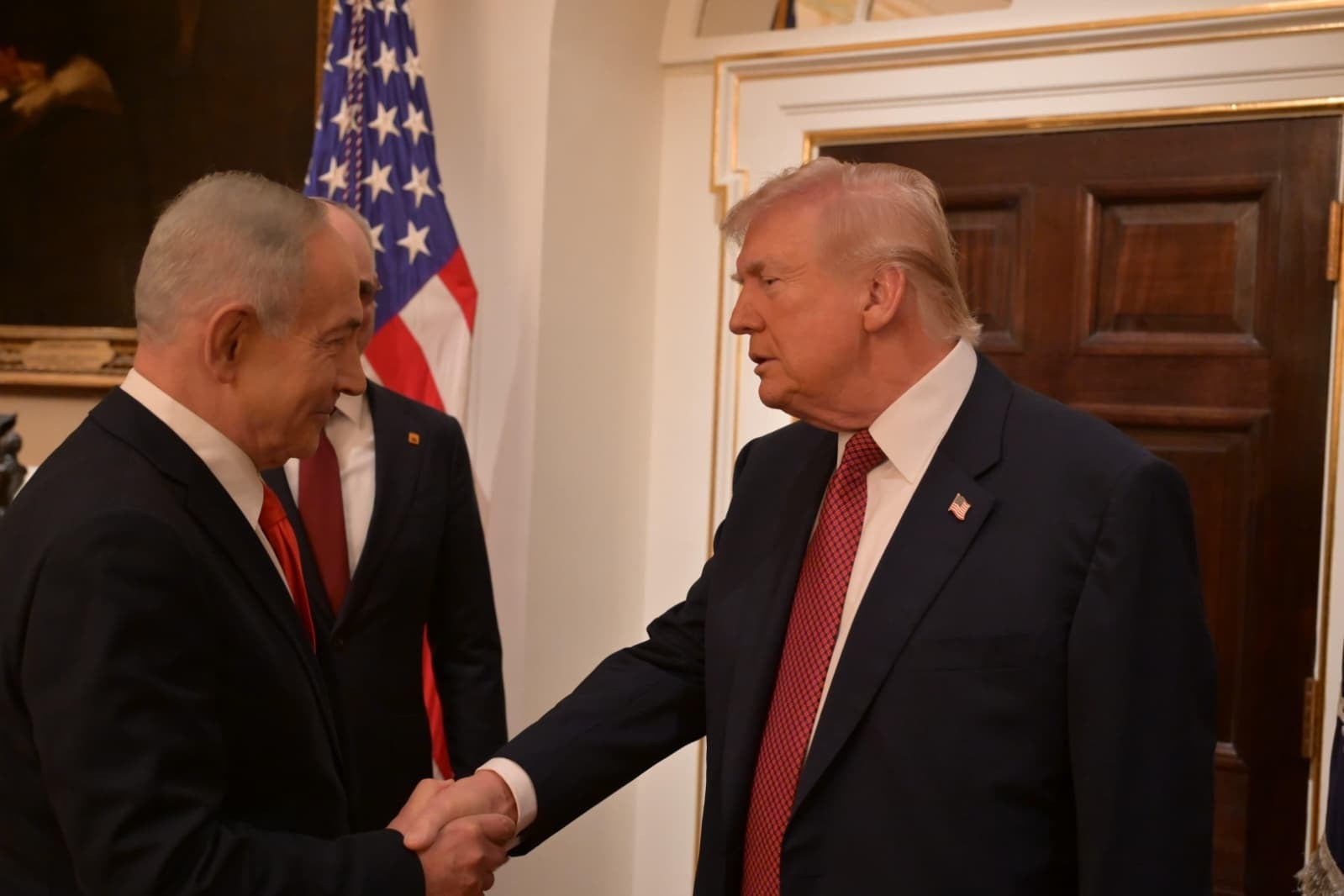
WASHINGTON — US President Donald Trump met privately with Prime Minister Benjamin Netanyahu at the White House on Wednesday, and later said he had insisted to the Israeli leader that American negotiations with Iran continue.
Netanyahu said following the meeting that he had stressed Israel’s security needs. The meeting lasted three hours, but was not followed by public statements or a press conference, with both Trump and Netanyahu preferring to put out brief statements.
The highly anticipated meeting, the leaders’ seventh since Trump returned to office last year, came at a tense time in the Middle East, as the US president has threatened to attack Iran over its brutal repression of anti-regime protests last month. Iran has said it would strike Israel and US targets in response.
The US has built up forces in the Middle East, and is readying to send more, but it has also embarked on negotiations with Iran over the Islamic Republic’s nuclear program. Those talks were expected to be the focus of the meeting.
But despite the charged lead-up, the event itself was relatively muted. Unlike other times they have met, the two leaders did not speak to press, take questions, or make any bombshell announcements. Netanyahu did not enter the White House via the West Wing entrance where reporters were waiting, but took the south entrance.
He added, “If it can, I let the Prime Minister know that will be a preference. If it cannot, we will just have to see what the outcome will be.”
In his own short readout after the meeting, Netanyahu said the two sides “addressed negotiations with Iran, Gaza, and regional developments.”
“The prime minister emphasized Israel’s security needs in the context of the negotiations, and the two agreed to maintain close coordination and ongoing communication,” said the Prime Minister’s Office.
Netanyahu had originally planned to travel to Washington next week, but flew to Wednesday’s flash meeting given the sky-high regional tensions. Trump has threatened to attack Iran over its protest crackdown, which rights groups estimate may have killed tens of thousands, and boasted of bringing a US “armada” to the region.
Against that backdrop, the US opened talks with Iran, with the first round taking place last weekend in Oman, and a second round planned soon. Trump has reportedly said that coming to an agreement on Tehran’s nuclear program is a “no-brainer,” and US Secretary of State Marco Rubio said earlier this week that negotiations would need to also address Iran’s missiles, its proxy groups, and its treatment of its own population. Trump also said the talks should cover the missile program.
Despite Trump’s insistence that he was prioritizing talks, the Wall Street Journal reported on Wednesday that the US Defense Department ordered a second carrier strike group to deploy to the Middle East.
Iran has said it is prepared to discuss curbs on its nuclear program in exchange for lifting sanctions, but it has ruled out linking the issue to missiles and it has insisted on the right to enrich uranium.
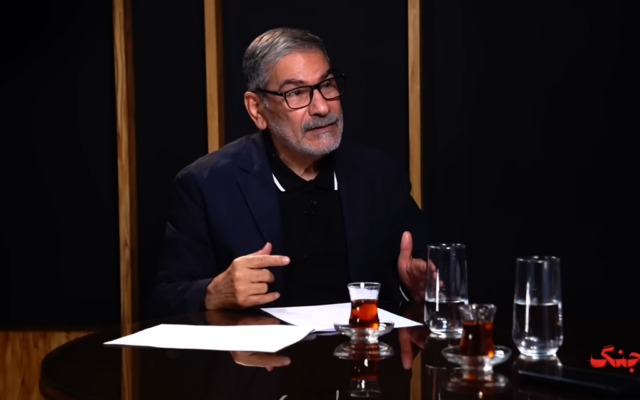
“The Islamic Republic’s missile capabilities are nonnegotiable,” Ali Shamkhani, an adviser to Iran’s supreme leader, said on Wednesday.

In his social media post following the meeting with Netanyahu, Trump referred to negotiations held last year between the US and Iran, which ended shortly before the US bombed Iranian nuclear facilities at the end of the 12-day Israel-Iran war in June.
“Last time Iran decided that they were better off not making a deal, they were hit with Midnight Hammer — that did not work well for them,” he wrote. “Hopefully this time they will be more reasonable and responsible.”
For his part, US Vice President JD Vance indicated that the US is not planning to overthrow the Iranian regime, and is focused on preventing it from obtaining nuclear weapons.
Asked by reporters if he wanted to see regime change in Iran, Vance replied, “If the Iranian people want to overthrow the regime, that’s up to the Iranian people. What we’re focused on right now is the fact that Iran can’t have a nuclear weapon.”
The US had recently appeared to be open to the idea of regime change in Iran, with Trump calling on protesters to “take over” government institutions, given the mass protests there, and reportedly asking aides for a strike plan that could help spur the toppling of the government in Tehran.
Vance also alluded to military action.
“The president has told his entire senior team that we should be trying to cut a deal that ensures the Iranians don’t have a nuclear weapon,” Vance said. “But if we can’t cut that deal, then there’s another option on the table. The president is going to continue to preserve his options.”
Ahead of Wednesday’s meeting, Netanyahu said he would present Israel’s “principles” on the US-Iran talks. Israel is wary of a narrow deal on Iran’s nuclear program that does not put an end to the regime’s uranium enrichment, require the moving overseas of its existing near-weapons-grade uranium, halt its ballistic missile development, and end its support for proxy terror groups, which have attacked Israel.
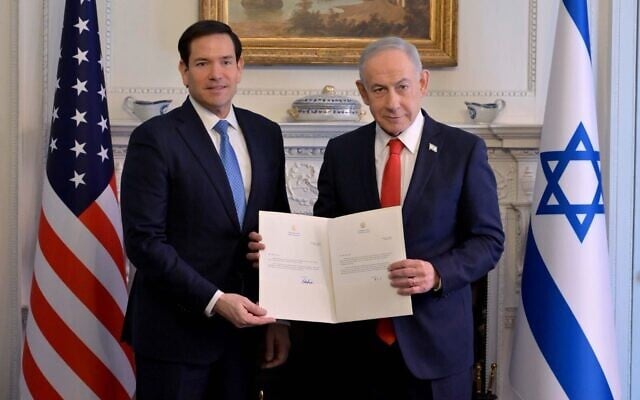
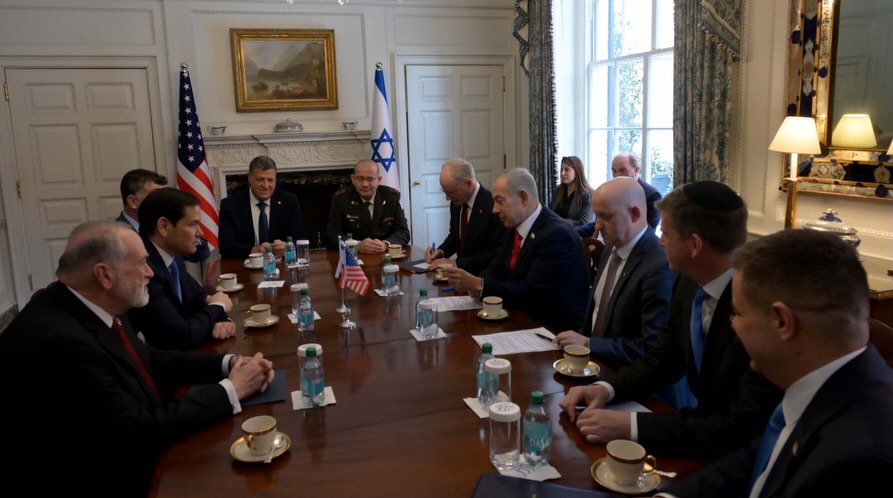
Netanyahu met with Rubio prior to the meeting, and also met with top White House advisers Steve Witkoff and Jared Kushner. According to Netanyahu’s office, Witkoff and Kushner provided “an update on the first round of talks they held with Iran last Friday.”
The meeting with Trump, according to a White House official, also included Rubio, US Defense Secretary Pete Hegseth, Witkoff, and Kushner.
According to a Channel 12 report aired as the meeting was taking place, it aimed to establish a joint course of action should Washington fail to reach an agreement with Iran.
The report, which cited US and Israeli officials, said Washington is skeptical that a deal with Iran can be reached — even one focused solely on Iran’s nuclear program, as opposed to one addressing missiles as well, a senior US official told the network. The official was said to add that if Israel and the US were to agree on a joint strike in the absence of a deal, it would be much more effective if done together.
The political and security establishments in Israel do not expect a deal to emerge, the report added, saying that Netanyahu seeks to preserve Israel’s freedom of action surrounding Tehran, regardless of whether a deal is reached.

Trump hails progress in Gaza
Also on the agenda was Gaza, with Trump looking to push ahead with the ceasefire agreement he helped broker that took effect in October. Progress on his 20-point plan to end the war and rebuild the war-torn enclave has stalled, with major gaps over steps such as Hamas disarming as Israeli troops withdraw in phases.
“We discussed the tremendous progress being made in Gaza, and the Region in general,” Trump wrote after the meeting.
Trump plans to hold the first meeting next week of his Board of Peace, which was initially framed to oversee future steps of the Gaza ceasefire plan but has taken shape with Trump’s ambitions of resolving other global crises. Netanyahu signed on to the body in his meeting with Rubio.
The day before the meeting, Trump stressed to the Axios news site that he opposes any Israeli move toward annexing the West Bank, declaring, “I am against annexation.”
He had previously ruled out Israel annexing the West Bank, despite calls from some of Netanyahu’s coalition partners to do so.
“We have enough things to think about now,” Trump said. “We don’t need to be dealing with the West Bank.”
Times of Israel staff contributed to this report